Magnum contact sheets are the film-strip proofs that Magnum photographers used to check, edit and file their work. They are also the title of a book and a touring exhibition that put those proofs on public view. The book, Magnum Contact Sheets, edited by Kristen Lubben and published by Thames & Hudson in 2011, reproduces 139 contact sheets by 69 photographers.1
In 2012, the International Center of Photography in New York showed a selection, and a Magnum touring show followed in Europe. This article explains what a contact sheet is, what the book and the shows contain, how Magnum documents particular cases, and what the sources leave unclear.
Magnum Contact Sheets at a Glance
| Item | What the sources say |
|---|---|
| Book | Magnum Contact Sheets, edited by Kristen Lubben, Thames & Hudson, London and New York, 2011 |
| Contents | 139 contact sheets by 69 photographers, with zoom-in details, selected photographs, press cards, notebooks and magazine spreads |
| Later format | Paperback with 524 pages and 446 illustrations; the publisher lists March 9, 2017 |
| First exhibition | International Center of Photography, New York, January 20 to May 6, 2012 |
| Touring exhibition | Produced by Magnum Photos with Forte di Bard; shown in Amsterdam, Berlin, Eschborn and Stavelot, among other places |
| Agency | Magnum Photos, founded in 1947 by Robert Capa, Henri Cartier-Bresson, George Rodger and David “Chim” Seymour |
What Is a Contact Sheet?
From Roll to Proof
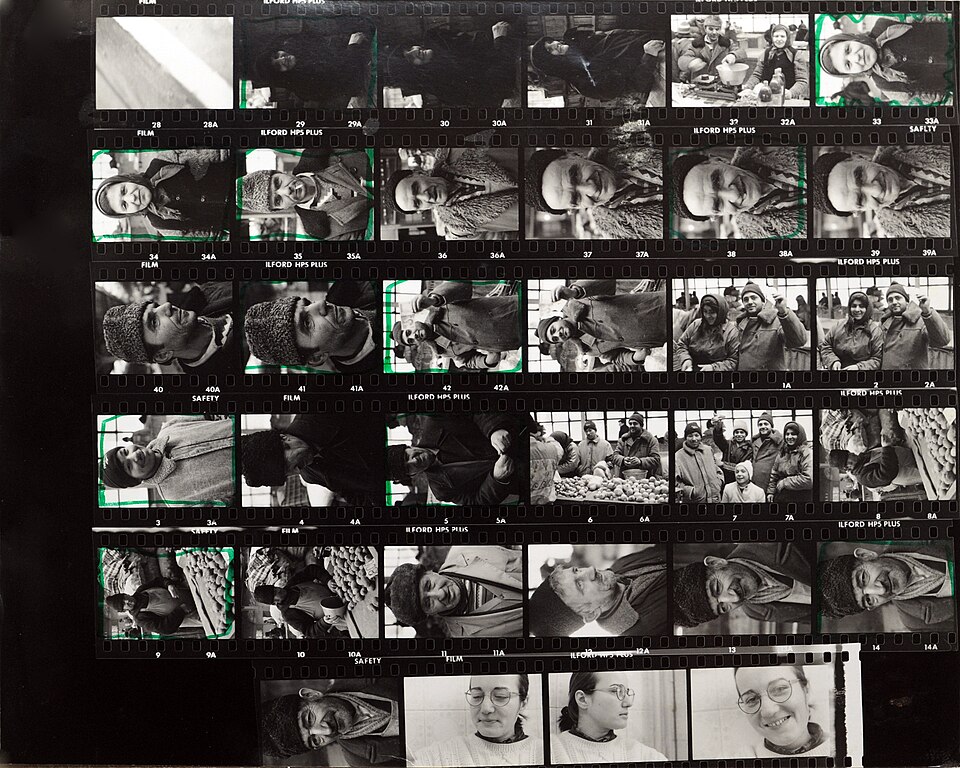
First, the ICP defines a contact sheet as a direct print of a roll or sequence of negatives. It is the photographer’s first look at what the film captured, and it records each step on the way to a picture.2 In addition, Magnum notes that a contact sheet reflects the economy of a roll of 36 frames, in contrast to the limitless shots that digital cameras allow. As a result, each frame had a value in that era.3
Lubben, for instance, calls the sheet, among other things, “an index to an archive of negatives.” Foam, however, goes further and notes that the contact sheet was never meant for publication or exhibition. Instead, it worked as a kind of notebook for the photographer.4 Therefore, showing it means showing mistakes, failures and lucky shots next to the famous frame.

Marks, Notes and Edits
Moreover, the marks matter as much as the frames. According to Magnum, the edit marks come in layers, showing how the choices were honed over repeated returns to the sheet. Similarly, Foam adds that the photographer’s notes often marked the chosen frame long after the shot.
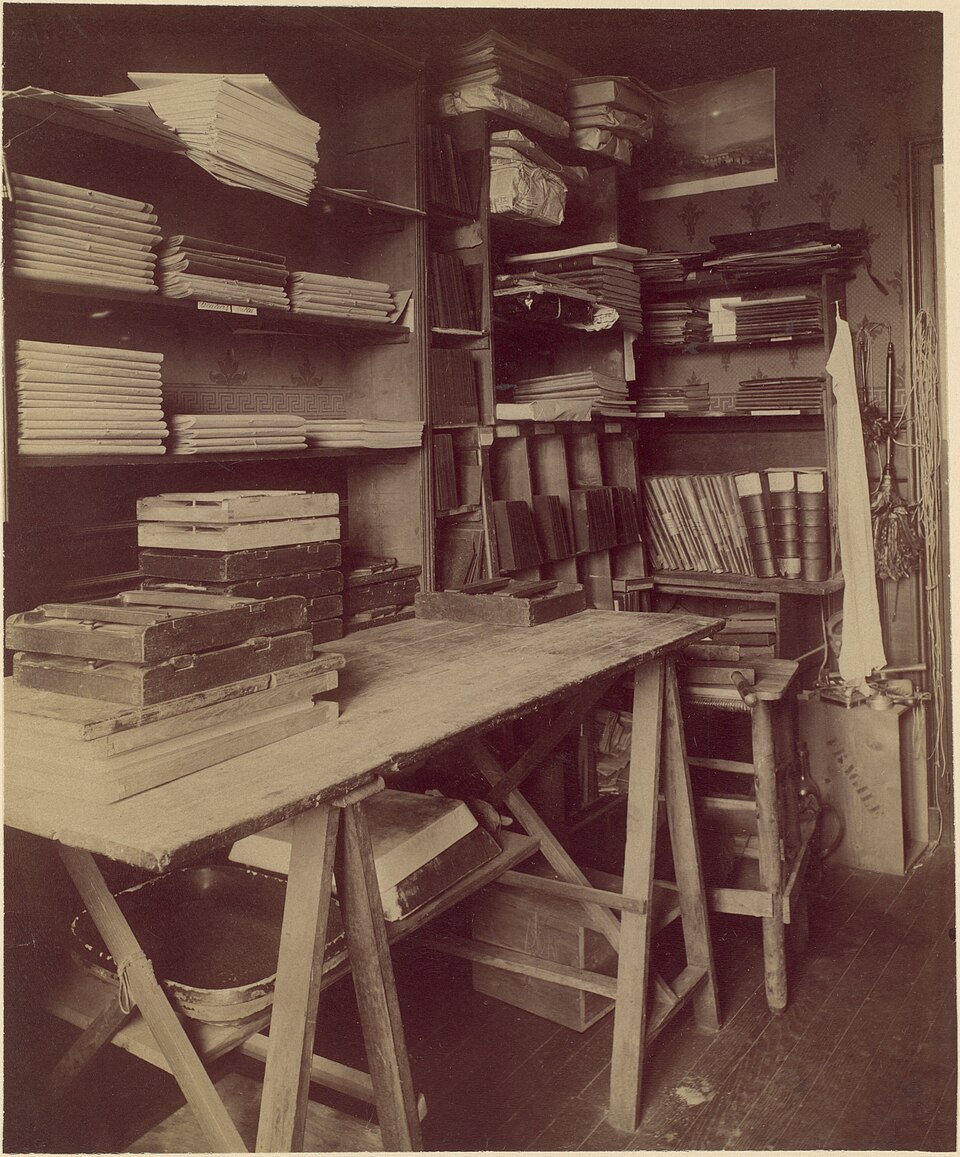

However, contact printing is much older than Magnum. For example, the Metropolitan Museum’s open-access photograph above shows the contact printing frames in the work room of Eugène Atget around 1910.
The Book Magnum Contact Sheets by Kristen Lubben
First, the publisher describes Kristen Lubben as a former longtime curator at the International Center of Photography and executive director of the Magnum Foundation. Then she edited the book, which appeared from Thames & Hudson in 2011.5 According to the publisher, entries come with texts written by the photographers themselves or by experts chosen by the members’ estates. The book also includes zoom-in details, selected photographs, press cards, notebooks and spreads from Life and Picture Post.
Overall, the sheets cover more than seventy years. For example, the publisher mentions Robert Capa’s Normandy landings, Bruno Barbey’s Paris protests of 1968, Thomas Dworzak’s images of the war in Chechnya, René Burri’s Che Guevara, Eve Arnold’s Malcolm X and Bruce Gilden’s New Yorkers.6 Moreover, it says the book appeared just as digital photography threatened to make the contact sheet obsolete. Later, the publisher issued a new, more accessible paperback format with 524 pages and 446 illustrations.
Magnum Contact Sheets as an Exhibition
First, the book came with an exhibition at ICP, New York, from January 20 to May 6, 2012. In addition, it included a selection from the 139 sheets in the book, and ICP described it as an “epitaph” to the contact sheet. Furthermore, ICP organized it in association with Magnum Photos.7 After that, Magnum produced a touring version with Forte di Bard. However, Magnum’s page for it lists 67 photographers, which differs from the book’s 69 because the two are different objects.8
| Venue | Dates | What the venue says |
|---|---|---|
| ICP, New York | January 20 to May 6, 2012 | Selection from the 139 sheets in the book |
| CO Berlin | 2015 (no exact dates found) | Listed by Magnum |
| Foam, Amsterdam | 2015 (no exact dates found) | 60 contact sheets and related images, 1930s to 2010 |
| The Cube, Deutsche Börse, Eschborn | May 13 to August 19, 2016 | More than 100 works shown next to their contact sheets |
| Stavelot Abbey, Belgium | March 29 to December 2, 2018 | First showing in Belgium and in a French-speaking country, according to the abbey |
How Each Venue Framed the Show
Indeed, each venue stressed a different angle.9 For example, Foam called the show a tribute to analogue technique and a swan song for a lost art form. Similarly, the abbey said contact sheets are often compared to artists’ sketchbooks and are also historical documents. Meanwhile, Deutsche Börse stressed the insight into selection processes and creative strategies.
What Magnum Contact Sheets Show About an Edit
First, Magnum publishes several cases online, with the sheet next to the chosen picture. The table below summarizes the ones we could read, using Magnum’s own captions. However, details of the cases come from Magnum, not from the book, which we have not read in full.10
| Photographer | Subject, place and date in Magnum’s caption | What Magnum notes |
|---|---|---|
| Elliott Erwitt | Chihuahua, New York City, 1946 | The sheet shows him reframing the dog with its owners’ shoes |
| Eve Arnold | Malcolm X, Chicago, 1962 | Life assigned her to document him |
| Leonard Freed | Martin Luther King Jr. returning to Baltimore after the Nobel Peace Prize | Dated October 31, 1964 for the print and October 31, 1963 for the sheet |
| Bruno Barbey | Students and police, Boulevard Saint-Germain, Paris, May 6, 1968 | Sheet and print shown together |
| Guy Le Querrec | Miles Davis, Salle Pleyel, Paris, November 3, 1969 | Caption names the quintet |
| Herbert List | Man and dog, Portofino, 1936 | The sheet is a reconstruction, not an original |
| Mikhael Subotzky | Beaufort West, South Africa, 2006 | A digital contact sheet |
What the Cases Suggest
Overall, these cases illustrate the question that Magnum and the publisher both pose: was the final image a set-up, a serendipitous encounter, or the fabled decisive moment? However, a sheet does not answer it by itself. For example, List’s reconstructed sheet reminds us that a contact sheet can be rebuilt later, and Freed’s mismatched dates show that captions deserve care.
Magnum Contact Sheets and the Magnum Archive
First, Tate says Magnum was set up in New York in 1947 by Capa, Cartier-Bresson, Rodger and Seymour, all former wartime photojournalists. It also adds that Magnum photographers keep the copyright of their pictures.11 For more on Cartier-Bresson, see our article on Henri Cartier-Bresson. Today, however, the public meets contact sheets in three ways: in the book, in exhibitions, and as prints. Magnum has sold contact-sheet prints through its shop, and it also offers licensing through Magnum PRO.12 Nevertheless, we found no statement that the full archive is open to the public.
Do Contact Sheets Survive in the Digital Age?
First, the sources agree that the physical sheet is now rare. ICP called the exhibition an epitaph because digital photography has made the contact sheet obsolete, and Foam called its show a swan song. The publisher also notes that the book appeared just as the shift to digital threatened the object.
Yet the idea has not vanished. Magnum’s caption for Mikhael Subotzky’s 2006 picture from Beaufort West calls it a digital contact sheet, so a grid of frames can still serve as a working record. However, it no longer carries the economy of 36 frames, and any claim about what that change does to editing is an interpretation, not a fact from these sources.
What Scholars Say About the Contact Sheet
However, few academic studies address the contact sheet directly, and we read the ones below at the abstract level only. First, Patricia Kiss Spineli argued in 2014 that the contact sheet is a useful tool for studying a photographer’s creative process. Then, in 2016, Spineli and Pfützenreuter examined the selection and editing marks on contact sheets and work prints. Finally, Soares and Fava reflected in 2017 on the publication of contact sheets.13
Magnum Contact Sheets FAQ
What is a Magnum contact sheet?
In other words, it is a direct print of a roll of negatives by a Magnum photographer, usually with the photographer’s edit marks, as reproduced in the book and shown in exhibitions.
Who edited the book?
Kristen Lubben edited it, and then Thames & Hudson published it in 2011.
How many contact sheets does the book contain?
Overall, the publisher counts 139 contact sheets by 69 photographers.
Where were Magnum contact sheets exhibited?
First, ICP showed a selection in New York in 2012, and then the touring show reached Berlin, Amsterdam, Eschborn and Stavelot, among other places.
Can I buy contact-sheet prints?
Yes, but Magnum has offered contact-sheet prints through its shop. Check the shop for current availability, because we could not.
Further Reading
- Kristen Lubben (ed.), Magnum Contact Sheets, London and New York: Thames & Hudson, 2011.
- International Center of Photography, Magnum Contact Sheets.
- Magnum Photos, “Contact Sheets: The Images Behind the Image”.
- Magnum Photos, Magnum Contact Sheets touring exhibition.
- Thames & Hudson, Magnum Contact Sheets.
Sources and Limits for Magnum Contact Sheets
Sources used for Magnum Contact Sheets
First, facts about the book come from Thames & Hudson’s product page and the Notre Dame library record. Second, exhibition facts come from ICP, Magnum, Foam, Deutsche Börse and Stavelot Abbey. Third, the cases come from Magnum’s own web story, and the agency’s founding comes from Tate and the abbey. In addition, we found the scholarly items through database searches and checked them in Crossref. Finally, the two photographs come from Wikimedia Commons under the licences in their captions.
Limits of what we could verify
First, we did not read the book itself, so we cannot confirm its page count in 2011, its foreword or its essays. Second, the publisher’s date of March 9, 2017 belongs to the paperback, and we found no first-edition page count. Third, we found no exact dates for the Berlin and Amsterdam shows, and we did not list every venue of the tour. In addition, we have not seen a Barbican or Photographers’ Gallery presentation, so we do not claim one. Furthermore, Magnum gives two dates for the Freed picture, which we report as they stand. Finally, we did not check whether any sheet in the book has been reconstructed beyond Herbert List’s, and we did not verify each caption against the book.
- Title, editor, publisher and year: University of Notre Dame Library catalog record. Number of sheets and photographers: Thames & Hudson, Magnum Contact Sheets product page.
- Definition and the “epitaph” remark: International Center of Photography, Magnum Contact Sheets exhibition page.
- The 36-frame remark and the Lubben quotations in this section: Magnum Photos, “Contact Sheets: The Images Behind the Image” (August 3, 2016).
- Notebook remark and the exhibition’s framing: Foam, Magnum Contact Sheets exhibition page.
- Author note: Thames & Hudson, Magnum Contact Sheets product page. Year of publication: University of Notre Dame Library catalog record.
- Photographers and subjects named in this paragraph: Thames & Hudson, Magnum Contact Sheets product page, product description.
- International Center of Photography, Magnum Contact Sheets exhibition page.
- Touring exhibition, co-production and 67 photographers: Magnum Photos, Magnum Contact Sheets exhibition page. The book’s 69 photographers: Thames & Hudson, Magnum Contact Sheets product page. Foam names a different co-producer, THOTH Publishers, alongside Magnum and Forte di Bard.
- Venue details: Foam, Magnum Contact Sheets exhibition page (60 sheets, 1930s to 2010); Deutsche Börse Group press release of May 12, 2016; Stavelot Abbey, Magnum Contact Sheets exhibition page. CO Berlin and Foam 2015 are dated only by Magnum Photos, Magnum Contact Sheets exhibition page.
- All rows: Magnum Photos, “Contact Sheets: The Images Behind the Image” (August 3, 2016). Where the Magnum page gives only a caption, we say so.
- Tate, “Magnum Photos”. The Stavelot Abbey page also gives 1947 and the same four founders (Stavelot Abbey, Magnum Contact Sheets exhibition page).
- Contact-sheet prints in the Magnum Shop and licensing links: Magnum Photos, “Contact Sheets: The Images Behind the Image” (August 3, 2016). We did not check current availability or prices.
- Spineli, Manuscrítica 26, 76–85, 2014, doi:10.11606/issn.2596-2477.i26p76-85. Spineli and Pfützenreuter, Manuscrítica 31, 136–149, 2016, doi:10.11606/issn.2596-2477.i31p136-149. Soares and Fava, PORTO ARTE 22(36), 2017, doi:10.22456/2179-8001.80109. All DOIs resolve in Crossref; the articles are in Portuguese, with English abstracts.