Can you make money with wedding photography? Public data gives a partial answer. This article collects what the U.S. Bureau of Labor Statistics, The Knot and Zola publish on pay and prices, then adds what the IRS and the U.S. Copyright Office say about tax and ownership. We read each page on 10 November 2026. For the wider picture, see our guide on how to make money with photography.
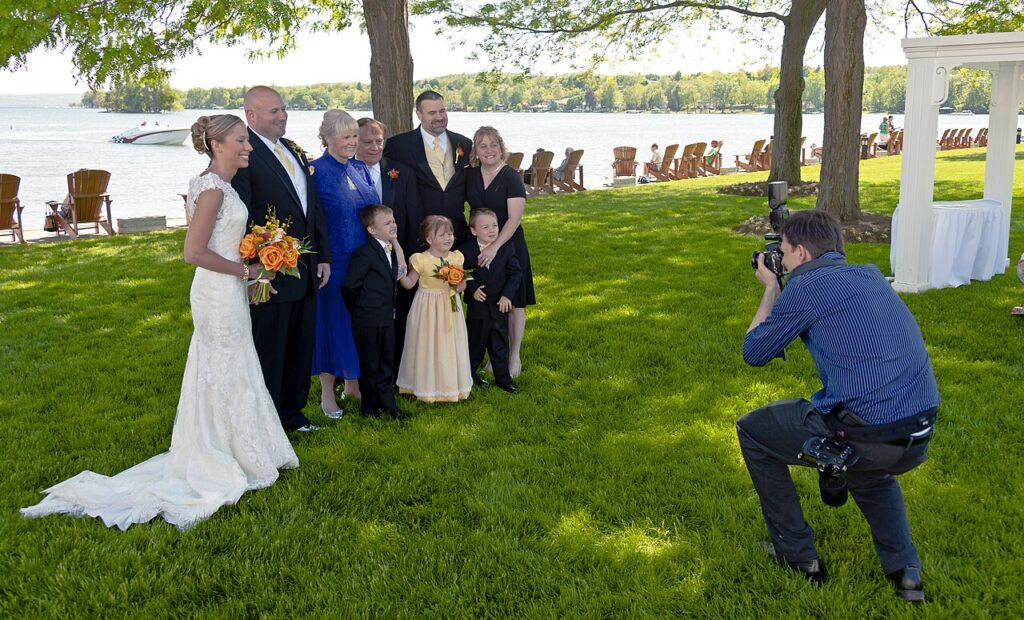

Make Money With Wedding Photography: The Short Version
In short, couples in the U.S. paid between $3,000 and $4,400 on average for a wedding photographer, depending on the source. However, a price is not a paycheck. Most photographers work for themselves, official pay data leaves them out, and we found no sourced figure for their costs. Therefore, nobody can promise you an income from these numbers alone.
What the BLS Says About Photographers
The Occupational Outlook Handbook reports a median pay of $44,660 per year for photographers in May 2025. However, the page says this figure excludes self-employed workers, who make up most of the occupation. Self-employed workers held 67 percent of about 145,000 photographer jobs in 2025.
Overall, the outlook is flat. The BLS projects a 1 percent decline in employment from 2025 to 2035, and about 10,700 openings a year, all from workers who leave the occupation. In addition, the page says wedding photographers usually work on location, that part-time work is common, and that schedules often include evenings and weekends. Wedding photographers are typically busiest in summer and fall.
Furthermore, for self-employed photographers, the page lists the work behind the camera: buying and adjusting equipment, advertising and planning marketing around seasonal demand, scheduling, record keeping, and billing. It gives no dollar figures for those costs.
What Couples Pay for a Wedding Photographer
Two large sources give different averages. The table shows both, and the gap matters.
| Source | Average price | Basis |
|---|---|---|
| The Knot | $3,000 | Real Weddings Study; 10,474 U.S. couples who married in 2025 |
| Zola | $4,400 | Zola Wedding Cost Index; the page does not state the data year; typical range $3,500 to $5,300 |
However, the pages do not explain the gap. Different samples and methods could explain it, but we could not check that. Moreover, both figures are what couples say they paid, not what photographers earned.
The Knot also breaks its data down. Across budget groups, the lower quartile paid $1,500, the median $2,800 and the upper quartile $4,700. Regionally, the average ran from $2,600 in the Southwest to $3,800 in the Mid-Atlantic. By guest count, couples with 1 to 50 guests paid $2,000, couples with 51 to 100 guests paid $2,700, and couples with more than 100 guests paid $3,500. Furthermore, The Knot estimates an hourly rate of about $375, but that estimate assumes an eight-hour day and describes price, not pay.

In addition, both pages list what moves a price: location, guest count, the number of photographers, travel fees, editing time and the scope of coverage, such as an engagement session. Zola adds general advice, not tied to its data. Basic packages cover 6 to 8 hours, standard packages 8 to 10, and premium packages more than 10. Saturdays from May to October cost the most, while off-season dates from November to April can cost less.
Self-Employment Tax When You Make Money With Wedding Photography
However, revenue is not income. As arithmetic, not a forecast: at The Knot’s $3,000 average, 10 weddings bring $30,000 and 20 weddings bring $60,000 before any cost. Next, tax takes a share. The IRS sets the self-employment tax at 15.3 percent, made up of 12.4 percent for Social Security and 2.9 percent for Medicare. For 2026, the Social Security part applies to the first $184,500 of combined wages, tips and net earnings.
Specifically, you owe this tax, and you file Schedule SE, once your net self-employment earnings reach $400. The IRS adds that you may need to make estimated tax payments each quarter. If you plan to make money with wedding photography in the U.S., ask an accountant how these rules apply to you.
Contracts and Copyright for Wedding Photographers
The U.S. Copyright Office says the author and first copyright owner of a photograph is generally the person who takes it. The main exception is a work made for hire, which covers photos a photographer takes within the scope of employment, or under an express agreement with a commissioning party for a purpose the law names. In addition, protection does not depend on registration, but the Office recommends it. You must register before you can sue for infringement of a U.S. work, and registration affects eligibility for some remedies and for the Copyright Claims Board.
Adorama’s contract guide says a wedding contract needs, at a minimum, the following items:
- Names, contact details, date and place.
- Coverage hours, and how extensions work and cost.
- Deliverables: number of edited images, file format, and any prints or albums.
- A realistic delivery timeline for the gallery.
- Payment terms: total price, retainer, balance date, late payment and payment types.
- Cancellation and postponement terms, including refunds and what happens if the photographer cannot work.
- Copyright and usage: who owns the images and how each side may use them.
- A limit on liability, which the guide says a lawyer should review.
The guide also calls it standard practice for the photographer to keep copyright and give the couple a personal-use licence. However, the guide gives no source for that claim, so treat it as the author’s view. Because we are not lawyers, ask a lawyer who works with creative professionals before you use any template.

A Checklist to Make Money With Wedding Photography
In short, this checklist comes from the sources above, not from our own business records.
- Compare your planned price with your region’s average in The Knot data, and with Zola’s range.
- Plan around the seasons: the BLS says wedding work peaks in summer and fall, and Zola says peak dates cost the most.
- Write your contract with every item from Adorama’s list, then have a lawyer read it.
- Decide in writing who owns the images, starting from the Copyright Office’s default.
- Set money aside for self-employment tax, and ask an accountant about quarterly payments.
- Track your own costs for gear, software, travel and marketing, because we found no sourced figure to copy.

What We Removed From This Article
An earlier version of this post called wedding photography lucrative and gave ten strategies with no source. It advised on portfolio size, the number of full galleries to show, video engagement rates, package design, add-on revenue, vendor partnerships, workshops, destination weddings and burnout. It also told readers to stuff a keyword into their website and linked to two homepages. As a result, we removed all of it, because none of it cited evidence.

Sources and Limits
- U.S. Bureau of Labor Statistics, Occupational Outlook Handbook: Photographers
- The Knot, average cost of a wedding photographer
- Zola, wedding photographer cost
- Adorama, wedding photography contract guide
- U.S. Copyright Office, what photographers should know about copyright
- IRS, self-employment tax
First, we read these pages through a summarising fetch tool, not as raw pages. In addition, all figures describe the United States, and we covered no other country. The BLS pay figure excludes self-employed photographers. Zola states no data year, and the meta description of its page gives a lower bound of $3,300 where its body text says $3,500. We found no sourced figures for the costs of gear, insurance, software or marketing, so we give none.
Also, Adorama’s legal claims have no cited source. Finally, nothing here is legal, tax or financial advice. One photograph and one museum image come from Wikimedia Commons, under CC BY-SA 3.0 and CC0. The other three images are AI-generated and distorted in places.