View from the Window at Le Gras (French: Point de vue du Gras) is generally regarded as the earliest surviving photograph made with the aid of a camera obscura. Created by the French inventor Joseph Nicéphore Niépce, probably in 1827, the image records the view from an upstairs window of his family estate at Saint-Loup-de-Varennes, near Chalon-sur-Saône. Rather than a conventional print, it is a faint heliograph formed on a pewter plate coated with bitumen of Judea. Its historical importance lies not simply in being the first photograph, but in preserving one of the earliest successful attempts to make a projected image from nature permanent1.
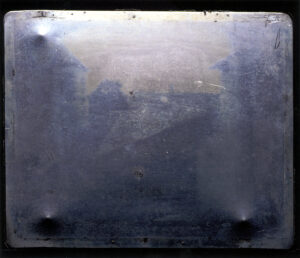
This article explores the context of Niépce's invention, the heliography process used to create the photograph, the image's content and preservation, and its legacy in photographic history.
Nicéphore Niépce and the Invention of Photography
Joseph Nicéphore Niépce (1765–1833) was an amateur scientist and inventor from Chalon-sur-Saône, France. In the early 19th century, there was growing interest in technologies that could capture images from nature and prints—effectively, an affordable picture for all. Niépce had already achieved success in other fields (he co-invented an early internal combustion engine in 1807), but by 1816 he turned to solving the problem of fixing images permanently. Using a camera obscura (a wooden box with a lens projecting an image onto a surface), Niépce began experimenting with light-sensitive materials. His goal was twofold: to copy existing artworks (like engravings) and to record real-life scenes directly from nature2.
Niépce's trials involved many chemicals and surfaces. By 1816 he managed to produce fleeting photographic images on paper, which he called points de vue (views). However, these early images were temporary. Over the next decade Niépce refined his methods through painstaking trial and error. He ultimately developed a technique he dubbed heliography—Greek for sun writing. In heliography, Niépce used a light-sensitive varnish made from bitumen of Judea (a type of asphalt) dissolved in lavender oil. He coated a sturdy surface (initially stone or metal) with this solution. When exposed to sunlight, the bitumen would harden in proportion to light intensity, while areas not struck by enough light remained soluble. After exposure, Niépce would wash the plate with a solvent (a mixture of oil of lavender and white petroleum) to dissolve away the unexposed bitumen, leaving behind a permanent image in hardened resin. This was essentially an etching created by light—wherever light had strongly hit, the bitumen stayed and protected the surface, and where it hadn\'t, Niépce could wash the coating off, exposing the polished surface beneath3.
By 1824–1826, Niépce's persistence paid off. He had some success copying engravings to stone in 1824, but wanted to capture the world from life. For his experiments, Niépce switched to a pewter plate as the medium—a flat, silver-colored metal plate that could hold the bitumen coating sturdily. He set up his camera obscura at the second-floor window of his country house at Le Gras (Saint-Loup-de-Varennes, Burgundy) and aimed it at the courtyard outside. Sometime in summer 1826 (or possibly 1827), Niépce prepared a plate with his bitumen mixture, inserted it in the camera, and began an extremely long exposure. Contemporary accounts traditionally estimate the exposure time at about 8 hours—inferred because sunlight illuminates buildings on both sides of the scene (suggesting the sun moved across the sky during the shot). In fact, Niépce wrote in late 1827 that his process was slow, and some modern researchers who recreated his technique conclude the exposure may have required several days of bright light. Either way, this was a multi-hour (or multi-day) exposure by necessity—Niépce needed to accumulate enough light to harden the bitumen4.
Capturing View from the Window at Le Gras
After the lengthy exposure was complete, Niépce removed the pewter plate from the camera obscura. He then used his solvent (lavender oil and white petroleum) to gently wash the plate. This washing removed the still-soft bitumen in the darker, unexposed areas while leaving behind the hardened bitumen where sunlight had struck during the exposure. The result was a fixed heliographic image: a thin layer of hardened bitumen remained on the pewter plate, and the image becomes visible through the interaction of the bitumen, the metal surface, and the angle of illumination. This small photograph—View from the Window at Le Gras—measures about 6.4 × 8.0 inches (16.2 × 20.2 cm). It represents a view out of Niépce's upstairs window, capturing parts of the surrounding buildings and landscape in light and shadow5.
When examining View from the Window at Le Gras, it's important to note that the original heliograph image is extremely faint. The surviving plate does not look like a modern photograph—it has to be held under raking light at a specific angle to see the image. The visibility is a bit like a daguerreotype in that it appears negative or positive depending on lighting and angle. What Niépce achieved, however, was astounding for its time: the world's first permanent camera image from nature. The view captured on the plate includes (from left to right) the wing of Niépce's house with a high roof (the estate's dovecote or pigeon house), a pear tree in the center, the slanted roof of a barn, a small shack and chimney of a bake-house behind it, and another building on the right. In the distance, one can discern the light horizon of the sky. The lighting is peculiar because, over the extended exposure, the sun illuminated different sides of the buildings sequentially—hence both facing walls of the courtyard appear lit. The image lacks fine detail and has a grainy, mottled appearance (partly from reproduction processes), but one can clearly make out architectural forms and areas of foliage. Importantly, the faintness is not due to fading over time—bitumen is actually quite stable—but rather because Niépce underexposed the plate relative to its requirements6.
Most widely circulated versions of the image are not direct impressions of what the original plate looks like under ordinary lighting. Because the heliograph is extremely faint, reproductions have often involved intensified contrast, retouching, or later photographic and digital processing. The familiar, relatively legible image is therefore also part of the object's reception history: it shows not only Niépce's plate, but the successive technologies used to make that plate visible to a modern audience7.
Niépce was proud of this breakthrough. In a December 1827 letter, he described his heliograph as the first uncertain step in a completely new direction, acknowledging it was imperfect but heralding a new era. He had proven that photography was possible—light alone could imprint an image of reality on a prepared surface, creating an image from nature that would not fade. This achievement, however, was just the beginning. Niépce knew the process needed improvement: the exposure was impractically long and the results lacked clarity. He continued to tinker with chemical formulas and methods after 1826, hoping to shorten exposure times and increase image contrast.
Early Reception and Niépce's Partnership with Daguerre
In 1827, Niépce traveled to England, bringing along several heliograph plates to show his work to others. Among these plates was View from the Window at Le Gras, notably the only camera-exposed image (the others were contact copies of engravings). Niépce befriended Sir Francis Bauer, a respected botanist and microscopist, who was fascinated by Niépce's invention. Bauer encouraged Niépce to present his process to the Royal Society in London. However, Niépce was secretive about his exact chemicals (understandably, he wanted to secure credit and perhaps profit) and the Royal Society had a rule against accepting papers on secret processes. Niépce submitted a paper outlining heliography in general terms, but without revealing the formula for the bitumen solution, it was rejected. Before Niépce returned to France, he entrusted Bauer with his photographic plates and manuscript, hoping they might eventually be recognized8.
Back in France, Niépce sought a partner to further develop the process. In 1829 he entered into a formal partnership with Louis-Jacques-Mandé Daguerre, a theater artist and entrepreneur who had also been experimenting with capturing images. Daguerre was well-known as the creator of the Diorama spectacle in Paris and had resources and chemistry skills. The Niépce-Daguerre partnership combined Niépce's foundational work with Daguerre's relentless experimentation. Unfortunately, Niépce died suddenly in 1833 before any new process was ready. Just six years later, in January 1839, Daguerre announced his own invention—the Daguerreotype, the first practical photographic process—to worldwide acclaim. Daguerre's method (developed after Niépce's death) used silver-plated copper and iodine fumes to dramatically cut exposure times to minutes, producing sharp, detailed images. The daguerreotype's sensational public reveal in 1839 marked the official birth of photography for most people, and Daguerre was hailed as the father of photography\9.
However, those early pioneers knew that Niépce had been the first to make a permanent photograph years earlier. In the excitement of 1839, Francis Bauer (still preserving Niépce's materials in England) made sure Niépce got credit. He displayed Niépce's original heliograph plates (including View from the Window at Le Gras) at the Royal Society in March 1839, demonstrating that Niépce's work pre-dated Daguerre's. Some historians even argue that Daguerre learned crucial ideas from Niépce during their partnership. Regardless, Niépce's contribution soon fell into obscurity in the public eye. Throughout the rest of the 19th century, Daguerre and British inventor William Henry Fox Talbot (who independently invented paper-based photography in 1839) were celebrated, while Niépce's point de vue was mostly treated as a curious footnote10.
Rediscovery and Legacy of the First Photograph
After its brief showing in 1839, View from the Window at Le Gras was stored away. It changed hands a few times in the 1800s and was last exhibited publicly in 1905, then essentially forgotten for almost 50 years. The plate survived in private storage in England, still in its original wooden frame with Francis Bauer's handwriting on the back noting Niépce's name and process. The photograph's re-emergence came thanks to the work of Helmut Gernsheim, a German–British photography historian, and his wife Alison Gernsheim. In 1952, the Gernsheims tracked down Niépce's long-lost heliograph plate. Helmut Gernsheim had been researching the origins of photography and realized that Niépce's achievement, though acknowledged by scholars, lacked a physical presence in historical accounts—people simply hadn\'t seen the actual image. Following clues (including Bauer's notes), the Gernsheims located View from the Window at Le Gras in the possession of descendants of its last owner, who had misidentified and tucked it away. The Gernsheims verified its authenticity and brought Niépce's first photograph to international attention, firmly cementing Niépce's status as a foundational figure in photography11.
Because the image on the pewter plate was so faint, the Gernsheims wanted to create a sharable copy. They enlisted the Kodak Research Laboratory in London to make a high-quality photographic reproduction in 1952. Even this proved challenging—capturing all the detail visible on the mirrored pewter when lit at an angle was difficult. Eventually, Helmut Gernsheim himself retouched the reproduced print with watercolor to enhance the contrast and make the scene clearer. For decades, this enhanced reproduction (often seen in books and articles) was the only version of Niépce's photo that circulated publicly. It wasn\'t until the late 1970s that less altered images of the plate were published, once preservation techniques improved. Unfortunately, at some point after 1952 the original plate also developed some physical distortions (small bumps on three corners), which further complicate viewing by causing stray reflections. Today, experts use careful lighting to mitigate this when displaying the piece12.
In 1963, the University of Texas at Austin purchased the Gernsheims\' photography collection, which included Niépce's View from the Window at Le Gras, as part of a trove of historic photographs. The Niépce heliograph is now housed at UT's Harry Ransom Center (HRC) as a crown jewel of their collection. Recognizing its importance, Helmut Gernsheim chose to donate Niépce's original plate rather than keep it or sell it elsewhere, ensuring it would reside in an institution dedicated to preservation. The HRC has since placed the Niépce plate on permanent display in a sealed, climate-controlled case filled with inert gas to protect it. Because viewing the image requires precise lighting, the exhibit uses a controlled light source and angled display to allow visitors to see the faint photograph clearly. In 2002–2003, scientists from the Getty Conservation Institute, in partnership with the HRC, conducted an in-depth scientific analysis of Niépce's plate using X-ray fluorescence and infrared spectroscopy. They confirmed Niépce's process—the image is indeed composed of bitumen, and the metal is a pewter alloy—and helped design the sophisticated encasement that now preserves this nearly 200-year-old artifact13.
The legacy of View from the Window at Le Gras is foundational. It may not be as visually striking as later photographs, but it holds a central place in the history of photography. In fact, in 2003 Life magazine included Niépce's photo in its list of 100 Photographs that Changed the World, a testament to its impact on human culture. Historians credit Niépce with being the first to achieve what had been dreamed of for centuries—capturing the elusive light-painted image permanently. Every photograph taken since, from daguerreotypes to digital images on smartphones, traces back to that small pewter plate in a Burgundy windowsill. Niépce's invention was soon overshadowed by Daguerre's more practical process, but today Niépce is rightfully acknowledged as a founding figure in photography. Museums and scholarly works now give him due credit; for example, the Nicéphore Niépce Museum in Chalon-sur-Saône, France (Niépce's hometown) is dedicated to his life and the early history of photography. And the Harry Ransom Center refers to View from the Window at Le Gras as the world's earliest extant permanent photograph from nature, highlighting its unrivaled significance14.
What makes the heliograph especially revealing is that it does not record a single instant. Its long exposure accumulates changing conditions of light, so the image registers duration as much as it records a place. The photograph is therefore both a view from a window and a material trace of time passing across that view. This temporal quality distinguishes it from later photographic practices that aimed to freeze a moment, and it invites us to think of photography not simply as a technology of instants, but as a medium capable of recording extended processes.
Frequently Asked Questions (FAQ)
Q: What is View from the Window at Le Gras?**A:** It is the world's earliest surviving photograph made with a camera obscura, created by French inventor Nicéphore Niépce in 1827. The image, captured on a pewter plate coated in bitumen, shows the view from an upstairs window of Niépce's estate (Le Gras) in France. In essence, it's the earliest example of a permanent camera image in photographic history.
Q: Why is View from the Window at Le Gras significant?**A:** This photograph marks a foundational moment in the birth of photography. Before Niépce, no one had successfully fixed a camera image permanently. Niépce's photo proved that it was possible to capture real life with a camera obscura and light-sensitive chemicals, laying the groundwork for all subsequent photographic processes. Its significance also comes from its rarity—it's a one-of-a-kind artifact that survived nearly two centuries and represents the moment human ingenuity turned light into a recorded image.
Q: How did Nicéphore Niépce create the first photograph?**A:** Niépce invented a technique called heliography. He coated a metal plate (pewter) with bitumen of Judea, a substance that hardens when exposed to light. He placed this plate in a camera obscura facing out his window and exposed it for many hours. The sunlight gradually hardened the bitumen on bright areas of the image. After exposing, Niépce washed the plate with a solvent, which removed the unhardened portions. The hardened bitumen left on the plate formed the photograph, showing a view of buildings and sky. This was a direct positive image created by the action of light over time.
Q: How long was the exposure for Niépce's photograph?**A:** The exposure time was extremely long compared to modern photography. Niépce's own notes suggest it took multiple days of sunlight to expose properly. However, based on the lighting of the buildings in the scene, historians often estimate around 8 hours of exposure were effective (the traditional figure given). It was certainly at least several hours—long enough for the sun to move across the sky. This long exposure was necessary because the chemicals Niépce used weren\'t very sensitive to light.
Q: What does the View from the Window at Le Gras photograph show?**A:** It shows the courtyard and buildings of Niépce's estate as seen from an upstairs window. You can see parts of building rooftops on either side of the frame, some trees and foliage, and a barn or outbuilding with a slanted roof in the center. The sky is bright in the background. Because of the long exposure, both sides of the courtyard appear lit by the sun. The scene looks grainy and monochromatic (the process only captured light and dark), but it's recognizable as a group of sunlit buildings and a bit of the surrounding landscape.
Q: Where is the original Niépce photograph now?**A:* The original plate of View from the Window at Le Gras* is preserved at the Harry Ransom Center at the University of Texas at Austin. It was rediscovered by Helmut Gernsheim in 1952 and eventually acquired as part of the Gernsheim collection by the Ransom Center in 1963. The plate is on display in a protective casing, and visitors can view this priceless piece of history under carefully controlled lighting.
Selected References
- Brown, B. The First Photograph. Harry Ransom Center, University of Texas at Austin.
- Gernsheim, H. The Origins of Photography. London: Thames & Hudson, 1982.
- Harding, C. N is for… Joseph Nicéphore Niépce, Creator of the First Photograph. National Science and Media Museum.
- Stulik, D., and A. Kaplan. Scientific Investigation of Niépce's Heliographs. Getty Conservation Institute.
- Silverman, K. The Miracle of Analogy: The History of Photography, Part 1. Stanford: Stanford University Press, 2015.
- The Niépce Heliograph. Harry Ransom Center, University of Texas at Austin.
- The Harry Ransom Center dates the heliograph to 1827 and describes it as the earliest surviving photograph produced with the aid of a camera obscura. See the [Harry Ransom Center's account of the Niépce heliograph](https://www.hrc.utexas.edu/niepce-heliograph/).
- For Niépce's early experiments and the development of heliography, see the [Harry Ransom Center's account](https://www.hrc.utexas.edu/niepce-heliograph/) and the National Science and Media Museum's [history of Niépce's first photograph](https://blog.scienceandmediamuseum.org.uk/a-z-of-photography-joseph-nicephore-niepce-first-photograph/).
- For a detailed description of the heliographic process, see the [National Science and Media Museum blog](https://blog.scienceandmediamuseum.org.uk/a-z-of-photography-joseph-nicephore-niepce-first-photograph/) and the [Harry Ransom Center's conservation account](https://cool.culturalheritage.org/byorg/abbey/an/an26/an26-3/an26-307.html).
- For the traditional eight-hour estimate, see the [Harry Ransom Center's account of the 2003 symposium](https://www.hrc.utexas.edu/press/releases/2003/at-first-light-symposium.html). For the material analysis of the plate, see the Getty Conservation Institute's [report on alternative-process photography and the Niépce heliograph](https://www.getty.edu/conservation/our_projects/science/photocon/alt_processes.pdf).
- For dimensions and technical details, see the [Wikipedia entry](https://en.wikipedia.org/wiki/View_from_the_Window_at_Le_Gras) and the [Harry Ransom Center](https://www.hrc.utexas.edu/niepce-heliograph/).
- For conservation details and the faintness of the original, see the [Harry Ransom Center's conservation account](https://cool.culturalheritage.org/byorg/abbey/an/an26/an26-3/an26-307.html).
- For the history of reproductions and retouching, see the [Wikipedia entry](https://en.wikipedia.org/wiki/View_from_the_Window_at_Le_Gras) and the [Harry Ransom Center's account](https://cool.culturalheritage.org/byorg/abbey/an/an26/an26-3/an26-307.html).
- For Niépce's 1827 trip to England and the Royal Society episode, see the [Wikipedia entry](https://en.wikipedia.org/wiki/View_from_the_Window_at_Le_Gras) and the [Harry Ransom Center's account](https://cool.culturalheritage.org/byorg/abbey/an/an26/an26-3/an26-307.html).
- For Daguerre's process and its relationship to Niépce, see the [Metropolitan Museum of Art's account](https://www.metmuseum.org/essays/daguerre-1787-1851-and-the-invention-of-photography).
- For the early reception and attribution of priority, see the [Wikipedia entry](https://en.wikipedia.org/wiki/View_from_the_Window_at_Le_Gras) and the [Harry Ransom Center's account](https://cool.culturalheritage.org/byorg/abbey/an/an26/an26-3/an26-307.html).
- For the Gernsheims\' rediscovery, see the [Wikipedia entry](https://en.wikipedia.org/wiki/View_from_the_Window_at_Le_Gras) and the [Harry Ransom Center's account](https://cool.culturalheritage.org/byorg/abbey/an/an26/an26-3/an26-307.html).
- For reproductions and conservation issues, see the [Wikipedia entry](https://en.wikipedia.org/wiki/View_from_the_Window_at_Le_Gras) and the [Harry Ransom Center's account](https://cool.culturalheritage.org/byorg/abbey/an/an26/an26-3/an26-307.html).
- For the Getty's scientific analysis, see the [Getty Conservation Institute report](https://www.getty.edu/conservation/our_projects/science/photocon/alt_processes.pdf) and the [Harry Ransom Center's 2003 symposium announcement](https://www.hrc.utexas.edu/press/releases/2003/at-first-light-symposium.html).
- For the plate's legacy and recognition, see the [Wikipedia entry](https://en.wikipedia.org/wiki/View_from_the_Window_at_Le_Gras) and the [Harry Ransom Center's account](https://cool.culturalheritage.org/byorg/abbey/an/an26/an26-3/an26-307.html).