We are living through something unprecedented in the history of human perception. Not a political crisis, not a media crisis — an epistemic crisis, one that strikes at the most primitive heuristic our species has ever developed for evaluating reality: seeing is believing.
For the first time in history, that heuristic is broken. Not bent. Not strained. Broken.
The evidence for this claim is not anecdotal. It's not the alarmist speculation of tech writers. It comes from peer-reviewed cognitive science, from computer vision benchmarks, from philosophy journals, from courtrooms, and from history books. And when you read it in full — when you actually sit with what the data says — it is genuinely unsettling.
This article is that full read.
Part I: The Machine Has Already Won the Arms Race
Let's start with the technical picture, because it's the foundation everything else rests on.
In 2022, something happened that most people outside machine learning research didn't notice. A new class of AI image generation technology — diffusion models — achieved photorealism at scale. The names you've heard since then: Midjourney, DALL-E 3, Stable Diffusion, FLUX.1, Google Imagen. These are not crude filters or Photoshop shortcuts. They are systems trained on billions of images that have learned, at a statistical level, what photographs look like — and can reproduce that quality on demand.
How good are they? A 2024 study published in Issues in Information Systems ran a controlled experiment presenting participants with images from Google's Imagen alongside real photographs. When researchers ran a statistical test to see whether participants rated the two groups differently in terms of perceived realism, the result was p = 0.999.1 In statistical terms, that's as close to "identical" as you can get.
This equivalence is not confined to experimental settings.
In April 2026, an image depicting the rescue of a U.S. airman in Iran circulated widely online and was shared by political figures as authentic documentation. It was entirely AI-generated.2
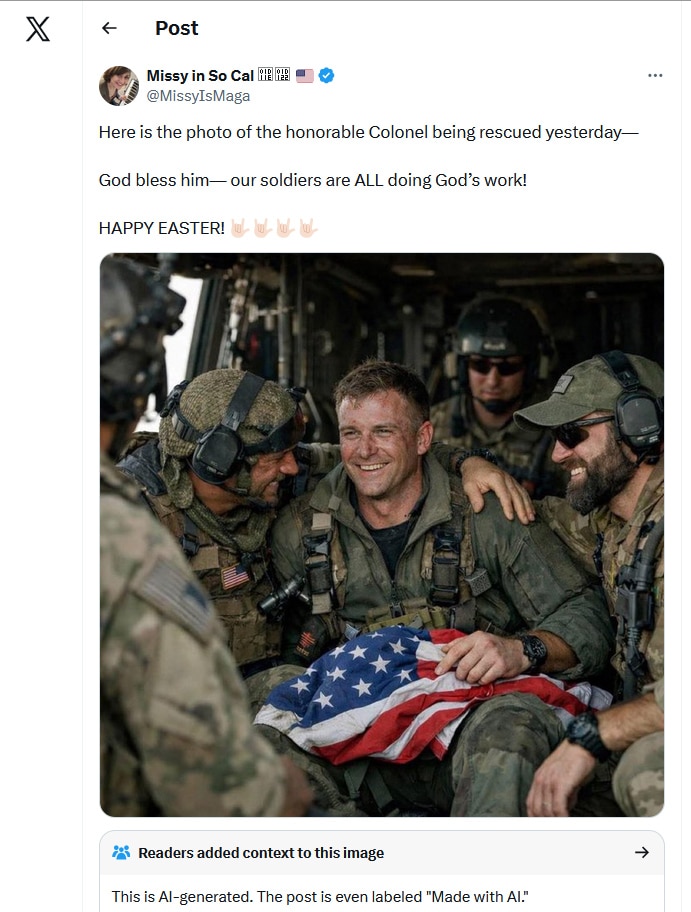
The image did not succeed because it was exceptional. It succeeded because it conformed perfectly to the visual grammar of routine photojournalism.
Stable Diffusion 3, released in 2024, uses a Multimodal Diffusion Transformer architecture with 8 billion parameters — and outperforms earlier generations across photorealistic detail, text rendering, and prompt fidelity.3 These aren't novelty generators. They are professional-grade fabrication engines.
Can humans tell the difference? No.
Here's the number that should stop you cold.
In 2022, researchers Sophie Nightingale and Hany Farid published a study in the Proceedings of the National Academy of Sciences (PNAS). They showed 315 participants faces generated by StyleGAN2 — a previous-generation AI system — and real human faces, and asked them to identify which was which. The average accuracy was 48.2%.4
Chance is 50%. The participants performed below chance.
Consider the following image.
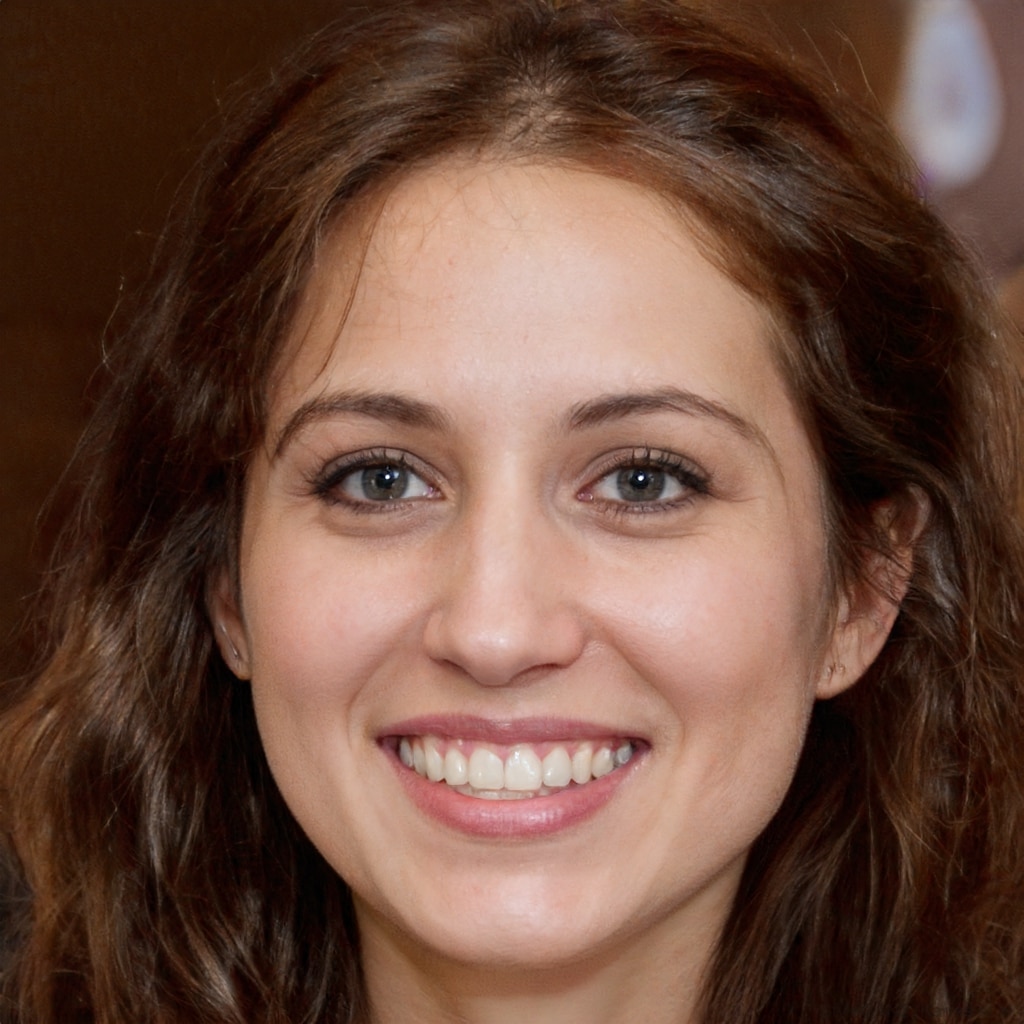
Decide whether this person exists.
This uncertainty is not a failure of attention. It is the exact condition measured in the experiment.
But that's not even the most alarming finding. The synthetic faces in that study were rated 7.7% more trustworthy than the real human faces. The machines have not just learned to look human. They've learned to look more trustworthy than humans.
This wasn't a fluke. A massive 2024 meta-analysis published in iScience — covering 56 papers and 86,155 participants — found an overall human deepfake detection accuracy of just 55.54%.5 The 95% confidence interval on that number crosses 50%, meaning that across the scientific literature, we cannot statistically distinguish human deepfake detection from random guessing.
For images specifically — static photographs rather than video — accuracy fell to 53.16%. Effectively coin-flip territory.
A 2024 study in Communications of the ACM drove the point home even harder: mean detection performance across all stimuli was 51.2%, with images specifically scoring 49.4% — below chance — and critically, prior familiarity with synthetic media did not improve performance.6 You can't train your eye to catch something it fundamentally cannot see.
What about AI detectors?
The obvious response is: forget human eyes, use AI detection tools. And in lab conditions, they're impressive. On the FaceForensics++ benchmark — the standard academic test dataset — top detectors achieve 95–99% AUC (area under the curve, basically a measure of discriminative accuracy).7
Then Meta ran the DeepFake Detection Challenge — a real-world stress test using over 100,000 video clips, with the best teams in the world competing. The top performer achieved 82.56% accuracy on the public test set. On the hidden, unseen black-box data? 65.18%.8 No participant exceeded 70%.
The 2025 Deepfake-Eval-2024 benchmark — testing detectors on 44 hours of real-world content from 88 websites in 52 languages — documented AUC drops of 45–50% compared to legacy benchmarks.9
The core problem is that detectors learn to spot compression artifacts and generative fingerprints specific to whatever systems they were trained on. The GenImage benchmark demonstrated this precisely: within-generator accuracy exceeds 98%, but cross-generator accuracy falls to approximately 70%.10 Train a detector on Midjourney images, and it struggles with DALL-E outputs. Train it on GAN images, and it misses diffusion model outputs almost entirely.
Diffusion models have made this worse by producing fewer spectral artifacts than GANs — undermining the frequency-domain forensics techniques that previously provided reliable detection.11
The scientific consensus is blunt: lab accuracy does not predict real-world performance. The gap between benchmark results and deployment conditions is not a solvable engineering problem — it's a fundamental structural issue in how detection works.
The researchers doing the most important work here: Hany Farid at UC Berkeley, Siwei Lyu's Media Forensic Lab at SUNY Buffalo (who created the Celeb-DF dataset and DeepfakeBench), Luisa Verdoliva's group at the University of Naples Federico II, and the FaceForensics++ team at TU Munich led by Matthias Nießner.
Part II: Philosophy Had This Figured Out — AI Just Made It Catastrophic
Here's something most technology reporting gets completely wrong: the crisis of photographic trust is not purely a technical problem. It is a philosophical one. And philosophers were warning about it long before diffusion models existed.
To understand why AI-generated images are epistemically different from Photoshopped images, you need to understand what philosophers thought photography was.
Photography's special claim to truth
For most of the twentieth century, there was a coherent — and genuinely compelling — philosophical argument that photographs have a unique relationship to truth that paintings, drawings, and illustrations simply don't.
Roland Barthes, in Camera Lucida (1980), articulated it as the ça-a-été — "that-has-been." The photograph, he argued, certifies that its referent existed before the lens. Whatever you feel about a photograph, the camera was pointed at something real.12
André Bazin's "Ontology of the Photographic Image" (1945) grounded this in mechanism: photography's power comes from its automatic, mechanical genesis. Unlike a painting, which passes through human intention, a photograph is produced by light acting on chemistry. Bazin compared it to a fingerprint — a physical trace of reality rather than a representation of it.13
The most rigorous version came from philosopher Kendall Walton, whose 1984 paper "Transparent Pictures" in Critical Inquiry argued that photographs are literally transparent to reality — prosthetic seeing devices, like telescopes and mirrors, whose outputs depend counterfactually on their subjects through belief-independent mechanical processes.14 When you look at a photograph, in a philosophically meaningful sense, you are seeing the thing photographed.
In semiotic terms — drawing on Charles Sanders Peirce's taxonomy of signs — photography is an indexical sign: causally connected to its referent through a physical chain. Smoke is an index of fire. A footprint is an index of a foot. A photograph, in this tradition, is an index of whatever was before the camera when the shutter opened.15
This indexical chain can now be severed or recomposed.
A recent controversy involved an influencer publishing an image in which her face had been placed onto another woman’s body, later attributing the transformation to an AI production process16
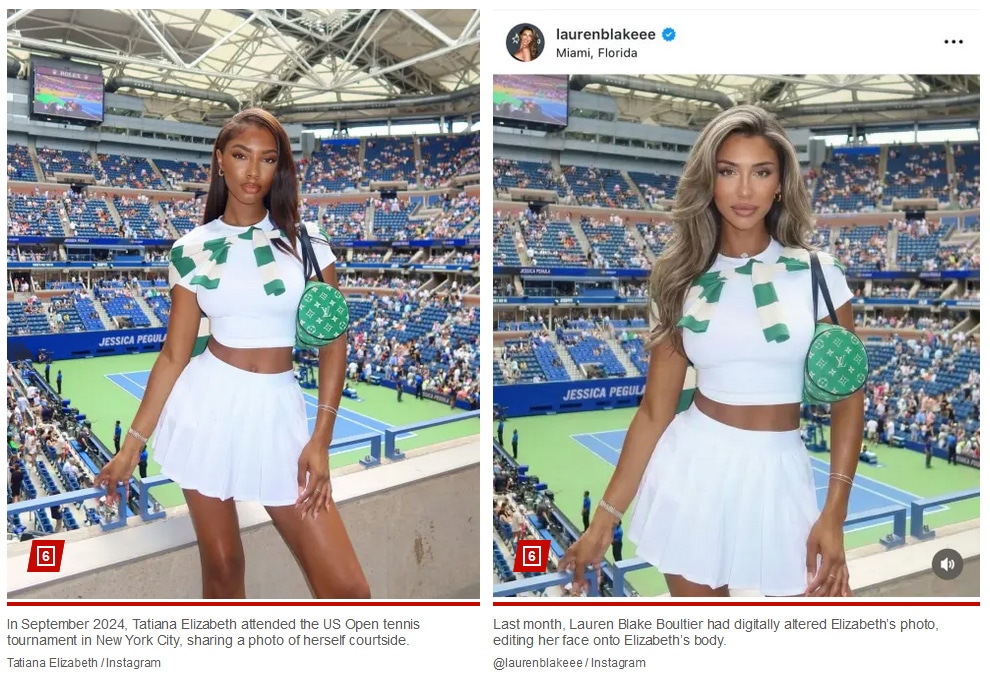
The resulting image does not refer to a single body. It is a composite without stable referent, breaking the causal continuity that grounded photographic indexicality.
This is why photographs feel different from paintings in courtrooms, in journalism, in science. Not just because they look more real, but because of a deep, intuitive understanding that they are causally connected to something that happened.
What AI does to this framework
AI-generated images sever the causal chain entirely.
When you generate an image with Midjourney or DALL-E, there is no referent. No light hit a sensor. No physical event was traced. The image is produced by a statistical model that has learned patterns from billions of existing images and recombines those patterns in response to a text prompt. In Peircean terms, it is an icon without an index: it resembles photographs through learned patterns, not physical causation.
Philosopher P.D. Magnus demonstrated this in a 2023 paper in AI & Society using an elegant thought experiment. He deliberately prompted an AI image generator with the misspelled phrase "Ehbruham Lynkon." The system produced an image that bore no resemblance to Lincoln — because it didn't recognize the reference.17
If the output depended on the referent — as Walton claimed photographs do — the name wouldn't matter. But it did matter, because the output depends on linguistic recognition, not physical causation. Walton's transparency condition fails entirely. AI images are not windows onto reality; they are windows onto a statistical distribution of how reality has been visually represented.
The epistemic backstop
Regina Rini, a philosopher at York University, coined a term in her 2020 paper in Philosophers' Imprint that has become essential to this debate: the "epistemic backstop."18
The idea: recordings — photographs, videos, audio — serve a regulatory function in human testimony and social epistemics. They operate in two ways. First, acute correction: you can check claims against recordings. Second, passive regulation: the knowledge that you might be recorded incentivizes people to be truthful in the first place. Politicians don't lie in press conferences the way they might lie in private partly because cameras are present.
Deepfakes threaten both functions simultaneously. If recordings can be fabricated at will, they can no longer serve as checks on testimony. And if everyone knows recordings can be fabricated, the passive deterrent effect evaporates too. Rini warned — in 2020, before the current generation of diffusion models existed — of "a slow-boiling but deeply consequential epistemic maelstrom."
Don Fallis, at Northeastern University, added a crucial dimension in a 2021 paper in Philosophy & Technology: photographs are not merely transmitters of existing knowledge but generative sources of new knowledge.19 They let you discover things you didn't know. Deepfakes reduce the information content of images toward zero, because you can no longer reliably extract facts about the world from visual representations.
Not everyone in philosophy takes the catastrophist view. Joshua Habgood-Coote's 2023 paper in Synthese argues, carefully, that social norms and historical precedents for manipulation make deepfakes less threatening than the alarmists suggest.20 But even his counterargument acknowledges the structural problem. It differs on severity, not on mechanism.
The deepest question — and the one where scholarly opinion has converged most clearly — is whether photography's epistemic privilege was ever real in the first place.
The answer, assembled across foundational works by Allan Sekula, Joel Snyder, John Tagg, Lorraine Daston, and Peter Galison, is a qualified but clear no.21
Photography's claim to objectivity was always institutionally constructed — maintained by editors, wire services, courts, professional associations, and social norms rather than by any inherent mechanical property of light-on-sensor. Victor Burgin put it sharply in 2025: "the truth claim of a photograph ultimately devolves upon language; the image alone is insufficient guarantee."
What AI has done is not shatter a real guarantee. It has shattered the social infrastructure that maintained the performance of a guarantee. That's arguably worse, because those institutions took centuries to build.
Part III: Your Brain Is Working Against You
Even if you intellectually understand that AI images exist, your cognitive architecture was not built to deal with them. And the research on this is, frankly, alarming.
The detection failure nobody wants to talk about
The most disturbing study in this literature comes from a 2021 paper by Köbis, Doležalová, and Soraperra in iScience. In a pre-registered experiment with 210 participants, they documented a clean metacognitive failure: people could not reliably detect deepfakes, but believed they could.22
Neither awareness training — reading Chesney and Citron's own warnings about deepfakes — nor financial incentives improved detection accuracy. The confidence-accuracy gap was not correctable by simply knowing the problem existed.
A 2024 consumer study by iProov (N = 2,000) found that only 0.1% of participants correctly identified all stimuli as real or fake — while average confidence remained above 60% regardless of accuracy.23
There is one bright spot. A 2022 PNAS study by Groh and colleagues found that human-AI collaboration improved detection accuracy from 66% to 73% (p < .001).24 Humans plus AI tools outperform either alone. That's meaningful — but it requires that AI detection tools are available, accurate, and actually used, none of which is guaranteed in the conditions where people encounter misinformation.
The liar's dividend: when real becomes fake
Here's the second-order effect that might be even more dangerous than direct deception.
In 2019, legal scholars Bobby Chesney and Danielle Citron published a landmark paper in the California Law Review that introduced the concept of the "liar's dividend."25
The liar's dividend describes what happens when deepfakes become sufficiently well-known: bad actors gain plausible deniability over authentic evidence. You don't need to fabricate a video of your opponent committing a crime. You just need, when authentic video of you committing a crime emerges, to be able to say: "That could be a deepfake."
This is not hypothetical. It is already happening.
Tesla lawyers suggested in court that video recordings of Elon Musk's statements "could be deepfakes." A defense attorney in the January 6 trial of Guy Reffitt argued that prosecution video evidence was AI-generated. Politicians in at least a dozen countries have made similar claims about authentic recordings of themselves. A 2023 PLOS ONE study analyzing 4,869 tweets during the Russia-Ukraine war found that authentic video of atrocities was routinely dismissed as deepfaked — not just by Russian state actors, but by ordinary users who had absorbed the ambient awareness that deepfakes exist.26
The first rigorous empirical test of the liar's dividend as a political strategy was published in the American Political Science Review in 2024. Schiff, Schiff, and Bueno ran five pre-registered experiments with over 15,000 American adults.27 The results were clarifying in unexpected ways.
Claiming that damaging content was misinformation did raise politician approval across partisan subgroups — and proved more effective than traditional crisis responses like silence or apology. But critically: these strategies worked against text-based reports of scandals. Against video evidence, they were largely ineffective. Video, it turns out, still carries more epistemic weight than text.
For now. The question is how long that lasts as generation quality improves.
How your brain makes it worse
Three cognitive mechanisms compound the threat in ways that don't respond well to warnings or corrections.
The illusory truth effect: Repetition increases perceived truthfulness, regardless of actual truth value. Pennycook, Cannon, and Rand demonstrated in the Journal of Experimental Psychology: General (2018) that even a single prior exposure to a fake news headline increased subsequent accuracy perceptions (d = 0.20) — an effect that persisted one week later and was not neutralized by fact-checker labels.28
Processing fluency: Photorealistic images are easy to process visually. Research by Reber and Schwarz (1999, Consciousness and Cognition) established that processing ease is a heuristic for truth — things that feel easy to understand feel true. AI-generated images are engineered to be visually fluent. A 2025 study in the Harvard Kennedy School Misinformation Review by Guo, Zhong, and Hu found that the realism of AI-synthesized images was a significant positive predictor of belief in false headlines (b = 0.36, p < .001).29
The continued influence effect: Once a false image is encoded as a memory, corrections rarely fully eliminate its influence. Ecker, Lewandowsky, and colleagues' comprehensive 2022 review in Nature Reviews Psychology documented this across dozens of studies — corrective information reduces but does not eliminate the impact of misinformation.30
And then there is what psychologist Timothy Levine called Truth-Default Theory: humans evolved a cognitive default that treats incoming communication as honest unless there's a specific trigger to activate skepticism.31 Photorealistic AI imagery provides no such trigger. It looks like what honest communication looks like. The cognitive machinery designed to catch lies simply doesn't engage.
This creates what is genuinely a double bind: educating people about deepfakes is necessary to prevent deception, but education also risks producing blanket distrust of all visual media — including authentic recordings of real events. This is the "epistemic maelstrom" Rini warned about in 2020. You lose either way.
Part IV: The Courtroom Is Completely Unprepared
On May 15, 2025, the Advisory Committee on Evidence Rules voted 8 to 1 on something that would have seemed science fiction five years ago: it approved a proposed new Federal Rule of Evidence specifically designed for AI-manipulated media, and sent it to public comment.32
That vote is a signal of how serious the problem has become. Because right now, American courts are operating under evidentiary frameworks that were not designed for a world where indistinguishable fabrication is available to anyone with a laptop.
The authentication gap
Federal Rule of Evidence 901(a) sets the threshold for authenticating evidence: you need evidence "sufficient to support a finding that the item is what the proponent claims it to be." The bar is deliberately low. There is no specific provision addressing AI-generated media. No established standard for what "authentic" means in a world of photorealistic synthesis.33
The proposed Rule 707 uses a burden-shifting mechanism: if an opponent can demonstrate a "reasonable basis" for believing evidence was AI-altered or generated, the burden shifts to the proponent to prove authenticity by a preponderance of the evidence. That sounds straightforward. The complication is that demonstrating a "reasonable basis" for doubting a video will become progressively easier as public awareness of deepfakes grows — potentially making all video evidence presumptively suspect.
Early case law is already sketching the contours of the problem. In Sz Huang v. Tesla, the court rejected Tesla's attempt to avoid authenticating video of Elon Musk's statements by arguing they might be deepfakes — a significant ruling that video does not become unauthenticated simply by alleging it could be synthetic. In USA v. Khalilian, the court found that non-expert voice identification testimony was sufficient for authentication despite deepfake claims.34
Professor Rebecca Delfino of Loyola Law School has proposed an alternative framework — "Deepfakes on Trial 2.0" — that would establish a heightened evidentiary standard requiring proponents of media evidence to affirmatively demonstrate authenticity rather than merely being subject to challenge.35 The leading legal scholars on these questions — Danielle Citron at UVA, Bobby Chesney at UT Austin, Ryan Calo at the University of Washington — are watching the proposed rule closely.
The provenance solution (and its limits)
The most ambitious technical response to the authentication problem is the C2PA standard — the Coalition for Content Provenance and Authenticity — co-founded in 2021 by Adobe, Arm, BBC, Intel, Microsoft, and Truepic as a Linux Foundation project.36
The concept is elegant. A camera cryptographically signs every photograph it takes at the hardware level, creating a tamper-evident chain of provenance. When you look at a C2PA-compliant image, you can verify the device that captured it, the time and location, and whether it was subsequently edited. The Content Authenticity Initiative — C2PA's industry partner — surpassed 5,000 members across five continents by mid-2025.37
Hardware adoption is accelerating. The Leica M11-P (2023) was the first consumer camera with C2PA built in. The Google Pixel 10 (2025) signs every photograph by default using hardware-backed keys. The U.S. Department of Defense became the first federal agency to implement Content Credentials in 2025.
But provenance-based approaches face two fundamental limitations. First: C2PA metadata can be stripped. It proves authenticity when present, but its absence proves nothing — someone can simply remove it. Second: adoption remains voluntary, and the Nikon Z6 III had its C2PA implementation suspended after a critical signing vulnerability was discovered.38
NIST AI 100-4, the U.S. government's authoritative guidance on synthetic content released in November 2024, was unusually direct about the fundamental limits of any single solution: "There is no perfect solution to solve the issue of public trust and harms stemming from digital content."39 The recommended approach is defense-in-depth: provenance tracking, detection, and prevention in combination, not any single technical fix.
The global legislative patchwork
The legislative response is moving, but unevenly.
The EU AI Act (Regulation 2024/1689), which entered into force on August 1, 2024, is the most comprehensive framework so far. Article 50 mandates that providers of deepfake-generating AI systems ensure outputs are marked in machine-readable format — with penalties reaching €35 million or 7% of global turnover.40
China's Deep Synthesis Provisions, effective January 2023, require mandatory labeling, user identity verification for all synthetic content, and explicit consent for biometric manipulation — making China's regulatory posture the most restrictive globally.41
The United States remains fragmented. The DEFIANCE Act passed the Senate in 2024 but stalled in the House. The NO FAKES Act was reintroduced in 2025. At least 11 states have enacted election-deepfake legislation. A patchwork of state laws covers nonconsensual intimate imagery. Federal comprehensive legislation addressing photographic authenticity across contexts does not yet exist.42
Part V: This Has Happened Before. This Time Is Different.
Here is a fact that will either comfort you or disturb you, depending on how you look at it: photographic manipulation is almost as old as photography itself.
The long history of photographic lies
William Mumler began selling "spirit photographs" in Boston in the 1860s — double exposures that appeared to show the deceased standing beside the living. His most famous image showed Mary Todd Lincoln with what appeared to be the ghost of her husband resting his hands on her shoulders. In 1869, Mumler was tried for fraud. P.T. Barnum testified against him by commissioning a fake spirit photograph of himself appearing alongside Lincoln's ghost — to demonstrate how easily the trick was done.43
He was acquitted. The manipulation continued for decades.
Oscar Rejlander's "The Two Ways of Life" (1857), a composite assembled from approximately 30 separate negatives, was displayed at the Manchester Art Treasures Exhibition and purchased by Queen Victoria. It demonstrated that composite photography — fabrication, in any functional sense — was being practiced as fine art within fifteen years of photography's invention.44
Soviet-era photo manipulation moved the practice from individual fraud to state policy. David King's The Commissar Vanishes (1997) documented the systematic airbrushing of politically eliminated figures — Trotsky, Yezhov, and hundreds of others — from official photographs.45 History was not just being rewritten in prose; it was being retouched in images.
The digital era lowered the technical barrier to near-zero. Brian Walski's composite Iraq War photograph for the Los Angeles Times (2003), Adnan Hajj's doctored Reuters images from the 2006 Lebanon War, National Geographic's digitally relocated pyramids for a 1982 cover — each generated controversy, institutional response, and updated ethics codes.46
What scholars figured out
The scholarly consensus that emerged from decades of critical study of photography's history is important: photography's claim to objectivity was always institutionally constructed, not technically guaranteed.
Allan Sekula demonstrated in "On the Invention of Photographic Meaning" (Artforum, 1975) that photographs have no inherent meaning — their truth claim depends on the institutional context in which they appear.47 Joel Snyder and Neil Walsh Allen argued in Critical Inquiry (1975) that the feeling of photographic veracity comes from a sense of inevitability — a social training in what "reality looks like in pictures" — rather than from any genuine mechanical guarantee.48
Lorraine Daston and Peter Galison's landmark work Objectivity (2007) showed that "mechanical objectivity" — the idea that machines produce images free from human bias and intention — emerged as a specific epistemic virtue in the mid-nineteenth century. It was a choice, made by scientific communities at a particular historical moment, to trust mechanism over expert judgment. It was not a fact about photography's nature.49
Jennifer Tucker's Nature Exposed (2005) documented how even Victorian science's trust in photographs was constructed through professional networks, institutional endorsement, and social protocols rather than inherent mechanical properties.50
The point is not that photographs were never meaningful or truthful. They were — because institutions maintained the conditions under which they could be trusted. Editors exercised judgment. Wire services enforced standards. Professional associations sanctioned violators. Courts developed authentication procedures. The trust was real, but its foundation was social, not mechanical.
Why this time is genuinely different
Previous photography trust crises had three properties the current one does not.
First, all prior manipulation started from a real photograph. A darkroom composite, a Photoshop edit, an airbrushed official portrait — all of these began with light hitting a sensor and someone real standing before a camera. The physical trace of reality was always the starting point, even if it was subsequently altered. AI-generated images have no starting point in reality at all.
Second, prior manipulation required skill and time. Mumler's double exposures required darkroom expertise. Soviet retouching required skilled artists. Walski's composite required Photoshop proficiency. AI generation requires a text prompt and four seconds. The democratization of fabrication is without precedent in scale.
Third, the institutional gatekeepers that modulated prior trust crises have been substantially weakened. In 1982, a doctored National Geographic cover created a scandal because the institution was trusted enough for its breach to matter. The web of professional photography ethics enforced by wire services, picture editors, and journalism schools that defined what "authentic" meant is now competing with an infinite stream of unverified social media content. Fred Ritchin, who sounded the first alarm about digital manipulation in 1982, argued in The Synthetic Eye (2024) that the AI era represents a qualitative rupture, not a continuation of the Photoshop era's gradual erosion.51
Tom Gunning's insight from his 2004 essay "What's the Point of an Index?" is exactly right: "The truth claim is always only a claim and lurking behind it is a suspicion of fakery, even if the default mode is belief."52
The default mode is about to change.
Part VI: The World Is Adapting — But Slowly
What's actually happening with AI imagery in disinformation
The empirical record on AI imagery's role in actual disinformation is more nuanced than the scariest headlines suggest — and more troubling in some dimensions.
Recorded Future documented 82 deepfakes targeting public figures in 38 countries between July 2023 and July 2024.53 The largest single category was financial scams. Electioneering accounted for 15.8% of cases; character assassination 10.9%.
The 2024 U.S. election provided the most closely watched test case. The conclusion from multiple independent analyses — the Knight First Amendment Institute, Harvard Ash Center, Munich Security Conference, News Literacy Project — is that the feared AI electoral apocalypse did not materialize. The News Literacy Project found that "cheap fakes" — old-fashioned non-AI manipulations like deceptive cropping and misleading context — were used seven times more often than AI-generated content in electoral misinformation.54
But specific cases document real harm. The Biden robocall in New Hampshire (January 2024) — an AI-cloned voice urging Democrats not to vote — reached an estimated 5,000 to 25,000 voters and resulted in a $6 million FCC fine and criminal indictment of political consultant Steve Kramer.55 The Slovakia election deepfake (September 2023) — fabricated audio of liberal candidate Michal Šimečka appearing to discuss vote-buying — circulated widely in the 48-hour pre-election media blackout period, representing one of only two documented cases with measurable electoral effects.
On social media, the scale of AI imagery use for spam and disinformation is extraordinary. A 2024 study by DiResta and Goldstein published in the Harvard Kennedy School Misinformation Review documented 125 Facebook Pages posting AI-generated imagery for spam and scam purposes, collectively receiving hundreds of millions of exposures — with most users unaware the images were synthetic.56
How institutions are responding
Newsrooms are moving, at least formally. The Associated Press issued comprehensive AI guidelines in August 2023 prohibiting AI-generated content in the news service. BBC Verify developed an internal deepfake detector that tests at approximately 90% accuracy in controlled conditions. The Reuters Institute's Digital News Report 2024 — covering 95,000+ respondents across 47 countries — found that only 19% of respondents were comfortable with news mostly made by AI.57
Scientific journals have adopted broadly consistent prohibitions. Nature, Elsevier, Taylor & Francis, and PNAS all prohibit AI-generated images in submissions except where AI use is part of the research methodology being reported.58
The pre-existing image manipulation problem in scientific publishing — documented by integrity consultant Elisabeth Bik — adds important context. Her 2016 mBio study estimated that approximately 4% of published papers contain problematic images, with about 2% likely deliberately manipulated. Her work has led to over 950 retractions.59 AI generation vastly lowers the skill threshold for this kind of manipulation.
What the public actually knows
Public awareness data presents a contradictory picture. Pew Research Center data from 2024–2025 shows 76% of Americans are concerned about AI producing false information, with 51% more concerned than excited about AI overall.60
Yet the European Digital Media Observatory found that over 40% of respondents encountered AI-generated media in the previous six months without recognizing it as such. Abstract concern about AI does not translate into detection ability in practice.
Two recent studies capture the deeper societal dynamic. Research by Hasell and Halversen (2024, Journalism Studies) documents "truth fatigue" — a growing generalized cynicism that undermines confidence in distinguishing fact from fiction across all media, not just AI imagery.61 Park and colleagues (2025, Journalism) find that this growing skepticism is measurably contributing to news avoidance and social disengagement.62
The mechanism is worth making explicit. If AI imagery erodes trust in visual evidence, the damage is not only to specific false images that people believe. The damage is to the epistemic commons — the shared informational space that democratic societies need to function. People who can't agree on what is real can't agree on what to do about it. The most consequential societal threat is not that any single deepfake will swing an election. It is that the cumulative erosion of visual trust will degrade the shared foundations of public reasoning.
What We Still Don't Know: The Eight Unresolved Questions
Here is what honest researchers will tell you: the evidence base for this problem is remarkably good, and the picture it paints is alarming. But there are crucial questions that remain empirically unresolved.
1. Does human detection ability have a floor? No longitudinal study has established whether the ~50% human baseline represents a stable floor or will continue declining as generation technology improves. The answer matters enormously for policy.
2. What is the dose-response curve of the liar's dividend? Schiff and colleagues showed the dividend grows with familiarity — but how much familiarity? Is there a saturation point? Can it be reversed by counter-education? We don't know.
3. How does this vary across cultures? Almost entirely unstudied beyond a handful of U.S./Singapore comparisons and limited EU data. Trust in institutions varies dramatically across societies, and that baseline appears to buffer against some effects. But we have virtually no systematic cross-cultural data.
4. Will C2PA-style provenance work at scale? The technical infrastructure is sound. Whether it can achieve sufficient adoption before trust erosion becomes irreversible is an empirical question that cannot yet be answered.
5. How do AI images interact with existing cognitive biases? The research on confirmation bias, motivated reasoning, and group identity effects on AI image belief is in its infancy. These are likely the most powerful moderators of susceptibility — and the most understudied.
6. What does chronic exposure do to epistemic calibration? No study tracks how months or years of living with AI imagery changes how people make truth judgments. Cross-sectional snapshots don't capture this.
7. Can detection generalize across unseen generators? The cross-dataset generalization problem remains the central unsolved challenge in forensic detection. No existing detector reliably transfers to generators it wasn't trained on.
8. How do juries actually evaluate AI-generated evidence? The legal framework for AI-generated evidence is being written in real time. Empirical research on jury cognition in these contexts is virtually nonexistent.
The Reckoning
Let's end where we began: with a fabricated photograph that looks exactly like a news image.
The problem isn't that such images exist. The problem is that you cannot tell, that your brain was not designed to tell, that the tools we're building to help you tell don't work well enough, and that the institutions that once maintained the social infrastructure of visual trust are weaker than at any previous moment in the history of photography.
Photography's claim to truth was always, in part, a social achievement. We built institutions — courts, wire services, picture editors, professional associations — that maintained conditions under which photographs could be trusted. Those institutions still exist, but they are competing against infinite synthetic visual content generated at zero marginal cost by anyone with a phone.
The historical record offers both comfort and warning. Society adapted to spirit photographs. To Soviet retouching. To Photoshop. Each crisis produced institutional innovation — new verification protocols, ethics codes, professional standards — that partially restored trust. Trust was never fully recovered, but it was sufficiently reconstructed for democratic communication to continue.
Whether the current adaptation can keep pace with a technology whose capabilities are advancing faster than any countermeasure in history is not a question the research literature can yet answer.
What it can answer — definitively, empirically, across dozens of peer-reviewed studies and thousands of experimental participants — is that the problem is real, it is here, and it is already operating on you.
The question is what we're going to do about it.
Sources by section
Section I — Technical:
Nightingale & Farid (2022), PNAS · Diel et al. (2024), iScience · Rössler et al. (2019), ICCV · Dolhansky et al. (2020), arXiv:2006.07397 · Zhu et al. (2023), NeurIPS · Corvi, Cozzolino & Verdoliva (2023), ICASSP · Issues in Information Systems, Vol. 25, 2024 · DeepFake-Eval-2024 (2025)
Section II — Philosophy:
Barthes (1980), Camera Lucida · Bazin (1945), Ontologie de l'image photographique · Walton (1984), Critical Inquiry · Krauss (1977), October · Magnus (2023), AI & Society · Rini (2020), Philosophers' Imprint · Fallis (2021), Philosophy & Technology · Habgood-Coote (2023), Synthese · Origgi, Sperber et al. (2010), Mind and Language · Fricker (2007), Epistemic Injustice · Nguyen (2020), Episteme · Sekula (1975), Artforum · Snyder & Allen (1975), Critical Inquiry · Tagg (1988), The Burden of Representation · Daston & Galison (2007), Objectivity
Section III — Cognitive/Psychological:
Köbis, Doležalová & Soraperra (2021), iScience · Vaccari & Chadwick (2020), Social Media + Society · Weikmann, Greber & Nikolaou (2025), International Journal of Press/Politics · Chesney & Citron (2019), California Law Review · Schiff, Schiff & Bueno (2024), APSR · Twomey et al. (2023), PLOS ONE · Pennycook, Cannon & Rand (2018), JEPG · Guo, Zhong & Hu (2025), HKS Misinformation Review · Ecker, Lewandowsky et al. (2022), Nature Reviews Psychology · Groh et al. (2022), PNAS · Levine (2014), Journal of Language and Social Psychology
Section IV — Legal/Forensic:
FRE Rule 901(a) · Proposed Rule 707 (Grossman & Grimm, 2025) · C2PA Specification v2.2 (May 2025) · NIST AI 100-4 (November 2024) · EU AI Act, Regulation 2024/1689 · China Deep Synthesis Provisions (January 2023) · DEFIANCE Act (S. 3696, 118th Congress) · NO FAKES Act (2025 reintroduction)
Section V — Historical:
Mumler trial (1869) · King (1997), The Commissar Vanishes · Sekula (1975) · Snyder & Allen (1975) · Tagg (1988) · Daston & Galison (2007) · Tucker (2005), Nature Exposed · Ritchin (2024), The Synthetic Eye · Gunning (2004), Nordicom Review
Section VI — Societal:
Recorded Future (2024) · DiResta & Goldstein (2024), HKS Misinformation Review · Bik et al. (2016), mBio · NCMEC CyberTipline data (2024) · IWF AI CSAM Report (2025–2026) · Reuters Institute Digital News Report (2024) · Pew Research Center (2025) · Park et al. (2025), Journalism · Hasell & Halversen (2024), Journalism Studies
- Issues in Information Systems, Volume 25, Issue 2, pp. 277–292, 2024. "AI-Generated Images and Perceptions of Realism." The Tukey's HSD test comparing Imagen images to real photographs returned p = 0.999, indicating no statistically significant difference in perceived realism.
- The Guardian, “Republicans fooled by AI-generated image of US airman rescued in Iran,” April 6, 2026. https://www.theguardian.com/us-news/2026/apr/06/republicans-ai-image-us-plane-member-rescue-iran
- Esser, P., et al. "Scaling Rectified Flow Transformers for High-Resolution Image Synthesis." Stability AI Research Paper, 2024. Published at ICML 2024.
- Nightingale, S.J., & Farid, H. (2022). "AI-synthesized faces are indistinguishable from real faces and more trustworthy." *Proceedings of the National Academy of Sciences*, 119(8), e2120481119. https://doi.org/10.1073/pnas.2120481119
- Diel, A., et al. (2024). "Human performance in detecting deepfakes: A systematic review and meta-analysis of 56 papers." *iScience*, published online 2024. https://www.sciencedirect.com/science/article/pii/S2451958824001714. The 95% confidence interval [48.87, 62.10] crosses the chance level of 50%, indicating that human performance is statistically indistinguishable from chance across the literature.
- Köbis, N., et al. (2024). "As Good as a Coin Toss: Human Detection of AI-Generated Content." *Communications of the ACM*. https://cacm.acm.org/research/as-good-as-a-coin-toss-human-detection-of-ai-generated-content/
- Rössler, A., et al. (2019). "FaceForensics++: Learning to Detect Manipulated Facial Images." *ICCV 2019*. The benchmark remains the most widely used evaluation in face manipulation detection, though its limitations in capturing real-world diversity are now well-documented.
- Dolhansky, B., et al. (2020). "The DeepFake Detection Challenge (DFDC) Dataset." arXiv:2006.07397. The gap between public leaderboard performance (82.56%) and private test set performance (65.18%) illustrates the core overfitting problem: detectors learn artifacts of training data, not genuine forensic signals.
- DeepFake-Eval-2024 Benchmark (2025), documented via Emergent Mind. Available at: https://www.emergentmind.com/topics/deepfake-eval-2024
- Zhu, M., et al. (2023). "GenImage: A Million-Scale Benchmark for Detecting AI-Generated Image." NeurIPS 2023. https://arxiv.org/abs/2306.08571
- Corvi, R., Cozzolino, D., & Verdoliva, L. (2023). "On the detection of synthetic images generated by diffusion models." *ICASSP 2023*. https://arxiv.org/abs/2211.00680
- Barthes, R. (1980). *La Chambre claire: Note sur la photographie*. Paris: Gallimard/Seuil. English translation: *Camera Lucida: Reflections on Photography*. Trans. Richard Howard. New York: Hill and Wang, 1981.
- Bazin, A. (1945). "Ontologie de l'image photographique." In *Qu'est-ce que le cinéma?* Paris: Éditions du Cerf, 1958. English translation in *What Is Cinema?* Vol. 1. Trans. Hugh Gray. University of California Press, 1967.
- Walton, K. (1984). "Transparent Pictures: On the Nature of Photographic Realism." *Critical Inquiry*, 11(2), 246–277. This paper remains one of the most cited in the philosophy of photography and the starting point for almost all subsequent debates about photographic realism.
- Krauss, R. (1977). "Notes on the Index: Seventies Art in America." *October*, 3, 68–81. Krauss's application of Peirce's semiotic categories to photography was foundational for subsequent visual culture scholarship.
- Source: https://nypost.com/2026/04/02/lifestyle/white-influencer-lauren-blake-boultier-breaks-silence-after-shes-accused-of-editing-her-face-onto-black-creators-body/
- Magnus, P.D. (2023). "On AI Image Generators and the Epistemic Standing of Photographs." *AI & Society*. https://doi.org/10.1007/s00146-023-01625-8. Magnus uses this demonstration to show that AI image outputs depend on linguistic interpretation, not physical causation — failing Walton's transparency test on its own terms.
- Rini, R. (2020). "Deepfakes and the Epistemic Backstop." *Philosophers' Imprint*, 20(24). https://philarchive.org/rec/RINDAT. This paper introduced the concept that has become central to subsequent philosophical discussions of deepfakes.
- Fallis, D. (2021). "The Epistemic Threat of Deepfakes." *Philosophy & Technology*, 34, 623–643. https://link.springer.com/article/10.1007/s13347-020-00419-2
- Habgood-Coote, J. (2023). "Deepfakes and the epistemic apocalypse." *Synthese*, 200, 1–20. https://link.springer.com/article/10.1007/s11229-023-04097-3
- Sekula, A. (1975). "On the Invention of Photographic Meaning." *Artforum*, 13(5), 36–45. Snyder, J., & Allen, N.W. (1975). "Photography, Vision, and Representation." *Critical Inquiry*, 2(1), 143–169. Tagg, J. (1988). *The Burden of Representation: Essays on Photographies and Histories*. Amherst: University of Massachusetts Press. Daston, L., & Galison, P. (2007). *Objectivity*. New York: Zone Books.
- Köbis, N., Doležalová, B., & Soraperra, I. (2021). "Fooled twice: People cannot detect deepfakes but think they can." *iScience*, 24(11), 103364. https://pmc.ncbi.nlm.nih.gov/articles/PMC8602050/
- iProov (2024). "Study Reveals Deepfake Blindspot: Only 0.1% Of People Can Accurately Detect AI-Generated Deepfakes." https://www.iproov.com/press/study-reveals-deepfake-blindspot-detect-ai-generated-content
- Groh, M., et al. (2022). "Deepfake detection by human crowds, machines, and machine-informed crowds." *PNAS*, 119(1), e2110013119. https://www.pnas.org/doi/10.1073/pnas.2110013119
- Chesney, R., & Citron, D. (2019). "Deep Fakes: A Looming Challenge for Privacy, Democracy, and National Security." *California Law Review*, 107(6), 1753–1820. This paper is the foundational legal-academic treatment of deepfakes and introduced the "liar's dividend" concept that has since generated extensive follow-on research.
- Twomey, C., et al. (2023). "Do deepfake videos undermine our epistemic trust? A thematic analysis of tweets that discuss deepfakes in the Russian invasion of Ukraine." *PLOS ONE*, 18(10), e0291668. https://journals.plos.org/plosone/article?id=10.1371/journal.pone.0291668
- Schiff, A., Schiff, J.R., & Bueno, N. (2024). "The Liar's Dividend: Can Politicians Claim Misinformation to Evade Accountability?" *American Political Science Review*. https://www.researchgate.net/publication/378335353
- Pennycook, G., Cannon, T.D., & Rand, D.G. (2018). "Prior Exposure Increases Perceived Accuracy of Fake News." *Journal of Experimental Psychology: General*, 147(12), 1865–1880. https://pubmed.ncbi.nlm.nih.gov/30247057/
- Guo, L., Zhong, B., & Hu, Y. (2025). "People are more susceptible to misinformation with realistic AI-synthesized images that provide strong evidence to headlines." *Harvard Kennedy School Misinformation Review*. https://misinforeview.hks.harvard.edu/article/people-are-more-susceptible-to-misinformation-with-realistic-ai-synthesized-images-that-provide-strong-evidence-to-headlines/
- Ecker, U.K.H., Lewandowsky, S., et al. (2022). "The psychological drivers of misinformation belief and its resistance to correction." *Nature Reviews Psychology*, 1, 13–29. https://www.nature.com/articles/s44159-021-00006-y
- Levine, T.R. (2014). "Truth-Default Theory (TDT): A Theory of Human Deception and Deception Detection." *Journal of Language and Social Psychology*, 33(4), 378–392. https://www.researchgate.net/publication/273593306
- The proposed rule, originally designated Rule 901(c) and later renumbered Rule 707, was authored by Professor Maura R. Grossman of the University of Waterloo and retired Judge Paul W. Grimm of Duke University. The Advisory Committee voted 8–1 to seek public comment in May 2025, with the comment period running through February 2026.
- Federal Rules of Evidence, Rule 901(a). The Advisory Committee Notes to Rule 901 were last substantively updated in 2017 and do not address generative AI.
- These cases represent some of the first instances in which deepfake claims were raised and adjudicated as evidentiary matters in U.S. courts. Legal analysis via Jones Walker LLP AI Law Blog, 2025, and Quinn Emanuel publications, 2025.
- Delfino, R.A. "A Deepfake Evidentiary Rule (Just in Case)." University of Illinois Chicago Law Library. https://library.law.uic.edu/news-stories/a-deepfake-evidentiary-rule-just-in-case/
- C2PA (Coalition for Content Provenance and Authenticity) published version 2.2 of its specification in May 2025. The coalition has been fast-tracked as an ISO international standard. https://c2pa.org
- Content Authenticity Initiative membership figures, mid-2025. The U.S. Department of Defense became the first federal agency to implement Content Credentials in 2025.
- The Nikon Z6 III C2PA implementation was suspended pending security remediation after a vulnerability in the signing infrastructure was identified in 2024.
- NIST AI 100-4 (2024). "Reducing Risks Posed by Synthetic Content: An Overview of Technical Approaches to Digital Content Transparency." National Institute of Standards and Technology. Released November 2024.
- EU AI Act, Regulation (EU) 2024/1689 of the European Parliament and of the Council, Official Journal of the European Union, 12 July 2024. Article 50 covers transparency obligations for certain AI systems, including deepfake generation.
- Cyberspace Administration of China, "Provisions on the Administration of Deep Synthesis of Internet Information Services," effective January 10, 2023.
- DEFIANCE Act of 2024, S. 3696, 118th Congress. NO FAKES Act, reintroduced 2025. State-level election deepfake laws documented in at least: Texas (SB 751, 2023), California (AB 602, 2019), Georgia, Indiana, Minnesota, and others.
- The trial of William H. Mumler (1869) is documented in Kaplan, L. (2008). *The Strange Case of William Mumler, Spirit Photographer*. Minneapolis: University of Minnesota Press. Barnum's testimony and his own demonstration photograph are documented in contemporaneous newspaper accounts.
- Rejlander, O.G. (1857). "The Two Ways of Life." Composite albumen silver print, assembled from approximately 30 negatives. Now in the collection of the Royal Photographic Society. Queen Victoria's purchase is documented in historical society records.
- King, D. (1997). *The Commissar Vanishes: The Falsification of Photographs and Art in Stalin's Russia*. New York: Metropolitan Books/Henry Holt.
- Walski was fired from the Los Angeles Times in April 2003 after the composite was discovered. Hajj's photographs were retracted by Reuters in August 2006. The National Geographic pyramid incident — moving the Great Pyramid of Giza to fit a vertical cover format — became one of the first major ethical controversies of digital photo manipulation.
- Sekula, A. (1975). "On the Invention of Photographic Meaning." *Artforum*, 13(5), 36–45. Reprinted in Burgin, V. (ed.) (1982). *Thinking Photography*. London: Macmillan.
- Snyder, J., & Allen, N.W. (1975). "Photography, Vision, and Representation." *Critical Inquiry*, 2(1), 143–169.
- Daston, L., & Galison, P. (2007). *Objectivity*. New York: Zone Books. Chapter 3, "Mechanical Objectivity," pp. 115–190.
- Tucker, J. (2005). *Nature Exposed: Photography as Eyewitness in Victorian Science*. Baltimore: Johns Hopkins University Press.
- Ritchin, F. (2024). *The Synthetic Eye: Photography's Transformation in the Age of AI*. New York: Aperture Foundation. Ritchin was among the first journalists to write about digital manipulation's implications for photography's truth claims, beginning with his 1984 *New York Times Magazine* article.
- Gunning, T. (2004). "What's the Point of an Index? Or, Faking Photographs." *Nordicom Review*, 25(1–2), 39–50.
- Recorded Future (2024). "Targets, Objectives, and Emerging Tactics: Political Deepfakes." https://www.recordedfuture.com/research/targets-objectives-emerging-tactics-political-deepfakes
- These conclusions were documented in multiple analyses of the 2024 U.S. election cycle, including Knight Columbia: https://knightcolumbia.org/blog/we-looked-at-78-election-deepfakes-political-misinformation-is-not-an-ai-problem
- The Biden New Hampshire robocall of January 21, 2024 was traced to Lingo Telecom and political consultant Steve Kramer. The FCC issued a $6 million fine to Lingo Telecom. Documented in NPR, Reuters, and the FCC's own enforcement action.
- DiResta, R., & Goldstein, J. (2024). "How spammers and scammers leverage AI-generated images on Facebook for audience growth." *Harvard Kennedy School Misinformation Review*. https://misinforeview.hks.harvard.edu/article/how-spammers-and-scammers-leverage-ai-generated-images-on-facebook-for-audience-growth/
- Reuters Institute for the Study of Journalism, *Digital News Report 2024*. Oxford University. https://reutersinstitute.politics.ox.ac.uk/digital-news-report/2024/public-attitudes-towards-use-ai-and-journalism
- Nature Portfolio Editorial Policies on AI: https://www.nature.com/nature-portfolio/editorial-policies/ai. Elsevier Generative AI Policies: https://www.elsevier.com/about/policies-and-standards/generative-ai-policies-for-journals. Taylor & Francis AI Policy: https://taylorandfrancis.com/our-policies/ai-policy/
- Bik, E.M., et al. (2016). "The Prevalence of Inappropriate Image Duplication in Biomedical Research Publications." *mBio*, 7(3), e00809-16. https://doi.org/10.1128/mBio.00809-16
- Pew Research Center (2025). "How the US Public and AI Experts View Artificial Intelligence." https://www.pewresearch.org/internet/2025/04/03/how-the-us-public-and-ai-experts-view-artificial-intelligence/
- Hasell, A., & Halversen, M. (2024). "Truth fatigue and the epistemic commons." *Journalism Studies*. Documenting the relationship between misinformation exposure and generalized media cynicism.
- Park, S., et al. (2025). "Epistemic skepticism and news avoidance in the AI era." *Journalism*.