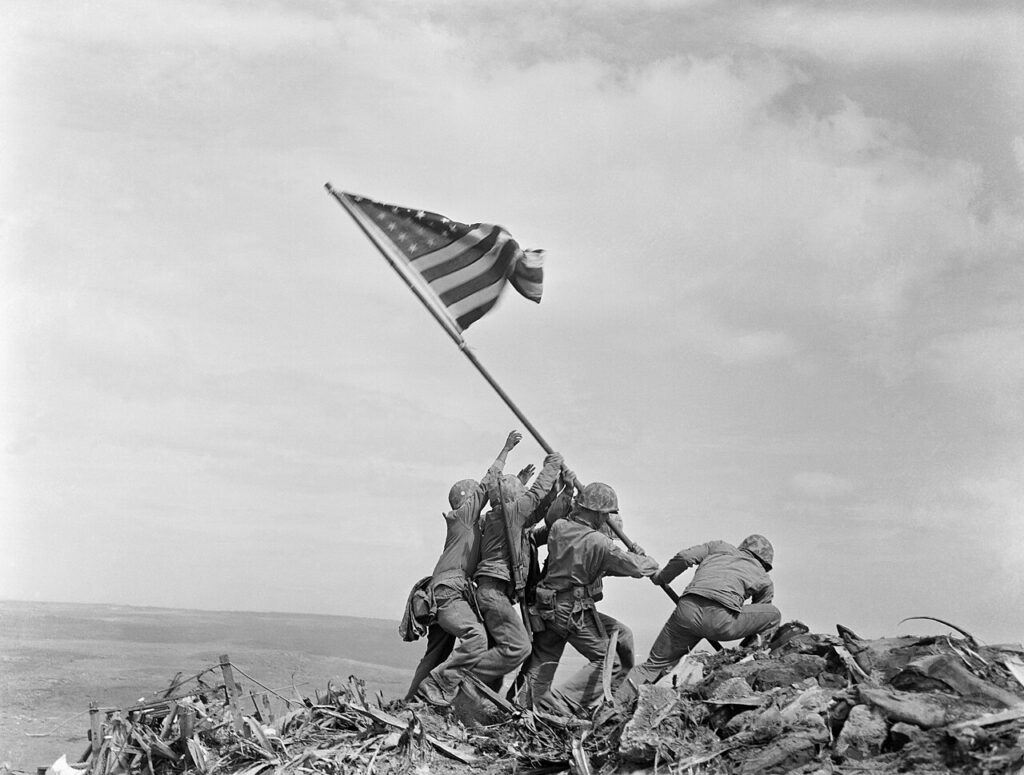
On February 23, 1945, Associated Press photographer Joe Rosenthal captured what would become the most reproduced photograph in history. The raising flag iwo jima photo wasn't just another war image—it was an accidental masterpiece that crystallized American resolve during World War II's final months. Shot atop Mount Suribachi with a Speed Graphic camera, this single frame transcended its moment to become the defining visual symbol of sacrifice, teamwork, and determination. But here's what most people don't know: Rosenthal didn't even look through his viewfinder when he pressed the shutter. The image that would win a Pulitzer Prize within months, raise $26 billion in war bonds, and inspire the Marine Corps War Memorial was captured in a split-second of instinct and luck. This wasn't the first flag raised that morning. And it would take 71 years to correctly identify all six men pushing that pole skyward.
The Battle Context: Why Iwo Jima Mattered
Iwo Jima wasn't just another Pacific island. Located 660 miles from Tokyo, this volcanic speck of land held strategic value that would cost thousands of American lives.1 The Americans needed it as an emergency landing strip for B-29 bombers striking the Japanese mainland. The Japanese knew this and fortified the island with 21,000 troops dug into an elaborate tunnel system carved from volcanic rock.
The invasion began on February 19, 1945. Marines expected to capture the island in five days. It took 36 days of some of the Pacific War's most brutal fighting.2 American casualties reached staggering numbers: 6,821 killed and 19,217 wounded. Nearly one-third of all Marines killed in World War II died on this eight-square-mile island. The Japanese fought with suicidal determination—only 216 of the 21,000 defenders survived.
Mount Suribachi dominated the southern tip of the island. This 556-foot volcanic cone gave Japanese artillery spotters a commanding view of the invasion beaches. Every Marine landing craft came under observation from its summit. Capturing Suribachi became the immediate objective—both for tactical advantage and psychological impact. Four days of savage fighting brought Marines to its base. Then came the climb.
The First Flag-Raising: The Story Nobody Remembers
Here's where the story gets complicated. The famous raising flag iwo jima photo wasn't the first flag raised on Mount Suribachi that morning. At approximately 10:20 AM on February 23, 1945, a patrol from Easy Company, 2nd Battalion, 28th Marines reached the summit.3 They carried a small American flag measuring 54 by 28 inches—taken from a landing craft.
Lieutenant Colonel Chandler Johnson, the battalion commander, watched from below as this first flag went up. Marines across the island erupted in cheers. Ships offshore sounded their horns. It was a genuine moment of triumph. Staff Sergeant Louis Lowery, a photographer from Leatherneck magazine, captured this first raising on film.
But Johnson had a problem. Secretary of the Navy James Forrestal, observing the battle from offshore, wanted that flag as a souvenir. Johnson wasn't about to let some politician claim the first flag raised on Suribachi. He ordered a runner to find a larger replacement flag and bring it to the summit. The first flag would come down. A second would go up. That flag came from USS Missoula—a massive 96 by 56 inches of bunting that could be seen across the island.4
The Photographer Who Almost Missed History
Joe Rosenthal nearly wasn't there. The 33-year-old AP photographer had been rejected for military service because of poor eyesight—his vision was so bad he wore thick glasses that became a running joke among Marines.5 He'd covered the Pacific War as a civilian photographer, island-hopping with invasion forces. On February 23, he decided to climb Suribachi with two Marine photographers: Private Bob Campbell and Sergeant Bill Genaust.
The climb was treacherous. Japanese snipers still operated in caves along the mountain's slopes. The volcanic ash gave way underfoot. Rosenthal, carrying his bulky Speed Graphic camera and film holders, struggled up the steep incline. When he reached the summit around 10:30 AM, he'd already missed the first flag-raising. Lowery was heading down as Rosenthal climbed up. "You're too late," Lowery told him. "They've already put up a flag."
But Rosenthal was about to get incredibly lucky.
The Accidental Masterpiece: Technical Analysis of an Iconic Shot
Rosenthal used a Speed Graphic camera—the workhorse of press photography in the 1940s. This large-format camera shot 4x5 inch negatives, providing exceptional detail but requiring precise focus and exposure.6 He likely used a shutter speed of 1/400 second—fast enough to freeze motion in bright sunlight. The film was standard black-and-white press film, probably Kodak Super XX.
When Rosenthal saw Marines gathering with the replacement flag, he positioned himself about 35 feet away. The ground sloped, so he stacked some stones and a sandbag to gain height. He wanted to shoot against the sky for dramatic contrast—a basic compositional choice that would prove brilliant. As the Marines began lifting the heavy pole, Rosenthal swung his camera toward them. He didn't have time to look through the viewfinder. He simply pointed, estimated the framing, and pressed the shutter.7
One frame. One chance. He got it.
Why This Composition Works: The Visual Elements
The raising flag iwo jima photo succeeds because of several compositional elements working in perfect harmony. The diagonal line of the flagpole creates dynamic movement—your eye follows it from lower right to upper left. This diagonal suggests effort, struggle, upward momentum. A vertical pole would've been static. This angle conveys action.
The six figures form a sculptural group, their bodies arranged in a rhythm of straining muscles and planted feet. You can't clearly see their faces—they're anonymous, representative of all Marines rather than individuals. This anonymity became crucial to the image's symbolic power. These aren't heroes seeking glory. They're men doing a job, working together.
The sky provides clean negative space, emphasizing the flag and figures. No distracting background elements. The harsh sunlight creates strong contrast between light and shadow, giving the image sculptural depth. The flag itself, caught mid-unfurl, adds a sense of moment—this is happening now, not a static pose.
Marine Sergeant Bill Genaust stood next to Rosenthal, filming in color with a 16mm motion picture camera. His footage proves this was a genuine moment of action, not a posed shot.8 Genaust would be killed in action nine days later, trapped in a cave by Japanese soldiers.
The Six Flag-Raisers: Men Behind the Icon
Identifying the six men in Rosenthal's photograph became a decades-long saga involving misidentification, controversy, and finally, in 2016, a resolution 71 years after the shutter clicked. The six flag-raisers were:
- Corporal Ira Hayes – A Pima Native American from Arizona, Hayes survived the battle but struggled with alcoholism and the burden of being called a hero. He died in 1955 at age 32.
- Private First Class Franklin Sousley – From Kentucky, the youngest of the group at 19. Killed in action on March 21, 1945, less than a month after the flag-raising.
- Sergeant Michael Strank – The squad leader, born in Czechoslovakia. Killed by friendly artillery fire on March 1, 1945, just six days after the photograph.
- Corporal Harlon Block – From Texas, initially misidentified in the photo. Killed on March 1, 1945, the same day as Strank.
- Private First Class Rene Gagnon – The runner who brought the replacement flag up the mountain. He survived the war but struggled with fame and died in 1979.
- Pharmacist's Mate Second Class Harold Schultz – A Navy corpsman, his presence in the photo wasn't confirmed until 2016, correcting a 71-year misidentification of Navy Corpsman John Bradley.
Three of the six men died within days of the photograph. They never knew they were in history's most famous war photo. The three survivors—Hayes, Gagnon, and initially Bradley (later corrected to Schultz)—were pulled from combat and sent on a war bond tour across America.
The Misidentification Saga
For 71 years, the Marine Corps believed Navy Corpsman John Bradley was one of the six flag-raisers. Bradley himself never disputed it publicly, though he rarely spoke about Iwo Jima. His son James Bradley wrote Flags of Our Fathers (2000), which became a bestseller and was adapted into a 2006 film directed by Clint Eastwood.
In 2016, two amateur historians analyzing Genaust's color film footage and other photographs from that day noticed discrepancies. The Marine Corps launched an official investigation. Using digital analysis and comparing uniform details, they concluded that Harold Schultz—not John Bradley—was the sixth man in Rosenthal's photograph. Schultz had died in 1995, never claiming his place in the iconic image.9
Bradley had been in the first flag-raising. He'd been on the summit. But he wasn't in the photograph. The confusion was understandable—and Bradley apparently chose not to correct the record.
From Battlefield to Front Page: The Photo's Lightning Distribution
After shooting the flag-raising, Rosenthal climbed down Mount Suribachi and sent his film back to Guam for processing. He had no idea what he'd captured. The film went to AP's mobile darkroom on Guam, where technicians developed the negatives and made prints. When photo editor John Bodkin saw the image, he immediately recognized its power. "Here's one for all time," he said.10
The photograph reached American newspapers via radio transmission in just 17.5 hours—remarkably fast for 1945 technology. The image was transmitted as a series of electrical signals that reconstructed the photograph at receiving stations. By February 25, the raising flag iwo jima photo appeared on front pages across America. The response was immediate and overwhelming.
Americans were exhausted by war. The fighting in Europe was winding down, but the Pacific campaign seemed endless. Casualties mounted with each island invasion. Iwo Jima's cost in American lives shocked the nation. Then this photograph appeared—six men working together to raise the flag on conquered ground. It gave the war a face that wasn't death and destruction. It showed determination, teamwork, victory.
President Franklin D. Roosevelt saw the photograph and immediately ordered the three survivors pulled from combat for a war bond tour. The Treasury Department needed to raise money for the war's final push. Rosenthal's image became the centerpiece of the 7th War Loan Drive. Printed on posters with the caption "Now All Together," it helped raise an astonishing $26 billion—nearly $400 billion in today's dollars.11
The Staging Controversy: Addressing the Accusations
Almost immediately, questions arose: Was the photograph staged? The controversy has persisted for eight decades, fueled by misunderstanding and Rosenthal's own inadvertent contribution to the confusion.
Here's what happened. After shooting the flag-raising, Rosenthal took another photograph—a posed shot of Marines gathered around the raised flag, smiling and waving. When a reporter later asked if he'd posed the flag-raising photo, Rosenthal thought the question referred to this second, staged image. He said yes. The reporter assumed Rosenthal meant the famous flag-raising shot. The misunderstanding spread.
The truth is straightforward: Rosenthal's famous raising flag iwo jima photo was not staged. It captured a genuine moment—the raising of a replacement flag. Yes, this was the second flag raised that morning. Yes, it was a larger flag brought specifically for better visibility. But the act of raising it was real, unposed, and captured in a split-second of action.12
Bill Genaust's color motion picture footage proves this conclusively. The footage shows the same moment from a slightly different angle—Marines straining to lift the heavy pole, the flag beginning to unfurl, the spontaneous nature of the action. If this were a carefully staged photograph, Rosenthal would've looked through his viewfinder, adjusted positions, ensured perfect framing. Instead, he pointed his camera and hoped for the best.
Rosenthal spent the rest of his life—he died in 2006 at age 94—defending the photograph's authenticity. He never claimed to have planned the composition or directed the Marines. He was simply in the right place at the right moment, with the skill and instinct to capture it.
The Pulitzer Prize and Unprecedented Recognition
In May 1945, just three months after pressing the shutter, Joe Rosenthal received the Pulitzer Prize for Photography. This remains the only photograph to win the Pulitzer in the same year it was taken—typically, the award recognizes work from the previous year.13 The Pulitzer committee couldn't wait. The image's impact demanded immediate recognition.
Rosenthal continued working as a photographer for decades, eventually joining the San Francisco Chronicle where he worked until retirement. But nothing he shot before or after matched the cultural impact of that single frame from Iwo Jima. It became both his greatest achievement and, in some ways, a burden. Every subsequent photograph existed in the shadow of February 23, 1945.
The photograph's copyright status is notable: as a work created by a civilian photographer covering military operations during wartime, it entered the public domain. This allowed unrestricted reproduction, contributing to its proliferation across American culture. No licensing fees. No restrictions. The image belonged to everyone.
Cultural Proliferation: From Stamps to Memorials
The raising flag iwo jima photo became the most reproduced photograph in history. It appeared on postage stamps, war bonds, recruiting posters, magazine covers, and countless other applications. In 1954, it inspired the Marine Corps War Memorial in Arlington, Virginia—a massive bronze sculpture designed by Felix de Weldon.14
De Weldon, an Austrian-born sculptor, began working on the memorial while the battle was still raging. He created a scale model, then worked with the three survivors—Hayes, Gagnon, and Bradley—as models. The finished memorial stands 78 feet tall, with figures over 32 feet high. It remains one of the most visited memorials in Washington, D.C.
The image has been parodied, referenced, and reinterpreted countless times. It appears in editorial cartoons, advertisements, protest imagery, and popular culture. This proliferation speaks to the photograph's deep embedding in American visual consciousness—it's an image everyone recognizes, even if they don't know the details behind it.
The Burden of Heroism: The Survivors' Struggles
The three survivors pulled from Iwo Jima for the war bond tour found themselves thrust into a role they never sought. They were called heroes, paraded before crowds, asked to reenact the flag-raising for publicity photographs. But they didn't feel like heroes. They'd simply raised a flag while their friends continued fighting and dying.
Ira Hayes struggled most visibly. The Pima Native American from Arizona's Gila River Reservation found himself celebrated as an American hero while Native Americans faced discrimination and poverty. He turned to alcohol. He was arrested multiple times for public intoxication. He tried to escape the spotlight, returning to the reservation, but the fame followed him. On January 24, 1955, Hayes was found dead in a field near his home. He was 32 years old. The official cause was exposure and alcohol poisoning.15
Rene Gagnon also struggled with civilian life. He worked various jobs, never finding the success Americans expected from a famous hero. He died in 1979 at age 54. Harold Schultz, whose presence in the photograph wasn't confirmed until after his death in 1995, never spoke publicly about being in the image—perhaps he understood the burden it carried.
The photograph captured a moment of triumph. But for the men in it, that moment was surrounded by death, fear, and the grinding brutality of combat. Three of them died within days. The three who survived carried psychological wounds that never fully healed. This tension—between the image's inspirational message and the reality of war's cost—adds complexity to how we understand this photograph today.16
Why This Image Endures: Psychological and Symbolic Power
Thousands of photographs were taken during World War II. Many showed more dramatic action, clearer views of combat, more obvious heroism. So why did this particular image become the defining photograph of American military effort?
The answer lies in what the image represents rather than what it literally shows. The raising flag iwo jima photo doesn't depict violence or death. It shows cooperation, effort, progress. Six men working together toward a common goal. The flag itself—the ultimate American symbol—rising against a clear sky. It's aspirational rather than documentary. It tells Americans what they wanted to believe about the war effort: that sacrifice leads to victory, that teamwork overcomes obstacles, that the cause is just and will prevail.
The composition's classical quality contributes to its power. The diagonal line, the sculptural arrangement of figures, the dramatic contrast—these elements give the photograph a timeless, almost mythological quality. It doesn't look like a snapshot. It looks like a monument. This formal perfection, achieved accidentally in a fraction of a second, elevates the image beyond mere documentation into the realm of art.17
The anonymity of the figures matters too. You can't see their faces clearly. They could be anyone—any Marine, any American, anyone's son or brother. This universality allows viewers to project themselves or their loved ones into the image. It's not about these six specific men (though their individual stories matter). It's about what they represent collectively.
Comparison with Other Iconic War Photographs
Other World War II photographs achieved iconic status: Robert Capa's D-Day landing images, Alfred Eisenstaedt's V-J Day kiss in Times Square, Yevgeny Khaldei's Soviet flag over the Reichstag. But Rosenthal's image surpassed them all in cultural penetration and symbolic power.
Capa's D-Day photographs are blurred, chaotic, immediate—they convey the terror and confusion of combat. Eisenstaedt's kiss captures spontaneous joy and relief. Khaldei's Reichstag flag (which was actually staged and manipulated in the darkroom) shows conquest and Soviet triumph. Rosenthal's photograph is different. It shows neither the chaos of battle nor the celebration of victory. It captures the moment between—the hard work of achieving victory, the collective effort required, the determination to plant a symbol of values worth fighting for.
This middle ground—aspirational but not triumphalist, dramatic but not chaotic—gave the image broader appeal and longer-lasting relevance. It could represent not just Iwo Jima or World War II, but any collective effort toward a worthy goal. This flexibility of meaning contributed to its endless reproduction and reinterpretation.
Legacy and Modern Reexamination
The 2016 identification of Harold Schultz demonstrates how even history's most famous photograph can hold undiscovered truths. Digital analysis, frame-by-frame examination of Genaust's film, comparison of uniform details—these modern forensic techniques revealed what 71 years of study had missed. It's a reminder that photographs, despite their seeming transparency, require careful interpretation.
James Bradley's book Flags of Our Fathers (2000) and Clint Eastwood's 2006 film adaptation brought renewed attention to the photograph and the men in it. The film particularly focused on the survivors' war bond tour and their struggles with unwanted fame. It presented a more complex, less triumphalist view of the image—acknowledging its power while examining its costs.
Today, the raising flag iwo jima photo exists in a different cultural context than 1945. We view World War II through the lens of subsequent conflicts—Korea, Vietnam, Iraq, Afghanistan. Questions about military intervention, the costs of war, and the gap between patriotic imagery and battlefield reality have become more prominent. Yet the photograph endures, its composition and symbolic power transcending changing attitudes toward war itself.18
The original negative, preserved by the Associated Press, has been digitally scanned and restored multiple times. Each technological advance reveals new details—texture in the uniforms, expressions on partially visible faces, the grain structure of 1940s film. These restorations ensure the image's preservation for future generations while raising questions about authenticity and alteration that would've been unimaginable in 1945.19
Conclusion: An Accidental Monument to Collective Effort
Joe Rosenthal's raising flag iwo jima photo succeeded because of perfect timing, instinctive composition, and symbolic resonance that transcended its specific moment. He didn't plan the shot. He didn't direct the subjects. He simply recognized a significant moment and captured it with technical skill and artistic intuition. That combination—documentary truth and aesthetic power—created an image that has endured for eight decades.
The photograph tells multiple stories simultaneously. It's a document of a specific event on February 23, 1945. It's a symbol of American determination and sacrifice during World War II. It's a classical composition that happens to be a photograph rather than a painting or sculpture. It's a reminder of the costs of war—three of the six men died within days, three survivors struggled with unwanted fame. It's proof that the most powerful images often happen accidentally, when preparation meets opportunity in a fraction of a second.
For photographers, the image offers crucial lessons: technical mastery matters, but so does instinct. Composition can elevate documentation into art. The most powerful photographs often show collective effort rather than individual heroism. And sometimes, despite careful planning and professional skill, the greatest images happen when you don't even look through the viewfinder—you just point, press, and hope.
The raising flag iwo jima photo remains the most reproduced photograph in history not because it shows war's reality, but because it shows war's meaning—or at least, the meaning Americans wanted to find in their sacrifice. That gap between image and reality, between symbol and truth, makes the photograph endlessly fascinating and perpetually relevant. It's not just a picture of six men raising a flag. It's a mirror in which each generation sees its own values, questions, and understanding of what heroism means.
Frequently Asked Questions
Was the raising flag Iwo Jima photo staged?
No, the famous photograph was not staged. It captured the genuine moment of raising a replacement flag on Mount Suribachi. This was the second flag raised that morning—the first was smaller and was replaced with a larger 96x56 inch flag from USS Missoula. While the replacement itself was planned (Colonel Johnson wanted a larger flag), the act of raising it was spontaneous and unposed. Bill Genaust's color motion picture footage, taken simultaneously, confirms the authenticity of the moment.20
Who were the six men in the Iwo Jima flag-raising photo?
The six flag-raisers were Corporal Ira Hayes, Private First Class Franklin Sousley, Sergeant Michael Strank, Corporal Harlon Block, Private First Class Rene Gagnon, and Pharmacist's Mate Second Class Harold Schultz. Three were killed in action within days: Sousley (March 21), Block (March 1), and Strank (March 1). The identification of Schultz wasn't confirmed until 2016, correcting a 71-year misidentification of Navy Corpsman John Bradley, who was actually in the first flag-raising but not Rosenthal's famous photograph.21
What camera did Joe Rosenthal use to take the Iwo Jima photo?
Rosenthal used a Speed Graphic camera, the standard press camera of the 1940s. This large-format camera shot 4x5 inch negatives and likely used a shutter speed of 1/400 second to freeze the motion of the flag-raising. The film was standard black-and-white press film, probably Kodak Super XX. Remarkably, Rosenthal didn't look through the viewfinder when taking the shot—he simply pointed the camera and estimated the framing, capturing the image through instinct and experience rather than careful composition.22
How quickly did the Iwo Jima photograph reach American newspapers?
The photograph reached American newspapers in just 17.5 hours—remarkably fast for 1945 technology. After Rosenthal shot the image around 10:30 AM on February 23, the film was sent to Guam for processing. Once developed, it was transmitted via radio signal to receiving stations in the United States. By February 25, the image appeared on front pages across America, generating immediate and overwhelming response. This rapid distribution contributed significantly to the photograph's impact on American morale during the war's final months.23
How much money did the Iwo Jima photo help raise in war bonds?
Rosenthal's photograph became the centerpiece of the 7th War Loan Drive and helped raise approximately $26 billion in war bonds—nearly $400 billion in today's dollars. The three survivors (initially identified as Hayes, Gagnon, and Bradley) were pulled from combat and sent on a nationwide tour, reenacting the flag-raising and promoting bond sales. The image appeared on posters with the caption "Now All Together," creating one of the most successful fundraising campaigns in American history. This economic impact demonstrates how a single photograph can directly influence national policy and public action.24
What happened to the actual flag raised on Iwo Jima?
The flag in Rosenthal's famous photograph—the 96x56 inch replacement flag from USS Missoula—was taken down shortly after being raised and eventually returned to the United States. The first, smaller flag (54x28 inches) was claimed by Colonel Chandler Johnson, who had ordered the replacement specifically to prevent it from becoming a souvenir for Secretary of the Navy James Forrestal. Both flags have been preserved, though their exact current locations and display status have varied over the decades. The flags remain powerful artifacts of one of World War II's most significant battles.25
- The National Archives documents the strategic importance of Iwo Jima as a critical airfield location for B-29 bomber operations.
- According to historical records, the Battle of Iwo Jima lasted from February 19 to March 26, 1945.
- The Smithsonian Magazine details the timeline of both flag-raisings on Mount Suribachi.
- Details about the replacement flag's dimensions and origin are documented in multiple historical sources.
- The International Photography Hall of Fame documents Rosenthal's background and his rejection from military service.
- Technical specifications of the Speed Graphic camera and Rosenthal's likely settings are analyzed in photography historical accounts.
- Rosenthal's own accounts of taking the photograph, including his admission about not using the viewfinder, are preserved in multiple interviews.
- Bill Genaust's color motion picture footage, taken simultaneously with Rosenthal's photograph, provides crucial evidence about the authenticity of the moment and can be referenced through the Metropolitan Museum of Art's historical documentation.
- This significant historical correction demonstrates how documentary photography continues to be reexamined and reinterpreted with new analytical methods.
- The rapid transmission process and John Bodkin's reaction are documented in historical accounts from the Associated Press.
- The economic impact of the photograph and its role in the 7th War Loan Drive is extensively documented, showing how visual imagery can directly influence national policy and public action, similar to how photography shapes modern marketing strategies.
- The staging controversy and Rosenthal's clarifications are thoroughly documented, and understanding the context of photographic authenticity remains relevant to contemporary discussions about post-documentary photography and truth in images.
- The unprecedented timing of Rosenthal's Pulitzer Prize win is noted in photographic history as an exceptional recognition of the image's immediate cultural impact.
- Felix de Weldon's work on the Marine Corps War Memorial, based directly on Rosenthal's photograph, represents one of the most significant translations of photographic imagery into monumental sculpture in American history.
- Ira Hayes's tragic post-war life and death highlight the complex psychological burden carried by those thrust into unwanted fame, a theme explored in James Bradley's book and Clint Eastwood's 2006 film adaptation.
- Understanding the psychological impact of war photography on both subjects and viewers connects to broader questions about the ethics and aesthetics of photography in representing human experience.
- The aesthetic qualities that make certain images transcend their documentary function relate to fundamental principles of photographic aesthetics and visual composition.
- The evolving interpretation of historical photographs across different cultural contexts demonstrates the fluid nature of photographic meaning, a concept central to understanding image critique and semiotics.
- Digital restoration and preservation of historical photographs intersects with contemporary debates about AI photography and image manipulation.
- The staging controversy has been thoroughly debunked through multiple sources of evidence, including Genaust's film footage and testimonies from Marines present on Mount Suribachi.
- The 2016 correction represents one of the most significant historical revisions in photographic documentation, resolved through careful analysis of multiple photographic sources.
- The technical specifications of Rosenthal's equipment and shooting method demonstrate how professional expertise can produce masterful results even without deliberate framing.
- The speed of transmission and distribution in 1945 represents impressive logistical coordination, especially given the technological limitations of wartime communications.
- The staggering financial impact of the photograph illustrates the power of visual imagery to motivate collective action and support for national causes.
- The physical flags serve as tangible connections to the photographic image, bridging the gap between symbolic representation and material reality.