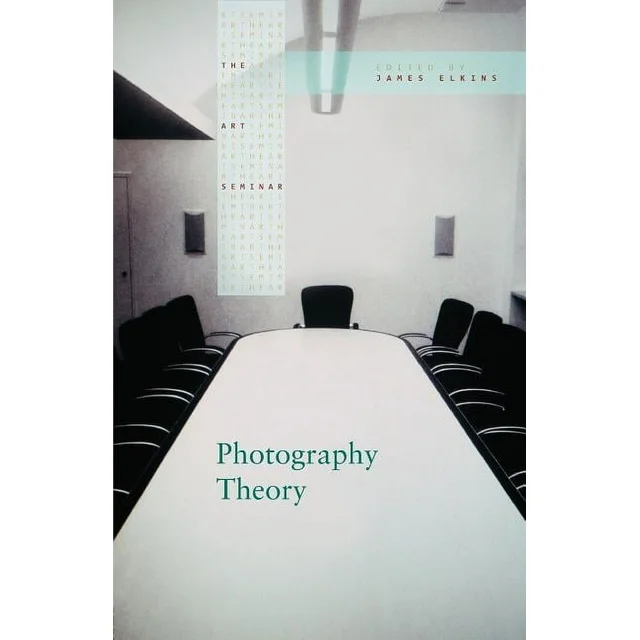
What is a photograph? While many have tried to answer this question, James Elkins took a different approach: he orchestrated the argument. His 2007 edited volume, Photography Theory, is less a definitive thesis and more a deliberate provocation—a stage for the field's most prominent voices to clash. Its importance lies not in providing answers, but in its unique role as a catalyst that exposed the fractures and entrenched positions within photography studies.
For students and scholars trying to navigate the dense forest of photographic theory, Elkins' work is an essential, if controversial, map. It shows you where the battles are fought.
The Architect of the Arena
Elkins' primary contribution was institutional and curatorial. As convener and editor of the Art Seminar series, he brought together over forty leading art historians and theorists—including figures like Rosalind Krauss, Victor Burgin, and Geoffrey Batchen—for a live debate. The core of the book is the transcribed seminar, a format that captures the raw, unfiltered, and often unresolved nature of theoretical discourse.
The aim was to explore optimal ways of theorizing photography. However, critics argue the discussion often reproduced entrenched positions rather than breaking new ground, heavily favoring the established ideas of Roland Barthes and Walter Benjamin while giving minimal attention to other significant thinkers. The seminar's limitation was its narrow scope, dominated by academic theorists with notably limited participation from photography practitioners.
Core Theoretical Interventions: A Critical Look
Elkins did not just facilitate; he actively intervened in key debates. His positions, however, have been met with significant criticism from academic reviewers.
- Against Barthes' Camera Lucida: Elkins' later book, What Photography Is, positions itself as a direct counter-narrative to Roland Barthes' beloved Camera Lucida. He argues Barthes' focus on memory, love, and loss creates a sentimental, "overwatered" humanism that ignores photography's "non-humanist, emotionless side". Elkins champions instead a photography of meaningless detail and "depopulated" views—the boring, incidental "surround" that the camera mechanically records.
- The Criticism: Scholars have heavily critiqued this reading. One analysis argues Elkins fails to engage with the philosophical complexity and ontological dimensions of Barthes's work, relying instead on simplistic binary oppositions1. His characterization of Barthes's central concept, the punctum, as a "deliberate eccentricity" has been dismissed as an oversimplification that underestimates the concept's depth.
- The Indexicality Debate: The seminar in Photography Theory grappled intensely with indexicality—the idea that a photograph is a physical trace of its subject. Elkins was surprised by how central yet unresolved this concept remained, noting the paradoxical coexistence of photography as both an objective "trace" and a subjective "projection of our desires".
- The Criticism: The debate was criticized for becoming overly abstract. Reviewers noted a failure to engage with the affective materiality of photographs themselves, treating photography as an abstract form rather than a tangible medium.
- Advocating for "Wayward" Writing: Frustrated with conventional academic prose, Elkins advocates for new, experimental forms of writing about images. He mimics Camera Lucida's fragmented structure in What Photography Is, aiming to create a text that is itself provocative and "badly behaved".
- The Criticism: While innovative, this methodological approach has been viewed as limited in scope and, at times, contradictory to its own assessments.
Scholarly Impact and Enduring Criticisms
The academic response to Elkins' project reveals a clear consensus on its value and its flaws.
| Aspect of Elkins' Work | Claim of Importance | Substantive Criticisms from Scholars |
|---|---|---|
| Institutional Role | Credited for shaping debates by convening major seminars and prompting critical scholarly engagement. | The seminar format was criticized for reproducing entrenched theoretical positions rather than exploring new territory. |
| Theoretical Contribution | Acknowledged for providing sophisticated analysis of photography's relationship with writing, technology, and knowledge. | Consistently criticized for oversimplification (especially of Barthes), failure to engage with philosophical complexity, and neglecting photography's affective power. |
| Scope & Methodology | Valued for attempting to expand theoretical scope to alternative practices. | Criticized for a narrow focus on well-established thinkers, neglecting the historicity of theory, and a major gap: the absence of practitioners' voices. |
Conclusion: The Essential Provocation
So, what is the importance of Photography Theory by James Elkins? The evidence suggests a split verdict.
For those seeking a pioneering, standalone theory of the photograph, Elkins' work may disappoint. Scholars have positioned it as facilitating discussion rather than synthesizing or bridging different perspectives. His substantive arguments are frequently challenged for their philosophical simplicity.
However, as a provocative institutional force, the book is invaluable. It captures a field in a moment of self-interrogation, especially as digital technology began unsettling analog-era certainties. For anyone studying the history of photography theory, it is a crucial primary source—a snapshot of the debates that defined the late 20th and early 21st centuries. It is important not for the conclusions it reaches, but for the passionate, flawed, and revealing conversation it stages. In the end, Elkins successfully proved that the question "What is a photograph?" is more productive than any single answer could ever be.