Picture this: You're scrolling through Instagram, and you stop dead in your tracks. That jaw-dropping shot of the Northern Lights? Shot on an iPhone 16 Pro. The tack-sharp portrait with creamy bokeh? Also an iPhone. Suddenly, that $3,000 mirrorless camera setup you've been eyeing feels less like a necessity and more like an extravagance. But before you cancel that cart, let's pump the brakes and dive into the 2025 reality of smartphone versus dedicated camera photography—because the truth is far more nuanced than the marketing hype suggests.
The Computational Photography Revolution: What Changed in 2025
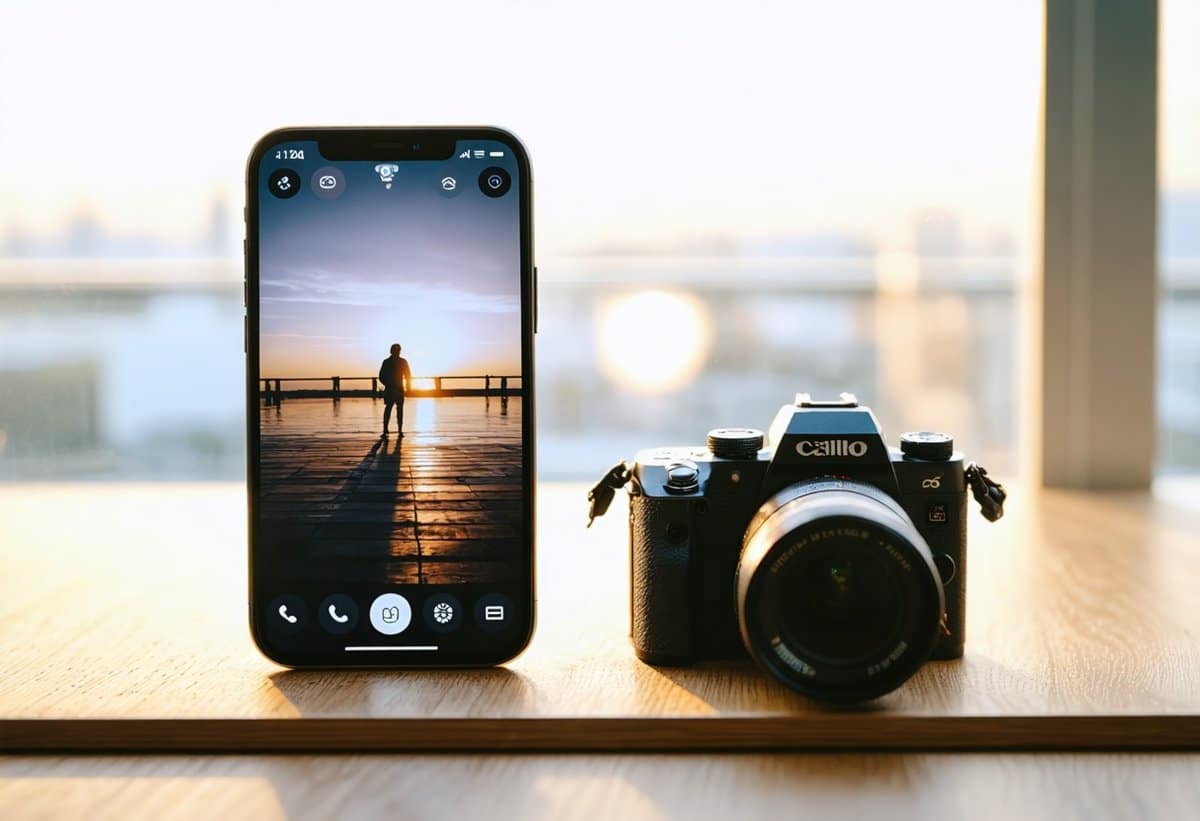
The iPhone 16 Pro represents a quantum leap in mobile imaging technology, but it's not alone. Computational photography—the marriage of advanced algorithms, artificial intelligence, and traditional optics—has fundamentally transformed what's possible with a device that fits in your pocket. Apple's latest flagship boasts a 48MP main sensor with ProRAW capabilities, a sophisticated night mode that rivals dedicated cameras, and AI-powered image stacking that happens in milliseconds.1
But here's what the commercials don't tell you: computational photography is both a blessing and a creative constraint. While it democratizes professional-looking results for casual users, it also imposes an aesthetic interpretation on your images. The iPhone doesn't just capture what you see—it captures what Apple's engineers think you want to see. For many photographers, that's a dealbreaker.
According to the Sony Alpha Universe, professional photographers increasingly use smartphones for scouting and social media content, but rely on mirrorless systems for client deliverables. The distinction matters more than ever in 2025.
Image Quality Deep Dive: Sensor Size Still Matters
Let's address the elephant in the room: megapixels are not the whole story. The iPhone 16 Pro's 48MP sensor sounds impressive until you realize it measures just 1/1.28 inches diagonally. Compare that to a full-frame mirrorless camera sensor at 36x24mm, and you're looking at a surface area difference of roughly 30 times. That's not a typo—thirty times more light-gathering capability.
Dynamic Range and Low-Light Performance
In optimal lighting conditions—bright daylight, evenly lit scenes—the iPhone 16 Pro produces images that can genuinely compete with entry-level mirrorless cameras. The computational HDR processing is nothing short of wizardry, pulling detail from shadows and highlights that would be blown out on older technology. But push the limits, and physics reasserts itself.2
Take night photography on your vacation, for instance. While the iPhone's night mode can produce surprisingly clean images of cityscapes and monuments, try capturing the Milky Way or star trails, and you'll quickly hit the limitations. The small sensor simply can't gather enough photons during long exposures without introducing excessive noise, no matter how sophisticated the processing algorithms become.
Professional bodies like the Royal Photographic Society have published extensive comparisons showing that while smartphone computational photography excels at scene optimization, it struggles with extreme conditions where raw sensor performance becomes paramount.
The Lens Equation: Optical Physics Versus Digital Zoom
The iPhone 16 Pro features a triple-camera system with equivalent focal lengths of 13mm, 24mm, and 77mm. It's a versatile range that covers most shooting scenarios. But here's the catch: these are fixed lenses. When you "zoom" beyond these focal lengths, you're either cropping into the 48MP sensor (digital zoom) or relying on AI upscaling. Neither approach matches the optical quality of a true telephoto lens on a mirrorless camera.
Depth of Field and Creative Control
Perhaps the most significant optical limitation of smartphone cameras is their inability to achieve shallow depth of field naturally. The small sensor and wide aperture (relatively speaking—f/1.78 on the main lens) mean that everything from about three feet to infinity tends to be in focus. Apple's Portrait Mode simulates bokeh using depth mapping and computational blur, and it's improved dramatically. But it's still simulation.
A mirrorless camera with an 85mm f/1.4 lens creates optical bokeh through physics—light rays converging through glass elements. The quality, character, and three-dimensional rendering are fundamentally different. For portrait photography that tells human stories, this distinction becomes crucial. The iPhone's computational approach occasionally struggles with complex subjects: hair strands, glasses, intricate jewelry, or subjects at oblique angles often reveal telltale edge artifacts.
Workflow and Professional Requirements
For professional photographers and serious enthusiasts, the camera is just the beginning. Workflow considerations often tip the scales toward dedicated camera systems. ProRAW on the iPhone 16 Pro is a genuine RAW format, offering significantly more editing latitude than standard HEIC or JPEG files. You can push shadows, recover highlights, and adjust white balance with impressive flexibility.
However, mirrorless cameras shooting in RAW (whether 14-bit or 16-bit) capture exponentially more color information and tonal gradations. When you're delivering images for print publication, large-format displays, or clients with exacting standards, that extra data becomes essential. The Canon EOS R5, for example, captures 45-megapixel RAW files with a full-frame sensor—the editing possibilities are in a different league entirely.
File Management and Backup
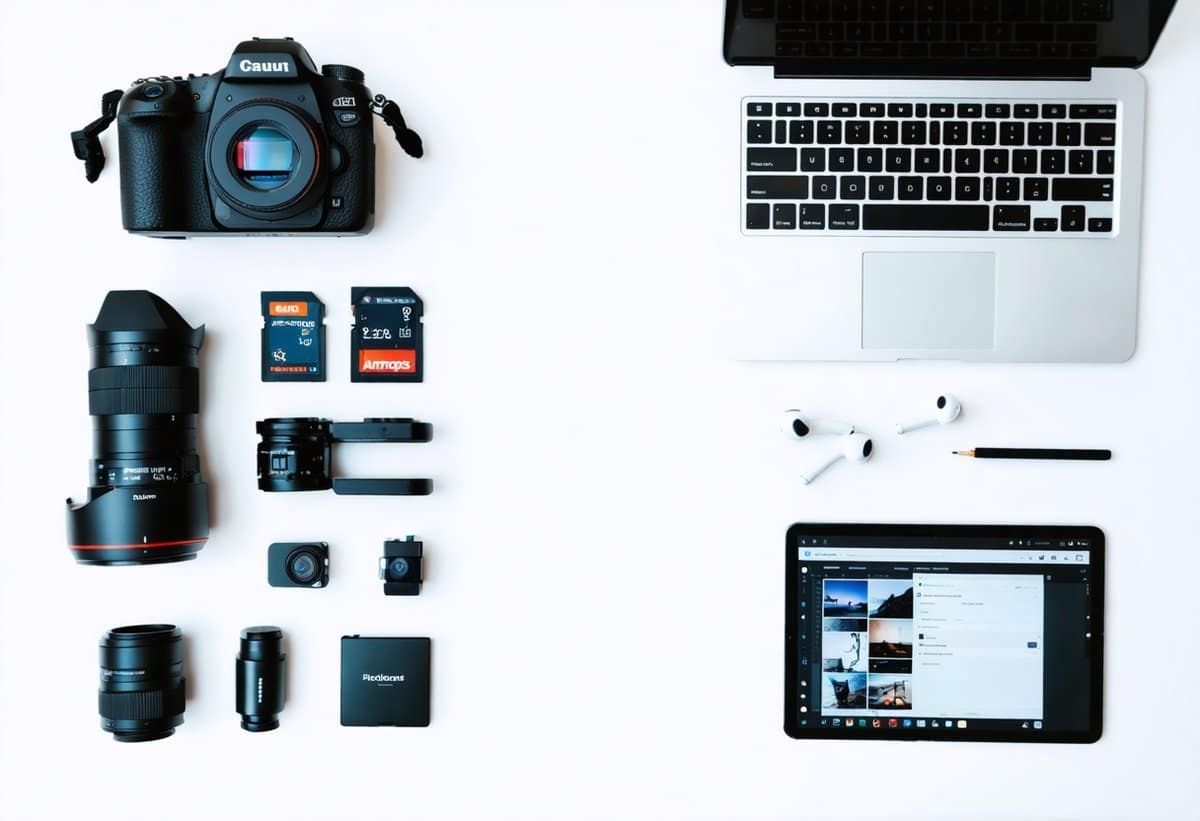
Professional mirrorless cameras offer dual card slots for redundant backup—shoot a wedding, and you're simultaneously writing to two memory cards. If one fails, you haven't just lost images; you've potentially lost your reputation. The iPhone 16 Pro, despite its sophistication, stores everything on internal memory with cloud backup as the safety net. For casual users, that's fine. For professionals? It's a non-starter.3
When the iPhone 16 Pro Actually Wins
Let's be clear: there are absolutely scenarios where the iPhone 16 Pro is not just adequate but actually superior to a mirrorless camera. Understanding these situations is key to making informed gear decisions.
Street and Documentary Photography
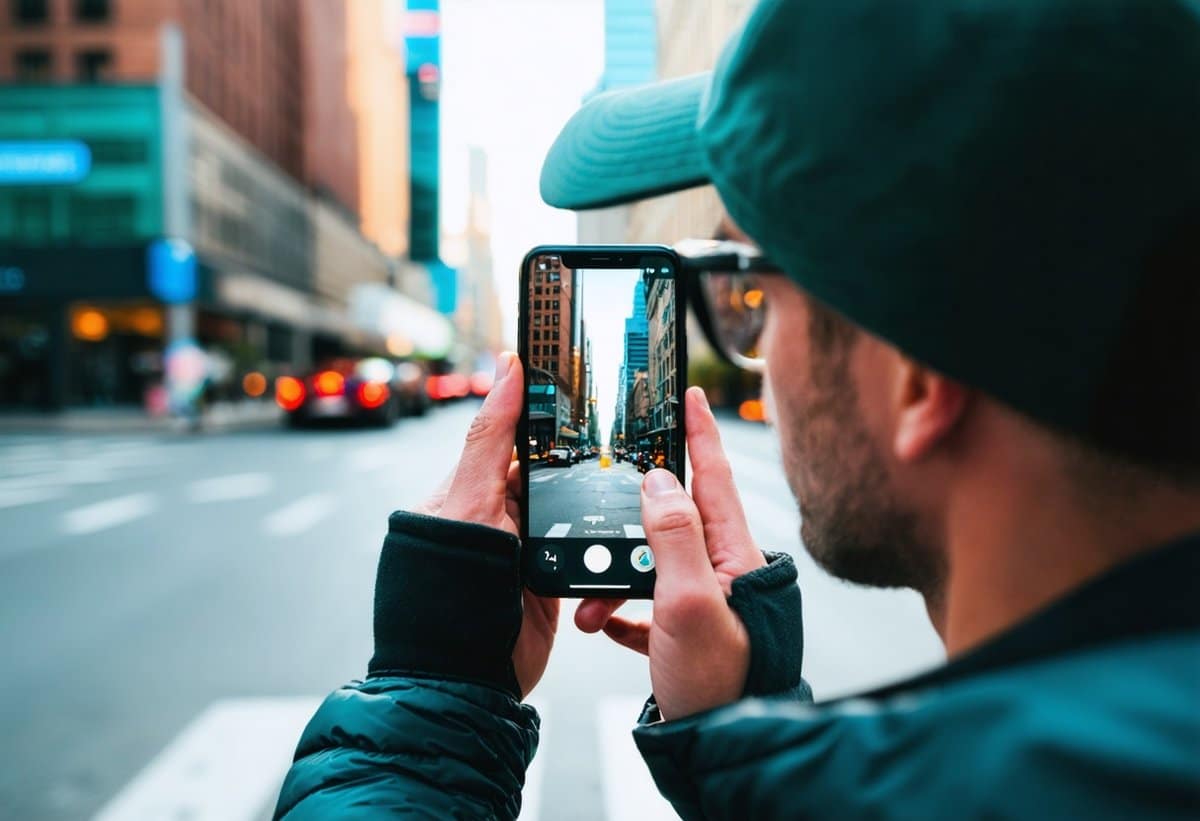
For discovering new destinations through street photography, the iPhone offers unparalleled discretion. People react differently to smartphones than to large cameras with protruding lenses. You blend into the environment, capture candid moments without altering behavior, and work quickly without drawing attention. The instant processing means you can review, edit, and share images immediately—a workflow advantage that professional cameras simply can't match without tethering to a computer or tablet.
Documentary photographers have increasingly adopted hybrid approaches, using iPhones for intimate, spontaneous moments while keeping mirrorless systems for formal portraits and controlled lighting situations.
Social Media Content Creation
If your primary output is Instagram, TikTok, or other social platforms, the iPhone 16 Pro is purpose-built for this ecosystem. The images are optimized for screen viewing, the aspect ratios are native to social media formats, and the editing apps are sophisticated and intuitive. You can shoot, edit, and publish in minutes without ever touching a computer. For influencers, content creators, and businesses focused on digital marketing, this streamlined workflow is worth its weight in gold.
When capturing global flavors through culinary photography, the iPhone's macro capabilities and computational color rendering can produce stunning food shots that look perfect on Instagram—often with less fuss than setting up proper lighting with a mirrorless system.
Video Capabilities
The iPhone 16 Pro's video capabilities deserve special mention. It shoots 4K ProRes at 60fps, includes advanced stabilization, and offers cinematic mode with rack focus effects. For run-and-gun video work, vlogging, or documentary-style content, it's remarkably capable. The integration with the Apple ecosystem means you can edit 4K footage directly on the device using apps like LumaFusion or transfer seamlessly to Final Cut Pro on a Mac.4
That said, dedicated cinema cameras and high-end mirrorless systems with professional video features still offer superior dynamic range, color science, and flexibility for serious video production. But for many creators, the iPhone represents 80% of the capability at 20% of the cost and complexity.
The Cost-Benefit Analysis
Let's talk money. The iPhone 16 Pro starts around $1,199 for the base model. A comparable mirrorless setup—say, a Sony A7 IV body with a 24-70mm f/2.8 lens—runs approximately $3,500. Add a telephoto lens, a fast prime, memory cards, extra batteries, and a decent bag, and you're easily north of $5,000. The price differential is substantial.
But here's the crucial question: what's the opportunity cost? If you're a hobbyist who shoots casually and primarily shares on social media, investing $5,000 in camera gear might be overkill. The iPhone you already own (or were planning to buy anyway) becomes a zero-marginal-cost solution for photography.
Conversely, if photography is your profession or serious passion, the mirrorless system pays for itself through superior image quality, creative control, and professional credibility. Clients expect to see professional equipment. Right or wrong, showing up to a paid portrait session with just an iPhone sends a message about your seriousness and capabilities.
The Nikon Z system and other major camera manufacturers have responded to smartphone competition by pushing innovation in mirrorless technology—better autofocus, improved ergonomics, and computational features of their own. The result is that dedicated cameras in 2025 are better than ever, even as smartphones close the gap.
Ergonomics and Shooting Experience
Something rarely discussed in spec comparisons is the actual experience of using the equipment. Photography isn't just about the final image—it's about the process, the tactile engagement, and the creative flow state that proper tools can facilitate.
Mirrorless cameras are designed for photography. They have dedicated dials for aperture, shutter speed, and ISO. The grip is ergonomically shaped for extended shooting sessions. The viewfinder shows you exactly what the sensor sees, with real-time exposure preview. You can make adjustments without taking your eye from the viewfinder, maintaining visual connection with your subject.
The iPhone, brilliant as it is, requires you to tap on a glass screen, swipe through menus, and hold the device at arm's length (or use the volume button as a shutter). For quick snapshots, it's perfectly adequate. For deliberate, methodical photography—the kind where you're carefully composing, waiting for light, and making precise technical decisions—the experience is fundamentally less satisfying.5
This matters more than you might think. The ritual of photography—mounting a lens, adjusting settings, looking through a viewfinder—is part of the creative process. It slows you down, makes you intentional, and connects you to the history and craft of the medium. For some photographers, this is essential. For others, it's unnecessary ceremony. Know which camp you're in.
Specialized Photography: Where Smartphones Fall Short
Certain photographic disciplines simply demand dedicated camera systems. No amount of computational wizardry can overcome fundamental physical limitations in these scenarios.
Sports and Wildlife Photography
Try photographing a soccer game from the sidelines or a bird in flight with an iPhone 16 Pro. The 77mm equivalent telephoto lens isn't nearly long enough, and the digital zoom quickly degrades image quality. Professional sports photographers use 400mm, 600mm, or even 800mm lenses—focal lengths that allow them to fill the frame with action from a distance. The autofocus systems on mirrorless cameras like the Canon EOS R3 or Sony A1 can track subjects at 20+ frames per second with near-perfect accuracy. The iPhone, despite its impressive computational autofocus, simply can't compete in these conditions.
Architectural and Real Estate Photography
Wide-angle architectural photography requires tilt-shift lenses to correct perspective distortion—keeping vertical lines parallel when shooting buildings. The iPhone's ultra-wide lens introduces barrel distortion that, while correctable in post-processing, never quite matches the optical precision of a dedicated tilt-shift lens on a full-frame camera. For professional real estate photography where straight lines and accurate spatial representation are critical, dedicated cameras remain the standard.
Studio and Commercial Photography
Studio photography with controlled lighting, multiple strobes, and precise color management demands the color accuracy and dynamic range that only larger sensors provide. Commercial clients expect to see RAW files with maximum editing flexibility. Product photography for catalogs or advertising requires tack-sharp focus, perfect color reproduction, and the ability to shoot tethered to a computer for immediate client review. The iPhone simply isn't built for this workflow, despite its impressive capabilities in other areas.
The Hybrid Approach: Best of Both Worlds
Here's the reality that most professional photographers have embraced: it's not either/or. The most versatile approach in 2025 is strategic use of both tools. Keep your iPhone 16 Pro for spontaneous moments, behind-the-scenes content, social media stories, and situations where a large camera would be intrusive or impractical. Use your mirrorless system for client work, fine art projects, specialized photography, and situations where image quality is paramount.
Think of it this way: professional chefs have both a chef's knife and a paring knife. Each excels at different tasks. The same logic applies to photographic tools. The iPhone has earned its place in the professional toolkit—not as a replacement for dedicated cameras, but as a complementary tool with its own strengths.
When shooting local events to capture their spirit, you might use your mirrorless camera for the main coverage while pulling out your iPhone for quick Instagram stories or behind-the-scenes clips. The workflow integration—shooting on mirrorless, editing on computer, then sharing via iPhone—combines the strengths of both platforms.
Future Trends: What's Coming Next
The trajectory of both smartphone and mirrorless camera technology suggests continued convergence in some areas and persistent differentiation in others. Computational photography will continue advancing—expect even more sophisticated AI-driven features, better low-light performance, and improved simulation of optical effects. Apple and other smartphone manufacturers are investing billions in imaging research.6
Meanwhile, camera manufacturers are incorporating their own computational features. Modern mirrorless cameras now include AI-powered subject detection, in-camera focus stacking, and advanced image processing that was unthinkable a decade ago. The Digital Photography Review has extensively covered how traditional camera makers are responding to smartphone competition by adding computational capabilities while maintaining their optical advantages.
The likely outcome? Smartphones will continue to dominate casual photography and social media content creation, while dedicated cameras will remain essential for professional work, specialized applications, and photographers who demand maximum creative control. The gap will narrow, but fundamental physics—sensor size, optical quality, ergonomic design—will ensure that both platforms have distinct roles.
Making Your Decision: Questions to Ask Yourself
So, should you invest in a mirrorless camera or stick with your iPhone 16 Pro? Ask yourself these questions:
- What's your primary output? If it's social media and screen viewing, the iPhone is probably sufficient. If you're printing large, shooting for clients, or creating fine art, invest in a mirrorless system.
- What subjects do you shoot? Casual portraits, street photography, and travel documentation work beautifully on iPhone. Sports, wildlife, studio work, and specialized genres demand dedicated cameras.
- How important is creative control? If you want to make every technical decision yourself, mirrorless cameras offer that granularity. If you prefer intelligent automation, smartphones excel.
- What's your budget? Be honest about what you can afford and what provides the best value for your specific needs. A $1,200 iPhone that you use daily might deliver more value than a $5,000 camera system that stays in the closet.
- Do you enjoy the process? Some photographers love the tactile engagement of dedicated cameras. Others find them cumbersome. Your enjoyment of the tool directly impacts how much you'll use it.
Remember that the best camera is the one you have with you. An iPhone 16 Pro that's always in your pocket will capture more meaningful moments than a mirrorless camera that's too heavy to bring along. But for intentional photography sessions where quality matters most, nothing beats a dedicated system.
Conclusion: The Reality Check
The iPhone 16 Pro represents the pinnacle of smartphone photography in 2025, and it's genuinely impressive. Computational photography has democratized professional-looking results, making it possible for anyone to capture stunning images without years of technical training. For millions of users, it's more than enough camera—it's the perfect camera.
But for photographers who push boundaries, work professionally, or simply love the craft of photography, mirrorless cameras remain irreplaceable. The superior image quality, creative control, optical capabilities, and professional workflow integration justify the investment. Physics hasn't been repealed—sensor size, optical quality, and ergonomic design still matter profoundly.
The 2025 reality check is this: smartphones and dedicated cameras serve different needs, and both have legitimate places in the photographic ecosystem. The debate isn't about which is "better" in absolute terms—it's about which is better for your specific needs, goals, and creative vision. Choose the tool that empowers your photography, whether that's the computational brilliance of the iPhone 16 Pro, the optical excellence of a mirrorless system, or—most likely—a thoughtful combination of both.
Now stop reading, grab whatever camera you have available, and go shoot something amazing. The best photographs aren't captured by the most expensive equipment—they're captured by photographers who understand their tools and use them with intention, creativity, and passion.
- Computational photography combines multiple exposures, applies machine learning algorithms for scene recognition, and processes images through neural engines—all before you even see the final result on your screen.
- Dynamic range refers to the camera's ability to capture detail in both the brightest and darkest parts of a scene simultaneously. Larger sensors inherently capture more information before computational processing begins.
- Professional photographers often follow the 3-2-1 backup rule: three copies of data, on two different media types, with one copy stored off-site. This becomes more complex with smartphone-only workflows.
- ProRes is a high-quality video codec developed by Apple that maintains exceptional image quality while remaining manageable for editing. It's widely used in professional video production.
- Ergonomic design in camera bodies isn't just about comfort; it directly impacts shooting speed, accuracy, and fatigue during extended sessions. Professional cameras are shaped by decades of refinement based on actual photographer feedback.
- Apple's investment in computational photography research rivals the R&D budgets of traditional camera manufacturers, reflecting the strategic importance of imaging capabilities in the smartphone market.