Light in photography is more than a technical condition. It is the raw material of every picture, and photographers have also turned it into a tool for drawing. This article follows that thread. First, it explains what Isaac Newton showed about white light. Then it describes the visible spectrum and the rainbow. Finally, it traces light painting from the nineteenth century to Picasso, and it lists the basic gear for trying it yourself.
A note on method: we checked each claim against the sources listed at the end. In short, this is a corrected and sourced version of an earlier, looser article on “the magic of light.”
Light in photography: the short version
| Idea | What the sources say |
|---|---|
| White light | A mixture of rays that bend by different amounts when they pass through a prism (Newton, 1666) |
| Visible spectrum | Roughly 380 to 750 nanometres, from violet at the short end to red at the long end |
| Rainbow | Sunlight bends as it enters a water droplet, reflects inside it and bends again on the way out, which separates the colours |
| Light painting | A light source moves during a long exposure; exposures usually last at least one second |
What Newton’s prism showed about white light
In 1666, Newton, then 23, passed a narrow sunbeam through a prism in a darkened room. According to a Live Science account, he then isolated one colour with a screen and sent it through a second prism. That colour bent again but did not change. He also recombined the spectrum into white light with a lens, then split it again.
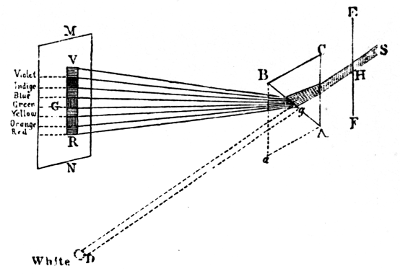
The result overturned a common idea of the time. White light is not a pure, basic substance. Instead, it is a mixture of rays that refract by different amounts. The colours are already in the light, and the prism only separates them. Newton did not report the work until 1672, when he sent an account to the Royal Society, and his book Opticks appeared in 1704.
The visible spectrum and the rainbow
Human eyes detect only a narrow slice of the electromagnetic spectrum. The astro4edu glossary gives it as roughly 380 to 750 nanometres. Within that band, the colours run continuously from violet through blue, green, yellow and orange to red.
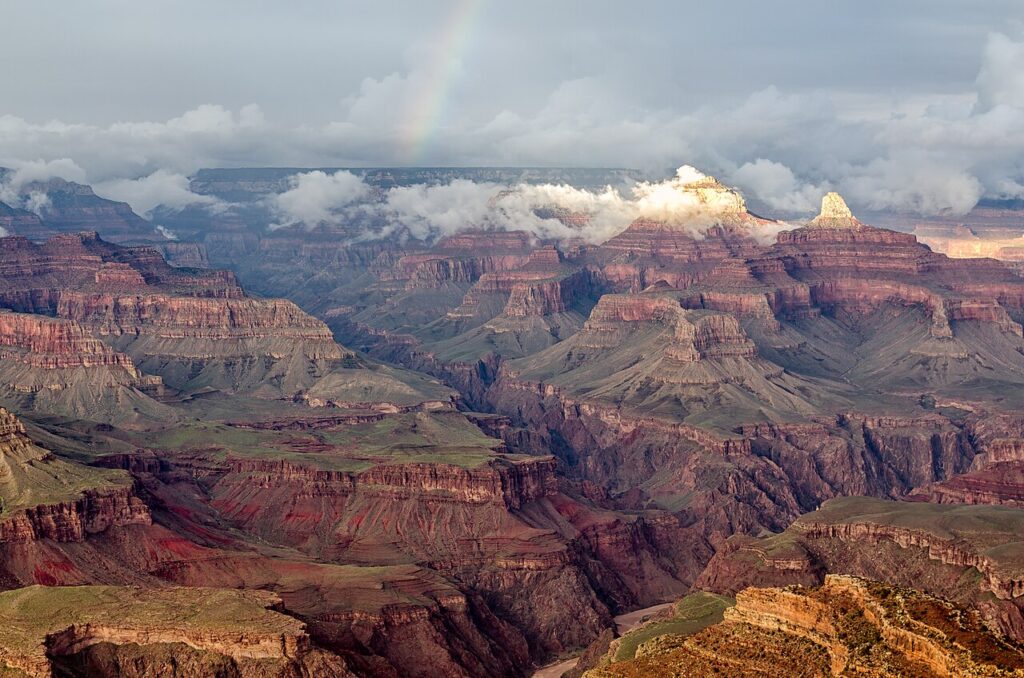
A rainbow shows the same separation in nature. According to NASA’s SciJinks, sunlight slows and bends as it enters a water droplet. It reflects off the droplet’s inner back surface, then bends again as it leaves. This bending separates the light into its component colours, much like a prism.
For photographers, the lesson is practical. Light is never simply “white” or “colourless.” The next sections show how photographers turned that fact into a technique.
Light in photography as drawing: a short history of light painting
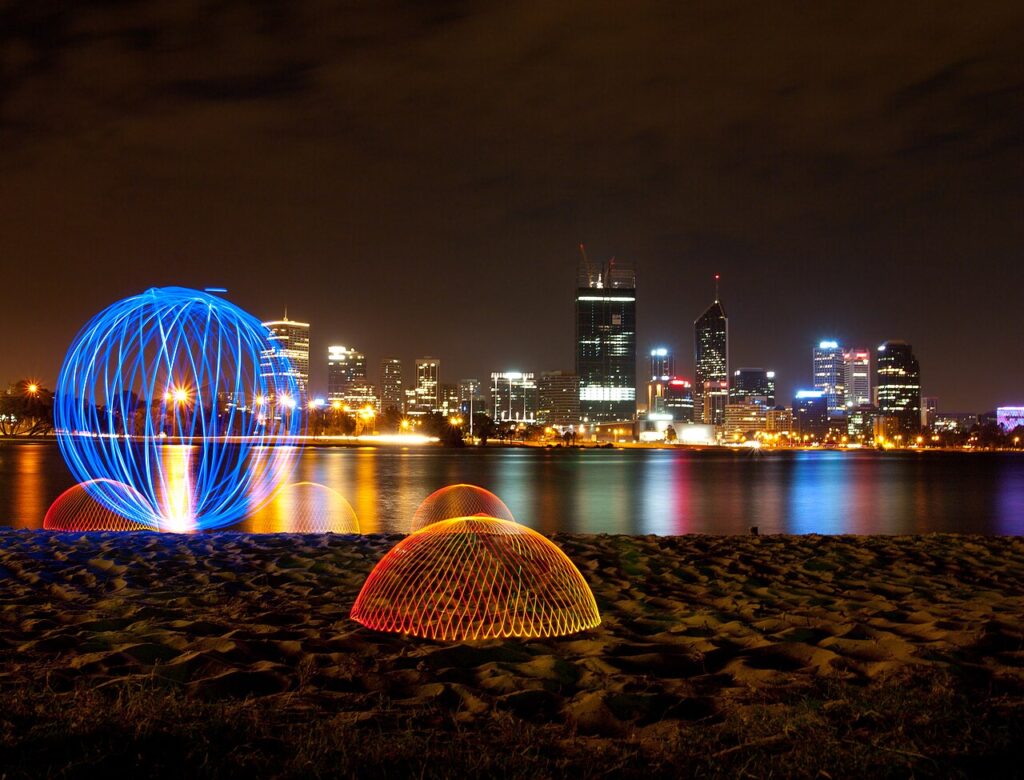
Light painting is a set of techniques in which a light source moves during a long exposure. According to Wikipedia’s overview, the earliest example dates from 1889, when Étienne-Jules Marey and Georges Demenÿ traced human motion with light. In 1914, Frank and Lillian Gilbreth used small lights and open shutters to track the movements of workers.
In 1935, Man Ray made the self-portrait “Space Writing,” which Wikipedia calls the first known art photograph made this way. He wrote his name in the air with a small light during a time exposure. Meanwhile, Barbara Morgan began her own light work that year.
The best-known case came in 1949. Gjon Mili had photographed ice skaters with lights on their skates, and he showed the pictures to Pablo Picasso. According to Google Arts & Culture, Mili then photographed Picasso in the South of France on a LIFE assignment. Picasso drew in the air with a small light in a dark room, while Mili used a long exposure and two cameras, one for a side view and one for a front view. Mili had only 15 minutes at first, but Picasso agreed to five more sessions.
Later artists extended the idea. Dean Chamberlain used handheld lights to colour parts of scenes from 1977, and Vicki DaSilva began light graffiti in 1980, according to Wikipedia. The two sources describe Picasso’s light slightly differently, as a flashlight and as a small electric bulb, so we simply call it a small light.
Try light in photography yourself: a light painting setup
The basics are simple. Wikipedia lists a tripod or solid support, a shutter-release cable or self-timer, and an exposure of at least one second. Light sources range from flashlights and fibre-optic pens to candles, steel wool, glow sticks and LED arrays, and colour gels can tint the light.
- Start dark. Choose a place with little other light, so your moving light dominates the frame.
- Fix the camera. Mount it on a tripod and release the shutter without touching it.
- Move deliberately. Draw one simple shape, then check the result and adjust the speed.
- Mind safety. Burning steel wool throws sparks, so, as our own precaution, keep clear of dry grass and wear eye protection.
For the thinking behind such experiments, see our guide to Michael Freeman’s The Photographer’s Mind, and for artificial light, our guide to Joe McNally’s The Hot Shoe Diaries.
Sources and limits
- Live Science: how Newton’s experiments revealed the mystery of light
- astro4edu glossary: visible light
- NASA SciJinks: how rainbows form
- Wikipedia: light painting
- Google Arts & Culture: Picasso and Gjon Mili’s light drawings
We rewrote this article on 10 November 2026. Our research tools return summaries of web pages, so check details against the originals. The earlier version also made claims about ultraviolet and infrared light, for example about flower markings that attract bees. We could not re-verify them from a fetchable source, so we removed them rather than keep them unchecked. We did not consult Newton’s Opticks directly.