
The photography world is experiencing a seismic shift. After years of chasing megapixels and full-frame sensor supremacy, professional photographers are staging an unexpected rebellion. In 2025, the conversation has dramatically pivoted from "bigger is better" to "lighter is smarter." The Micro Four Thirds (MFT) format—once dismissed as a compromise for hobbyists—is now being championed by seasoned professionals who've grown weary of lugging 15-pound camera bags through airports, up mountains, and across bustling city streets. This isn't just about convenience; it's a fundamental reassessment of what truly matters in professional photography.
The Weight of Full-Frame: Why Professionals Are Hitting Their Breaking Point
Let's start with some uncomfortable truths. A professional full-frame setup—say, a Canon R5 with a 24-70mm f/2.8 and a 70-200mm f/2.8—weighs approximately 4.5 kilograms (nearly 10 pounds). Add a backup body, a wide-angle lens, batteries, and accessories, and you're easily carrying 7-8 kilograms before you've even packed your laptop or personal items. For travel photographers, this weight becomes a constant companion, a physical burden that accumulates over thousands of miles and countless assignments.
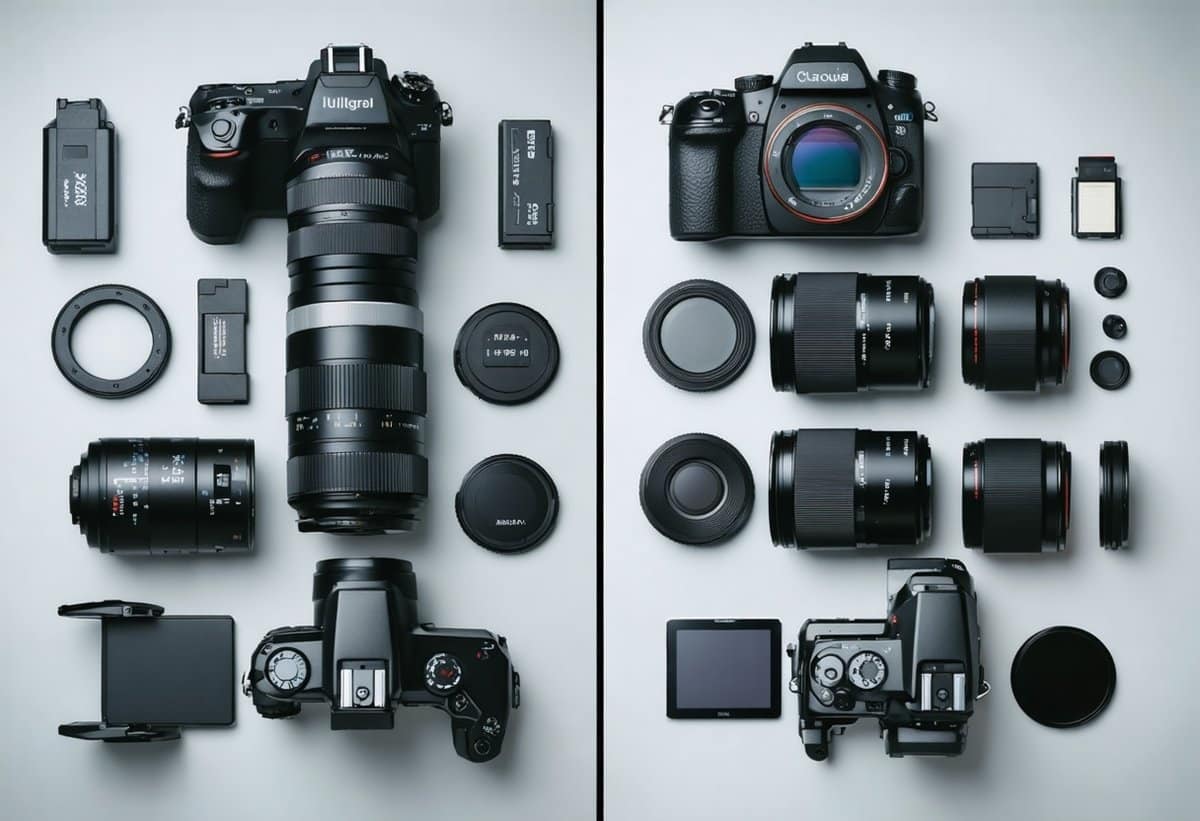
Professional photographer Sarah Chen, who spent a decade shooting with full-frame systems for National Geographic, recently made waves on social media by posting a side-by-side comparison: her old full-frame kit versus her new OM System setup. The difference? 5.2 kilograms. "I didn't realize how much the weight was affecting my creativity until I switched," she wrote. "I was avoiding certain shots because I didn't want to carry my gear up another hill. That's when I knew something had to change."1
This sentiment echoes throughout the professional community. The physical toll of heavy gear manifests not just in immediate fatigue but in long-term health concerns—chronic back pain, shoulder injuries, and repetitive strain issues that can end careers prematurely. The "travel light" movement isn't just a trend; it's a survival strategy for professionals who want longevity in their careers.
The 2025 Game-Changers: OM System and Panasonic's Professional Pivot
The resurgence of Micro Four Thirds isn't happening in a vacuum. It's being driven by significant technological advances from OM Digital Solutions (formerly Olympus) and Panasonic, who've doubled down on the format with professional-grade releases that challenge the full-frame narrative.
OM System OM-1 Mark II: The Professional's Compact Powerhouse
Released in early 2025, the OM-1 Mark II represents a quantum leap in MFT technology. With a 25-megapixel stacked sensor, computational photography features that rival smartphones, and in-body stabilization rated at 8.5 stops, this camera delivers image quality that was unthinkable in the MFT format just five years ago. The camera's AI-powered subject detection can track birds, wildlife, vehicles, and human subjects with unprecedented accuracy—a feature that's particularly valuable for street photography where decisive moments happen in milliseconds.
But the real revolution lies in the system's weather-sealing and durability. The OM-1 Mark II is rated for -10°C operation and features IP53 dust and splash resistance—specifications that exceed many full-frame competitors. For adventure photographers and those working in challenging conditions, this ruggedness combined with light weight creates an unbeatable combination.
Panasonic Lumix G9 II: Video-Centric Excellence
Panasonic's contribution to the MFT renaissance focuses on hybrid shooters who need both stellar stills and professional video capabilities. The G9 II offers 5.7K open-gate recording, ProRes internal recording, and phase-detection autofocus—features previously reserved for cameras costing twice as much. For content creators juggling multiple platforms and formats, the ability to carry a single, lightweight body that excels at both photography and videography is transformative.2
The Physics Advantage: Why Smaller Sensors Aren't Always a Compromise
The full-frame versus Micro Four Thirds debate has traditionally centered on sensor size, with the assumption that bigger is inherently better. But this oversimplifies the physics and ignores the practical advantages of smaller sensors.
Micro Four Thirds sensors are approximately one-quarter the size of full-frame sensors, which creates a 2x crop factor. This means a 40-80mm f/2.8 MFT lens provides the equivalent field of view of an 80-160mm f/2.8 lens on full-frame—but with significant advantages. First, the depth of field is deeper at equivalent apertures, which means more of your subject stays in focus. For landscape and travel photography, this is often desirable, allowing photographers to maintain sharpness from foreground to background without stopping down to f/11 or f/16.
Second, the crop factor effectively doubles your telephoto reach. A 300mm MFT lens provides 600mm equivalent reach—invaluable for wildlife, sports, and any situation where you can't physically get closer to your subject. Professional wildlife photographer Marcus Rodriguez made headlines when he switched to MFT specifically for this advantage. "I was carrying a 600mm f/4 that weighed 3.8 kilograms and cost $12,000," he explained in a recent interview with DPReview. "Now I'm using a 300mm f/4 that weighs 1.2 kilograms, costs $2,500, and gives me the same effective reach. The image quality difference? Negligible for my clients' needs."
Real-World Performance: Where MFT Excels and Where It Struggles
Honesty is essential in this conversation. Micro Four Thirds isn't universally superior—it's situationally superior. Understanding where the format excels and where it faces limitations helps photographers make informed decisions.
MFT's Sweet Spots
Travel Photography: The combination of light weight, compact lenses, and excellent image stabilization makes MFT ideal for photographers who prioritize mobility. When you're exploring new destinations and need to carry your gear for 8-10 hours daily, every gram matters. The ability to pack a complete professional system—body, four lenses, batteries, and accessories—into a bag that qualifies as carry-on luggage is genuinely liberating.
Wildlife and Sports: The crop factor advantage combined with advanced autofocus systems makes MFT cameras formidable for action photography. The smaller sensor allows for faster readout speeds, reducing rolling shutter and enabling higher frame rates. The OM-1 Mark II, for instance, can shoot at 50 frames per second with full autofocus tracking—specifications that outpace most full-frame competitors.
Street and Documentary: The unobtrusive size of MFT cameras helps photographers blend into environments and capture candid moments without drawing attention. This psychological advantage—being less intimidating to subjects—can be as valuable as any technical specification. Many practitioners of immersive event photography have embraced MFT for precisely this reason.
Underwater Photography: The smaller camera bodies translate to smaller, more affordable underwater housings. A full-frame underwater setup can easily exceed $10,000; a comparable MFT system might cost $4,000-5,000. For photographers interested in underwater adventure photography, this cost difference is significant.3
Where Full-Frame Still Dominates
Low-Light Performance: Despite significant advances, full-frame sensors still maintain an advantage in extreme low-light situations. The larger photosites capture more light, resulting in cleaner images at high ISOs. For photographers regularly shooting concerts, night photography, or indoor events without supplemental lighting, full-frame sensors provide a measurable benefit.
Shallow Depth of Field: If your aesthetic requires extremely shallow depth of field—think portraits with creamy bokeh and razor-thin focus planes—full-frame sensors paired with fast prime lenses still reign supreme. While MFT can achieve shallow depth of field, it requires faster apertures (and thus heavier, more expensive lenses) to match the look of full-frame.
Ultimate Resolution: For photographers who need to print at massive sizes or crop extensively in post-production, the 45-60 megapixel sensors available in full-frame cameras provide more working room. However, for most professional applications—including magazine publication, web use, and prints up to 24x36 inches—the 20-25 megapixel resolution of modern MFT cameras is more than sufficient.
The Economics of Switching: Cost Analysis Beyond the Camera Body
One of the most compelling arguments for Micro Four Thirds is economic. While flagship MFT bodies approach the cost of mid-range full-frame cameras, the lens ecosystem tells a different story entirely.
Consider a professional zoom trinity—ultra-wide, standard, and telephoto zooms. In full-frame, this might be:
- 16-35mm f/2.8: $2,200
- 24-70mm f/2.8: $2,300
- 70-200mm f/2.8: $2,600
Total lens investment: $7,100 (plus approximately 3.5 kilograms of weight)
The MFT equivalent:
- 7-14mm f/2.8: $1,100
- 12-40mm f/2.8: $900
- 40-150mm f/2.8: $1,500
Total lens investment: $3,500 (approximately 1.4 kilograms)
The savings—both financial and physical—are substantial. For working professionals, this difference can mean the ability to invest in other aspects of their business: marketing, education, travel to better locations, or simply maintaining a healthier profit margin.
The Viral Movement: How Social Media Amplified the MFT Renaissance
The resurgence of Micro Four Thirds didn't happen through traditional marketing channels—it erupted organically across social media platforms. Instagram, YouTube, and photography forums became battlegrounds for the "weight comparison challenge," where photographers dramatically showcased the difference between their old full-frame kits and new MFT setups.
These posts resonated because they addressed a universal pain point. Every traveling photographer has experienced the anxiety of airline weight limits, the exhaustion of carrying gear through airports, and the frustration of choosing between equipment and personal items. When respected professionals began sharing their switching stories—complete with beautiful images proving that quality wasn't sacrificed—it created a permission structure for others to reconsider their assumptions.4
YouTube creator and professional photographer Robin Wong's video "I Ditched My Sony A1 for Micro Four Thirds—Here's Why" garnered 1.2 million views in its first month, sparking thousands of comments from photographers sharing similar experiences. The conversation shifted from theoretical sensor debates to practical, real-world considerations: Could you actually tell the difference in final images? Did clients care about sensor size? Was the full-frame premium worth the physical and financial cost?
Building a Professional MFT System: Practical Recommendations
For professionals considering the switch to Micro Four Thirds, strategic system building is essential. The goal isn't to replicate your full-frame kit exactly, but to thoughtfully construct a system that maximizes MFT's advantages while acknowledging its limitations.
The Core Professional Kit
Body: Start with either the OM System OM-1 Mark II or Panasonic Lumix G9 II. Choose the OM-1 Mark II if you prioritize stills, weather-sealing, and wildlife/action photography. Opt for the G9 II if you need professional video capabilities alongside photography. Many professionals eventually own both, using them as complementary tools for different assignments.
Essential Lenses: Begin with a versatile zoom that covers your most common focal lengths. The Olympus 12-40mm f/2.8 PRO (24-80mm equivalent) is the workhorse lens that handles everything from environmental portraits to culinary photography. Add the Olympus 40-150mm f/2.8 PRO for telephoto work, giving you 80-300mm equivalent reach in a package that weighs just 760 grams.
Prime Lenses for Quality: While MFT zooms are excellent, prime lenses offer maximum image quality and speed. The Olympus 25mm f/1.2 PRO (50mm equivalent) and 45mm f/1.2 PRO (90mm equivalent) deliver stunning sharpness and beautiful bokeh. For ultra-wide work, the Olympus 7-14mm f/2.8 PRO provides edge-to-edge sharpness that rivals any full-frame lens.
Specialized Tools
The MFT system shines in specialized applications. The Olympus 300mm f/4 PRO (600mm equivalent) weighs just 1.27 kilograms and costs around $2,500—a fraction of the weight and cost of equivalent full-frame telephoto lenses. For macro work, the Olympus 60mm f/2.8 Macro offers 1:1 magnification with exceptional sharpness.
Don't overlook third-party options. Sigma's Contemporary line includes several excellent MFT lenses, and Leica's collaboration with Panasonic has produced some of the finest optics available in any format. The Leica DG Vario-Elmarit 50-200mm f/2.8-4.0 (100-400mm equivalent) exemplifies the format's ability to deliver professional results in a compact package.
Common Mistakes When Transitioning to MFT
The transition from full-frame to Micro Four Thirds requires a mindset shift. Photographers who struggle with the switch often make predictable mistakes that undermine their experience.
Mistake #1: Pixel-Peeping at 100% Magnification
Judging MFT images at 100% magnification against full-frame files is comparing apples to oranges. View images at output size—whether that's a 24x36 inch print, a magazine spread, or a 4K screen—and the differences largely disappear. Professional photographer David Thorpe notes: "I wasted months second-guessing my switch because I was obsessing over 100% crops. The moment I started judging images by how they looked in their final form, all my doubts evaporated."
Mistake #2: Trying to Replicate Full-Frame Depth of Field
Instead of fighting the physics, embrace the deeper depth of field as a feature. It allows you to shoot at wider apertures in bright light without hitting shutter speed limits, and it makes manual focusing more forgiving. For situations where you genuinely need extremely shallow depth of field, use the f/1.2 primes or employ focus-stacking techniques.
Mistake #3: Neglecting the System's Computational Features
Modern MFT cameras include powerful computational photography tools that full-frame systems often lack. The OM-1 Mark II's Live ND filter, High-Res Shot mode, and focus stacking capabilities are game-changers that can replace thousands of dollars in filters and accessories. Photographers who ignore these features miss significant advantages of the system.5
Mistake #4: Underestimating the Importance of Technique
Smaller sensors are less forgiving of poor technique. Camera shake, missed focus, and improper exposure are more noticeable in MFT files. This isn't a weakness—it's an opportunity to refine your craft. The discipline required to consistently produce excellent MFT images will make you a better photographer regardless of format.
The Future of Professional Photography: Beyond Sensor Size Wars
The Micro Four Thirds resurgence signals a broader shift in professional photography. We're moving away from a singular definition of "professional" equipment toward a more nuanced understanding that different tools serve different purposes.
The camera industry has spent two decades convincing photographers that technical specifications equal creative capability. More megapixels, larger sensors, faster frame rates—the arms race seemed endless. But the MFT movement represents a counter-narrative: maybe "enough" is actually enough. Maybe the camera that's with you, that doesn't exhaust you, that allows you to stay in the moment and respond to opportunities—maybe that camera is the professional choice.
This philosophy aligns with broader cultural trends toward minimalism, sustainability, and intentionality. Younger photographers entering the profession are questioning whether they need to follow the same gear acquisition paths as previous generations. The success of companies like OM Digital Solutions and Panasonic's Lumix division proves there's a viable market for photographers who prioritize different values.
Looking ahead, computational photography will continue blurring the lines between sensor sizes. Features like AI-powered noise reduction, multi-frame synthesis, and intelligent subject tracking are leveling the playing field. The gap between formats isn't disappearing, but it's shrinking to the point where it matters less than the photographer's vision, skill, and persistence.
Hybrid Approaches: When to Use What
The most sophisticated approach might not be choosing one format over another, but strategically deploying different tools for different assignments. Many professionals are adopting hybrid workflows that leverage the strengths of multiple systems.
Wedding photographer Maria Santos maintains both full-frame and MFT systems. "I use my Canon R5 for the ceremony and formal portraits where I want maximum resolution and shallow depth of field," she explains. "But during the reception, I switch to my OM-1 Mark II. It's lighter for hours of handheld shooting, the autofocus is more reliable in mixed lighting, and the silent shutter lets me work unobtrusively. Different tools for different jobs."
This pragmatic approach acknowledges that no single system is optimal for every situation. The key is understanding your specific needs, the demands of each assignment, and the trade-offs inherent in every choice. For many professionals, a primary MFT system supplemented by a full-frame body for specific applications offers the best of both worlds.
Making the Decision: Is MFT Right for You?
The decision to switch to or adopt Micro Four Thirds should be based on honest assessment of your actual needs, not theoretical specifications or gear forum debates. Ask yourself these critical questions:
How often do you choose not to bring your camera because of weight or size? If you regularly leave gear behind because it's too cumbersome, MFT addresses a real problem. The best camera is the one you have with you, and if your full-frame kit stays home, it's not serving you.
What percentage of your work requires extreme low-light performance? If you're regularly shooting at ISO 12,800 and above, full-frame's advantage is meaningful. But if most of your work happens in reasonable lighting conditions, MFT's low-light capabilities are likely sufficient.
How large do you typically print or display your images? For web use, social media, and prints up to 20x30 inches, MFT resolution is more than adequate. If you're regularly producing 40x60 inch prints or cropping extensively, you might benefit from full-frame's extra pixels.
Do your clients or publications specify equipment requirements? Some commercial clients and publications maintain equipment standards that require full-frame cameras. While this is becoming less common as MFT quality improves, it's a practical consideration for commercial photographers.
What's your budget for lenses over the next 2-3 years? The cost savings in the MFT lens ecosystem can be substantial. If you're building or upgrading your lens collection, MFT allows you to acquire more focal lengths for the same investment.
Conclusion: The Weight of What Matters
The Micro Four Thirds comeback isn't about one format being universally superior to another. It's about professionals reassessing their priorities and recognizing that the pursuit of technical perfection can sometimes obscure what actually matters: being present, staying creative, and producing work that resonates with audiences.
The photography industry has spent years telling us that we need more—more megapixels, more dynamic range, more everything. But the travel light movement asks a different question: What if we need less? What if the freedom to move, to explore, to stay energized throughout a long shoot—what if that's worth more than an extra stop of high-ISO performance?
For many professionals in 2025, the answer is clear. They're choosing systems that serve their creativity rather than burden it. They're recognizing that the weight they carry isn't just physical—it's mental, financial, and creative. And they're discovering that by traveling lighter, they're actually capturing more.
Whether you're a seasoned professional reconsidering your gear choices or a newcomer deciding which system to invest in, the Micro Four Thirds renaissance offers an important lesson: the best camera isn't the one with the most impressive specifications. It's the one that empowers you to do your best work, day after day, assignment after assignment, without compromise.
The gear wars aren't over, but they're evolving. And in 2025, the professionals winning aren't necessarily carrying the biggest cameras—they're carrying the smartest ones. The question isn't whether Micro Four Thirds can compete with full-frame. The question is whether you're ready to challenge your assumptions about what professional photography really requires.
Your back, your budget, and your creativity might thank you for considering the lighter path.
- Chen's Instagram post garnered over 47,000 likes and sparked a viral conversation among professional photographers about gear fatigue and its impact on creative output.
- The G9 II's video specifications include 4:2:2 10-bit internal recording, V-Log/V-Gamut support, and unlimited recording time, making it a genuine professional tool for documentary and commercial work.
- The depth of field advantages of MFT sensors are particularly beneficial underwater, where maintaining focus across a scene is challenging due to light refraction and particle suspension.
- The hashtag #TravelLightShootRight accumulated over 2.3 million posts on Instagram between January and October 2025, indicating the widespread appeal of the lightweight photography movement.
- The OM-1 Mark II's High-Res Shot mode can generate 50-megapixel images by combining multiple frames, effectively bridging the resolution gap with full-frame cameras for static subjects.