Travel photography art did not begin with golden-hour sunsets. It began with chemistry, heavy equipment and long exposures. This article follows four sourced steps: Maxime Du Camp and Gustave Flaubert in Egypt, Francis Frith’s Egyptian tours, Samuel Bourne in the Himalayas, and the autochromes of National Geographic. Then it explains golden hour and blue hour. We read each page on 10 November 2026.
Travel Photography Art Before the Snapshot
Early travellers could not simply point a camera and shoot. They carried chemicals, glass or paper, and a way to develop their pictures far from home. However, the constraints shaped the pictures. Each frame cost effort, so each one needed a reason to exist. In that sense, the history below shows how travel photography art grew out of limits, not out of inspiration alone.
Du Camp and Flaubert: Paper Negatives in Egypt
According to Imaging Resource, Flaubert and Du Camp sailed for Alexandria in autumn 1849. Du Camp carried a wooden calotype camera, a tripod and jugs of chemicals. The calotype used ordinary writing paper for negatives, and he could sensitise the paper in a hotel room or a tent and store it until needed.
The method had its costs. Calotype prints look softer than daguerreotypes, and Henry Fox Talbot licensed his process strictly. Moreover, Du Camp had no exposure meter, so he found his exposure times by trial and error and timed them with a pocket watch. The article says the pair produced hundreds of photographs, without giving a count.
After returning to France, Du Camp made salted paper prints and bound them in albums, which he sold in 1852. The source calls the result arguably the first travel photography book. That wording is the author’s hedge, and we repeat it as such. In addition, sources give the album’s title in slightly different forms.
Francis Frith: The Mammoth Plate in Egypt
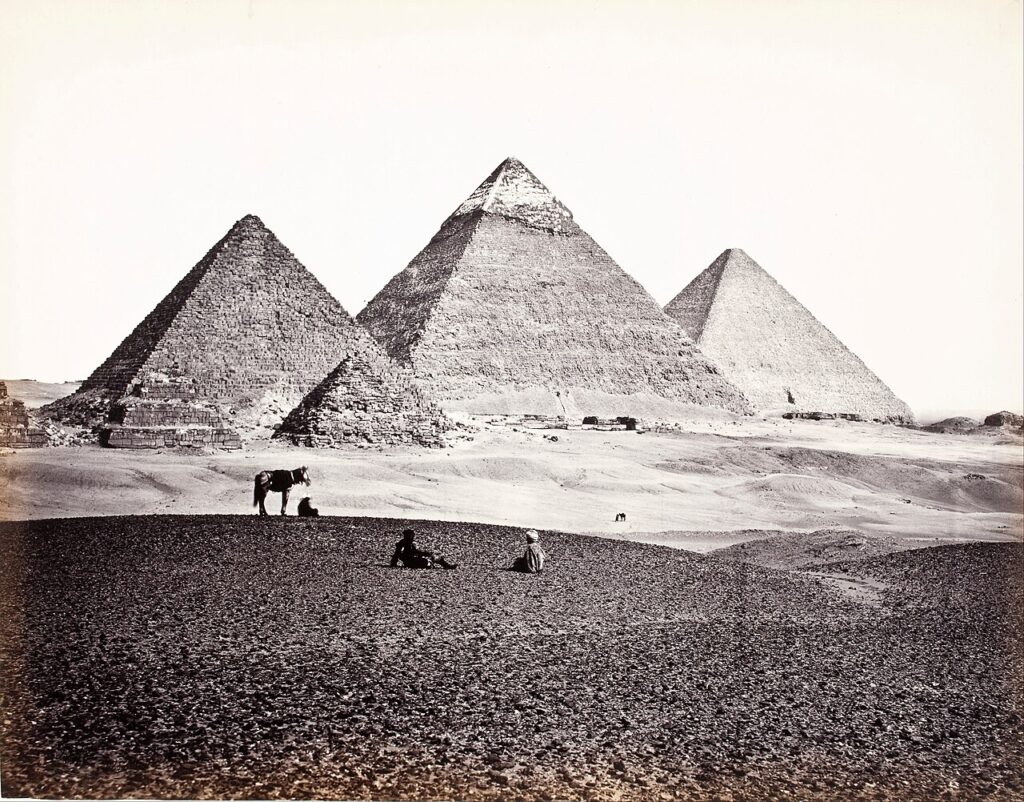
Daniel Blau’s gallery page says Frith made two tours of Egypt, in 1856 to 1857 and in 1859 to 1860, and calls them the most ambitious and systematic excursions of his time. He took a stereo camera, a whole-plate camera and a mammoth-plate camera. The mammoth-plate camera travelled in a covered vehicle that also served as a portable darkroom and shelter.
Frith worked with the wet-collodion process, which Frederick Scott Archer made generally available in 1851. The page adds that wet-plate photography had not yet been tested in desert conditions. Furthermore, it says Frith came back to England in July 1857 with his first negatives ready for printing and exhibition.

Samuel Bourne in the Himalayas
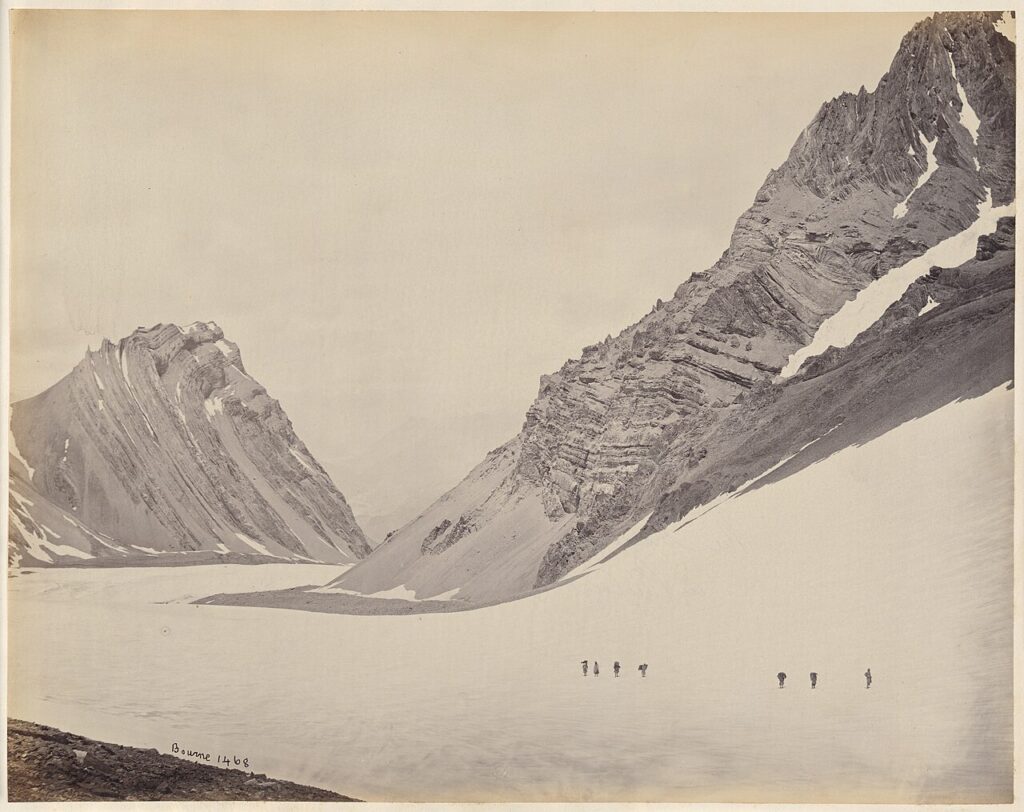
Wikipedia reports that Samuel Bourne (1834 to 1912) spent six years in India and left in November 1870. He made three major Himalayan trips. The first started from Simla on 29 July 1863 and returned on 12 October with 147 fine negatives. The third began on 3 July 1866 and reached the Gangotri Glacier.
Bourne also worked with wet collodion, mainly on a 10 by 12 inch plate camera. His first expedition needed about 30 porters for the equipment, and the third about forty. Wikipedia adds that he photographed the Manirung Pass at 18,600 feet, and that this held the altitude record for photographs for twenty years. As a result, the crossing in the picture below needed a team, not just a photographer.

Wikipedia also says that a fire in Calcutta on 6 February 1991 destroyed his archive of about 2,200 glass negatives. We could not confirm this with a second source, so we treat it with care.
Colour Arrives: Travel Photography Art at National Geographic
According to National Geographic, the Lumière brothers introduced the autochrome in 1907. A glass plate carried potato starch grains dyed red, green and blue, which acted as a colour filter, and an emulsion layer on top. The developed plate became a transparency.
The magazine published its first natural colour photograph in 1914, an autochrome of a flower garden in Belgium. Its archives hold almost 15,000 glass autochrome plates. However, the process had limits. Exposures were long, so subjects had to stay still, and the plates were fragile enough that photographers carried them in heavy wooden suitcases. National Geographic used autochromes into the early 1930s and moved to Kodachrome by 1938.
What Light Means for Travel Photography Art
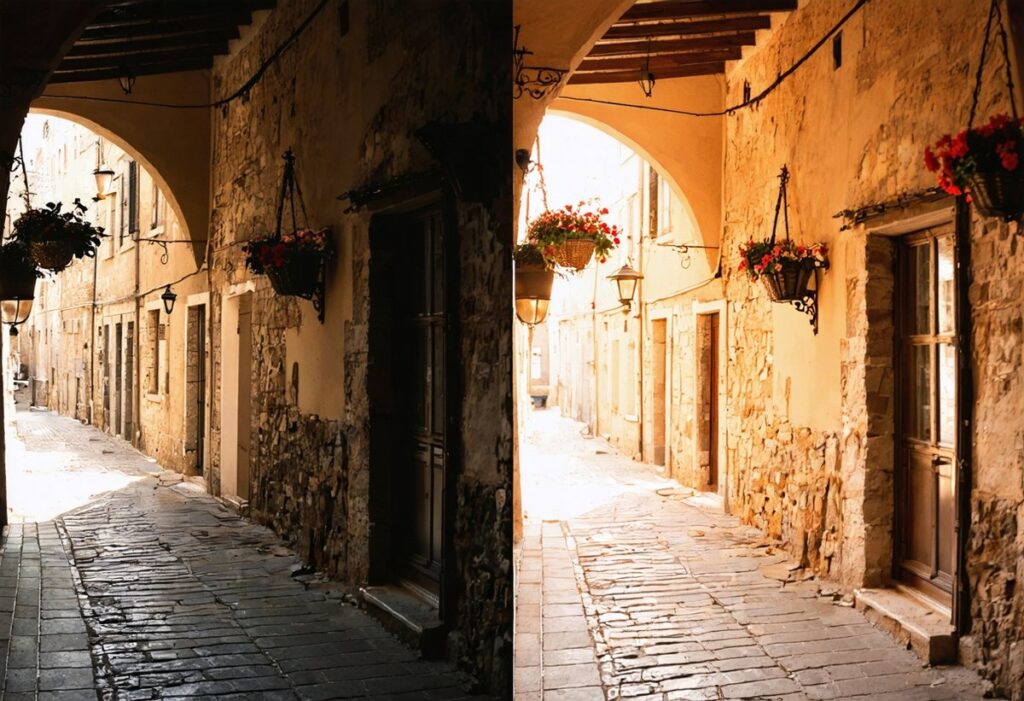
Wikipedia’s article on golden hour describes the light shortly after sunrise or before sunset as redder and softer than when the sun is high. The low sun travels through more atmosphere, which cuts direct intensity and adds indirect sky light. In Los Angeles, one hour after sunrise or before sunset, the sun sits about 10 to 12 degrees above the horizon.
The word hour is figurative. The effect depends on how long the sun takes to climb to that height, which changes with latitude and season. Closer to the equator, the sun gets there in under an hour. Far from the equator, it takes longer, and in some seasons the sun may never reach 10 degrees, so the golden hour can last all day.
Blue hour comes just before sunrise or just after sunset. The sun sits well below the horizon, the light is mostly blue, and shadows lose their sharp edges. The page gives no sun angle for blue hour, and it gives no colour temperatures for either.
A Short Checklist for Travel Photography Art
This checklist follows from the sources above. It does not come from our own travel records.
- Look up when golden hour falls at your destination and season, because latitude changes how long it lasts.
- Plan for the kit and the helpers your method needs: Bourne relied on porters, and Frith on a vehicle that doubled as a darkroom.
- Expect to test your exposures. Du Camp had no meter and worked by trial and error.
- Check the local rules on photographing people before you travel. Our post on street photography travel law and ethics covers France, Germany, the U.K. and the U.S.
What We Removed From This Article
An earlier version of this post described travel photography in lyrical terms: the photographer as a bard, light as a sacred ingredient, and the camera as a passport. It stated no facts and cited no source. We removed that text and replaced it with the history and the light notes above. We also removed three links to unrelated posts, because they did not support any claim.
Sources and Limits
- Imaging Resource, on Du Camp and Flaubert’s trip
- Daniel Blau, on Francis Frith in Egypt
- Wikipedia, Samuel Bourne
- National Geographic, on autochrome photography
- Wikipedia, golden hour (photography)
We read these pages through a summarising fetch tool, not as raw pages. Several sources are secondary: a photography site, a gallery page and Wikipedia. The Imaging Resource article gives no end date for the Egypt trip and no count of photographs, so we give none. The Daniel Blau page says nothing about publication or business for Frith, so we leave it out. We read no museum catalogue directly, and we did not verify the Calcutta fire elsewhere.
We also did not test any of this ourselves. The light notes come from Wikipedia and include a Los Angeles example only. Two photographs here come from Wikimedia Commons, one in the public domain and one under CC0. The other three images are AI-generated.