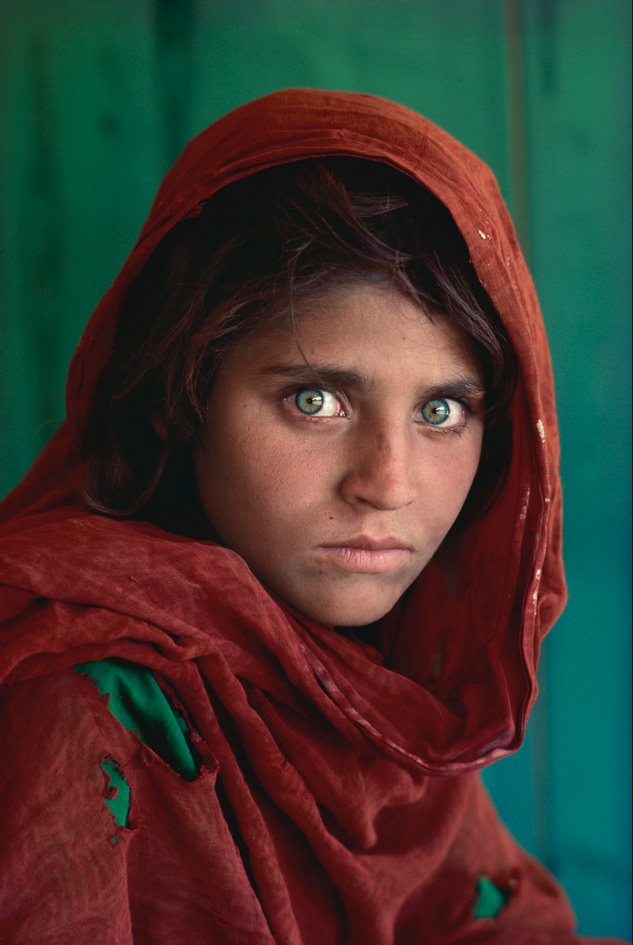
In December 1984, photojournalist Steve McCurry entered a makeshift school tent in Pakistan's Nasir Bagh refugee camp and captured what would become the most recognized magazine cover in National Geographic's history. The Afghan Girl Steve McCurry photographed—later identified as Sharbat Gula—wasn't just another refugee portrait. Those piercing green eyes, that tattered red shawl, that expression mixing defiance with vulnerability: it became the face of an entire generation displaced by war. But here's what most people don't know: the story behind this iconic image is far more complex, ethically fraught, and ultimately tragic than the romanticized narrative suggests.
The photograph's journey from a refugee camp to global icon raises uncomfortable questions about consent, exploitation, and the power dynamics inherent in documentary photography. It's a masterclass in compositional technique and a cautionary tale about the unintended consequences of fame. Sharbat Gula never asked to become a symbol. She didn't receive compensation when her image generated millions in revenue. And when McCurry finally found her seventeen years later, the life she'd lived bore little resemblance to the hopeful narrative Western audiences had projected onto those green eyes.1
Let's examine what makes this photograph work so brilliantly from a technical and aesthetic standpoint—and why that brilliance comes with a significant moral cost.
The Technical Mastery Behind the Afghan Girl Steve McCurry Captured
McCurry shot the portrait using a Nikon FM2 camera with a 105mm Nikkor lens, loaded with Kodachrome 64 film.2 The lighting? Entirely natural. The tent's opening provided soft, directional illumination that wrapped around Gula's face, creating dimensional modeling without harsh shadows. This wasn't studio perfection—it was available light photography executed with extraordinary precision.
The aperture setting was likely around f/5.6, providing sufficient depth of field to keep her face sharp while allowing the background to fall into a complementary blur. That background color—a rich, oxidized green-brown—wasn't accidental. McCurry positioned Gula against a worn chalkboard, creating a color harmony that makes those green eyes explode from the frame.3 The composition follows classical portrait conventions: eyes positioned in the upper third, direct eye contact with the lens, triangular face shape leading the viewer's gaze upward.
But technical excellence alone doesn't explain the photograph's power. What makes this image work is the psychological tension McCurry captured. Gula's expression isn't submissive or grateful—the typical affect expected from refugee subjects. It's wary, penetrating, almost accusatory. Her hands, initially covering her face, had been coaxed away by the teacher who'd granted McCurry access.4 That reluctance never fully disappeared. You can see it in the set of her jaw, the slight tension around her eyes.
McCurry himself was on assignment documenting the Soviet-Afghan War's refugee crisis, visiting more than thirty camps during this trip. He'd been photographing for weeks, accumulating thousands of images. This particular frame took less than five minutes to capture. He clicked the shutter a handful of times, thanked the teacher, and moved on. Neither he nor Gula could have predicted what would follow.5
Composition and Color Theory: Deconstructing Visual Impact
The Afghan Girl photograph operates on multiple compositional levels simultaneously. At its most basic, it's a classic headshot—tightly cropped, centered subject, direct gaze. But look closer. The triangular composition created by her shawl frames her face like Renaissance portraiture, drawing the eye inexorably toward those eyes. The rule of thirds places her irises precisely where they'll command maximum attention.
The color palette is deceptively sophisticated. Kodachrome film rendered colors with particular saturation and warmth, but McCurry's instinct for complementary relationships elevated the technical medium. The red shawl—faded, worn, but still vibrant—creates visual tension against the cool green background. Those green eyes become the fulcrum point where warm and cool tones converge.6 The skin tones, rendered in warm ochres and browns, bridge these opposing color temperatures.
Texture plays a crucial role too. The rough weave of the shawl, the smooth planes of her face, the granular quality of the background—each surface catches light differently, creating visual interest across the entire frame. This textural variation keeps the eye moving, discovering new details with each viewing. The small tear in her shawl, the dirt on her face, the slight asymmetry of her features: these "imperfections" humanize what could otherwise feel like an overly composed studio portrait.
But here's where aesthetic analysis bumps against ethical reality. These compositional choices—the ones that make the photograph so visually arresting—also participate in what critics call the "colonial gaze." The direct stare, the exotic eyes, the markers of poverty presented as aesthetic elements: they position Gula as an object for Western consumption rather than a subject with agency.7 The hidden truth behind the image's composition is that its beauty depends partly on maintaining power imbalances.
The Symbolism of Green Eyes
Western audiences fixated on Gula's green eyes, often attributing them to Alexander the Great's armies or other romanticized historical narratives. The reality is more prosaic: genetic diversity in Afghanistan includes various eye colors, and green eyes, while less common, aren't extraordinary.8 But the Western obsession with her eyes reveals more about the viewer than the subject. Those eyes became a screen onto which audiences projected their own narratives about Afghan women, refugee resilience, and Eastern exoticism.
The photograph's success partly depended on Gula conforming to Western beauty standards while simultaneously appearing "authentically" Afghan. Too beautiful and she'd seem unrepresentative; too ordinary and the image wouldn't have commanded attention. She occupied a precise sweet spot that made her simultaneously relatable and exotic—a deeply problematic dynamic that contemporary documentary photography increasingly interrogates.
The Context: Soviet-Afghan War and Refugee Crisis
To understand the Afghan Girl photograph, you need to grasp what was happening in Afghanistan in 1984. The Soviet invasion, which began in 1979, had devastated the country. By the time McCurry arrived at Nasir Bagh, approximately 3 million Afghans had fled to Pakistan, with another 1.5 million in Iran.9 These weren't orderly refugee camps with international infrastructure—they were sprawling, under-resourced settlements where families lived in tents, survival was precarious, and children like Sharbat Gula had witnessed horrors that would mark them permanently.
Gula's parents had been killed in a Soviet bombing raid. She'd fled her village with her grandmother and siblings, walking for weeks to reach Pakistan. At Nasir Bagh, she attended a makeshift school in a tent—the very location where McCurry would find her. The camp housed thousands of refugees in conditions that barely qualified as humanitarian.10 Disease, malnutrition, and trauma were endemic. Education was sporadic, provided largely by volunteer teachers working with minimal resources.
McCurry's assignment from National Geographic was to document this refugee crisis, to put human faces on statistics that Western audiences found abstract. The magazine had a long tradition of humanizing distant conflicts through portraiture, though this tradition carried its own problematic assumptions about who gets to tell whose stories.11 The Soviet-Afghan War was a Cold War proxy conflict, with the United States funding mujahideen fighters against Soviet forces. American audiences had strategic reasons to care about Afghan refugees—but that care was mediated through geopolitical interests, not pure humanitarianism.
When the photograph appeared on National Geographic's June 1985 cover, it arrived in a specific political context. The Reagan administration was ramping up support for anti-Soviet forces worldwide. Afghan refugees weren't just victims; they were evidence of Soviet brutality, useful for justifying American intervention. The photograph's emotional impact served political purposes, whether McCurry intended that or not.12
The Seventeen-Year Search and Iris Recognition Technology
For nearly two decades, the Afghan Girl remained anonymous. McCurry hadn't recorded her name. The teacher who'd facilitated the photograph couldn't be located. Gula herself had returned to Afghanistan in 1992, married, and settled in the Tora Bora region—yes, the same area that would later become infamous as Osama bin Laden's hideout.13 She had no idea her face had become globally iconic, reproduced millions of times on magazine covers, posters, and murals worldwide.
In 2002, National Geographic launched a formal search to find her. McCurry returned to Pakistan with a team that included forensic experts and iris recognition specialists. The technology they employed was cutting-edge: iris patterns are unique to each individual and remain stable throughout life, making them more reliable than fingerprints for identification purposes.14 The team photographed hundreds of women in the region, scanning their irises against the 1984 image.
They found her in a remote village. The iris match came back at 99.9% certainty—virtually impossible to dispute. But the woman they found bore little resemblance to the girl from 1984. Life had aged her dramatically. The 2002 photograph McCurry took shows the same bone structure, the same eyes—but the face is weathered, lined, exhausted. She looks decades older than her actual age of approximately thirty.15
When McCurry showed her the original photograph, she didn't immediately recognize herself. She'd never seen it before. Her husband hadn't known. Her children hadn't known. The revelation that her face had circulated globally for seventeen years was disorienting, unsettling. National Geographic provided her with financial assistance—the first compensation she'd ever received for the image that had generated enormous revenue for the magazine.16
Sharbat Gula's Life After Discovery
The 2002 discovery thrust Gula into an unwanted spotlight. She gave limited interviews, always through translators, always uncomfortable with the attention. Her statements revealed a woman who'd survived extraordinary hardship but felt no particular connection to the photograph that had made her famous. She'd lost her husband. She'd buried children. She'd lived through Taliban rule, the American invasion, and ongoing instability.17
In 2016, Pakistani authorities arrested her for possessing forged identity documents. Like many Afghan refugees in Pakistan, she'd obtained fraudulent papers to avoid deportation. The arrest became international news—not because document fraud is unusual among refugees, but because she was the Afghan Girl. The Pakistani government deported her to Afghanistan, where she arrived to media fanfare she clearly didn't want.18
The Afghan government, eager for positive publicity, provided her with an apartment and promised support. But as Afghanistan's situation deteriorated, those promises proved hollow. When the Taliban retook control in 2021, Gula's circumstances became dire. In late 2021, she was evacuated to Italy as a refugee—again. The girl who'd fled Soviet bombs in 1984 was fleeing Taliban rule in 2021, her life bookended by displacement.19
The Ethics of Consent and Photographic Exploitation
Here's the uncomfortable question at the heart of the Afghan Girl photograph: was it ethical to take this picture? Gula was a child. She was a refugee living in a camp with no power, no resources, no ability to refuse a foreign photographer with institutional backing. The teacher who granted access wasn't her parent or guardian. She was initially reluctant, covering her face—a culturally significant gesture of modesty that was overridden to get the shot.20
Contemporary photojournalism ethics require informed consent, especially when photographing minors. But in 1984, those standards were less developed. McCurry operated within the accepted practices of his time—which doesn't make those practices right, just typical. The power dynamics were stark: wealthy Western photographer, impoverished refugee child, institutional authority of National Geographic, cultural differences around gender and photography. Every element of the encounter was structured by inequality.
Then there's the question of compensation. The photograph generated millions in revenue through magazine sales, prints, exhibitions, and licensing. Gula received nothing until 2002, and even then, the assistance was framed as charity rather than payment for commercial use of her image.21 Copyright law protects photographers, not subjects. McCurry owns the image legally, but morally? That's murkier.
Critics argue the photograph exemplifies "poverty porn"—the aestheticization of suffering for consumption by privileged audiences. The image's beauty depends on Gula's vulnerability. Her tattered clothing, her displaced status, her youth—these aren't incidental details. They're central to the photograph's emotional impact. We're moved by her suffering, but that movement rarely translates into meaningful action. The photograph becomes a substitute for engagement, allowing viewers to feel they've connected with the Afghan refugee crisis without actually doing anything about it.22
The Colonial Gaze and Western Representation
Afghan voices have been notably absent from most discussions of the Afghan Girl photograph. Western critics, curators, and photographers have analyzed it endlessly, but Gula herself has rarely been asked what she thinks—and when she has, her discomfort is evident. This asymmetry reflects broader patterns in how Western media represents non-Western subjects, particularly women from Muslim-majority countries.
The photograph fits a familiar narrative: the exotic, suffering woman from the East who needs Western attention and rescue. Her green eyes make her legible to Western audiences in ways that brown eyes might not have—they're a point of identification, a bridge that makes her seem less foreign. But this narrative erases Afghan women's agency, reducing them to symbols rather than recognizing them as complex individuals with their own perspectives and desires.23
The fact that Gula wasn't wearing a burqa in the photograph has been cited by some as evidence of Afghan women's pre-Taliban freedom. But this reading ignores context: she was in a school tent, in a women-only space, in a refugee camp where traditional social structures had broken down. The photograph doesn't represent typical Afghan women's dress or circumstances—it captures a specific moment in a specific context. Yet it's been deployed repeatedly to make generalizations about Afghan culture and women's status.
Steve McCurry's Career and Later Controversies
Steve McCurry built his career significantly on the strength of the Afghan Girl photograph. Born in Philadelphia in 1950, he'd been working as a photojournalist for several years before the 1984 assignment that would define his career. His style—saturated colors, strong compositions, humanistic approach—became synonymous with National Geographic's aesthetic.24
But in 2016, controversies emerged that complicated his legacy. A photographer noticed that one of McCurry's images had been heavily manipulated in post-processing—not just color correction or cropping, but substantial alteration of content. A pole had been cloned out. Elements had been removed to "clean up" the composition. As scrutiny increased, more examples surfaced.25
McCurry's response was to reclassify himself as a "visual storyteller" rather than a photojournalist—a distinction that allows for more creative license but also undermines the documentary authority his work had claimed. The controversy cast retrospective doubt on his entire body of work. If recent images were manipulated, what about earlier ones? The Afghan Girl photograph predated digital manipulation, but questions about staging, selection, and representation remained.
The manipulation scandal matters because it speaks to larger questions about photographic truth. Documentary photography derives its power from the assumption that it shows reality. When that assumption breaks down, the entire genre's credibility suffers. McCurry's defenders argue that minor post-processing doesn't invalidate the essential truth of his images. Critics counter that any manipulation betrays the documentary contract with viewers.26 This tension is particularly relevant for understanding contemporary photography ethics.
The Photograph's Cultural Impact and Legacy
The Afghan Girl photograph became more than just an image—it became a cultural touchstone. It's been reproduced on murals in Kabul, referenced in contemporary art, parodied in memes, and cited in policy discussions about refugees. Its influence on photojournalism is undeniable. It established a template for humanitarian portraiture that countless photographers have followed: direct gaze, natural light, cultural signifiers, emotional intensity.27
But what did this influence actually accomplish? Did the photograph improve conditions for Afghan refugees? Did it change policy? The honest answer is: marginally, at best. American aid to Afghanistan in the 1980s was directed toward military resistance to Soviet forces, not humanitarian relief for refugees. The photograph raised awareness but didn't fundamentally alter the geopolitical calculations that produced the refugee crisis in the first place.28
Compared to other iconic war photographs—Nick Ut's image of Phan Thi Kim Phuc fleeing napalm, Dorothea Lange's Migrant Mother, Kevin Carter's vulture photograph—the Afghan Girl is notably less confrontational. It doesn't show violence or death. It presents suffering in an aesthetically palatable form. This palatability may explain its popularity, but it also limits its political force. We can admire the photograph without being disturbed by it, appreciate its beauty without confronting uncomfortable truths about our complicity in the systems that produce refugee crises.
The photograph's second life in the digital age has been particularly strange. It's been memed, filtered, recontextualized in ways that further distance it from its original subject. Gula's face has been used to sell products, promote causes she knows nothing about, and illustrate articles on topics unrelated to Afghanistan. Each reproduction dilutes the connection between image and reality, transforming her from a person into a symbol that can mean whatever viewers want it to mean.29
National Geographic's Editorial Role
The decision to feature the Afghan Girl on National Geographic's cover wasn't obvious. The magazine had thousands of images to choose from in 1985. What made editors select this particular portrait? Part of it was undoubtedly the technical excellence and visual impact. But part was also the photograph's alignment with American foreign policy interests and cultural assumptions about the Muslim world, femininity, and what makes a compelling "victim."
National Geographic has a complex legacy regarding representation. The magazine has published groundbreaking documentary work and also perpetuated Orientalist stereotypes. The Afghan Girl photograph sits at this intersection—genuinely powerful as an image, but also complicit in problematic patterns of representation. The magazine's later efforts to find Gula and provide assistance can be read as genuine concern or as an attempt to retroactively justify the original exploitation.30
Lessons for Contemporary Photography
What should photographers learn from the Afghan Girl photograph? First, that technical excellence and ethical practice aren't the same thing. The photograph works brilliantly as a visual artifact while raising serious moral questions. Second, that subjects' rights and dignity must be centered in documentary work. The fact that Gula received no compensation and wasn't informed about the photograph's use for seventeen years is indefensible by contemporary standards.31
Third, photographers must interrogate their own positionality. McCurry's identity as a wealthy American man photographing an impoverished Afghan girl created power dynamics that shaped every aspect of the encounter. Acknowledging those dynamics doesn't invalidate the work, but ignoring them is irresponsible. Fourth, the gap between aesthetic impact and political effect should temper claims about photography's power to create change. Beautiful images can raise awareness without challenging the structures that produce suffering.
Contemporary photographers working in conflict zones and refugee situations face these questions constantly. Some are developing new approaches: collaborative projects where subjects have input into how they're represented, revenue-sharing agreements, ongoing relationships rather than extractive encounters. These practices acknowledge that documentary photography is always a relationship between photographer and subject, not just a technical act of image capture.32 Understanding portrait photography aesthetics must include these ethical dimensions.
The Afghan Girl photograph also demonstrates how single images can become divorced from context. Most people who've seen the photograph know nothing about the Soviet-Afghan War, refugee camp conditions, or Sharbat Gula's actual life. The image circulates as pure symbol, its meaning determined by viewers' projections rather than historical reality. Photographers and editors bear responsibility for providing context, but audiences must also commit to engaging with images beyond their surface appeal.
Conclusion: Beauty, Exploitation, and Photographic Responsibility
The Afghan Girl Steve McCurry photographed in 1984 deserves better than to be remembered only as those green eyes. Sharbat Gula is a woman who survived extraordinary trauma, who raised children in impossible circumstances, who was displaced multiple times, who never asked for fame and received little benefit from it. The photograph that made her face globally iconic is undeniably powerful—technically brilliant, emotionally resonant, compositionally masterful. But that power came at a cost that Gula bore while others profited.
We can acknowledge the photograph's aesthetic achievement while interrogating the ethics of its creation and circulation. We can appreciate McCurry's skill while questioning the systems that enabled him to photograph vulnerable subjects without meaningful consent or compensation. We can recognize the image's cultural impact while noting its limited political effectiveness. These aren't contradictions—they're the complex realities of documentary photography in an unequal world.
The photograph's ultimate legacy may be as a cautionary tale about the gap between photographic beauty and justice. It shows us that technical mastery isn't enough, that good intentions don't excuse exploitative practices, and that iconic images can simultaneously reveal and obscure the realities they claim to document. For photographers today, the Afghan Girl photograph poses essential questions: Whose stories are we telling? Who benefits from our work? What responsibilities do we bear to the people we photograph? How do we balance aesthetic ambition with ethical obligation?
These questions don't have simple answers. But asking them—seriously, continuously, uncomfortably—is the price of doing documentary work responsibly. The Afghan Girl photograph reminds us that every image contains a human being whose dignity and agency matter more than any photograph's success. That's a lesson worth remembering every time we raise a camera toward another person's face.
Frequently Asked Questions
Who is the Afghan Girl in Steve McCurry's famous photograph?
The Afghan Girl is Sharbat Gula, who was approximately 12-13 years old when photographed by Steve McCurry in December 1984 at Nasir Bagh refugee camp in Pakistan. She remained anonymous until 2002, when National Geographic located her using iris recognition technology. Her parents were killed in Soviet bombing, and she fled Afghanistan with her grandmother and siblings, eventually settling in the refugee camp where McCurry found her attending a makeshift school.33
What camera and film did Steve McCurry use for the Afghan Girl photograph?
McCurry used a Nikon FM2 camera with a 105mm Nikkor lens, loaded with Kodachrome 64 film. The photograph was taken using entirely natural light from the tent opening, with no artificial lighting or flash. The aperture was likely around f/5.6, providing sufficient depth of field while creating a soft background blur. Kodachrome film was renowned for its exceptional color saturation and archival stability, which contributed significantly to the photograph's enduring visual impact and the vibrant rendering of Gula's green eyes against the muted background.34
Did Sharbat Gula receive compensation for the Afghan Girl photograph?
Sharbat Gula received no compensation when the photograph was initially taken in 1984 or during the seventeen years it circulated globally on magazine covers, posters, and exhibitions. Only after National Geographic located her in 2002 did she receive financial assistance from the magazine, though the exact amount has not been publicly disclosed. The photograph generated millions in revenue through magazine sales and licensing, raising significant ethical questions about photographers' obligations to compensate subjects whose images are commercially exploited, particularly vulnerable subjects like refugee children who cannot provide informed consent.35
Where is Sharbat Gula now?
As of 2021, Sharbat Gula is living in Italy as a refugee after being evacuated from Afghanistan following the Taliban takeover. She was previously deported from Pakistan to Afghanistan in 2016 after being arrested for possessing forged identity documents—a common situation among Afghan refugees facing deportation. The Afghan government provided her with an apartment, but conditions deteriorated as the country's situation worsened. Italy granted her refugee status and provided housing and support, marking her third displacement after fleeing Soviet bombing in the 1980s and later instability in Afghanistan.36
What ethical controversies surround the Afghan Girl photograph?
The photograph raises multiple ethical concerns: lack of informed consent from a minor refugee subject, no compensation despite enormous commercial success, power imbalances between wealthy Western photographer and impoverished subject, potential exploitation of suffering for aesthetic purposes ("poverty porn"), and the colonial gaze that positions Afghan women as exotic objects for Western consumption. Additionally, Gula was initially reluctant and covering her face—a culturally significant gesture of modesty that was overridden to capture the image. The photograph's circulation without her knowledge or permission for seventeen years, and its use to represent Afghan refugees generally rather than respecting her individual story, further complicate its ethical standing.37
How was Sharbat Gula identified seventeen years after the original photograph?
In 2002, National Geographic launched a search using iris recognition technology, which analyzes over 200 distinct characteristics in iris patterns that remain stable throughout a person's lifetime. McCurry returned to the region with forensic experts and photographed hundreds of women, scanning their irises against the 1984 image. When they found Sharbat Gula in a remote Afghan village, the iris match returned 99.9% certainty—virtually definitive identification. The technology was more reliable than facial recognition, especially given how dramatically aging and hardship had changed her appearance. The 2002 photograph McCurry took shows the same bone structure and eyes but reveals a face weathered by decades of poverty, conflict, and loss.38
- Sharbat Gula was approximately 12-13 years old when photographed and had never been photographed before that moment.
- Kodachrome film was renowned for its exceptional color saturation and archival stability, contributing significantly to the photograph's enduring visual impact.
- The color theory at work here is sophisticated: the muted, earthy background tones create maximum contrast with her irises while the red shawl provides a complementary accent.
- The teacher's role in convincing Sharbat to remove her hands remains a crucial but often overlooked element of how this photograph came to exist.
- The entire photographic session lasted only minutes, with McCurry taking just a few frames before departing the tent.
- Green eyes are relatively rare among Pashtuns but not unknown, occurring due to genetic variation in the region's population.
- The concept of the colonial gaze in photography refers to how Western photographers have historically framed non-Western subjects as exotic, primitive, or in need of rescue.
- Genetic studies show that eye color variation in Central Asian populations results from complex inheritance patterns rather than singular historical events.
- The Afghan refugee crisis of the 1980s was one of the largest forced displacement events of the Cold War era.
- Nasir Bagh refugee camp, located near Peshawar, Pakistan, was one of dozens of camps housing Afghan refugees throughout the 1980s and 1990s.
- National Geographic's editorial approach historically emphasized individual human stories over systemic political analysis.
- The timing of the photograph's publication coincided with increased American military aid to Afghan mujahideen fighters.
- Sharbat Gula married at approximately age 13 and had four children, though one died in infancy.
- Iris recognition technology analyzes over 200 distinct characteristics in the iris pattern, creating a unique biometric signature.
- The comparison between the 1984 and 2002 photographs provides a stark visual document of the toll that conflict, poverty, and hardship exact on human bodies.
- The exact amount of financial assistance provided to Sharbat Gula has not been publicly disclosed, though National Geographic established a fund for her benefit.
- Sharbat Gula's husband died of hepatitis, leaving her a widow with limited means of support in a society that offers few options for single women.
- The 2016 arrest and deportation highlighted the precarious legal status of Afghan refugees in Pakistan, many of whom face similar circumstances.
- Italy granted Sharbat Gula refugee status in 2021, providing her with housing and support after her evacuation from Afghanistan.
- In conservative Afghan culture, particularly among Pashtuns, photographing women without head covering can be considered immodest or shameful.
- The commercial exploitation of Gula's image without compensation raises significant questions about photographers' obligations to subjects whose images generate revenue.
- The concept of "poverty porn" critiques how images of suffering can satisfy viewers' emotional needs while reinforcing rather than challenging the conditions that produce suffering.
- Feminist critiques of conflict photography emphasize how images of women are often used to justify military intervention under the guise of liberation.
- McCurry has published numerous books and exhibited internationally, becoming one of the most commercially successful photojournalists of his generation.
- The photo manipulation controversy raised questions about whether McCurry's work should be classified as photojournalism or fine art photography, which have different ethical standards.
- The debate over digital manipulation in documentary photography reflects broader anxieties about truth and representation in an age of easily altered images.
- The photograph's influence can be seen in subsequent refugee crisis photography from Syria, Sudan, Myanmar, and elsewhere.
- Studies of humanitarian photography's impact suggest that iconic images rarely translate into sustained policy changes or resource allocation.
- The viral circulation of images in digital culture often severs them from their original contexts, enabling multiple and sometimes contradictory interpretations.
- National Geographic's institutional role in shaping public perceptions of non-Western cultures has been the subject of extensive academic critique.
- Current photojournalism ethics guidelines emphasize informed consent, fair compensation, and ongoing communication with subjects whose images are used commercially.
- Emerging models of collaborative documentary photography seek to redistribute power and agency between photographers and subjects.
- Sharbat Gula's identity was confirmed through iris recognition technology with 99.9% certainty in 2002, seventeen years after the original photograph.
- Kodachrome 64's particular color characteristics—warm saturation and fine grain—were crucial to the photograph's aesthetic qualities.
- The delayed and limited compensation highlights ongoing debates about fair payment and subjects' rights in documentary photography.
- Gula's life trajectory—from Soviet bombing survivor to multiple displacements—illustrates the ongoing Afghan refugee crisis spanning four decades.
- Contemporary photojournalism ethics emphasize informed consent, fair compensation, and subjects' rights to control how their images are used—standards the Afghan Girl photograph violates by current measures.
- The iris recognition technology used represented cutting-edge biometric identification methods in 2002, demonstrating the photograph's cultural significance that justified such extensive search efforts.