You've seen it a thousand times—eleven men casually eating lunch on a steel beam suspended 850 feet above Manhattan, their legs dangling over the void as if they're sitting on a park bench. The lunch atop skyscraper photo has become so embedded in our cultural consciousness that we forget how absolutely insane the image really is. Taken on September 20, 1932, during the construction of Rockefeller Center's RCA Building (now the Comcast Building), this single photograph captured something more than daredevil bravado—it crystallized the audacious spirit of Depression-era America, when men risked everything for a day's wage and the skyline itself was an act of defiance.1
But here's what most people don't know: this wasn't a candid moment. It was staged. A publicity stunt. And that fact doesn't diminish its power one bit—it actually makes the story more fascinating. These workers really were that high up. They really did work without safety equipment. And they really did eat lunch on steel beams. The photo just captured a choreographed version of their everyday reality.
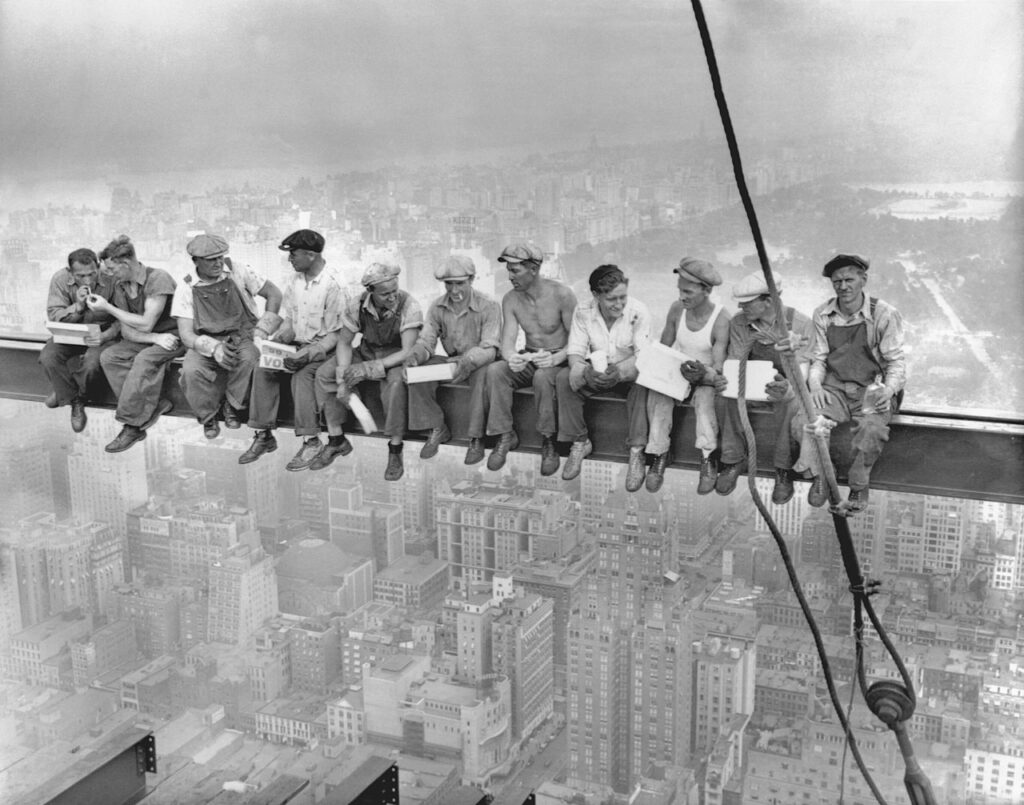
The Visual Composition That Made History
Let's talk about why this particular image burned itself into collective memory when dozens of similar construction photos from the era faded into obscurity. The composition is deceptively simple—a horizontal line of men against the geometric chaos of Manhattan below. But look closer at the visual elements that make it work.2
The beam creates a strong horizontal line that anchors the entire frame, providing visual stability that contrasts sharply with the vertiginous drop below. The workers are arranged in a rhythm—not perfectly spaced, but with enough variation to feel natural while maintaining compositional balance. Some lean back, others lean forward, creating a dynamic visual flow that guides your eye across the frame.
Technical Photography Achievement in 1932
Now consider the technical feat of capturing this shot. In 1932, photographers didn't have lightweight digital cameras with autofocus and image stabilization. They worked with large-format cameras that could weigh 20 pounds or more, using glass plates or sheet film that required precise exposure calculations.3 The photographer—most likely Charles C. Ebbets, though attribution remains disputed—had to position himself on another beam or scaffold to capture this angle, facing the same deadly drop as his subjects.
The lighting conditions presented their own challenges. Shooting in bright midday sun at 850 feet meant harsh shadows and extreme contrast. Yet the final image maintains remarkable detail in both highlights and shadows, suggesting the photographer used a relatively small aperture (perhaps f/11 or f/16) for maximum depth of field, with a fast enough shutter speed to freeze any movement from wind or the workers themselves.4
The Economic Context: Why Men Climbed Into the Sky During the Depression
Here's the brutal economic reality that made this photo possible: in 1932, America was drowning in the Great Depression. Unemployment hit 25%. Banks failed. Breadlines stretched around blocks. And yet Rockefeller Center was rising, floor by floor, beam by beam, employing approximately 40,000 workers during its construction.5
Ironworkers—the men who walked steel beams at deadly heights—earned about $15 per day, roughly $330 in today's dollars. That was premium money when factory workers made $2 per day, if they could find work at all. The job attracted immigrants, particularly Irish, Italian, and Mohawk workers, who brought specialized skills and a willingness to risk their lives for economic survival.6
The Mohawk connection deserves special attention. Men from the Kahnawake reserve near Montreal had been working high steel since the 1880s, when they helped build bridges across the St. Lawrence River. By the 1930s, Mohawk ironworkers had established a community in Brooklyn's North Gowanus neighborhood, commuting to Manhattan construction sites. Their presence in this photo—several workers are believed to be Mohawk, though definitive identification remains elusive—represents a crucial but often overlooked chapter in both Native American history and New York's construction heritage.
What Safety? Construction Standards in 1932
Look at the photo again. No harnesses. No safety lines. No hard hats. The workers wear flat caps, work shirts, and regular trousers. One man casually lights a cigarette. Another holds a bottle—probably water or soda, though persistent rumors suggest alcohol, which was technically illegal during Prohibition but commonly consumed on construction sites.7
This wasn't recklessness; it was standard practice. Construction safety regulations in 1932 were virtually nonexistent compared to modern standards. The Occupational Safety and Health Administration (OSHA) wouldn't exist for another 38 years. Falls were considered an occupational hazard, accepted as the price of building skyward. During Rockefeller Center's construction, multiple workers died, though exact numbers remain disputed due to incomplete record-keeping.8
Today's construction workers would be arrested for working under these conditions. OSHA mandates fall protection at any height above six feet. Workers must use personal fall arrest systems, guardrails, or safety nets. The contrast illuminates how dramatically workplace safety culture has evolved, though contemporary discussions about sustainable and ethical practices in all industries continue this evolution.
The Publicity Machine: Rockefeller Center's Marketing Genius
Let's address the elephant on the beam: this was a publicity stunt, pure and simple. Rockefeller Center's developers hired photographers to document construction, but more importantly, to create compelling images that would generate press coverage and public interest. The lunch atop skyscraper photo was part of a broader campaign that included multiple shots taken the same day.9
Why stage these photos? In 1932, Rockefeller Center represented a massive gamble. John D. Rockefeller Jr. was building the largest private construction project in modern history during an economic catastrophe. Office space sat vacant across Manhattan. He needed to generate excitement, demonstrate progress, and create a narrative of American resilience and ambition. These photos weren't just documentation—they were marketing and photography working in perfect synchronization.
The strategy worked brilliantly. The photo appeared in newspapers across the country, capturing public imagination precisely as intended. It showed Americans that despite the Depression, despite the breadlines and bank failures, the country was still building, still reaching upward, still daring to dream big.
The Other Photos Nobody Remembers
Here's what's fascinating: the lunch photo wasn't the only image from that September 20th shoot. Photographers captured workers napping on beams, tossing a football, and performing other staged activities. Some images show the same workers in different poses. Yet only the lunch photo achieved iconic status. Why?
The answer lies in compositional psychology. The lunch photo balances danger with normalcy in perfect tension. The men aren't performing acrobatics or obviously showing off—they're doing something utterly mundane (eating lunch) in an utterly extraordinary context (850 feet up). This juxtaposition creates cognitive dissonance that makes the image unforgettable. The other photos, showing more obviously staged stunts, lacked this subtle power.10
The Mystery of Attribution: Who Really Took the Photo?
For decades, the lunch atop skyscraper photo existed without a confirmed photographer. The image was credited simply to "Bettmann/CORBIS" or listed as photographer unknown. This anonymity is itself revealing—in the 1930s, press photographers were workmen like the ironworkers they photographed, rarely receiving individual credit for their images.
Modern research suggests Charles C. Ebbets as the most likely photographer, though Thomas Kelley and William Leftwich have also been proposed. Evidence supporting Ebbets includes his known work for Rockefeller Center's publicity department and stylistic similarities with other confirmed Ebbets photos. However, definitive proof remains elusive because original negatives and comprehensive assignment records have been lost to time.11
This uncertainty doesn't diminish the photo's power—if anything, it enhances its mythic quality. The anonymous photographer becomes an everyman figure, much like the unidentified workers, representing collective achievement rather than individual glory. It's a fitting parallel for a project that employed thousands of workers whose individual contributions have been largely forgotten while the building itself endures.
The Quest to Name the Workers: Identification Status
For 80 years, the eleven men in the photo remained anonymous. Then in 2012, researchers examining newly discovered negatives and conducting extensive interviews with descendants identified two workers with reasonable certainty: Joseph Eckner and Joe Curtis. This breakthrough came from painstaking research comparing facial features, clothing details, and family testimony.12
Worker Identification Status Table
- Worker #1 (far left): Unidentified - Believed to be Mohawk ironworker based on facial features and clothing
- Worker #2: Unidentified - Possible Irish immigrant based on family claims, disputed
- Worker #3: Joseph Eckner - Confirmed through family photographs and descendant testimony
- Worker #4: Unidentified - Multiple conflicting claims from different families
- Worker #5 (lighting cigarette): Joe Curtis - Confirmed through distinctive facial features and family records
- Worker #6 (center): Unidentified - Claimed by both Irish and Italian families, no consensus
- Worker #7: Unidentified - Believed to be Mohawk based on contemporary accounts
- Worker #8: Unidentified - Possible identification disputed by multiple researchers
- Worker #9: Unidentified - Claimed by family in Slovakia, evidence inconclusive
- Worker #10: Unidentified - No credible identification claims
- Worker #11 (far right): Unidentified - Multiple conflicting family claims
The identification quest reveals something profound about historical memory. These men helped build one of America's most famous landmarks, yet their names were lost almost immediately. Their families treasured stories and photographs, but without documentation, those memories couldn't be definitively connected to the iconic image. It's a reminder that history often remembers monuments while forgetting the hands that built them.13
The Photo's Journey From Publicity to Icon
Here's a curious fact: the lunch atop skyscraper photo didn't become truly iconic until decades after it was taken. In 1932, it appeared in newspapers, generated some publicity, and then largely faded from public consciousness. The workers moved on to other jobs. The photographer remained anonymous. The image sat in archives, one among thousands of Depression-era construction photos.
The photo's resurrection began in the 1970s and accelerated through the 1980s and 1990s as poster companies discovered its commercial appeal. Suddenly, the image appeared in college dorm rooms, office cubicles, and coffee shops worldwide. It became a symbol of working-class heroism, American ambition, and New York City's indomitable spirit.14
This delayed recognition raises interesting questions about how images acquire cultural meaning. The photo's significance wasn't inherent—it was constructed over time through repeated reproduction, cultural context, and collective interpretation. In 1932, it was publicity. By 2000, it was art. The image didn't change; our relationship to it did.
Cultural Impact and Media Appearances
The photo's journey to icon status accelerated through countless recreations, parodies, and homages. It's been recreated by everyone from Sesame Street characters to celebrities at charity events. Artists have reimagined it in paintings, sculptures, and digital art. Advertisers have appropriated its composition for campaigns selling everything from beer to financial services.
Some notable appearances include: a 1993 recreation by female ironworkers to mark the 61st anniversary, multiple Lego versions, appearances in films and television shows, and countless social media memes. Each reproduction reinforces the original's iconic status while often stripping away historical context. The staged publicity stunt becomes authentic documentary. The dangerous working conditions become nostalgic Americana. The immigrant workers become generic symbols of American labor.15
Decoding the Beam: Location and Architectural Context
Let's get specific about location. The photo was taken on the 69th floor of the RCA Building during its construction phase. The building would eventually rise to 70 floors (later expanded to 70 floors above ground), making it the centerpiece of Rockefeller Center. That beam, positioned 850 feet above street level, was part of the structural framework for what would become office space.16
Construction of the RCA Building followed this timeline: groundbreaking in 1931, steel framework erected through 1932, topped out in 1933, and officially opened in 1933. The September 20, 1932 photo captured a crucial moment—the building was nearing its full height, making the publicity push particularly timely. Rockefeller Center needed to demonstrate progress to potential tenants and investors.
What happened to that specific beam? It was eventually encased in the building's structure, now buried within walls, floors, and ceilings. The exact spot where those eleven men sat is probably someone's office floor or ceiling, the steel beam still there but invisible, supporting the building just as it was designed to do. There's something poetic about that—the photo preserved a moment that physically still exists but can never be seen again.
The Psychology of Casual Courage
Why do the men look so relaxed? This question haunts everyone who studies the photo. Several psychological and cultural factors explain their apparent nonchalance, and none of them are simple.
First, habituation. These men worked at height every day. What seems terrifying to ground-dwellers was their normal workplace. Psychological research shows humans can adapt to almost any environment through repeated exposure. The ironworkers' brains had recalibrated risk assessment—the beam felt normal because it was normal, for them.17
Second, masculine culture. Construction sites in the 1930s demanded performative toughness. Showing fear was unacceptable. Workers who appeared nervous at height faced ridicule and potentially lost employment. The casual poses in the photo reflect this cultural expectation—whether or not the men felt afraid internally, they couldn't show it externally.
Third, economic necessity. When the alternative is unemployment during the Depression, you climb the beam. You eat lunch 850 feet up. You don't complain. The photo captures not just physical courage but economic desperation masked as bravado.
Fourth, the staged nature. Knowing photographers were present likely influenced behavior. The workers were performing, consciously or unconsciously, for the camera. This doesn't make their courage less real—they were still genuinely at deadly height—but it adds another layer of complexity to interpreting their casual demeanor.
Comparing Depression-Era Photography: Why This Image Endured
The 1930s produced countless iconic photographs: Dorothea Lange's "Migrant Mother," Walker Evans' Alabama tenant farmers, Margaret Bourke-White's industrial landscapes. Each captured Depression-era America from different angles. So why did this particular construction photo achieve comparable iconic status?
Unlike Lange's work, which emphasized suffering and desperation, the lunch photo projects defiant optimism. The workers aren't victims—they're builders. They're creating something monumental despite economic catastrophe. This narrative proved more commercially viable and emotionally satisfying than images of poverty and displacement.18
The photo also benefits from compositional simplicity. Eleven men, one beam, one city below. It's immediately readable, requiring no context to understand the basic situation. Compare this to more complex documentary images that demand historical knowledge to fully comprehend. The lunch photo's visual clarity made it perfect for reproduction and commercial use.
Additionally, the photo's ambiguity allows multiple interpretations. Is it about courage? American ambition? Working-class heroism? Immigrant contributions? Dangerous working conditions? All of the above? This interpretive flexibility lets different audiences project different meanings onto the same image, expanding its cultural resonance across time and context.
Copyright, Commerce, and the Public Domain Question
The lunch atop skyscraper photo has generated millions of dollars in licensing fees over decades. Originally held by the Bettmann Archive, the image was acquired by Corbis (founded by Bill Gates) in 1995, then sold to Getty Images in 2016. This commercial history raises fascinating questions about who profits from historical images and whether that's appropriate.19
Is the photo in the public domain? The answer is complicated. Images published before 1928 are definitively in the public domain in the United States. Images published between 1928 and 1963 are in the public domain only if copyright wasn't renewed. For the lunch photo, published in 1932, the copyright status depends on whether proper renewal occurred—and records from that era are often incomplete or contradictory.
Getty Images claims copyright and actively licenses the image, though some legal scholars argue it should be in the public domain. This uncertainty hasn't stopped widespread reproduction, both authorized and unauthorized. The photo's ubiquity has made enforcement difficult—it appears on thousands of websites, in countless publications, and on merchandise worldwide.
The commercial exploitation raises ethical questions. The workers received their day wages and nothing more. Their descendants have no claim to licensing revenue. The photographer, if it was Ebbets, was likely a salaried employee whose work belonged to his employer. The only beneficiaries have been successive corporate copyright holders. Is this fair? Legal, perhaps. But fair?
Modern Recreations and the Rockefeller Center Experience
Rockefeller Center has embraced the photo's iconic status, though not without controversy. The Top of the Rock observation deck, which opened to the public in 2005, offers views from near where the photo was taken. Visitors can stand at similar heights (albeit behind safety glass) and imagine the workers' experience.20
Various organizations have staged recreations, some respectful, others exploitative. A 1993 recreation by female ironworkers made a powerful statement about gender barriers in construction trades. Celebrity charity events have featured sanitized, safety-harnessed versions that miss the original's danger entirely. Each recreation inevitably comments on the original, whether intentionally or not.
The most interesting recreations engage critically with the photo's context. Art projects that highlight the workers' anonymity, or emphasize the dangerous working conditions, or explore the immigrant experience, add depth to our understanding. Recreations that simply reproduce the composition for commercial purposes or entertainment flatten the image's historical complexity into mere spectacle.
Lessons for Contemporary Photography
What can modern photographers learn from this 92-year-old image? More than you might think. The photo demonstrates that powerful images often combine documentary authenticity with conscious composition. Yes, it was staged, but the danger was real. The workers were genuinely at height, genuinely eating lunch, genuinely comfortable with their extraordinary workplace. The staging enhanced rather than fabricated the truth.21
The photo also shows how context shapes meaning. Divorced from its publicity origins and Depression-era economic context, the image has been reinterpreted countless times. Contemporary photographers should consider how their images might be understood differently in future contexts, by audiences with different cultural frameworks and historical knowledge.
Technical lessons abound too. The photographer achieved remarkable depth of field, keeping both foreground workers and background cityscape in focus. The composition balances horizontal stability with vertical danger. The lighting, though harsh, emphasizes texture and dimension. These aren't happy accidents—they're the result of skill, experience, and understanding how cameras translate three-dimensional reality into two-dimensional images.
Perhaps most importantly, the photo demonstrates that iconic images often capture contradictions: danger and normalcy, individual and collective, moment and timelessness. Photographers seeking to create meaningful work might focus less on perfect technical execution and more on finding subjects that embody complex, even contradictory truths about human experience.
The Unresolved Questions That Keep Us Looking
Ninety-two years later, the lunch atop skyscraper photo still generates questions without definitive answers. Who exactly were all eleven men? Who took the photograph? Was anyone actually afraid despite their casual poses? Did they understand they were creating an iconic image, or did it feel like just another publicity stunt? What did they talk about during that lunch? Did they remain friends after the job ended? How many survived the Depression? How many lived to see the photo become famous?
These unanswered questions are part of the photo's enduring appeal. It's a window into a moment we can see but never fully understand. We can analyze composition, research context, and interview descendants, but we can't truly know what it felt like to sit on that beam, 850 feet above Manhattan, eating lunch while a photographer captured your casual courage for posterity.
The photo reminds us that history is built by ordinary people doing extraordinary things, often without recognition. Those eleven workers helped create one of America's most famous landmarks, and for 80 years, their names were lost. They risked their lives for wages that seem impossibly low today. They worked without safety equipment that modern regulations consider essential. And yet they built the skyline we still admire.
In an age of AI photography and digital manipulation, the lunch atop skyscraper photo stands as testament to a different era of image-making. No Photoshop, no safety nets (literal or figurative), no second chances. Just eleven men, one beam, one photographer, and a moment that somehow captured something essential about American ambition, working-class courage, and the human capacity to find normalcy in extraordinary circumstances.
The next time you see this image—and you will see it again, because it's everywhere—look closer. Notice the individual faces, the specific details, the cigarette smoke, the lunch items, the casual body language. Remember that these were real people with names (mostly forgotten), families (mostly anonymous), and lives (mostly unrecorded) beyond this single frozen moment. The photo's power lies not just in its dramatic composition but in this tension between the spectacular and the ordinary, between the moment captured and the lives that continued beyond the frame.
Frequently Asked Questions
Was the lunch atop skyscraper photo staged or real?
The photo was staged as a publicity stunt for Rockefeller Center, but the danger was completely real. The workers genuinely sat on a steel beam 850 feet above street level without safety equipment. While the lunch break was arranged for photographers, ironworkers regularly ate lunch at height during construction. The staging enhanced a real practice rather than fabricating something entirely artificial.22
Who were the eleven workers in the photograph?
Only two workers have been identified with reasonable certainty: Joseph Eckner and Joe Curtis, confirmed through 2012 research comparing family photographs and descendant testimony. The other nine remain unidentified, though multiple families have made claims. The workers were likely a mix of Irish, Italian, and Mohawk ironworkers, typical of Depression-era construction crews. The identification quest continues, with researchers examining newly discovered photographs and conducting interviews with descendants.23
How high were the workers in the lunch atop skyscraper photo?
The workers sat on a steel beam approximately 850 feet (260 meters) above street level, on what would become the 69th floor of the RCA Building (now Comcast Building). To put this in perspective, that's roughly equivalent to an 85-story building by modern standards, or about the height of a 70-story skyscraper. A fall from this height would be instantly fatal, yet the workers had no safety harnesses, nets, or other protective equipment—standard practice for 1930s construction.24
Who took the famous lunch atop skyscraper photo?
The photographer is most likely Charles C. Ebbets, though attribution remains disputed. Thomas Kelley and William Leftwich have also been suggested as possible photographers. All three worked for Rockefeller Center's publicity department in 1932. The uncertainty stems from incomplete record-keeping and the common practice of not crediting individual photographers for press and publicity images. Evidence supporting Ebbets includes stylistic analysis and his known work on other Rockefeller Center publicity photos, but definitive proof has never been found.25
When did the lunch atop skyscraper photo become famous?
The photo was taken September 20, 1932, and published October 2, 1932, in the New York Herald Tribune, generating publicity for Rockefeller Center. However, it didn't achieve iconic status until decades later. The image's resurrection began in the 1970s and accelerated through the 1980s-1990s when poster companies discovered its commercial appeal. By the 2000s, it had become one of the most reproduced photographs in history. This delayed recognition is unusual—the photo's cultural significance was constructed over time rather than being immediately apparent.26
Is the lunch atop skyscraper photo in the public domain?
The copyright status is complicated and disputed. Published in 1932, the photo would be in the public domain if copyright wasn't properly renewed between 1959-1963. Getty Images (which acquired the image through Corbis) claims copyright and actively licenses it. However, some legal scholars argue incomplete or improper renewal placed it in the public domain. The uncertainty hasn't prevented widespread reproduction, both authorized and unauthorized. For commercial use, most organizations obtain licenses from Getty Images to avoid potential legal issues, though the underlying copyright claim remains questionable.27
- The photograph was published in the New York Herald Tribune on October 2, 1932, as part of a publicity campaign for Rockefeller Center.
- The photograph demonstrates classic principles of documentary photography while maintaining artistic composition. More on documentary photography's importance at Why Is Documentary Photography Important Nowadays?
- Large-format cameras of the era typically used 4x5 or 8x10 inch film plates, requiring manual focus and exposure settings.
- Period cameras like the Graflex Speed Graphic, commonly used for press photography, could achieve shutter speeds up to 1/1000 second.
- According to historical records, Rockefeller Center construction provided crucial employment during the Depression's darkest years.
- Mohawk ironworkers gained legendary status for their fearlessness at height, though recent scholarship questions whether this was cultural trait or economic necessity combined with specialized training.
- Prohibition ended in December 1933, just over a year after this photo was taken.
- Modern construction safety requires fall protection systems, hard hats, safety harnesses, and comprehensive training—standards that would have been unimaginable in 1932.
- Other photos from the same session show workers sleeping on beams, playing football, and engaging in various activities—all staged for maximum dramatic effect.
- The human brain responds strongly to unexpected juxtapositions, making the casual lunch scene more memorable than obviously performative images.
- The Smithsonian has documented the ongoing attribution controversy and research efforts.
- The 2012 documentary "Men at Lunch" investigated the workers' identities, focusing particularly on claims that two men were from Shanaglish, Ireland.
- This parallels broader issues in photographic documentation of working-class subjects throughout history.
- The photo's commercial licensing through Corbis (later acquired by Getty Images) generated millions in revenue, though none reached the workers or their families.
- This transformation mirrors broader patterns in how nostalgic photography reshapes historical understanding.
- The RCA Building was renamed the GE Building in 1988 and became the Comcast Building in 2015, though many New Yorkers still refer to it by its original name.
- Modern psychology recognizes this as "risk homeostasis," where perceived danger decreases with familiarity, though actual danger remains constant.
- This reflects broader patterns in how societies prefer triumphant narratives over uncomfortable truths about economic inequality.
- The Internet Archive provides access to historical versions of the photograph for research purposes.
- The observation deck is on the 67th-70th floors, close to but not exactly where the original photo was taken on the 69th floor during construction.
- This balance between documentation and artistry remains central to contemporary discussions about post-documentary photography.
- Multiple photos were taken during the same session, showing workers in various staged poses, all at genuine deadly heights.
- The 2012 documentary "Men at Lunch" investigated worker identities but reached definitive conclusions for only two men.
- Modern construction safety regulations require fall protection at any height above six feet, making the 1932 conditions unthinkable today.
- Original negatives and comprehensive assignment records have been lost, making definitive attribution impossible without additional evidence.
- The transformation from publicity photo to cultural icon demonstrates how images acquire meaning through repeated reproduction and changing cultural contexts.
- Copyright law for works published between 1928-1963 is particularly complex, requiring case-by-case analysis of renewal records.