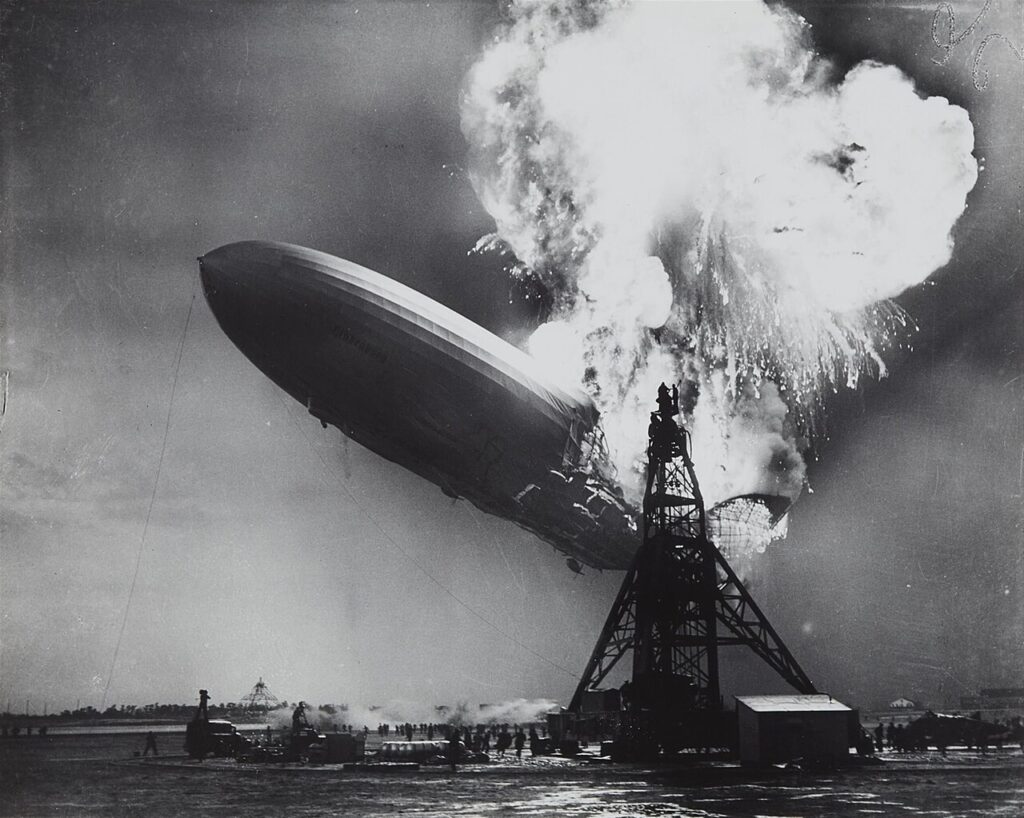
On May 6, 1937, at approximately 7:25 PM, photographer Sam Shere stood at Lakehurst Naval Air Station in New Jersey, his 4x5 Speed Graphic camera ready. Within seconds, the massive German airship Hindenburg erupted into flames, and Shere—acting purely on instinct—captured what would become the definitive hindenburg disaster photo 1937. He didn't even raise the camera to his eye. There wasn't time. The entire catastrophe, from first spark to crumpled wreckage, lasted just 32 seconds.1
That single frame—shot without looking, processed in a darkroom hours later, and transmitted across the world via wirephoto technology—became more than documentation. It became the visual embodiment of technological hubris, the end of the airship era, and a watershed moment in disaster photography. But why this image? Twenty-two photographers were present that evening, all with similar equipment, all witnessing the same catastrophe. What made Shere's photograph the one that endured?
The Photographer Behind the Lens: Sam Shere's Journey to Lakehurst
Sam Shere wasn't a household name before May 6, 1937—and paradoxically, he remains relatively obscure even after capturing one of history's most recognizable images. Born in 1905, Shere worked for International News Photos (INP), a wire service that competed fiercely with Associated Press and Acme Newspictures.2 Wire service photographers lived by speed and instinct—getting the shot, developing it fast, and transmitting it faster.
The assignment seemed routine. The Hindenburg had completed nine successful transatlantic crossings in 1936, its inaugural season. This flight from Frankfurt, Germany, carried 97 people—36 passengers and 61 crew members. Shere joined the crowd of journalists, photographers, and newsreel cameramen who regularly covered the airship's arrivals at Lakehurst. These weren't exactly breaking news events; they were spectacles, public relations opportunities, visual fodder for the papers.3
Shere's career before the Hindenburg consisted of the standard photojournalism grind: political events, crime scenes, human interest stories. His work after that day? It continued in much the same vein, though the Hindenburg photo opened doors. Yet unlike other photographers whose single iconic image launched them into celebrity—think Joe Rosenthal with Iwo Jima—Shere remained a working photojournalist, his name often absent even when his most famous photograph appeared in print.4
The Speed Graphic: The Photojournalist's Weapon of Choice
Every photographer at Lakehurst that evening carried essentially the same tool: the 4x5 Speed Graphic, manufactured by Graflex. This wasn't coincidence—it was industry standard. From the 1930s through the 1950s, the Speed Graphic dominated American photojournalism so completely that it became synonymous with press photography itself.5
Technical Specifications and Limitations
The Speed Graphic shot 4x5 inch sheet film—large format by today's standards, which meant exceptional detail but also significant constraints. Each exposure required manually inserting a film holder, removing the dark slide, making the exposure, replacing the dark slide, and removing the holder before inserting the next one. You couldn't rapid-fire shots. You had to make each frame count.6
The camera featured both a focal plane shutter and a lens-mounted shutter, offering flexibility in different lighting conditions. Most press photographers used a 127mm Kodak Ektar lens, which provided a slightly wide-angle view—ideal for capturing scenes with context. The film speed? By modern standards, laughably slow. The fastest commonly available film in 1937 had an ASA rating around 40-50, requiring either bright light or long exposures.7
But here's where the Speed Graphic earned its reputation: it was built like a tank, reliable under pressure, and featured a brilliant optical viewfinder mounted on top. This viewfinder—a simple wire frame affair—allowed photographers to compose shots quickly without looking through the lens. It's this feature that enabled Shere's instinctive capture. When the Hindenburg ignited, he didn't have time for precision. He pointed and shot.
The 32-Second Catastrophe: Timeline and Context
Understanding when Shere's photograph was taken requires reconstructing those horrific 32 seconds. The Hindenburg disaster unfolded with devastating speed, but it wasn't instantaneous. There was a sequence, a progression that multiple photographers and newsreel cameramen documented from different angles and moments.8
7:25:00 PM - The Hindenburg approaches the mooring mast. Weather has delayed landing; thunderstorms passed through earlier. The ship vents hydrogen to reduce lift for landing.
7:25:09 PM - First flames appear near the top of the tail section, likely ignited by static discharge or electrical spark.
7:25:11 PM - Fire spreads rapidly through the hydrogen cells. The rear section is fully engulfed.
7:25:15-20 PM - Shere captures his photograph. The fireball has consumed approximately one-third of the airship. The tail section is collapsing toward the ground.
7:25:34 PM - The entire structure lies on the ground, a twisted skeleton wreathed in flames.
Shere's image captures the moment when the disaster was undeniable but not yet complete—when the Hindenburg was simultaneously an airship and an inferno. The forward section still maintains some structural integrity. The ground crew, visible as tiny silhouettes, haven't fully comprehended what's happening. This temporal positioning is crucial to the photograph's power. It shows transformation in progress, the instant when one reality becomes another.9
The Instinctive Shot: 'I Didn't Even Have Time to Get It Up to My Eye'
Shere's most famous quote about the photograph reveals everything about how it came to exist: "I didn't even have time to get it up to my eye." This wasn't false modesty or dramatic embellishment. It was literal truth. When the Hindenburg ignited, Shere reacted with pure muscle memory, pointing his Speed Graphic at the airship and triggering the shutter.10
This method—hip shooting, instinctive photography, whatever you want to call it—was both necessity and technique. The Speed Graphic's top-mounted viewfinder made it possible. Shere had trained his eye and hands to work together, to compose without conscious thought. Years of wire service work had built this reflex. When news broke, you shot first and asked questions later.
But there's something else in that quote: the singular nature of his capture. "I didn't even have time" implies he wanted a second shot but couldn't manage it. The Speed Graphic's manual film loading meant his next frame would have required 10-15 seconds of fumbling with film holders. By then, the Hindenburg was on the ground. Other photographers with their cameras already raised, already focused, captured the subsequent moments. Shere had one chance, and his instinct nailed it.11
Composition by Instinct: Why This Frame Works
Look at the composition. The fireball dominates the right side of the frame, a massive bloom of flame and smoke that draws the eye immediately. But the left side shows the forward section still intact, still recognizable as an airship. This balance—destruction and structure, chaos and order—creates visual tension that makes the image unforgettable. The ground crew silhouettes provide scale, emphasizing the Hindenburg's enormous size even as it dies.12
The horizontal orientation captures the full length of the disaster. A vertical framing would have emphasized the height but lost the narrative sweep. The slight upward angle places the viewer on the ground, among the witnesses, experiencing the horror from a human perspective rather than an omniscient viewpoint. These compositional choices weren't conscious decisions—they were the result of trained instinct meeting extraordinary circumstances.
The Competition: 22 Photographers and Why Shere's Image Endured
Shere wasn't alone. Twenty-two still photographers and numerous newsreel cameramen documented the Hindenburg's final moments. Murray Becker of Associated Press captured powerful images. Gus Pasquerella shot from different angles. The newsreel footage, particularly Herbert Morrison's audio-accompanied film, became equally iconic.13 So why did Shere's photograph become THE image?
Timing played a role. His frame captured the optimal moment—dramatic enough to convey catastrophe, early enough to show the airship's form. But timing alone doesn't explain it. Other photographers shot similar moments. The answer lies in a combination of factors: composition, distribution, and perhaps luck.
Murray Becker's photographs, particularly his ground-level shots showing the framework collapsing, are technically excellent and emotionally powerful. They appear in many historical collections of the disaster. But they lack Shere's balance of recognizable structure and consuming fire. Becker's images show either too much destruction or too little—they miss that perfect transitional instant.
The newsreel footage offers something photographs can't: motion, sound, the temporal unfolding of tragedy. Herbert Morrison's anguished narration—"Oh, the humanity!"—became as iconic as any still image. But newsreels required theaters for viewing. Photographs could be printed in newspapers, posted in public spaces, reproduced endlessly. They were accessible, immediate, and permanent in ways film wasn't.14
Distribution and the Wire Service Advantage
International News Photos' distribution network gave Shere's image a crucial advantage. Within hours of the disaster, his photograph traveled via wirephoto technology to newspapers across America and internationally. Wirephoto—a system that converted photographs into electrical signals transmitted over telephone lines—was still relatively new in 1937, having been introduced commercially in the 1920s.15
The process was slow by modern standards. A single photograph took about seven minutes to transmit. But compared to physical transport of prints or negatives, it was miraculous. Newspapers in California could run the Hindenburg photograph in their morning editions, just hours after the disaster occurred in New Jersey. This rapid, widespread distribution meant Shere's image reached millions of viewers simultaneously, imprinting itself on public consciousness before competing photographs could gain traction.
From Negative to Icon: The Darkroom and Distribution Process
After capturing the image, Shere faced the next challenge: development. In 1937, this meant a race against deadline and competing photographers. He rushed his film holders to a darkroom—likely a temporary setup at Lakehurst or a facility in nearby New York—where technicians processed the 4x5 sheet film using standard techniques of the era.16
The development process for sheet film was straightforward but time-sensitive. The exposed film went into a tray of developer, where the latent image gradually appeared. Too little time and the image would be thin, lacking density. Too much and it would block up, losing detail in the highlights—critical when photographing a fireball. The developer was then stopped, the film fixed to make it permanent, washed, and dried.
From the negative, technicians made prints for wirephoto transmission. The wirephoto system required high-contrast prints with good tonal separation. The print was wrapped around a rotating drum, and a photoelectric cell scanned it line by line, converting light and dark values into electrical signals. On the receiving end, another machine reversed the process, exposing photographic paper to recreate the image.17
By midnight, Shere's photograph was appearing in newsrooms across the country. By morning, it was on front pages. The speed was unprecedented—a disaster in New Jersey, photographed at 7:25 PM, visible to millions by breakfast. This rapid dissemination helped establish the image as the definitive visual record before the public had processed the event itself. The photograph didn't just document history; it shaped how people understood what had happened.
Visual Analysis: Deconstructing the Power of the Image
Strip away the historical significance and examine the photograph purely as a visual object. What makes it work? The fireball itself is the obvious focal point—a massive, almost organic form of flame and smoke that dominates the frame's right side. Its shape suggests violence and chaos, yet there's a terrible beauty in the way the fire blooms against the darkening sky.18
The lighting conditions were challenging. At 7:25 PM in early May, the sun was setting. The sky was overcast from earlier storms. Natural light was dim, yet the fire provided its own illumination—bright enough to properly expose the film but not so bright as to completely blow out the highlights. This balance between ambient dusk light and firelight creates the photograph's dramatic tonal range. The sky reads as a mid-gray, the ground as darker gray, the fire as brilliant white, and the airship's framework as black silhouette.
Black and white was the only option in 1937 for news photography, but it serves the image well. Color might have been more visceral, more immediately shocking. But monochrome abstracts the disaster slightly, transforming it from raw documentation into something closer to art. The lack of color focuses attention on form, contrast, and composition rather than the literal horror of burning hydrogen and human bodies.19
The Human Element: Silhouettes and Scale
Look at the ground crew silhouettes in the foreground. They're small, dark shapes against the lighter ground, and they provide crucial context. Without them, the Hindenburg could be any size—the photograph could be showing a model or a small fire. The human figures establish scale, making clear that we're witnessing something enormous. They also provide emotional entry points. We see people watching, presumably horrified, giving us permission to look, to witness, to feel.
The silhouettes are anonymous. We can't see faces or individual reactions. This anonymity universalizes the experience. They could be anyone. We could be them. This identification draws viewers into the photograph, making it not just a document of a specific event but a representation of human vulnerability in the face of disaster.
Historical Impact: The End of the Airship Era
The Hindenburg disaster killed 36 people—13 passengers, 22 crew members, and one ground crew member. Remarkably, 62 people survived, many by jumping from the burning airship as it neared the ground. But the death toll alone doesn't explain the disaster's historical significance. Other transportation accidents of the era killed more people with less fanfare. What made the Hindenburg disaster a watershed moment was the combination of extensive media coverage, symbolic resonance, and perfect timing.20
The disaster effectively ended commercial passenger airship travel. Not immediately—there were discussions of continuing with helium-filled ships—but the public's faith was shattered. The Hindenburg represented German technological achievement, luxury travel, and the future of aviation. Its destruction in 32 seconds, witnessed by millions through photographs and newsreels, demonstrated the technology's fundamental vulnerability. Hydrogen, the gas that gave airships their lift, was also their fatal flaw.21
Shere's photograph became the visual shorthand for this technological failure. When people thought of the Hindenburg, they saw his image. When they thought of airships, they saw disaster. The photograph didn't just document the end of an era—it actively shaped how that ending was understood and remembered. This is the power of iconic imagery: it doesn't merely reflect history; it constructs historical memory.
The Birth of Modern Disaster Photography
The Hindenburg disaster was the first major catastrophe to be extensively photographed and filmed as it happened. Previous disasters had been documented after the fact—ruined buildings, rescue efforts, victims. But here, multiple cameras captured the entire sequence from normal operation to complete destruction. This comprehensive visual documentation established new standards and raised new questions for photojournalism.22
Should photographers document human suffering? Where's the line between public interest and exploitation? These weren't new questions in 1937, but the Hindenburg coverage made them urgent. Some of the photographs and newsreel footage showed people jumping from the burning airship, bodies falling, survivors staggering away. Newspapers had to decide what to publish, what was too graphic, what the public needed to see versus what they simply wanted to see.
Shere's photograph, interestingly, avoids the most graphic elements. You can't clearly see individual victims. The image shows disaster on a grand scale—technological failure, structural collapse, elemental destruction—but it doesn't focus on personal tragedy. This may partly explain its endurance. It's dramatic without being exploitative, shocking without being gratuitous. It allows viewers to comprehend the magnitude of the disaster without forcing them to confront individual death.
Influencing Generations of Photojournalists
The photograph influenced how subsequent disasters were covered. It demonstrated that being present wasn't enough—positioning, timing, and instinct mattered. It showed that a single frame could capture the essence of an event more effectively than a sequence. And it established the template for disaster photography: the moment of transformation, the balance between structure and chaos, the human scale against overwhelming forces.23
When you look at later disaster photographs—the Challenger explosion, the World Trade Center attacks, the Beirut explosion—you can see echoes of Shere's composition. The fireball against sky. The structural elements still visible. The sense of capturing the precise moment when everything changes. Whether photographers consciously referenced Shere's work or independently arrived at similar solutions to similar visual problems, the influence is undeniable.
Copyright, Attribution, and the Public Domain Question
Here's where things get complicated. Who owns the Hindenburg photograph? The answer isn't straightforward. The image appears in countless publications, websites, and educational materials, often without attribution to Shere or any copyright notice. Is it in the public domain? Maybe. It depends.24
International News Photos, Shere's employer, would have owned the copyright initially under work-for-hire principles common in 1937. INP was later absorbed into other agencies, and tracking the copyright chain becomes murky. Many photographs published before 1964 entered the public domain because copyright holders failed to renew registrations—renewal was required under pre-1978 copyright law. Did someone renew the Hindenburg photograph's copyright? The records are unclear.
Some versions of the photograph carry no copyright notice at all, which under 1937 law could have placed them immediately in the public domain. Other versions appear with various agency attributions—INP, Acme, Getty Images. The Metropolitan Museum of Art holds prints attributed to Shere, but museum ownership of physical prints doesn't necessarily convey copyright in the image itself.
This copyright confusion has practical effects. Educational institutions generally feel comfortable using the image, assuming public domain status. Commercial publishers are more cautious, sometimes licensing versions from stock agencies that claim rights. The result is that one of the 20th century's most iconic photographs exists in a legal gray zone, widely reproduced but with uncertain ownership.25
The Photograph's Afterlife: Museum Collections and Cultural Memory
Original prints of Shere's Hindenburg photograph reside in several major collections. The Metropolitan Museum of Art in New York holds prints. The International Center of Photography, also in New York, maintains archival materials related to Shere's career. The National Air and Space Museum in Washington, D.C., includes the image in its Hindenburg disaster documentation. Various historical societies and archives in New Jersey preserve copies, given the disaster's local significance.26
But the photograph's real afterlife exists in reproduction. It appears in history textbooks, documentaries, museum exhibitions, and online encyclopedias. It's been referenced in art projects, including Jojakim Cortis and Adrian Sonderegger's meticulous recreation of famous photographs using models and miniatures. It's been colorized, manipulated, and recontextualized. Each reproduction carries the image further from its original physical form while simultaneously reinforcing its iconic status.
The photograph has become a symbol beyond its specific historical moment. It represents technological hubris, the fragility of human achievement, the power of photojournalism, and the moment when the future imagined in the 1930s—a future of giant airships crossing oceans—died in flames. This symbolic weight means the image continues to resonate with audiences who have no direct connection to 1937, who never experienced the age of airships, who understand the Hindenburg only through this photograph.
Sam Shere's Legacy: The Anonymous Icon-Maker
Sam Shere died in 1982, 45 years after capturing his most famous photograph. His obituaries mentioned the Hindenburg image, but he never achieved the recognition afforded to other photographers of iconic moments. He continued working in photojournalism for decades, capturing countless images that appeared in newspapers and magazines, most of them forgotten.27
This anonymity reveals something about photojournalism and cultural memory. We remember the images but forget the image-makers. The photograph becomes detached from its creator, taking on a life of its own. Shere's name appears in photo credits when people bother to look, but most viewers of the Hindenburg photograph couldn't tell you who took it. They don't need to know. The image itself carries all the information they require.
Is this unfair? Perhaps. But it's also testament to the photograph's power. It transcended its origins, becoming larger than any individual's achievement. Shere was in the right place with the right equipment and the right instincts. He captured a moment that needed to be captured. The photograph is his legacy, even if his name isn't attached to it in most viewers' minds.
The International Center of Photography preserves Shere's archive, ensuring that researchers and historians can access his work and understand his career beyond the single famous frame. This archival preservation matters. It provides context, shows the breadth of his work, and reminds us that iconic photographs don't emerge from nowhere—they're created by working photographers with careers, skills, and lives beyond their most famous images.
Technical Challenges and Creative Solutions in 1937
Modern photographers, accustomed to digital cameras with instant feedback, automatic exposure, and effectively unlimited frames, might not fully appreciate the technical challenges Shere faced. Every aspect of the photograph—from exposure to composition to timing—required skill, experience, and luck working together.28
Exposure calculation was manual. Shere had to estimate the light levels, factor in the brightness of the fire, and set his aperture and shutter speed accordingly. Get it wrong and the negative would be unusable—overexposed to blank white or underexposed to impenetrable black. There was no chimping, no histogram, no second chance. The film speed's limitations meant he needed the fire's light to properly expose the scene. Had the disaster occurred an hour earlier in full daylight, or an hour later in darkness, the photographic challenges would have been entirely different.
Focus was manual, though the Speed Graphic's depth of field at typical press camera settings (f/11 or f/16) meant that everything from about 15 feet to infinity would be acceptably sharp. This forgiving depth of field was one reason the camera worked well for news photography—you could shoot quickly without precise focusing. But it also meant less control over selective focus, less ability to isolate subjects through shallow depth of field. The aesthetic of 1930s press photography was defined partly by these technical constraints.
The One-Shot Reality
The most significant constraint was the single-frame reality. Shere shot once. The disaster was over before he could reload. Modern photographers covering breaking news might shoot hundreds of frames, knowing they can select the best one later. Shere had to get it right the first time. This constraint forced a different approach—anticipation rather than reaction, decisive action rather than continuous shooting.29
Interestingly, this limitation may have contributed to the photograph's quality. Shere couldn't spray and pray. He had to commit to the moment, to trust his instinct, to make a single decisive action. The photograph carries that commitment. It feels definitive, not like one frame selected from a sequence but like the frame, the essential capture.
Comparing 1937 and Modern Disaster Photography
The Hindenburg disaster occurred at a pivotal moment in media history—late enough that photography and newsreels were established, early enough that coverage was still limited by technology. Compare this to modern disasters, which are documented by dozens or hundreds of cameras, both professional and amateur, with images appearing online within seconds.30
When the World Trade Center was attacked in 2001, thousands of people photographed the event. When the Beirut port exploded in 2020, the disaster was captured from countless angles on smartphones. The visual record of modern disasters is comprehensive, overwhelming, and immediate. We don't have to wait for a single photographer's definitive image—we see everything from every angle in real time.
But does this comprehensive coverage produce more iconic images? Not necessarily. The abundance of modern disaster photography can be numbing. When we see a hundred similar images, none of them stands out. The Hindenburg photograph's power derives partly from its singularity. It was the image, not one of many images. This scarcity created impact.
Modern disaster photography also faces different ethical challenges. In 1937, photographs took hours to reach the public. Today, they appear online instantly, often before authorities have notified victims' families. The speed of dissemination has outpaced our ethical frameworks for managing it. Shere's photograph, for all its dramatic power, was mediated through editorial processes—darkroom work, wire service transmission, newspaper layout. Modern disaster images often bypass these mediating steps entirely, appearing raw and unfiltered on social media.
The Decisive Moment Before Cartier-Bresson
Henri Cartier-Bresson published "The Decisive Moment" in 1952, articulating a philosophy of photography that emphasized capturing the perfect instant when visual elements align to create meaning. But Shere's Hindenburg photograph, taken 15 years earlier, exemplifies this concept perfectly. He captured the exact moment when the disaster was fully visible but not yet complete, when the airship was simultaneously recognizable and destroyed.31
This timing wasn't accidental, but it also wasn't entirely controlled. Shere reacted instinctively, and his instinct happened to trigger the shutter at the optimal moment. A second earlier and the fire would have been less dramatic. A second later and the airship's structure would have collapsed further, losing the tension between form and destruction. The decisive moment, in this case, was as much about luck as skill—but luck favors the prepared photographer.
The photograph also demonstrates another aspect of Cartier-Bresson's philosophy: the idea that composition and timing are inseparable. Shere's instinctive framing placed the fireball, the intact forward section, and the ground crew in perfect visual relationship. This composition couldn't have been achieved at a different moment because the elements were in motion, constantly changing their spatial relationships. The decisive moment isn't just about when you shoot—it's about the convergence of timing and composition, content and form.
Educational Use and Commemorative Function
For 85+ years, Shere's photograph has served educational and commemorative purposes. It appears in history textbooks illustrating the end of the airship era, in photography courses demonstrating photojournalism's power, in museums contextualizing technological development and disaster response. The State of New Jersey includes the disaster in its historical curriculum, using the photograph as a primary source document.32
Commemorative uses are equally significant. Lakehurst Naval Air Station maintains a small monument to the disaster, and the photograph appears in related materials. Anniversary coverage of the event invariably features Shere's image. Survivors and their descendants have used the photograph to explain their experiences, pointing to the exact moment when their lives changed forever.
This dual function—educational and commemorative—gives the photograph ongoing relevance. It's not just a historical artifact but a living document, continuously reinterpreted and recontextualized for new audiences. Students in 2024 look at the same image that newspaper readers saw in 1937, but they bring different knowledge, different questions, different emotional responses. The photograph remains constant while its meanings multiply.
Economic Value and Print Market
What's an original Shere Hindenburg print worth? The answer varies wildly depending on provenance, condition, and print generation. A vintage print from 1937, especially one with clear provenance to Shere or INP, could command thousands of dollars at auction. Later prints, even if made from the original negative, are worth less. Modern reproductions have minimal monetary value beyond their framing and presentation.33
The uncertain copyright status complicates the market. If the image is truly in the public domain, then anyone can make and sell prints, which theoretically should depress prices. But the market for historical photographs doesn't always follow logical economic principles. Collectors value authenticity, provenance, and connection to the original photographer or event. A print that Shere himself made and signed would be valuable regardless of copyright status, because it's an artifact with direct connection to the photographer.
Stock agencies like Getty Images license versions of the photograph for commercial use, charging fees based on usage rights and reproduction size. These licensing fees generate ongoing revenue, though it's unclear who ultimately receives this money given the murky copyright situation. Educational institutions often use the image without licensing, assuming fair use or public domain status. The result is a complex economic ecosystem where the photograph generates value in some contexts while circulating freely in others.
Conclusion: The Enduring Power of a Split-Second Decision
Sam Shere's hindenburg disaster photo 1937 endures because it captures something essential about catastrophe, technology, and human vulnerability. It shows us the moment when the future collapsed, when the promise of airship travel died in flames, when 36 people lost their lives in 32 seconds. But it shows us more than that. It demonstrates the power of photojournalism to freeze time, to create visual icons that transcend their specific historical moments, to shape how we remember and understand the past.34
The photograph's technical excellence—achieved through instinct rather than careful planning—reminds us that great photography sometimes emerges from the intersection of skill, preparation, and luck. Shere's years of experience gave him the reflexes to react instantly. His Speed Graphic gave him the tool to capture the moment. The timing gave him the decisive instant when all visual elements aligned. Remove any of these factors and the photograph wouldn't exist.
For photographers today, the Hindenburg image offers lessons that transcend its 1930s technology. It shows the value of preparation and instinct working together. It demonstrates that constraints—limited film, manual exposure, single frames—can focus rather than limit creativity. It proves that the decisive moment isn't just theory but practice, that split-second timing can create images that resonate for generations. And it reminds us that photojournalism matters, that bearing witness to history is both a privilege and a responsibility.
What photographs are we creating today that will endure for 85 years? Which images will future generations use to understand our time? These questions matter for anyone committed to photography as documentation, as art, as historical record. Shere couldn't have known his instinctive shot would become iconic. He just knew he had to capture the moment. That commitment to bearing witness, to documenting what happens even when it's horrific, defines photojournalism at its best.
The Hindenburg photograph isn't just about an airship disaster in 1937. It's about how we see, how we remember, how images shape our understanding of history. It's about the photographer's role as witness and interpreter. And it's about the strange alchemy that transforms a split-second decision into an icon that outlives its creator, its subjects, and its original context. That's the power of photography. That's what makes certain images unforgettable.
Want to explore more iconic photographs that shaped history? Share your thoughts on what makes an image truly unforgettable in the comments below. And if you're interested in the technical aspects of historical photojournalism or the evolution of disaster photography, check out our other articles exploring why documentary photography matters and how photographic technology has transformed visual storytelling.
Frequently Asked Questions About the Hindenburg Disaster Photo
Who took the famous Hindenburg disaster photograph?
Sam Shere, a photographer working for International News Photos (INP) wire service, captured the most iconic image of the Hindenburg disaster. He shot the photograph on May 6, 1937, at approximately 7:25 PM at Lakehurst Naval Air Station in New Jersey. Shere famously shot the image instinctively, without raising his camera to his eye, because the disaster unfolded so rapidly. While 22 photographers were present that day, Shere's image became the definitive visual record of the catastrophe due to its perfect timing, composition, and rapid distribution through the wire service network.35
What camera and settings did Sam Shere use to photograph the Hindenburg?
Shere used a 4x5 Speed Graphic camera, the standard press camera of the 1930s-1950s era. The Speed Graphic shot large format sheet film, providing excellent detail but limiting photographers to single frames that required manual reloading. The camera likely used a 127mm Kodak Ektar lens, typical for press photography of the period. Film speed was approximately ASA 40-50, slow by modern standards. The exact aperture and shutter speed settings aren't documented, but press photographers typically shot at f/11 or f/16 for maximum depth of field, with shutter speeds fast enough to freeze action—probably 1/100 or 1/200 second. The dusk lighting combined with the fire's illumination provided just enough light to properly expose the film.36
How many people died in the Hindenburg disaster?
The Hindenburg disaster killed 36 people: 13 passengers, 22 crew members, and one ground crew member. Remarkably, 62 of the 97 people aboard survived, many by jumping from the airship as it neared the ground during its 32-second collapse. The relatively high survival rate was due to several factors: the airship was close to the ground when it ignited, the fire spread from the rear forward giving people in the front sections more time to escape, and the hydrogen burned upward rather than downward. Despite the lower death toll compared to other transportation disasters of the era, the Hindenburg disaster had enormous psychological and historical impact due to its extensive media coverage and what it symbolized about technological progress and safety.37
Is the Hindenburg disaster photograph in the public domain?
The copyright status of Shere's Hindenburg photograph is complex and somewhat unclear. The image was originally copyrighted by International News Photos (INP), Shere's employer, under work-for-hire principles. However, many photographs published before 1964 entered the public domain because copyright holders failed to renew registrations, which was required under pre-1978 U.S. copyright law. It's uncertain whether the Hindenburg photograph's copyright was properly renewed. Additionally, some versions published without copyright notice may have immediately entered the public domain under 1937 law. Today, the image appears widely in educational contexts, suggesting many institutions treat it as public domain, while some stock agencies still license versions. The safest approach for commercial use is to license the image or consult with a copyright attorney, while educational and fair use applications are generally considered acceptable.38
Why did Sam Shere only take one photograph of the Hindenburg disaster?
Shere only captured one frame because the disaster unfolded with shocking speed—just 32 seconds from ignition to complete collapse—and his 4x5 Speed Graphic camera required manual reloading between shots. The process of removing an exposed film holder, inserting a fresh one, removing the dark slide, and preparing for the next shot took 10-15 seconds even for experienced photographers. By the time Shere could have reloaded, the Hindenburg was on the ground. His famous quote—"I didn't even have time to get it up to my eye"—reveals how quickly he had to react. He shot instinctively, pointing his camera at the burning airship without looking through the viewfinder, and by the time he could have composed a second shot, the disaster was over. This single-frame limitation was typical of large format press photography and required photographers to make every shot count, developing the anticipation and instinct that defined great photojournalism of the era.39
Where can I see original prints of the Hindenburg disaster photograph?
Original prints of Shere's Hindenburg photograph are held in several major museum collections. The Metropolitan Museum of Art in New York includes prints in its photography collection, which can be viewed by appointment or during special exhibitions. The International Center of Photography, also in New York, maintains archival materials related to Shere's career including the Hindenburg image. The Smithsonian's National Air and Space Museum in Washington, D.C., displays Hindenburg-related materials including photographic documentation of the disaster. Various New Jersey historical societies and archives preserve prints given the disaster's local significance. However, many of these institutions keep original prints in climate-controlled storage to preserve them, displaying reproductions in public galleries. Researchers and serious photography students can typically arrange to view original prints by appointment. The photograph also appears in numerous temporary exhibitions about photojournalism history, disaster documentation, and 1930s technology.40
- The Hindenburg disaster unfolded with shocking speed, consuming the 804-foot airship in approximately 32-34 seconds from initial ignition to ground impact.
- International News Photos (INP) was one of the major wire services of the 1930s, distributing photographs to newspapers across the United States and internationally. Information from International Center of Photography archives.
- The Hindenburg's arrivals were well-publicized events, attracting crowds and extensive media coverage as demonstrations of German technological prowess and the luxury of transatlantic air travel.
- The phenomenon of iconic photographs overshadowing their creators is explored in the context of documentary photography's role in shaping collective memory.
- The Speed Graphic's dominance in mid-20th century photojournalism made it an iconic symbol of the profession, appearing in countless films and photographs of reporters at work.
- Large format photography's technical demands required photographers to work deliberately, making the capture of spontaneous, fast-moving events particularly challenging.
- 1930s film technology limited photographers' ability to shoot in low light or capture fast action, making Shere's successful capture of the Hindenburg disaster particularly remarkable given the dusk lighting conditions.
- The detailed timeline of the Hindenburg disaster has been reconstructed through analysis of multiple photographic and film sources, witness testimony, and physical evidence from the investigation.
- The concept of capturing transitional moments in photography relates to Henri Cartier-Bresson's later articulation of the "decisive moment," though Shere's work preceded Bresson's theoretical framework.
- Shere's account of shooting without looking through the viewfinder has been documented in multiple interviews and retrospective accounts of the disaster, as noted in Time's 100 Most Influential Photographs.
- The technical limitations of 1930s camera equipment meant photographers often had to choose between preparing for the expected shot or remaining flexible enough to capture unexpected developments.
- Visual analysis of the photograph's composition reveals classical principles of balance and tension, despite being captured instinctively without deliberate framing.
- Multiple photographers and newsreel operators captured the Hindenburg disaster from various positions around the landing field, creating a comprehensive visual record of the catastrophe from different perspectives and moments in time.
- The different media properties of still photography versus motion pictures influenced how the disaster was remembered and which images became culturally dominant.
- Wirephoto technology revolutionized news photography by enabling near-instantaneous distribution of images across vast distances, fundamentally changing how visual news reached the public.
- 1930s photographic processing required careful darkroom work with chemical developers, stop bath, and fixers, followed by washing and drying before prints could be made or images transmitted.
- The wirephoto transmission process involved mechanical scanning and electrical signal conversion, with image quality dependent on the contrast and clarity of the original print.
- The aesthetic qualities of disaster photography raise complex ethical questions about finding visual beauty in tragic events, a tension explored in various contexts of post-documentary photographic practice.
- The aesthetic properties of black and white photography, particularly in documentary contexts, create different emotional and cognitive responses than color imagery, as discussed in analyses of photographic media and historical memory.
- The Metropolitan Museum of Art's collection includes Shere's photograph, recognizing its significance as both historical document and photographic artwork.
- The Hindenburg disaster's impact on public perception of airship safety was immediate and permanent, despite the relatively high survival rate and ongoing debates about the cause of the fire.
- The Hindenburg disaster marked a turning point in disaster photography, establishing precedents for how catastrophic events would be visually documented and disseminated in the media age.
- The influence of iconic disaster photographs on subsequent photojournalistic practice represents a form of visual language development, where certain compositional and temporal strategies become standardized approaches to documenting catastrophe.
- Copyright status of historical photographs often depends on complex factors including original publication details, copyright registration and renewal, and whether images were created by government employees or contractors.
- The copyright status of historically significant photographs often becomes contentious when commercial interests conflict with educational and cultural access, raising questions about intellectual property versus cultural heritage.
- Major museum collections preserve historical photographs both as artifacts and as cultural documents, ensuring their availability for research, education, and public engagement with historical events.
- Many photojournalists who captured historically significant images remained relatively anonymous, with their photographs becoming far more famous than their names—a phenomenon reflecting the nature of wire service and newspaper photography in the mid-20th century.
- The technical constraints of 1930s photography required photographers to master manual exposure calculation, anticipate action, and work within severe limitations on film capacity and processing speed.
- The single-exposure constraint of large format photography required photographers to develop heightened anticipation skills and compositional instincts, as explored in discussions of photographic technique and creative constraints.
- The evolution of disaster documentation from single-photographer coverage to crowdsourced visual records represents a fundamental shift in how catastrophic events are recorded and understood.
- The concept of the "decisive moment" in photography, while formalized by Cartier-Bresson in the 1950s, was practiced intuitively by photojournalists like Shere throughout the 1930s and 1940s.
- The use of historical photographs in education serves multiple functions: as documentary evidence, as objects for visual analysis, and as emotional entry points for engaging with past events.
- The photography print market values original vintage prints significantly higher than later generations, with provenance, condition, and historical significance all affecting market value.
- The enduring cultural significance of iconic photographs reflects their ability to crystallize complex historical events into single, comprehensible visual moments that shape collective memory across generations.
- Sam Shere's career and work are documented in the International Center of Photography archives.
- The Speed Graphic's technical specifications and its dominance in mid-20th century photojournalism made it the standard tool for news photographers covering breaking events.
- Detailed casualty information and survivor accounts are documented in various historical analyses of the disaster.
- Copyright status of historical photographs involves complex legal questions about registration, renewal, and work-for-hire status that can vary depending on specific publication history.
- The technical constraints of 1930s camera equipment fundamentally shaped how photojournalists approached breaking news coverage, requiring decisive action rather than continuous shooting.
- Museum collections preserve historical photographs both as artifacts and as cultural documents, with access policies balancing preservation needs against educational and research access.