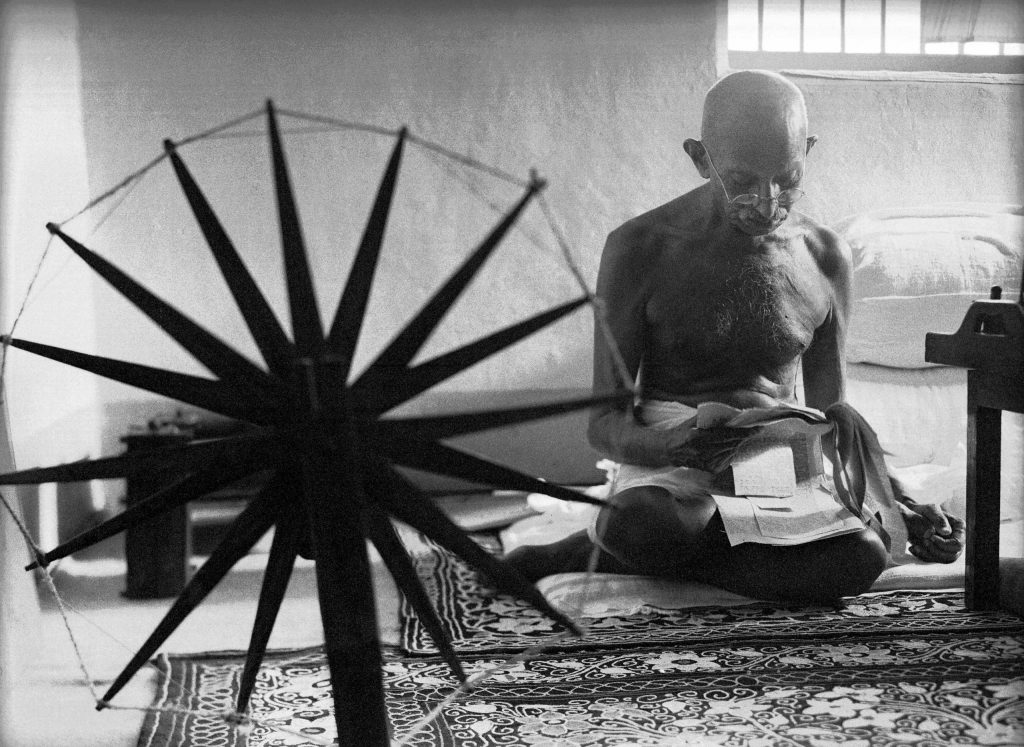
When Margaret Bourke-White walked into Gandhi's residence in 1946, she carried more than her camera equipment. She'd spent days learning to spin cotton on a charkha—a requirement the Mahatma himself imposed before he'd allow her to photograph him. This wasn't just another assignment for LIFE magazine. The gandhi spinning wheel photo bourke white would become one of the most reproduced images of the 20th century, capturing not just a man, but an entire movement for independence in a single frame.1
The photograph shows Gandhi cross-legged on the floor, his hands working the spinning wheel with practiced precision. Natural light streams across the scene. His glasses catch a glint of illumination. Behind him, barely visible, sits his secretary Pyarelal. But it's the charkha—that simple wooden wheel—that dominates the composition. This wasn't accidental. Nothing about this shoot was.2
The Three Conditions: Gandhi's Terms for the Shoot
Gandhi didn't make things easy for Bourke-White. He imposed three non-negotiable conditions before she could photograph him. First, she had to learn to use the spinning wheel herself—not just understand it intellectually, but actually spin cotton into thread. Second, she couldn't use artificial lighting or flash photography. Third, she had to remain silent during the spinning session to preserve the meditative quality of the practice.3
Why these specific demands? Gandhi understood symbolism better than most politicians ever will. The spinning wheel wasn't just a prop. It represented swadeshi—the principle of self-sufficiency that formed the economic backbone of India's independence movement. By requiring Bourke-White to learn the craft, he ensured she'd understand what she was photographing. She couldn't reduce it to exotic imagery or colonial curiosity.4
Bourke-White spent several days practicing with the charkha before the actual shoot. Her hands fumbled at first—the rhythm eluded her, the thread broke repeatedly. But she persisted. This preparation period transformed her approach to the assignment. She began to see the spinning wheel not as a quaint artifact but as a revolutionary tool. Her understanding deepened with each attempt to master the technique.5
Technical Mastery in Impossible Conditions
Let's talk about the technical nightmare Bourke-White faced. No artificial lights meant working with whatever natural illumination filtered through the windows. In 1946, film speeds weren't what they are today. She was shooting with a Speed Graphic camera—the workhorse of photojournalism—loaded with medium-format film that required relatively long exposures in low light.6
Gandhi's spinning created another challenge: motion. The wheel turned, his hands moved, the thread flowed. Any exposure long enough to gather sufficient light risked motion blur. Bourke-White had to time her shots precisely, waiting for moments of relative stillness while maintaining proper exposure. She likely used a wide aperture to maximize light gathering, sacrificing some depth of field for shutter speed.7
The Lighting Setup That Wasn't
Bourke-White couldn't control the light, so she controlled everything else. She positioned herself to take advantage of the window light streaming from Gandhi's left side. This created the dramatic side lighting that defines the photograph—illuminating his face and hands while allowing shadows to add depth and dimension. The light wraps around the spinning wheel, making it glow against the darker background.8
The composition itself reveals Bourke-White's mastery. She shot from a low angle, placing herself at Gandhi's eye level rather than standing above him. This choice creates intimacy and equality between subject and viewer. The spinning wheel occupies the lower third of the frame, grounding the composition. Gandhi's face, though not centered, becomes the natural focal point through the interplay of light and the directional lines created by his posture and the wheel's structure.9
The Charkha: More Than Wood and Thread
You can't understand this photograph without understanding what the spinning wheel meant to India's independence movement. Gandhi didn't choose the charkha randomly. He transformed it from a household tool into a weapon of economic resistance. Every yard of hand-spun khadi was a yard of British textile not purchased. Every hour spent spinning was an hour invested in Indian self-sufficiency.10
The symbolism ran deeper still. Spinning required patience, discipline, and daily practice—qualities Gandhi believed essential for independence. It was meditation and revolution combined. The repetitive motion calmed the mind while the accumulating thread represented tangible progress toward freedom. Historical research shows how the spinning wheel became central to Gandhi's philosophy of non-violent resistance.11
The charkha appeared on the Indian National Congress flag before independence. After 1947, it evolved into the Ashoka Chakra—the wheel that still appears at the center of India's national flag. This transformation from spinning wheel to national symbol traces directly through photographs like Bourke-White's, which distributed the image globally and cemented its iconic status.12
1946: India on the Brink
The timing of this photograph matters enormously. In 1946, India stood at a crossroads. Independence was inevitable—the British Empire was crumbling, exhausted by World War II. But the path forward remained unclear and increasingly violent. Partition loomed. Hindu-Muslim tensions were escalating. The dream of a unified, independent India was fracturing.13
Bourke-White arrived in India specifically to document this pivotal moment. LIFE magazine understood that history was unfolding, and they wanted their star photographer on the ground. She would go on to photograph the partition itself—the massive migrations, the violence, the human cost of independence. But this quiet image of Gandhi spinning captured something the chaos couldn't: the philosophical foundation of the independence movement.14
Gandhi was 77 years old when Bourke-White photographed him. He had approximately 18 months left to live. On January 30, 1948, an assassin's bullets would end his life. This photograph, then, carries additional weight as one of the last major portraits of Gandhi before his death. It shows him not as a martyr or saint, but as he lived daily—spinning thread, practicing what he preached, embodying the revolution he led.15
A Female Photographer in a Man's World
Margaret Bourke-White broke barriers her entire career. She was LIFE magazine's first female photojournalist, hired when the magazine launched in 1936. She photographed Stalin, covered World War II from the front lines, documented the liberation of concentration camps, and survived a torpedo attack on a transport ship. By 1946, she'd already established herself as one of the world's premier photojournalists.16
But gaining access to Gandhi as a woman added another dimension to this achievement. The gender dynamics of the era made her presence in male-dominated spaces remarkable. Gandhi himself had complex views on women's roles—he advocated for women's education and participation in the independence movement, yet maintained traditional views in other areas. That he granted Bourke-White this access, imposed his conditions, and allowed her to work speaks to both her reputation and his recognition of photography's power.17
The power dynamic during the shoot reveals Gandhi's media savvy. He controlled every aspect: the lighting, the setting, the photographer's preparation, the atmosphere. Yet he also recognized Bourke-White's skill and gave her the space to work once she'd met his conditions. This mutual respect between photographer and subject comes through in the final image. It's not exploitative or voyeuristic. It's a collaboration between two professionals who understood the historical importance of the moment.18
From Contact Sheet to Icon: The Selection Process
Bourke-White didn't shoot just one frame that day. She exposed multiple sheets of film, exploring different angles and moments. Some showed Gandhi from further back, including more of the room. Others focused tighter on his hands and the wheel. Several included his secretary Pyarelal more prominently in the background. The image that became iconic was selected from this larger set.19
What made this particular frame succeed? The balance. Gandhi's face is visible and expressive, but not dominating. The spinning wheel is prominent without overwhelming. The composition creates a triangle between Gandhi's face, his hands, and the wheel—a stable geometric structure that feels complete. The background provides context without distraction. Every element serves the narrative.20
The photograph first appeared in LIFE magazine's coverage of Indian independence. LIFE's editors recognized they had something special—an image that transcended typical news photography to become art. They gave it prominent placement and generous size in the magazine layout. From there, it spread globally, reproduced in newspapers, magazines, books, and eventually textbooks around the world.21
Multiple Versions and Crops
Over the decades, this image has appeared in various crops and formats. Some versions crop tighter on Gandhi, minimizing the spinning wheel. Others emphasize the wheel more. The most iconic version—the one that appears in history books and exhibitions—maintains the balance Bourke-White originally composed, showing both Gandhi and the charkha in equal measure.22
Some prints show Pyarelal clearly in the background, while others fade him into shadow. This variation results from different printing techniques and exposure choices in the darkroom. The original negative contained all this information, but darkroom work could emphasize or minimize different elements. Museum collections often hold multiple vintage prints that show these variations.23
Legacy and Market Value
Original prints of this photograph command significant prices in the art market. A vintage print—one made during Bourke-White's lifetime from the original negative—can sell for tens of thousands of dollars at auction. The exact value depends on print quality, provenance, and market conditions. Antiques Roadshow has featured appraisals of Bourke-White's Gandhi photographs, demonstrating collector interest.24
The original negatives from this shoot are part of the LIFE Picture Collection, now managed by Shutterstock after a series of corporate acquisitions. This means the images remain accessible for licensing, though rights management has become complex. Museums, publishers, and educators can license the image for various uses, while the copyright continues to generate revenue decades after Bourke-White's death in 1971.25
Major exhibitions have featured this photograph. The Museum of Modern Art, the International Center of Photography, and museums across India have displayed it. It appears in permanent collections and temporary exhibitions about photojournalism, 20th-century history, and Indian independence. Each exhibition context adds layers of interpretation and meaning to the image.26
Educational Impact
This photograph appears in photography curricula worldwide. It's taught as an example of documentary photography that transcends mere recording to become art. Students analyze its composition, lighting, and historical context. They study Bourke-White's approach to gain access, her technical solutions to challenging conditions, and her ability to capture symbolic meaning in a single frame.27
In India, the image appears in history textbooks, on postage stamps, and in countless reproductions. It's become part of the visual vocabulary of Indian independence—as recognizable as the tricolor flag itself. Generations of Indian students have encountered Gandhi first through this photograph, making it foundational to national memory and identity.28
Why This Image Endures
Plenty of photographers captured Gandhi. Why did this image become the iconic one? Several factors converge. First, the symbolism is perfect—Gandhi with the spinning wheel that represented his entire philosophy. Second, the composition balances intimacy with dignity. We see Gandhi as human and approachable, yet the image maintains respect. Third, the technical execution is flawless despite the challenging conditions. The lighting, focus, and timing all work together.29
But there's something else. The image captures contradiction and complexity. Gandhi sits on the floor, humble and simple, yet he's orchestrating a revolution that will topple an empire. The spinning wheel is ancient technology, yet it's being wielded as a modern political weapon. The photograph is quiet and meditative, yet it represents active resistance. These tensions give the image depth that simpler, more straightforward portraits lack.30
Bourke-White herself understood what she'd captured. In her writings and interviews, she reflected on this shoot as one of her most significant. She recognized that learning to spin had transformed her understanding, that Gandhi's conditions had forced her to engage more deeply than she might have otherwise. This depth of engagement shows in the final image. It's not a tourist snapshot or a celebrity portrait. It's a document of philosophy made visible.31
Influence on Later Photojournalism
This photograph influenced how subsequent generations approached photographing political leaders. It demonstrated that symbols matter—that showing a leader engaged in meaningful activity reveals more than a formal portrait. It proved that natural light and simple compositions could create powerful images without elaborate setups. It showed that respecting a subject's conditions and requirements could lead to better work, not worse.32
Photographers covering subsequent independence movements and political transformations looked to this image as a model. How do you capture the essence of a movement in a single photograph? Bourke-White's answer: show the leader engaged in the practice that defines the philosophy. This approach influenced coverage of civil rights leaders, anti-colonial movements, and political transitions worldwide.33
The photograph also demonstrated the power of portrait photography to create historical records. In an age before television became ubiquitous, photographs like this one shaped global understanding of distant events and leaders. They created visual reference points that persist long after the events themselves fade from living memory.34
The Digital Age and Continued Relevance
In 2025, this 1946 photograph remains remarkably relevant. It circulates on social media, appears in digital exhibitions, and continues to illustrate articles about leadership, resistance, and independence. But why does an analog-era image resonate in the digital age? Perhaps because it represents something increasingly rare: depth, patience, and meaningful symbolism.35
The photograph's black and white palette helps it transcend its era. Color dates images—clothing styles, decor, and color grading all anchor photographs to specific periods. Black and white feels more timeless. The simplicity of the composition also aids longevity. There's nothing extraneous to distract or date the image. Just Gandhi, the wheel, and light.36
Modern photographers studying this image learn lessons about constraints and creativity. Bourke-White couldn't use flash, couldn't control the light, had to work with slow film and long exposures. Yet she created an iconic image. This challenges contemporary photographers who have access to incredible technology but sometimes struggle to create meaningful work. The lesson: technical capabilities don't guarantee powerful images. Vision, preparation, and understanding matter more.37
Viewing and Purchasing Prints
For those interested in owning a print of this iconic photograph, several options exist. Art galleries and dealers occasionally offer vintage prints, though these command premium prices. Modern prints made from the original negatives are more accessible and still maintain high quality.38
Museums with photography collections often have prints on display or in their archives. The National Gallery of Art, Museum of Modern Art, and International Center of Photography all hold examples of Bourke-White's work. In India, museums and galleries dedicated to independence history frequently feature this image. Viewing a high-quality print in person reveals details that reproductions miss—the tonal range, the texture of the paper, the subtle gradations in the shadows.39
For educational or editorial use, licensing through Shutterstock's LIFE Picture Collection provides access to high-resolution scans. These digital files allow for reproduction in publications, websites, or exhibitions. The licensing fees vary based on usage, but they ensure legal use of the image while supporting the archive's preservation work.40
Conservation and Archival Preservation
The original negatives from this shoot require careful conservation. Film degrades over time—the gelatin emulsion can deteriorate, the base can become brittle, and chemical reactions can cause fading or discoloration. Professional archives store negatives in climate-controlled environments with stable temperature and humidity. They use archival-quality sleeves and boxes that won't introduce contaminants.41
Digital scanning has created backup copies of these irreplaceable negatives. High-resolution scans capture detail that allows for large-format printing while preserving the information if the original negatives eventually deteriorate beyond use. However, archivists maintain that original negatives hold information and qualities that even the best scans can't fully capture.42
Vintage prints from this shoot also require conservation attention. Photographs can fade from light exposure, suffer from improper storage conditions, or sustain physical damage. Museums and collectors invest in proper framing with UV-protective glass, archival matting, and appropriate display conditions to preserve these prints for future generations.43
Conclusion: A Photograph That Spins History
The gandhi spinning wheel photo bourke white captured more than a moment—it captured a movement, a philosophy, and a man who embodied both. Seventy-nine years after Bourke-White clicked her shutter, this image continues to resonate because it balances the personal and the political, the simple and the profound, the ancient and the modern. Gandhi sits with his spinning wheel, and in that simple act, we see revolution.44
Margaret Bourke-White's technical mastery, combined with her willingness to meet Gandhi's conditions and truly understand her subject, produced an image that transcends photojournalism to become art. It appears in museums and textbooks, on stamps and currency, in digital exhibitions and social media feeds. Each reproduction carries forward the symbolism Gandhi imbued in that wooden wheel—self-sufficiency, patience, discipline, and resistance to oppression.45
For photographers today, this image offers lessons that remain relevant regardless of technology. Understand your subject deeply. Respect their conditions and requirements. Use constraints as creative challenges rather than limitations. Seek symbolic elements that communicate meaning beyond the literal. Compose with intention. Master your technical tools so thoroughly that they become invisible, allowing vision to dominate. These principles, demonstrated so perfectly in this 1946 photograph, remain the foundation of powerful documentary and portrait photography.46
What photograph will you create that captures not just a person, but an idea? What symbol will you find that communicates complex philosophy in simple visual terms? What constraints will you embrace that force you deeper into your subject? These questions, raised by Bourke-White's iconic image, challenge every photographer to look beyond the surface and find the meaning beneath. The spinning wheel keeps turning, and its lesson endures: true power lies not in complexity but in profound simplicity, not in force but in patient, persistent practice.
Frequently Asked Questions
When exactly was the gandhi spinning wheel photo bourke white taken?
Margaret Bourke-White photographed Gandhi with his spinning wheel in 1946, approximately 18 months before his assassination in January 1948. The exact date varies in different sources, but it occurred during her assignment to document Indian independence for LIFE magazine. The shoot took place at Gandhi's residence, where he maintained his daily spinning practice as both spiritual discipline and political statement.47
What were Gandhi's three conditions for allowing the photograph?
Gandhi required that Bourke-White learn to use the spinning wheel herself before photographing him, that she use only natural light without flash or artificial illumination, and that she remain silent during his spinning session to preserve its meditative quality. These conditions reflected his philosophy of simplicity and ensured the photographer understood the symbolic importance of what she was documenting rather than treating it as exotic imagery.48
Why is the spinning wheel so significant to Indian independence?
The charkha (spinning wheel) symbolized swadeshi—economic self-sufficiency and resistance to British colonial control. Gandhi promoted hand-spinning and wearing khadi (hand-spun cloth) as a boycott of British textiles, which had destroyed India's traditional textile industry. The spinning wheel represented both practical economic resistance and philosophical principles of simplicity, patience, and self-reliance that Gandhi believed essential for independence. It appeared on the Indian National Congress flag and evolved into the Ashoka Chakra on India's national flag.49
How much are original prints of this photograph worth?
Vintage prints of Bourke-White's Gandhi photograph—those made during her lifetime from the original negative—can command tens of thousands of dollars at auction, depending on condition, provenance, and market conditions. Modern prints made from the original negatives are more affordable, typically ranging from hundreds to low thousands of dollars. The exact value depends on print quality, size, edition number, and whether the print includes proper authentication and documentation.50
What camera and film did Margaret Bourke-White use for this photograph?
Bourke-White likely used a Speed Graphic camera, the standard press camera of the 1940s, which shot 4x5 inch sheet film. Given the low-light conditions and Gandhi's prohibition on artificial lighting, she would have used the fastest film available at the time and a wide aperture to gather maximum light while maintaining sufficient shutter speed to minimize motion blur from Gandhi's spinning. The technical challenges of shooting in natural light with slow film required precise timing and expert exposure judgment.51
Where can I see original prints of this photograph?
Original prints appear in major museum collections including the Museum of Modern Art in New York, the International Center of Photography, the National Gallery of Art, and various museums in India dedicated to independence history. The LIFE Picture Collection, now managed by Shutterstock, holds the original negatives and offers licensing for reproduction. Galleries specializing in vintage photography occasionally offer prints for sale. Checking museum websites for current exhibitions or permanent collection displays is the best way to find opportunities to view high-quality prints in person.52
- Margaret Bourke-White was the first female photojournalist hired by LIFE magazine, breaking barriers in a male-dominated field.
- Gandhi spent approximately 30 minutes daily spinning as both spiritual practice and political statement, according to historical records.
- These conditions reflected Gandhi's philosophy of simplicity and his resistance to Western technological intrusion.
- The swadeshi movement encouraged Indians to boycott British textiles and produce their own khadi (hand-spun cloth), directly challenging British economic control.
- Bourke-White later wrote about how learning to spin changed her perception of Gandhi's movement from abstract political theory to tangible economic resistance.
- The Speed Graphic was the standard press camera of the era, using 4x5 inch sheet film or roll film adapters.
- Contemporary photojournalists studying this image note the shallow depth of field that keeps Gandhi sharp while softening the background elements.
- This use of natural side lighting became a teaching example in photography schools for creating dramatic portraits without artificial illumination.
- Compositional analysis reveals how Bourke-White used the rule of thirds and leading lines to create visual harmony.
- The British textile industry had devastated India's traditional spinning and weaving sectors through colonial policies that favored imported British cloth.
- Gandhi incorporated spinning into the daily routine at his ashrams, making it mandatory for all residents regardless of social status.
- The Ashoka Chakra represents the eternal wheel of law in Buddhist and Hindu philosophy, connecting ancient symbolism with modern nationalism.
- The Cabinet Mission of 1946 attempted to negotiate Indian independence but failed to resolve communal tensions between the Indian National Congress and the Muslim League.
- Bourke-White's coverage of partition included some of the most harrowing images of the 20th century, documenting mass displacement and communal violence.
- Bourke-White also photographed Gandhi much closer to his assassination, though the spinning wheel image from 1946 became more iconic.
- Bourke-White was also the first female war correspondent credentialed to work in combat zones during World War II.
- Gandhi understood modern media better than most political leaders of his era, carefully controlling his image and message.
- This collaborative approach contrasts sharply with colonial-era photography of Indian subjects, which typically objectified and exoticized its subjects.
- Standard photojournalistic practice involved shooting multiple variations to give editors options for different layouts and emphases.
- Photographic composition theory identifies triangular arrangements as particularly stable and pleasing to the human eye.
- LIFE magazine's circulation in the 1940s exceeded 5 million copies weekly, giving photographs published there enormous reach.
- Different crops serve different editorial purposes, but the full composition remains the most reproduced version.
- Darkroom printing allowed photographers significant control over the final appearance of an image through dodging, burning, and exposure adjustments.
- Vintage prints are valued higher than modern prints because they were made closer to the photographer's original vision and under their potential supervision.
- Copyright law in the United States protects photographs for 70 years after the photographer's death, meaning Bourke-White's work remains under copyright until 2041.
- Museum exhibitions often provide detailed wall text and contextual materials that shape how viewers understand and interpret photographs.
- Photography programs use this image to teach the intersection of technical skill, historical awareness, and symbolic thinking.
- The photograph's appearance in educational materials has made it arguably more influential than any single written text about Gandhi.
- Iconic photographs typically combine strong symbolism, technical excellence, and emotional resonance in ways that allow multiple interpretations.
- The most enduring photographs often contain visual or conceptual paradoxes that reward repeated viewing and contemplation.
- Bourke-White's memoir "Halfway to Freedom" details her experiences photographing India during independence and partition.
- Contemporary photojournalists cite this image as an example of how constraints can enhance rather than limit creative work.
- The visual language established by photographs like this one shaped how political movements presented themselves to global audiences.
- Photographs function as both historical documents and cultural artifacts, serving different purposes across different time periods.
- Social media's emphasis on instant, disposable imagery makes carefully composed, symbolically rich photographs stand out more, not less.
- Black and white photography's continued relevance in the digital era demonstrates that aesthetic choices matter more than technological capabilities.
- Photography education increasingly emphasizes conceptual and contextual understanding over technical mastery alone.
- Modern prints use archival materials and processes that often exceed the longevity of vintage prints, though collectors typically prefer vintage prints for their historical value.
- Museum viewing allows appreciation of print quality and scale that digital reproductions cannot convey.
- Proper licensing supports archives and ensures photographers' estates receive compensation for their work's continued use.
- Photographic conservation is a specialized field requiring knowledge of chemistry, materials science, and art history.
- The debate between analog preservation and digital backup continues in archival circles, with most institutions pursuing both strategies.
- Light exposure is cumulative and irreversible—once a photograph fades, the lost information cannot be recovered.
- The photograph's endurance demonstrates how single images can become shorthand for complex historical movements and ideas.
- The photograph's continued circulation keeps Gandhi's philosophy visible to new generations who might never read his writings.
- Timeless photographic principles transcend technological changes and remain relevant across different eras and equipment.
- Some sources place the shoot in late 1946, while others suggest early 1947, reflecting the challenges of precise historical documentation.
- Gandhi's conditions demonstrate his sophisticated understanding of media representation and his determination to control how he and his movement were portrayed.
- The spinning wheel's symbolism connected economic resistance with spiritual practice and national identity.
- The photography art market values vintage prints higher because they were made closer to the photographer's original vision and may have been supervised or approved by the photographer.
- The Speed Graphic's large format film provided excellent image quality and detail that has allowed the photograph to be reproduced at various sizes while maintaining quality.
- Museums rotate their photography collections, so prints may be in storage rather than on display at any given time—contacting the museum's photography department can provide information about viewing opportunities.