In March 1936, a government photographer nearly drove past a makeshift camp in Nipomo, California. Something made Dorothea Lange turn her car around. Twenty miles down the road, she couldn't shake the image of a weather-beaten tent she'd glimpsed from the highway. That decision—to backtrack those twenty miles—produced the Migrant Mother Dorothea Lange photograph, an image that would become the defining visual document of the Great Depression and perhaps the most recognized photograph in American history.1
But here's what most people don't know: the woman in the photograph wasn't a migrant pea picker. She never received a cent from the image that made her face synonymous with American poverty. And her Cherokee heritage—a crucial part of her identity—was erased from the historical narrative for decades. The story behind this iconic photograph is far more complex, ethically fraught, and fascinating than the sanitized version you'll find in most textbooks.
The Day That Changed Documentary Photography Forever
March 1936. California's Central Valley. Dorothea Lange was wrapping up a month-long assignment for the Resettlement Administration (later renamed the Farm Security Administration), documenting migrant workers for the federal government. She was cold, tired, and eager to get home to San Francisco. She'd already passed the pea-pickers' camp near Nipomo when something gnawed at her.2
"I saw and approached the hungry and desperate mother, as if drawn by a magnet," Lange later wrote. She found Florence Owens Thompson, 32 years old, sheltering under a lean-to tent with her seven children. Their car had broken down. They'd sold the tires from their car to buy food. The pea crop had frozen; there was no work, no money, no prospects.3
Lange spent approximately ten minutes with the family. She took six exposures with her Graflex camera, working quickly, moving closer with each frame. She asked no names. Thompson later recalled that Lange promised the photographs wouldn't be published—a promise that would haunt their relationship for decades.4
Six Frames, One Icon
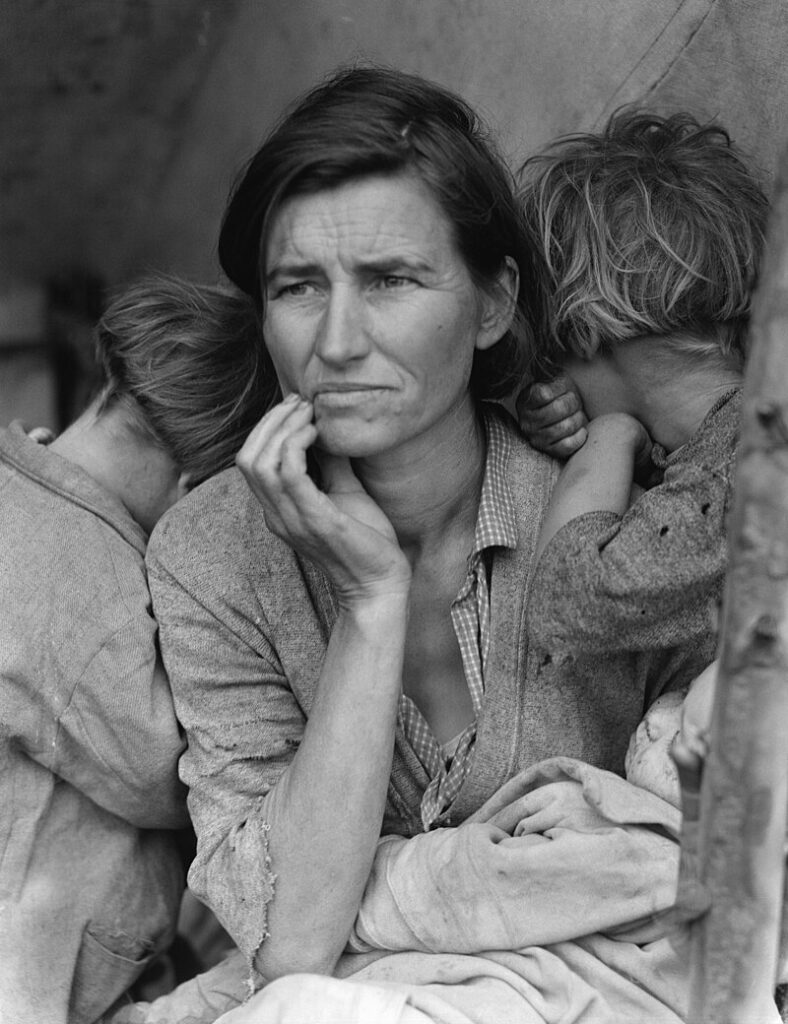
Why did this particular frame become iconic while the other five remained relatively unknown? The answer lies in Lange's mastery of documentary composition and her understanding of visual psychology. In the first frames, she captured the entire family—children scattered, the scene chaotic. As she moved closer, she narrowed her focus, eliminating distractions until only the essential elements remained.5
The final frame—the one we know as Migrant Mother—achieves something remarkable. Thompson's face fills the frame, her hand raised to her chin in a gesture that reads as both contemplation and anxiety. Two children lean against her shoulders, their faces turned away, creating a triangular composition that draws the eye inexorably to the mother's weathered face. An infant sleeps in her lap. The composition is classical, almost Renaissance in its pyramidal structure, yet the subject matter is utterly contemporary and raw.
Look at that hand. It's not just resting on her face—it's pressed there, fingers tensed. The gesture conveys worry, exhaustion, the weight of impossible decisions. Art historians have noted its similarity to Rodin's The Thinker, but this isn't philosophical contemplation. This is a mother calculating whether her children will eat tomorrow.6
The Technical Mastery Behind the Image
Lange shot with a Graflex camera, likely her Graflex Series D, using large-format film that captured extraordinary detail. This wasn't a candid snapshot—the Graflex required careful focusing and exposure calculation. Yet the image doesn't feel staged. That's the mark of documentary photography at its finest: technical precision in service of authentic human emotion.
The exposure was perfect for the overcast conditions—enough detail in the shadows of Thompson's face to reveal every line of worry, enough highlight retention to preserve the texture of her worn clothing. The depth of field keeps Thompson and her children in sharp focus while the tent canvas behind them blurs slightly, isolating the subjects from their environment without completely divorcing them from context.7
Here's a detail most people miss: in one of the six frames, Lange's thumb appears in the corner of the negative. When the photograph was prepared for publication and archival purposes, this thumb was retouched out. It's a small technical flaw that humanizes the photographer—even masters make mistakes under pressure. But it also raises questions about documentary authenticity. If we accept one retouching, where do we draw the line?8
Lange's Documentary Approach
Dorothea Lange didn't just point and shoot. She developed a method for documentary work that balanced artistic vision with journalistic integrity. She'd approach subjects slowly, talking with them, building rapport before raising her camera. This wasn't manipulation—it was respect. She understood that to photograph someone's suffering, you needed their trust, however brief.
Her field notes reveal her process. She'd observe first, noting details about her subjects' circumstances, their body language, the environmental context. Only then would she begin photographing, often starting wide and moving closer as her subjects became comfortable with her presence. This methodical approach is evident in the six Migrant Mother Dorothea Lange frames—you can literally see her moving closer, eliminating extraneous elements, honing in on the emotional core of the scene.9
From Government File to Cultural Icon: The Photograph's Journey
Lange returned to San Francisco and developed the negatives. She immediately recognized the power of what she'd captured. On March 10, 1936—just days after the shoot—the San Francisco News published the photograph with Lange's caption describing the "destitute pea pickers" in Nipomo. The response was immediate. The federal government rushed 20,000 pounds of food to the camp.10
But by the time the food arrived, Florence Thompson and her family had moved on. They never benefited from the aid the photograph generated. This would become a recurring pattern: the image created value—political, cultural, monetary—but none of it flowed back to the woman whose face embodied the Depression's human cost.
The photograph entered the public domain immediately as a work created by a federal employee. This meant anyone could reproduce it without permission or payment. Newspapers, magazines, textbooks, museum exhibitions—Migrant Mother appeared everywhere. It became the visual shorthand for the Great Depression, reproduced millions of times. Yet Thompson remained anonymous, her name unknown to the public for 42 years.11
The FSA Photography Program's Mission
To understand why this photograph existed at all, you need to understand the Farm Security Administration's photography program. Established under Roy Stryker's direction, the FSA hired photographers to document rural poverty and the government's efforts to address it. The goal was explicitly political: generate public support for New Deal programs by showing Americans the devastating impact of the Depression.12
Lange was one of Stryker's key photographers, alongside Walker Evans, Arthur Rothstein, and others. She brought a particular sensitivity to her subjects—perhaps because she'd experienced hardship herself. Polio had left her with a limp; she understood what it meant to be marked by circumstances beyond your control. Her photographs consistently centered human dignity even in documenting degradation.
The FSA program represented a new approach to documentary photography—government-sponsored, widely distributed, explicitly intended to shape public opinion. It worked. Images like Migrant Mother built support for federal intervention in the economy and established documentary photography as a powerful tool for social change.
Florence Owens Thompson: The Erased Identity
For decades, the woman in America's most famous photograph had no name. She was simply "Migrant Mother"—a symbol, not a person. When a reporter finally tracked her down in 1978, Florence Owens Thompson was 75 years old and living in a trailer in Modesto, California. The revelation sparked media attention, but it also revealed uncomfortable truths about the photograph's creation and legacy.13
Thompson was Cherokee, born in Indian Territory (now Oklahoma) in 1903. Her Native American heritage was completely absent from Lange's caption and subsequent discussions of the photograph. This erasure wasn't accidental—it reflected the broader invisibility of Native Americans in Depression-era discourse and the tendency to universalize white poverty while ignoring racial and ethnic specificity.14
Lange's caption described Thompson and her family as "destitute pea pickers in California." But they weren't pea pickers. Thompson's husband had recently died, leaving her with seven children. They were traveling from Southern California to Watsonville to find work when their car broke down. The frozen pea crop meant there was no work in Nipomo, but they weren't part of the migrant agricultural workforce the caption suggested.15
Why does this matter? Because the caption shaped how Americans understood the photograph. It fit the narrative of Dust Bowl migrants fleeing to California, reinforcing specific ideas about Depression-era poverty. The reality was more complex—a widowed Cherokee woman stranded by mechanical failure, not following the harvest. The simplification made for better propaganda, but it erased Thompson's actual story.
Thompson's Life Before and After
Before that March day in 1936, Florence Thompson had already lived a hard life. Born Florence Leona Christie, she married at 17 and had ten children, though three died young. She worked in fields, canneries, restaurants—whatever would feed her family. She was tough, resourceful, and proud. After her husband died, she eventually remarried and continued working into her 70s.16
When Thompson learned in 1978 that she was the "Migrant Mother," her reaction was complicated. She felt exploited. "I wish she hadn't taken my picture," she told reporters. "I can't get a penny out of it." She saw the photograph in newspapers, magazines, textbooks—her face everywhere, her story nowhere. The image had generated enormous value for institutions, publications, and Lange's reputation. Thompson got nothing.17
She even attempted to have all prints recalled—an impossible task given the photograph's public domain status and widespread reproduction. The request revealed her fundamental misunderstanding of how the image had proliferated and her powerlessness to control her own representation. It's a stark example of the ethical problems inherent in documentary photography: who benefits from images of suffering?
The Ethical Paradox of Documentary Photography
Here's the uncomfortable truth about the Migrant Mother Dorothea Lange photograph: it's simultaneously a masterpiece of compassionate documentary work and an example of exploitation. Both things are true. Lange created an image that humanized poverty, potentially influencing policy and building support for aid programs. But she also profited professionally from Thompson's suffering while Thompson remained poor.18
Did Lange owe Thompson compensation? The law said no—Thompson had no legal claim to the image. But ethics aren't just about legality. Lange built a career partly on this photograph. Museums charge admission to exhibitions featuring it. Textbook publishers profit from its reproduction. Meanwhile, Thompson worked minimum-wage jobs until she couldn't work anymore.
In 1983, Thompson suffered a stroke. Her children, desperate to pay her medical bills, publicized her identity and launched a fundraising campaign. They raised $35,000—a significant sum, but a fraction of the value the photograph had generated over 47 years. The campaign succeeded partly because of the irony: the woman who symbolized Depression-era poverty needed charity herself.19
This raises questions that documentary photographers still grapple with. Should subjects receive compensation when their images are used commercially? Does the public interest in documentary work override individual privacy and dignity? Can you create ethical documentary work when the power dynamic between photographer and subject is so unequal? There are no easy answers, but Migrant Mother forces us to ask the questions.
The Children's Perspective
Thompson's children have given numerous interviews about growing up in the shadow of the photograph. Their accounts are mixed. Some felt pride that their mother represented American resilience. Others resented the invasion of privacy and the way the image reduced their mother to a symbol. Katherine McIntosh, one of the children leaning on Thompson's shoulder in the photograph, said her mother "didn't want to be a symbol of anything."20
The children also corrected misconceptions. They weren't starving—they'd eaten birds the boys had killed. They weren't abandoned—their mother was fiercely protective and resourceful. The photograph captured a moment of worry, not their entire reality. But once an image becomes iconic, it's nearly impossible to complicate the narrative it represents.
Why This Image Endured When Others Didn't
The FSA photography program produced over 170,000 images. Many were powerful. Why did this one become the Depression photograph? The answer involves composition, timing, distribution, and something harder to quantify—emotional resonance.21
Compositionally, the photograph is nearly perfect. The triangular structure creates stability even as the subject matter conveys instability. Thompson's face is centered, her expression complex—worry, yes, but also strength and determination. The children's turned faces create mystery and universality; they could be anyone's children. The texture of the worn clothing tells a story without words. Every element serves the emotional impact.
The photograph also benefits from ambiguity. Thompson's expression isn't easily categorized. She's not crying or smiling. She's thinking, worrying, enduring. That complexity allows viewers to project their own interpretations onto the image. It becomes a Rorschach test for attitudes about poverty, motherhood, resilience, and suffering.22
Compare it to other famous Depression-era photographs—Arthur Rothstein's "Dust Storm, Cimarron County," Walker Evans's Alabama tenant farmer portraits. They're powerful, but they're more specific, less universal. Migrant Mother achieves something rare: it's simultaneously specific (this woman, this moment) and universal (any mother, any hardship). That duality explains its endurance.
The Role of Timing and Distribution
The photograph appeared at exactly the right moment. By March 1936, the Depression had been grinding on for seven years. Americans were exhausted, desperate for solutions. The New Deal was underway but controversial. Images like Migrant Mother made the case for federal intervention visceral and undeniable.23
The FSA's distribution network ensured the image reached wide audiences. It appeared in newspapers, magazines, government publications, and exhibitions. Each reproduction reinforced its iconic status. By the 1940s, it was already recognized as the Depression photograph. That early canonization, combined with its public domain status, ensured continued reproduction and cultural penetration.
The Photograph's Cultural Life and Legacy
Walk into any American history classroom, and you'll likely see Migrant Mother in the textbook. It's been reproduced so many times that exact counts are impossible. The Smithsonian National Museum of American History holds original prints. The Library of Congress maintains the negatives. Museums worldwide have exhibited it. It's been referenced, parodied, and appropriated in countless contexts.24
Artists have responded to it. Photographers have paid homage to it. During the 2008 financial crisis, commentators invoked it to draw parallels between Depression-era hardship and contemporary economic struggles. It's become a visual shorthand not just for the 1930s, but for economic suffering generally.
This ubiquity has a cost. The image has become so familiar that we risk not really seeing it anymore. It's wallpaper, a cliché, the default Depression photograph. We've lost the shock of the original encounter—that moment when viewers first confronted Thompson's worried face and recognized their own vulnerability reflected back.
Impact on Documentary Photography
The Migrant Mother Dorothea Lange photograph fundamentally shaped documentary photography as a medium. It demonstrated that documentary work could be both artistically sophisticated and politically effective. It established templates for photographing poverty that photographers still follow (and critique) today. It proved that a single image could influence public opinion and potentially policy.25
But it also established problematic patterns. The emphasis on individual suffering rather than systemic analysis. The aestheticization of poverty. The power imbalance between photographer and subject. The question of who benefits when suffering becomes art. Contemporary documentary photographers must reckon with this legacy, learning from Lange's compositional mastery while questioning the ethics of her approach.
Modern approaches to documentary photography increasingly emphasize collaboration with subjects, compensation, and shared authorship—direct responses to the ethical problems Migrant Mother exemplifies. The photograph's legacy includes both its artistic achievements and the uncomfortable questions it raises about representation, power, and exploitation.
Technical Analysis: What Photography Students Can Learn
Strip away the historical significance and ethical debates for a moment. What makes this photograph work visually? Everything. The composition is a masterclass in visual hierarchy and emotional direction.26
Start with the triangular composition. Thompson's head forms the apex, her shoulders and the children's bodies creating the base. This pyramidal structure is classically stable, creating visual harmony even as the subject matter conveys instability. Your eye naturally travels up the triangle to Thompson's face—exactly where Lange wants your attention.
Now look at the hand. It breaks the left side of the triangle, creating visual tension. That hand draws your eye to Thompson's face and adds a narrative element—this is a person thinking, worrying, processing. Without that gesture, the composition would be static. The hand makes it dynamic.
The children's turned faces are crucial. If they looked at the camera, they'd compete for attention with Thompson. By turning away, they frame her face and create mystery. Who are they? What are they looking at? The composition becomes about the mother's response to circumstances we can only imagine.27
The tonal range is extraordinary. Look at the detail Lange captured in Thompson's face—every line, every shadow. The texture of the worn clothing tells its own story. The slightly out-of-focus background isolates the subjects without completely divorcing them from context. You can still see the tent canvas, still understand the environment, but it doesn't distract from the human element.
The framing is tight but not claustrophobic. There's just enough space around the subjects to let them breathe, to suggest the larger world beyond the frame. This is sophisticated visual storytelling—showing enough to understand the context, eliminating everything that doesn't serve the emotional narrative.
Lessons for Contemporary Photographers
What can contemporary photographers learn from this image? First, the importance of getting close—both physically and emotionally. Lange's first frames from this session are good. The final frame is transcendent. The difference is proximity and focus. She eliminated everything that didn't serve the story.
Second, the power of gesture and expression. Thompson isn't performing for the camera. That hand-to-face gesture appears unconscious, natural. It's the kind of authentic moment that can't be directed, only captured. This requires patience, observation, and the ability to recognize decisive moments.
Third, composition matters even in documentary work. Actually, especially in documentary work. The idea that documentary photography should be artless or unstudied is nonsense. Lange's careful composition amplifies rather than diminishes the photograph's emotional impact. Technical mastery serves authentic storytelling.
Finally, and perhaps most importantly: consider the ethics. Before you press the shutter, ask yourself who benefits from this image. Are you telling someone's story or exploiting their circumstances? Do you have their genuine consent? What responsibility do you have to your subjects beyond the moment of exposure? These questions don't have easy answers, but they're essential to ask. For insights into modern ethical approaches, explore post-documentary photography practices that address these concerns.
The Archive: Where the Photographs Live Now
The original negatives of all six exposures from the Nipomo camp session are held by the Library of Congress in Washington, D.C. They're part of the FSA-OWI photograph collection, one of the most significant documentary photography archives in existence. The collection contains over 170,000 black-and-white negatives and 1,600 color photographs documenting American life from 1935 to 1944.28
Original prints exist in numerous museum collections, including the Museum of Modern Art in New York, the Oakland Museum of California (which houses the Dorothea Lange Archive), and the Smithsonian. Each institution has contributed to the photograph's canonical status through exhibitions, publications, and educational programs.
Because the photograph is in the public domain, anyone can reproduce it freely. This has contributed to its ubiquity but also means Thompson and her descendants have no legal claim to control or profit from its use. The public domain status reflects the photograph's creation as government work, but it creates the ethical paradox we've discussed: infinite reproduction, zero compensation to the subject.
Digital archives have made the photograph even more accessible. You can view high-resolution scans of all six exposures online. You can zoom in to see every detail of Thompson's face, the texture of the tent canvas, the worn fabric of the children's clothing. This accessibility is democratizing—anyone with internet access can study the photograph. But it also contributes to image fatigue, to the sense that we've seen this photograph so many times we no longer really see it.
Conclusion: An Image That Won't Let Go
Nearly ninety years after Dorothea Lange turned her car around on that California highway, the Migrant Mother Dorothea Lange photograph remains as powerful and problematic as ever. It's a masterpiece of composition and emotional storytelling. It's also a document of exploitation, however well-intentioned. Both things are true.
Florence Owens Thompson died in 1983, just months after the fundraising campaign that finally brought her financial relief. She never reconciled with her status as "Migrant Mother." She felt the photograph stole something from her—her privacy, her dignity, her right to define her own story. Yet the photograph also preserved her strength, her resilience, her humanity at a moment of crisis. It made her face synonymous with maternal love under impossible circumstances.
For photographers, the image offers enduring lessons in composition, documentary technique, and ethical complexity. It demonstrates how technical mastery and genuine human connection can create transcendent work. It also warns about the costs of that work, the ways documentary photography can exploit even as it illuminates.
The photograph endures because it captures something universal about human experience—worry, love, determination in the face of hardship. Thompson's expression is complex enough to accommodate multiple interpretations, specific enough to feel authentic. That combination of universality and specificity is rare and powerful.
What's your relationship with this photograph? Have you seen it so many times it's become invisible, or can you still access its emotional power? More importantly, how do you reckon with its ethical complications? These aren't rhetorical questions. They're essential for anyone working in documentary photography or engaging seriously with photographic history. Share your thoughts in the comments below, and explore our series on documentary photography's evolving ethics and impact.
Frequently Asked Questions
Who was the woman in the Migrant Mother photograph?
The woman was Florence Owens Thompson, a 32-year-old Cherokee mother of seven children. She remained anonymous until 1978, when a reporter identified her 42 years after the photograph was taken. Thompson was not a migrant pea picker as Lange's caption suggested, but a widow whose car had broken down while traveling to find work. She felt exploited by the photograph's widespread use and never received compensation for it.29
Why did Dorothea Lange take the Migrant Mother photograph?
Lange was working for the federal Resettlement Administration (later the Farm Security Administration) documenting rural poverty and migrant workers. She took the photograph as part of her government assignment to create images that would build public support for New Deal programs. Lange later said she was "drawn like a magnet" to Thompson's camp after initially driving past it. The photograph was meant to document the human cost of the Depression and generate support for federal relief efforts.30
How many photographs did Dorothea Lange take of Florence Thompson?
Lange took six exposures during approximately ten minutes with Thompson and her children. She worked methodically, starting with wider shots of the family and progressively moving closer, eliminating extraneous elements with each frame. The final, tightest composition became the iconic image known as Migrant Mother. All six negatives are preserved in the Library of Congress FSA-OWI collection and show Lange's documentary process and compositional evolution.31
Is the Migrant Mother photograph copyrighted?
No, the photograph is in the public domain. Because Lange took it as a federal employee working for a government agency, it's considered a work of the U.S. government and not subject to copyright. This means anyone can reproduce, distribute, or use the image without permission or payment. This public domain status contributed to the photograph's widespread reproduction and iconic status, but it also meant Florence Thompson and her descendants could never control its use or receive compensation for it.32
What camera and film did Dorothea Lange use for Migrant Mother?
Lange used a Graflex camera, likely her Graflex Series D, with large-format film. The Graflex was a professional camera that required careful focusing and exposure calculation—it wasn't a point-and-shoot device. The large-format film captured extraordinary detail, which is why high-resolution scans of the negative reveal so much texture and information. Lange's technical mastery with this equipment, combined with her documentary sensibility, produced the photograph's remarkable combination of technical precision and emotional authenticity.33
Did Florence Thompson ever receive money from the Migrant Mother photograph?
No, Thompson never received direct compensation from the photograph during most of her life. The image was in the public domain, so she had no legal claim to royalties or licensing fees despite its widespread reproduction. In 1983, when Thompson suffered a stroke, her children launched a fundraising campaign that raised $35,000 for her medical care. The campaign succeeded partly by publicizing the irony that the woman who symbolized Depression-era poverty needed charity herself. Thompson died later that year, having spent most of her life in the economic circumstances the photograph documented.34
- Lange described being "drawn like a magnet" to Florence Thompson's camp, a detail documented in her field notes from March 1936.
- The exact date is documented as early March 1936, though Lange's field notes don't specify the precise day of the month.
- Thompson's family was stranded after their car's timing chain broke, not because they were following agricultural work as commonly assumed.
- Thompson's children confirmed in later interviews that their mother felt betrayed by the photograph's publication and widespread use.
- All six photographs from the session are preserved in the Library of Congress collection and show Lange's methodical approach to the subject.
- The hand-to-face gesture has been extensively analyzed in art historical literature as a universal symbol of contemplation and concern.
- Analysis of the negative reveals Lange's sophisticated understanding of exposure and development for maximum tonal range.
- The thumb removal is documented in archival records and represents one of the few alterations made to Lange's Depression-era work.
- Lange's field notes and methodology are preserved in the Oakland Museum of California's Dorothea Lange Archive.
- The rapid publication and government response is documented in contemporary newspaper accounts from March 1936.
- As a work of the U.S. federal government, the photograph entered the public domain upon creation, making it freely reproducible without copyright restrictions.
- The FSA photography program operated from 1935 to 1944, producing over 170,000 black-and-white photographs documenting American life during the Depression and World War II.
- Thompson was rediscovered by a reporter in 1978, leading to a flurry of media coverage that finally identified the subject of the famous photograph.
- Thompson's Cherokee heritage and birth in Indian Territory are documented in family records and later interviews with her children.
- The discrepancy between Lange's caption and Thompson's actual circumstances has been extensively documented by historians and Thompson's family members.
- Biographical details about Thompson's life come from interviews with her children and family records compiled after her 1978 rediscovery.
- Thompson's quotes about feeling exploited by the photograph appeared in multiple newspaper interviews following her 1978 identification.
- The ethical debates surrounding documentary photography and subject compensation continue to be discussed in contemporary photography discourse.
- The 1983 fundraising campaign received national media coverage, highlighting the irony of Thompson's continued poverty despite the photograph's fame.
- Katherine McIntosh's interviews about the photograph and her mother's feelings have been preserved in various oral history collections.
- Comparative analysis of FSA photographs reveals common themes and subjects, but few achieved the iconic status of Migrant Mother.
- Art historical analysis emphasizes the photograph's compositional ambiguity as key to its lasting power and multiple interpretations.
- The photograph's publication coincided with key New Deal legislative debates, amplifying its political impact.
- The photograph's presence in educational materials has made it one of the most widely recognized images in American visual culture.
- Documentary photography's development as a distinct genre was significantly influenced by FSA work, particularly Lange's images.
- The photograph is frequently used in photography education to teach compositional principles and documentary techniques.
- Compositional analysis reveals how each element—positioning, gesture, gaze direction—contributes to the photograph's emotional impact.
- The Library of Congress FSA-OWI collection is digitized and available for public viewing and research online.
- Thompson's identity and biographical details were confirmed through interviews with her children and family records after her 1978 rediscovery.
- Lange's field notes and later interviews document her motivations and the circumstances of the photograph's creation.
- All six photographs from the session are available for viewing in the Library of Congress digital collections.
- The public domain status of federal government works is established by U.S. copyright law and applies to all FSA photography program images.
- Details about Lange's equipment and technical approach are documented in photographic histories and analysis of her FSA work.
- The 1983 fundraising campaign and Thompson's financial situation were documented in contemporary news coverage.