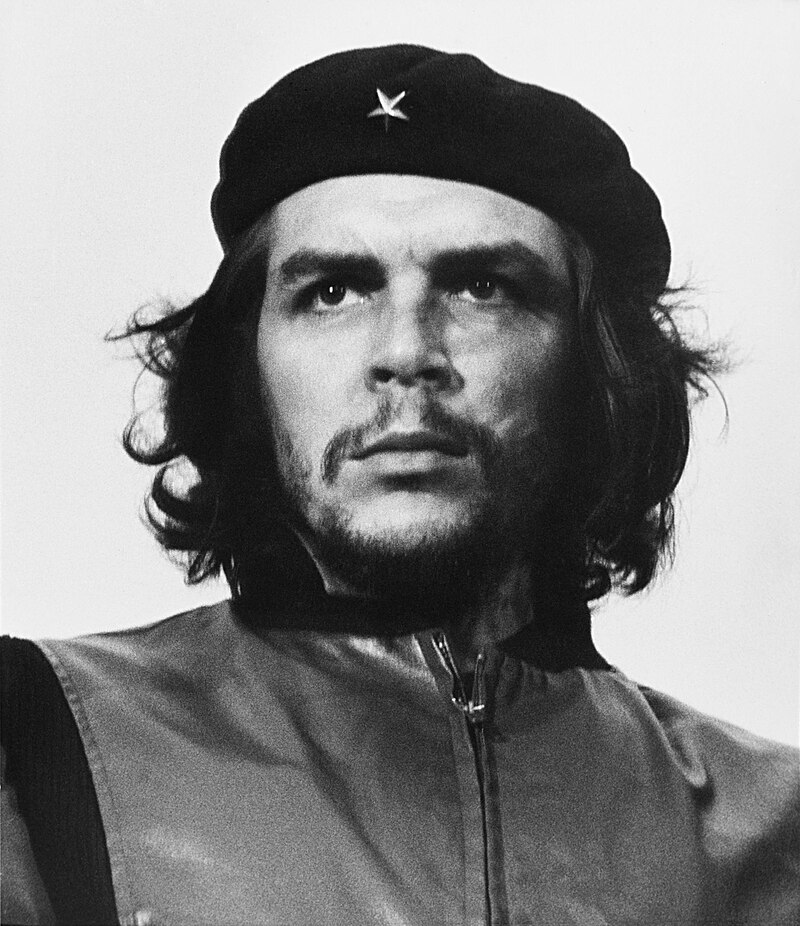
On March 5, 1960, Cuban photographer Alberto Korda raised his Leica M2 camera during a memorial service in Havana and captured two frames of a 31-year-old revolutionary named Ernesto "Che" Guevara. He had no idea that one of those frames—later titled Guerrillero Heroico—would become what the Maryland Institute College of Art called "the most famous photograph in the world."1 This che guevara photo alberto korda created didn't just document a moment. It became revolution's face, capitalism's paradox, and one of the most reproduced images in human history—despite sitting unpublished in Korda's studio for seven years.
What makes a photograph transcend its moment? Why did this particular image—among thousands of Che Guevara portraits—become the definitive icon? The answer lies in a perfect storm of composition, context, timing, and the accidental nature of artistic immortality. Korda almost didn't take the shot. The photograph remained virtually unknown until Che's death in 1967. And the photographer himself never profited from its global proliferation, even as it appeared on everything from protest banners to vodka advertisements.
The La Coubre Explosion: Cold War Context Behind the Lens
To understand Guerrillero Heroico, you need to understand what brought Korda and Che together that March afternoon. The day before, on March 4, 1960, a French freighter called La Coubre had exploded in Havana Harbor while unloading Belgian munitions.2 The blast killed over 75 people and injured hundreds. Cuba's revolutionary government immediately suspected CIA sabotage—a claim the United States denied but which fit the escalating tensions of the early Cold War.
Fidel Castro organized a massive memorial service at the Colón Cemetery. Thousands gathered. The atmosphere crackled with grief and revolutionary fervor. Alberto Korda, then working as Castro's semi-official photographer, positioned himself near the speakers' platform with his trusty Leica M2 fitted with a 90mm lens.3 He'd been photographing the revolution since its early days, documenting everything from military campaigns to diplomatic visits.
During Castro's speech, something caught Che Guevara's attention on the platform. His expression shifted—hardened into what Korda later described as a look of "absolute implacability." The photographer reacted instinctively, firing off two frames. Just two. The entire sequence lasted maybe ten seconds. Then Che's face relaxed, and the moment vanished.
Technical Mastery: The Camera Settings That Created an Icon
Let's talk about the technical brilliance that makes this che guevara photo alberto korda captured so visually arresting. Korda was using a Leica M2 rangefinder camera—a compact, quiet, incredibly precise instrument favored by photojournalists worldwide. The 90mm lens gave him the compression and reach he needed to isolate Che from the surrounding crowd without getting physically close.4
The lighting conditions were perfect—overcast Cuban sky providing soft, even illumination without harsh shadows. This natural diffusion gave Che's face that sculptural quality, every detail rendered with clarity. The film stock, likely Kodak Plus-X or Tri-X, captured a tonal range that would prove essential when the image was later reproduced in high-contrast posters.5
Composition That Commands Attention
What makes the composition so powerful? Start with Che's gaze—slightly upward, looking beyond the frame, into some distant horizon. It's not confrontational but determined, almost prophetic. His expression combines intensity with a hint of melancholy, creating emotional complexity that invites interpretation rather than dictating it.
The beret with its single star sits at a perfect angle, creating a diagonal line that adds dynamism to the frame. His hair flows from beneath it, giving texture and movement. The jacket collar frames his face naturally, drawing the eye to those penetrating eyes. The contrast between the dark beret and hair against his lighter skin creates visual separation that makes the image readable even when reproduced at tiny sizes or in extreme high contrast.
But here's what most people don't realize: the iconic image we know is cropped. The original frame included more background—palm trees, sky, other people. Someone—likely Italian publisher Giangiacomo Feltrinelli, though this remains disputed—made the decision to crop tightly around Che's face and upper shoulders.6 That cropping decision changed everything. It removed context and specificity, transforming a documentary photograph into a timeless symbol.
Seven Years in Darkness: The Unpublished Masterpiece
Here's where the story gets strange. After developing the film, Korda made a print and hung it in his Havana studio. And there it stayed. For seven years. No publication. No exhibition. No distribution. The photograph that would eventually cover millions of walls worldwide spent the better part of a decade as a personal memento in a photographer's workspace.
Why? Partly because Korda shot hundreds of photographs during that period, many of which seemed more immediately newsworthy. Partly because the Cuban press had other priorities—the revolution was consolidating power, dealing with the Bay of Pigs invasion, navigating the Missile Crisis. A portrait of Che, however striking, wasn't urgent news. And partly because, as Korda himself later explained, he simply didn't recognize its potential impact at the time.7
Everything changed on October 9, 1967, when Che Guevara was executed in Bolivia after a failed guerrilla campaign. Suddenly, the Argentine-born revolutionary who'd helped Castro seize power became a martyr. His death at 39 transformed him from controversial political figure into romantic symbol of revolutionary sacrifice.
Italian publisher Giangiacomo Feltrinelli, a wealthy leftist who'd met Korda in Cuba, requested copies of photographs of Che. Korda gave him the print—no payment, no contract, no copyright discussion. Feltrinelli recognized what he had. He cropped it, reproduced it as a poster, and distributed it across Europe.8 By 1968, as student protests erupted from Paris to Mexico City, Che's face appeared everywhere—on banners, posters, T-shirts, walls.
The Photographer's Paradox: Korda's Relationship with His Creation
Alberto Korda—born Alberto Díaz Gutiérrez in 1928—wasn't a revolutionary zealot who picked up a camera. He was a successful commercial photographer who'd worked in fashion and advertising before Castro's revolution.9 He knew lighting, composition, and commercial value. Yet when his most famous image began circulating globally, he received nothing.
This wasn't entirely accidental. Korda made a conscious decision: he would allow free use of the image for revolutionary and socialist causes while opposing commercial exploitation. In his words, Che's image belonged to the people, not to capitalism. This principled stance meant that while his photograph appeared in leftist publications, protest movements, and solidarity campaigns worldwide, he didn't see a cent.
But Korda drew a line at commercial appropriation. In 2000, when Smirnoff vodka used the image in an advertising campaign without permission, he sued. The case settled out of court for approximately $50,000, which Korda donated to Cuba's healthcare system.10 The irony wasn't lost on anyone: the most reproduced photograph in history, depicting an anti-capitalist revolutionary, finally generated income when a vodka company tried to sell liquor with it.
Beyond One Image: Korda's Broader Legacy
It's worth remembering that Korda's career extended far beyond this single frame. He documented Cuba's revolutionary period extensively, capturing Castro, Che, Camilo Cienfuegos, and countless other figures and moments. His work combined documentary instinct with formal aesthetic training, creating images that were both historically important and visually sophisticated.
He photographed underwater scenes, fashion, nature, and Cuban life across four decades. But inevitably, Guerrillero Heroico overshadowed everything else. It became both blessing and curse—ensuring his place in photography history while reducing his diverse body of work to a single image. Korda died in Paris on May 25, 2001, while on a photography assignment, his legacy forever intertwined with Che's face.11
From Revolution to Retail: The Image's Cultural Evolution
The trajectory of Guerrillero Heroico through different decades reveals how images can be appropriated, reinterpreted, and stripped of original meaning. In the late 1960s and early 1970s, the image functioned as genuine revolutionary iconography. Students in Paris, activists in Latin America, anti-war protesters in the United States—they displayed Che's face as a symbol of resistance against imperialism, capitalism, and establishment power.12
By the 1990s, something shifted. The Soviet Union collapsed. The Cold War ended. Revolutionary socialism lost its geopolitical context. Yet Che's image persisted, increasingly divorced from its political origins. It appeared on products marketed to teenagers who couldn't locate Bolivia on a map, let alone explain Che's role there. The face became aesthetic rather than ideological—a symbol of vague rebellion, youth, and counterculture cool.
The 2000s accelerated this commodification. You could buy Che bikinis, Che lighters, Che mouse pads, Che baby clothes. The image appeared in contexts that would have horrified both Guevara and Korda. A revolutionary who wrote extensively against consumerism became one of capitalism's most profitable icons. The Maryland Institute College of Art's designation as "most famous photograph" reflected not political impact but sheer ubiquity—the image had transcended meaning to become pure visual currency.
This evolution raises uncomfortable questions about how images function in culture. Can a photograph retain its original meaning when reproduced millions of times in wildly different contexts? Does the che guevara photo alberto korda took still communicate revolution, or has it become an empty signifier—recognizable but meaningless? Art historians and cultural critics continue debating these questions, with no consensus in sight.13
Copyright, Authenticity, and the Market for Prints
The legal and commercial history of Guerrillero Heroico reads like a case study in intellectual property chaos. In many countries, the image entered public domain because Cuba didn't enforce international copyright treaties during the Cold War. In others, Korda's estate and Cuban authorities have attempted to maintain control. The result? A legal patchwork where the image is simultaneously protected and freely reproducible depending on jurisdiction and use.
Authentic prints by Korda are extremely rare and valuable. He made relatively few prints during his lifetime, and those that exist command significant prices at auction. A signed Korda print sold at auction in 2001 for over $10,000—modest compared to other iconic photographs but significant for an image so widely reproduced that original prints seemed unnecessary.14
Authentication presents challenges. The negative remained in Cuba, controlled by Korda's estate and later by Cuban cultural authorities. Prints can be dated through paper and chemical analysis, but the image's widespread reproduction means forgeries and unauthorized prints circulate constantly. Collectors seeking genuine Korda prints need documentation tracing provenance directly to the photographer or his authorized representatives.
The Feltrinelli Distribution Network
Giangiacomo Feltrinelli's role in distributing the image deserves closer examination. As a wealthy Italian publisher with leftist sympathies, he had both the resources and the network to disseminate the photograph globally. After receiving prints from Korda in 1967, Feltrinelli produced posters that appeared in bookstores, universities, and protest movements across Europe.15
Feltrinelli himself became increasingly radicalized, eventually going underground with Italian far-left groups. He died in 1972 under mysterious circumstances—officially an accidental death while attempting to sabotage electrical infrastructure, though some suspected assassination. By then, Che's image had escaped any individual's control, reproducing virally through posters, silkscreens, and eventually digital media.
Artistic Derivatives and Pop Culture Appropriation
The image's visual power has inspired countless artistic interpretations, appropriations, and variations. Irish artist Jim Fitzpatrick created a high-contrast, two-tone version in 1968 that became nearly as iconic as the original. His stylized interpretation, with its bold red and black colors, appeared on countless posters and became the template for screen-printed reproductions.16
Pop artists like Andy Warhol incorporated Che's image into their work, treating it as they did Marilyn Monroe or Mao Zedong—as a cultural icon ripe for artistic commentary. Street artists, graphic designers, and illustrators have created thousands of variations: Che with different expressions, different contexts, different messages. Some honor the revolutionary; others mock or subvert him.
The image has appeared in music videos, album covers, films, and television shows. It's been projected onto buildings, carved into mountainsides, and rendered in everything from coffee foam to sand sculpture. This proliferation speaks to the photograph's compositional strength—it remains recognizable even when radically transformed or reduced to simple outlines.
For photographers, studying how this image has been appropriated offers insights into portrait photography's lasting impact. What makes a portrait transcend its subject? How do formal elements—composition, lighting, expression—contribute to an image's ability to function symbolically rather than merely documentarily?
Comparing Che Photographs: Why This One Won
Che Guevara was photographed extensively throughout his life. From his motorcycle journey across South America to his guerrilla campaigns in Cuba, Congo, and Bolivia, cameras documented his transformation from middle-class Argentine medical student to revolutionary icon. So why did Korda's image become the definitive representation?
Compare it to other famous Che photographs: René Burri's 1963 image of Che smoking a cigar is excellent—dynamic, characterful, engaging. But it's too specific, too casual. Osvaldo Salas photographed Che numerous times with similar access to Korda, producing technically accomplished portraits. But none achieved the symbolic weight of Guerrillero Heroico.
The difference lies in that expression—simultaneously fierce and contemplative, present and distant. The upward gaze suggests vision and aspiration. The slight frown indicates seriousness without anger. The composition removes distracting elements while retaining just enough context (the beret, the hair, the jacket) to maintain identity. It's specific enough to be recognizable but abstract enough to be universal.
Timing mattered too. The image emerged publicly at precisely the moment when Che's death transformed him from controversial political figure to martyr. Had it been published in 1960, it might have been just another revolutionary portrait. Released in 1967-68, it became the visual embodiment of romantic revolutionary sacrifice.
Photographic Analysis: What Makes It Work
Let's break down the technical and aesthetic elements that make this che guevara photo alberto korda captured so effective. Understanding these components offers lessons for anyone interested in documentary photography or portrait work.
Tonal Range and Contrast
The photograph's tonal range—from the deep blacks of Che's hair and beret to the lighter tones of his skin—creates depth and dimension. The mid-tones are rich and detailed, giving texture to his beard and jacket. This tonal gradation means the image reproduces well across different media, from high-quality prints to cheap photocopies. Even when reduced to high-contrast black and white, the composition remains readable because the value structure is sound.17
The Power of the Gaze
Che isn't looking at the camera. His gaze directs upward and to the side, beyond the frame. This creates psychological space—the viewer wonders what he's seeing, what he's thinking. A direct gaze would have created confrontation; looking away creates mystery. The slight upward angle suggests aspiration, vision, looking toward the future. It's the gaze of someone seeing beyond present circumstances.
Symbolic Elements
The beret with its single star became inseparable from Che's image. That star—a simple five-pointed metal insignia—adds a focal point at the top of the frame. It's small but significant, drawing the eye upward and reinforcing the vertical composition. The wild hair flowing from beneath the beret adds texture and movement, preventing the image from feeling too formal or static. These weren't calculated props; they were simply what Che was wearing. But they function perfectly as visual elements.
For photographers interested in how technical choices shape aesthetic impact, this image demonstrates that mood and meaning emerge from formal decisions—focal length, framing, timing, and the decisive moment when expression aligns with composition.
The Contact Sheet Mystery
Photography enthusiasts often wonder about the contact sheet from that day—what other frames existed? Korda reportedly took only two frames of Che during that brief moment. The first was slightly out of focus or poorly composed; the second was the keeper. This economy of shooting reflects both Korda's skill and the limitations of film photography—you didn't spray and pray with a manual Leica. You waited, watched, and fired when the moment arrived.
The contact sheet from that day's shooting would have included many other images: Castro speaking, crowds grieving, officials on the platform. But those two frames of Che stood apart. Korda recognized this immediately when developing the film, which is why he made a print for his studio wall. He just didn't realize that personal favorite would eventually become the world's most recognized photograph.18
The Economic Paradox: Priceless Yet Worthless
Here's the strangest aspect of Guerrillero Heroico: it's simultaneously the most valuable and most valueless photograph in history. Its cultural value is incalculable—it's been reproduced more than any other photograph, recognized globally, and has influenced visual culture for over five decades. Yet its economic value to its creator was essentially zero.
Korda never registered copyright in most jurisdictions. He gave away reproduction rights freely to revolutionary causes. The image circulated so widely that enforcing copyright became practically impossible. When he did enforce it—in the Smirnoff case—he donated the settlement. His estate and Cuban authorities have attempted to license the image for commercial uses, but enforcement remains spotty and complicated by jurisdictional issues.
Compare this to other iconic photographs where photographers or their estates earn ongoing licensing revenue. Annie Leibovitz's celebrity portraits, Steve McCurry's "Afghan Girl," Dorothea Lange's "Migrant Mother"—these images generate income through licensed reproduction. Korda's image generates revenue for countless others—poster companies, T-shirt manufacturers, advertisers—but rarely for those with legitimate copyright claims.
This economic paradox reflects the image's political origins. An anti-capitalist icon can't function within capitalist frameworks without contradiction. Korda's principled stance—allowing free use for political purposes while opposing commercial exploitation—was admirable but practically unenforceable once the image achieved viral status.
For photographers today navigating questions about monetizing their work, Korda's story offers a cautionary tale about controlling image distribution in an age of easy reproduction.
Legacy and Continuing Relevance
More than six decades after Korda pressed his Leica's shutter, Guerrillero Heroico remains visually and culturally potent. New generations discover it, reinterpret it, and argue about what it means. The image has outlived both its subject and its creator, taking on meanings neither could have anticipated.
For photography students and practitioners, it offers multiple lessons. Technically, it demonstrates how formal excellence—composition, lighting, timing—creates lasting impact. Historically, it shows how context shapes meaning and how images can escape their original purpose. Ethically, it raises questions about copyright, compensation, and the relationship between art and commerce.
The photograph also reminds us that iconic images often emerge accidentally. Korda didn't set out to create the world's most famous photograph. He was doing his job, documenting an event, responding instinctively to a fleeting expression. The image's power came from technical skill meeting perfect circumstances—and from the unpredictable ways culture adopts and transforms visual symbols.
In our current era of digital photography and instant global distribution, when anyone can capture and share images worldwide within seconds, Guerrillero Heroico represents something increasingly rare: a photograph that genuinely changed visual culture. Not because it documented a decisive historical moment—the La Coubre memorial was significant but not world-changing. But because it crystallized complex ideas—revolution, resistance, idealism, sacrifice—into a single, perfect frame.
Whether you see Che Guevara as hero, villain, or something more complicated, Korda's photograph remains a masterclass in portraiture's power. It proves that sometimes the most important photographs aren't the ones carefully planned and executed, but the ones captured in a moment of pure photographic instinct—when a skilled photographer recognizes something essential in a face and preserves it forever.
The che guevara photo alberto korda took that March afternoon in 1960 didn't just capture a revolutionary's face. It captured something deeper—the romantic ideal of revolution itself, frozen in silver halide and transformed into visual myth. That transformation, from documentary photograph to global icon, represents photography's unique power to shape how we see history, politics, and ourselves. And that power, more than any political ideology, ensures Guerrillero Heroico will continue resonating for generations to come.
Frequently Asked Questions
Why did Alberto Korda's Che Guevara photo remain unpublished for seven years?
Korda captured the image in March 1960 but it remained in his studio until after Che's death in October 1967. During those seven years, the photograph simply wasn't considered newsworthy—Korda had shot hundreds of images during Cuba's revolutionary period, and this particular portrait didn't stand out as urgent for publication. It was only after Che became a martyr that Italian publisher Giangiacomo Feltrinelli requested photographs, and Korda provided this image, which Feltrinelli then cropped and distributed globally.19
What camera and settings did Korda use to photograph Che Guevara?
Alberto Korda used a Leica M2 rangefinder camera fitted with a 90mm lens to capture Guerrillero Heroico. The specific film stock was likely Kodak Plus-X or Tri-X, standard black-and-white films of that era. The overcast Cuban sky provided soft, even natural lighting that eliminated harsh shadows and gave Che's face that sculptural quality. The 90mm lens allowed Korda to compress the background and isolate Che from the surrounding crowd at the memorial service, creating the intimate framing that makes the image so powerful.20
Why didn't Korda profit from the most reproduced photograph in history?
Korda made a principled decision to allow free use of the image for revolutionary and socialist causes while opposing commercial exploitation. He gave the photograph to Giangiacomo Feltrinelli without payment or copyright agreement, and it quickly spread beyond anyone's control. Cuba didn't enforce international copyright treaties during the Cold War, and the image entered public domain in many jurisdictions. Korda only sued for unauthorized commercial use once—against Smirnoff vodka in 2000—settling for approximately $50,000, which he donated to Cuba's healthcare system. His stance meant that while the image generated millions in revenue for others, he received essentially nothing.21
How did the cropping change the original photograph?
The iconic version of Guerrillero Heroico is cropped from a larger original frame that included more background elements—palm trees, sky, and other people at the memorial service. The decision to crop tightly around Che's face and upper shoulders (likely made by publisher Giangiacomo Feltrinelli, though this remains disputed) transformed the image from a documentary photograph with specific temporal and spatial context into a timeless, universal symbol. By removing environmental details, the cropping focused all attention on Che's expression and the iconic elements—his beret with star, his intense gaze, his determined expression—making the image function symbolically rather than documentarily.22
What was the La Coubre explosion that prompted the memorial service?
On March 4, 1960, the French freighter La Coubre exploded in Havana Harbor while unloading Belgian munitions, killing at least 75 people and injuring hundreds more. Cuba's revolutionary government suspected CIA sabotage as part of escalating Cold War tensions, though the United States denied involvement. Fidel Castro organized a massive memorial service the following day at Colón Cemetery, where thousands gathered to mourn the victims. It was during Castro's speech at this emotionally charged event that Korda captured Che Guevara's expression—a look of what Korda described as "absolute implacability" that became the iconic image.23
How much are authentic Korda prints of Guerrillero Heroico worth?
Authentic prints made and signed by Alberto Korda are extremely rare and valuable, with signed prints selling at auction for $10,000 or more. However, the market is complicated by authentication challenges—the image has been reproduced so widely that countless unauthorized prints exist claiming various levels of authenticity. Genuine Korda prints require documentation tracing provenance directly to the photographer or his authorized representatives. The negative remained in Cuba, controlled by Korda's estate and Cuban cultural authorities, making authentication particularly important for collectors. Despite the image's ubiquity, original prints by Korda are scarce because he made relatively few during his lifetime, focusing instead on allowing free reproduction for political causes.24
- The Maryland Institute College of Art made this declaration based on the image's unprecedented global reproduction and cultural penetration across multiple decades.
- The La Coubre was carrying approximately 76 tons of grenades and ammunition when it exploded, killing at least 75 people and injuring hundreds more.
- Korda's choice of a 90mm lens was crucial—it provided enough reach to isolate subjects from a distance while maintaining the sharpness and tonal quality Leica lenses were famous for.
- The Leica M2, introduced in 1958, was known for its reliability and the exceptional optical quality of its lenses, making it ideal for capturing decisive moments in documentary photography.
- Plus-X and Tri-X were the dominant black-and-white films of the era, with Tri-X offering higher sensitivity (ASA 400) for available light situations.
- The cropping decision transformed the image from a documentary photograph into an icon by removing temporal and spatial context, making Che's expression universal rather than specific to that moment.
- Korda kept the negative in his personal archive rather than submitting it to Cuban media outlets, suggesting he viewed it as a personal artistic achievement rather than a news photograph.
- Feltrinelli's publishing house had already gained notoriety for publishing Boris Pasternak's "Doctor Zhivago" against Soviet wishes, establishing him as a key figure in Cold War cultural politics.
- Before 1959, Korda ran a successful Havana studio called "Korda" (a name inspired by Hungarian filmmakers Alexander and Zoltan Korda) that specialized in fashion and advertising photography.
- The Smirnoff lawsuit represented one of the few times Korda actively enforced copyright claims, and his decision to donate the settlement reinforced his stated principles about the image's proper use.
- Korda was in Paris for an exhibition of his work when he suffered a heart attack, dying at age 72 with his photography career still active.
- The 1968 student protests in Paris, Mexico City, and other global cities prominently featured Korda's image, establishing it as the visual shorthand for youth rebellion and anti-establishment politics.
- Scholars like John Berger and Susan Sontag have written extensively about how reproduction and context transform photographic meaning, using Korda's Che image as a prime example.
- The market for Korda prints is complicated by questions of authentication, as numerous unauthorized prints and reproductions flood the market claiming various levels of authenticity.
- Feltrinelli's distribution network extended beyond his publishing house to include leftist political organizations, student groups, and cultural institutions throughout Western Europe.
- Fitzpatrick's version, created as a tribute after Che's death, simplified Korda's photograph into graphic elements that were easier to reproduce through screen-printing and other low-tech methods.
- Tonal range refers to the distribution of values from pure black to pure white in a photograph, with rich mid-tones generally indicating proper exposure and development.
- Contact sheets show all frames from a roll of film printed at small size, allowing photographers to select the best images for enlargement—a crucial step in film photography workflow.
- The seven-year gap between capture and publication demonstrates how historical context can transform an image's significance—what seemed like a simple portrait in 1960 became a powerful symbol after Che's death in 1967.
- The Leica M2 with 90mm lens combination was ideal for photojournalism—compact enough for mobility while providing sufficient reach to isolate subjects without intrusive proximity.
- Korda's position created an economic paradox where an anti-capitalist icon became one of capitalism's most profitable images, enriching everyone except its creator and subject.
- The cropping decision demonstrates how post-capture editing choices can fundamentally alter an image's meaning and impact, transforming documentation into iconography.
- The La Coubre explosion and subsequent memorial occurred during a period of intense Cold War confrontation between Cuba and the United States, providing the politically charged context for Korda's photograph.
- The market value of authentic Korda prints reflects their rarity rather than the image's cultural significance, as the photograph's widespread reproduction makes original prints particularly scarce and desirable to collectors.