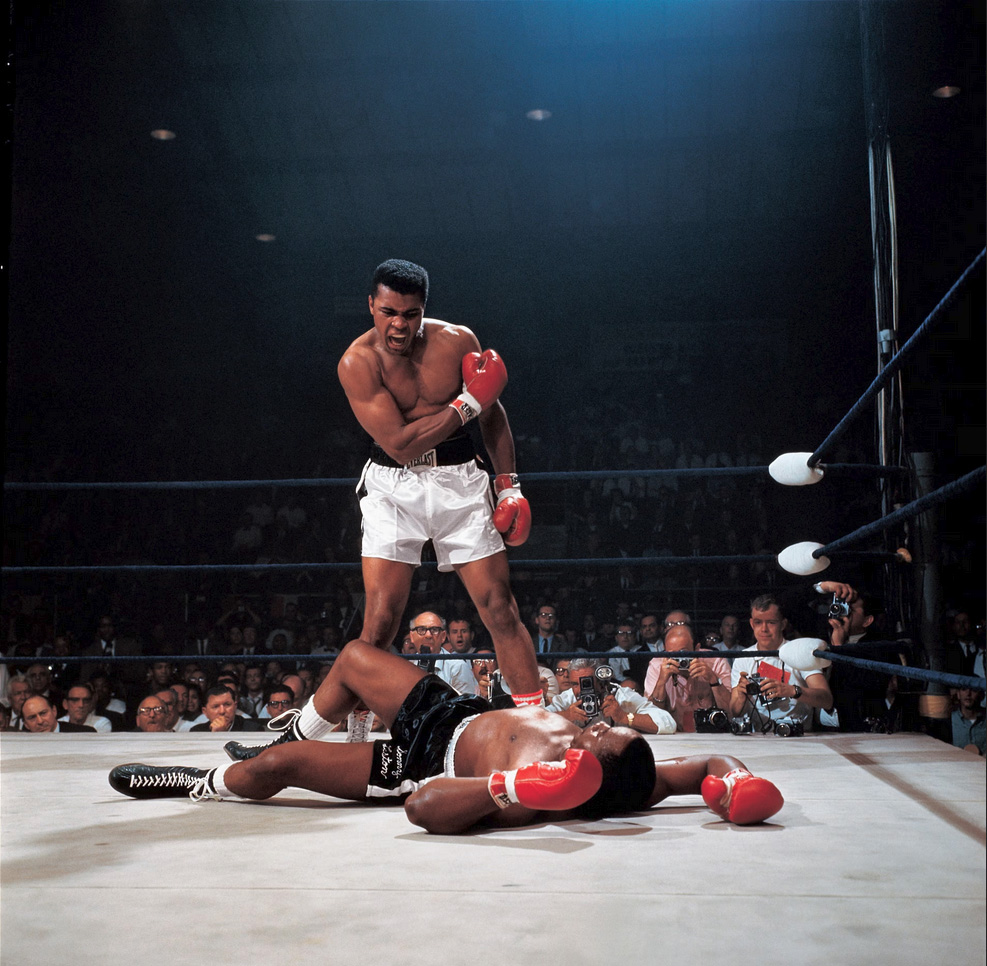
On May 25, 1965, in a cramped boxing arena in Lewiston, Maine, a 22-year-old photographer named Neil Leifer captured what many consider the greatest sports photograph ever taken. The muhammad ali sonny liston knockout photo didn't just document a controversial first-round knockout—it froze a moment of athletic dominance so visually arresting that it transcends sport entirely. Ali stands over the fallen Liston, right arm cocked, face contorted in a primal roar, while the former champion lies sprawled on the canvas in a composition so perfect it seems choreographed. But this wasn't staged. This was real, and Leifer had exactly one chance to get it right.1
The photograph's power lies not just in what it shows, but in how it shows it. From directly overhead, Leifer's camera transforms the boxing ring into a stage, the ropes into leading lines that pull your eye straight to the drama at center canvas. Ali's white trunks glow against the blue mat. Liston's dark form creates a stark contrast. The crowd—all 2,434 of them in an arena built for thousands more—becomes a blur of faces ringing the action.2 This isn't just sports photography. It's portraiture of triumph and defeat, captured in a single frame.
The Technical Gamble: How Leifer Got the Shot Nobody Else Could
Let's talk about the gear first, because the technical execution here was borderline insane for 1965. Leifer didn't just show up with a camera and hope for the best. He brought a remote-controlled camera—cutting-edge technology at the time—and convinced arena officials to let him mount it directly above the ring.3 The camera itself was likely a Nikon F or similar professional body loaded with Kodak Ektachrome color slide film, probably rated at ASA 200 or 400 to handle the arena's inadequate lighting.
Here's where it gets interesting. Leifer's technical approach required him to pre-focus the camera on the center of the ring and set an aperture wide enough—probably f/4 or f/5.6—to maintain acceptable depth of field while keeping shutter speeds fast enough to freeze motion. We're talking 1/500th of a second minimum, possibly faster. The lighting at St. Dominic's Arena wasn't designed for color photography; most sports shooters still relied on black-and-white film that performed better in low light. Leifer's decision to shoot color was itself a gamble that paid off spectacularly.4
The overhead position wasn't just aesthetically bold—it was logistically nightmarish. Leifer had to rig the remote trigger, ensure the camera wouldn't shake from arena vibrations, and hope the exposure settings he'd chosen would work when the moment came. He couldn't adjust anything once the fight started. One shot. That's all he'd get from that angle. Meanwhile, he was also shooting from ringside with a handheld camera, hedging his bets like any smart photographer would.5
The 'Phantom Punch': Why This Knockout Sparked Decades of Controversy
The fight lasted one minute and forty-two seconds. That's it. Sonny Liston, the intimidating former champion who'd terrorized the heavyweight division, went down from what appeared to be a short right hand that many spectators—and even some at ringside—claimed they never saw land. They called it the "phantom punch," and the controversy around it has never fully died.6
Was the fight fixed? The rumors started immediately. Liston had connections to organized crime—that wasn't speculation, it was documented fact. The first Ali-Liston fight in 1964 had ended with Liston quitting on his stool, claiming a shoulder injury that many doubted. Now here was Liston, going down from a punch that looked more like a tap than a knockout blow, staying down while referee Jersey Joe Walcott lost control of the count, and Ali standing over him screaming "Get up and fight, sucker!"7
Leifer's photograph doesn't answer whether the punch was real or the fight was fixed. What it does is capture the perception of dominance. Ali looks invincible. Liston looks finished. Whether the knockout was legitimate or not, the image tells the story that would define both fighters' legacies: Ali as the brash young champion who couldn't be beaten, Liston as the aging tough guy whose time had passed. Photography doesn't always capture truth—sometimes it captures mythology.
The Forensic Evidence Hidden in the Frame
Look closely at the photograph and you can see details that fuel the controversy. Ali's right arm is extended but not fully, suggesting a short punch rather than a haymaker. Liston's position on the canvas—flat on his back, arms splayed—doesn't match the typical collapse pattern of a fighter knocked unconscious by a head shot. His eyes appear open. Boxing analysts have spent decades examining this image, trying to determine from Ali's body mechanics and Liston's fall pattern whether the knockout was genuine.8
The overhead angle actually makes this analysis possible. Ringside photographers captured the moment from horizontal perspectives that compress the action and make spatial relationships unclear. Leifer's bird's-eye view provides a geometric clarity that other angles can't match. You can see exactly where Ali's feet are planted, how his weight is distributed, the angle of his shoulder rotation. It's this forensic quality—unintentional but invaluable—that makes the photograph useful beyond its aesthetic impact.
Why Lewiston, Maine? The Bizarre Venue Choice That Made History
A heavyweight title fight in Lewiston, Maine? The location makes no sense until you understand the circumstances. The rematch was originally scheduled for Boston, but Massachusetts authorities pulled the license at the last minute, citing concerns about Liston's criminal connections and the legitimacy of the contest. Promoters scrambled for an alternative venue and landed on St. Dominic's Arena in Lewiston, a hockey rink in a small Maine city with no boxing tradition whatsoever.9
The venue change happened with barely three weeks' notice. That's why attendance was so pathetic—2,434 people in a space that could hold more than twice that number. It's also why the lighting was so challenging for photographers. Hockey arenas aren't lit for color photography; they're lit for hockey. The overhead lights created harsh shadows and uneven illumination that would have been a nightmare for any photographer trying to shoot color film at 1960s ISO speeds.10
But here's the thing: those limitations created the photograph's dramatic lighting. The harsh overhead illumination that made shooting difficult also created the stark contrast between Ali's white trunks and the darker canvas, between the brightly lit ring and the shadowy crowd. Technical constraints became aesthetic advantages. Sometimes you need bad conditions to make great art.
Composition Decoded: Why This Image Works Visually
Strip away the historical context and you're left with a compositionally perfect photograph. The overhead perspective transforms the boxing ring into a geometric frame—four ropes creating a square within the frame, with the action positioned slightly off-center according to the rule of thirds. Ali occupies the upper right intersection point, the most visually dominant position in Western compositional tradition. Liston's prone body creates a diagonal line across the lower portion of the frame, leading the viewer's eye from bottom left toward Ali.11
The color palette is deceptively simple but incredibly effective. Blue canvas. White trunks. Flesh tones. The crowd becomes an impressionistic blur of color—no individual faces, just a ring of humanity bearing witness. This is what portrait photography aesthetics looks like when applied to sports: isolating the subject, controlling the viewer's focus, using color and composition to convey emotion rather than just document action.
And then there's Ali's body language. His right arm is still extended from the punch, his left arm cocked at his side, his mouth open in that famous taunt. Every element of his posture communicates dominance, aggression, youth, power. Compare this to Liston—horizontal, passive, defeated. The photograph is a study in contrasts: vertical versus horizontal, active versus passive, triumph versus defeat, youth versus age. You don't need to know anything about boxing to understand what's happening here. The visual language is universal.12
The Overhead Revolution in Sports Photography
Before Leifer's Ali-Liston photograph, sports photography meant ringside or courtside positions. Photographers shot from eye level or slightly elevated press positions, capturing horizontal perspectives that placed them within the action. The overhead angle was virtually unused—partly because it required special equipment and permissions, partly because nobody had proven it could produce compelling images.13
Leifer changed that. After this photograph appeared in Sports Illustrated, overhead cameras became standard equipment at major sporting events. Modern sports photography—with its aerial perspectives, remote cameras mounted on cables and cranes, and drone footage—traces its lineage directly back to what Leifer did in Lewiston. He proved that changing perspective could transform documentation into art. That's a lesson that applies far beyond sports, influencing everything from documentary photography practices to commercial work.
The Other Photographers: Alternative Angles Nobody Remembers
Leifer wasn't alone at ringside. Multiple photographers covered the fight, including Herb Scharfman and other wire service shooters. They all captured the knockout moment. Some got sharp, well-exposed images from conventional angles. None of them created an iconic photograph. Why?14
Perspective is everything. The ringside shots show Ali and Liston from roughly horizontal viewpoints, with other figures—the referee, cornermen, ringside spectators—cluttering the frame. These images document the event but don't distill it. They're busy, complex, harder to read. Leifer's overhead angle eliminates visual noise. The ring becomes a stage, the ropes become a frame, and the two fighters become the only elements that matter. It's reductionist in the best sense—stripping away everything that doesn't serve the image's emotional core.
There's also timing. Leifer caught the moment when Ali was standing directly over Liston, creating that perfect vertical-horizontal contrast. A second earlier or later and the composition falls apart. Other photographers might have captured the punch landing or Liston hitting the canvas, but those moments don't have the same visual or emotional impact. The photograph works because it shows the aftermath—the moment of dominance asserted, the fight effectively over, the champion standing triumphant over the fallen challenger.15
From Sports Illustrated to Cultural Icon: The Image's Journey
The photograph appeared in Sports Illustrated's coverage of the fight, but its cultural impact extended far beyond the magazine's pages. Over the decades, it's been reproduced in countless contexts: posters, album covers, advertisements, documentaries, museum exhibitions. It's appeared in art galleries and on dorm room walls. It's been referenced, parodied, and homaged in everything from music videos to political cartoons.16
Why does this image have such staying power? Part of it is Ali himself—his transformation from Cassius Clay to Muhammad Ali, his refusal to be drafted for Vietnam, his role as a cultural lightning rod in 1960s America. The photograph captures him at a pivotal moment: young, powerful, defiant, seemingly invincible. It's an image of Black excellence and athletic dominance at a time when both were deeply threatening to white America. The photograph's meaning has evolved over time, absorbing new layers of significance as Ali's legacy has been reassessed and celebrated.17
But there's also something universal about the image that explains its endurance. It's a photograph about triumph. About standing over your defeated opponent. About the moment when victory is absolute and undeniable. That narrative resonates across cultures and time periods. It's why the image has been used to sell everything from sneakers to software—it communicates winning in the most primal, visual terms possible.
The Economics of an Icon: What This Photograph Is Worth
Leifer has sold limited edition prints of the photograph for decades, typically in editions of 350 signed and numbered copies. Prices vary depending on size and print quality, but authenticated prints through Leifer's official channels can command thousands of dollars. Vintage prints from 1965 are exponentially more valuable, with auction prices reaching well into five figures for museum-quality examples.18
The photograph's commercial licensing has generated substantial revenue over the years. Every time it appears in a documentary, textbook, advertisement, or editorial context, licensing fees are paid. For a photographer, creating a single image with this kind of enduring commercial value is like winning the lottery. Most professional photographers never capture anything that has this kind of long-term earning potential. Leifer was 22 years old when he took it.19
This economic reality has influenced how photographers approach their work, especially in sports and photojournalism. The possibility of capturing "the one"—the single image that defines a career and generates income for decades—drives photographers to take risks, invest in expensive equipment, and position themselves for moments that might never come. It's a lottery mentality, but when the payoff looks like Leifer's Ali-Liston photograph, it's easy to understand why photographers keep playing. For insights on building sustainable income from photography, explore modern passive income strategies that complement iconic image creation.
Ali's Perspective: What the Champion Thought About the Photo
Muhammad Ali was notoriously media-savvy, understanding the power of imagery better than almost any athlete of his era. He posed for countless photographs throughout his career, often staging moments specifically for cameras. But the Leifer photograph wasn't staged—it was spontaneous, captured in the chaos of an actual fight. Did Ali appreciate what Leifer had captured?20
In various interviews over the years, Ali acknowledged the photograph's iconic status and seemed pleased that it showed him at his most dominant. The image reinforced the persona he'd carefully constructed: the Louisville Lip, the Greatest, the fighter who could predict the round of his knockouts and then deliver. Standing over Liston, arm extended, mouth open in that famous taunt—it's Ali at his most Ali. The photograph became inseparable from his brand, used in promotional materials and retrospectives throughout his life.21
But there's an interesting tension here. The fight's controversial nature—the phantom punch, the rumors of a fix—meant the photograph also documented one of the most disputed moments in boxing history. Ali always maintained the knockout was legitimate, that his "anchor punch" had caught Liston perfectly and put him down for good. The photograph became visual evidence in that ongoing argument, used by both those who believed Ali and those who remained skeptical.
Technical Deep Dive: Recreating the Shot with Modern Equipment
Could you recreate Leifer's photograph today? Technically, it would be much easier. Modern digital cameras handle low light infinitely better than 1965 film stocks. You could shoot at ISO 6400 or higher with minimal noise, using shutter speeds fast enough to freeze even the quickest boxing movements. Autofocus systems would eliminate the need to pre-focus on the center of the ring and hope the action happens where you expect.22
Remote cameras are now standard equipment at major sporting events, often mounted on robotic rigs that allow photographers to pan, tilt, and zoom from remote positions. You wouldn't need to rig a static camera and hope for the best—you could actively frame and adjust throughout the fight. Some photographers now use multiple remote cameras positioned at various angles, covering every possible perspective simultaneously. The technical barriers that made Leifer's overhead shot so challenging in 1965 have largely disappeared.23
But here's the paradox: easier doesn't mean better. Modern sports photography produces thousands of technically perfect images from every major event. How many become iconic? Very few. The democratization of advanced equipment means everyone can capture the overhead angle, the decisive moment, the perfect composition. What made Leifer's photograph special wasn't just technical execution—it was the combination of technical execution, artistic vision, historical significance, and cultural resonance. You can't recreate that by simply having better gear.
There's also the color question. Leifer's decision to shoot color in 1965 was unusual and risky. Today, color is the default, and photographers who want to make a statement often choose black-and-white instead. The photograph exists in both versions—Leifer shot color slides but also had black-and-white prints made—and they work differently. The color version has warmth and immediacy; the black-and-white version has classical gravitas. Both are powerful, but the color original has become the definitive version, partly because it was what Sports Illustrated published and partly because the color palette—that blue canvas, those white trunks—is so integral to the image's impact.24
Legacy and Influence: How One Photograph Changed Sports Photography
Walk into any major sporting event today and you'll see Leifer's influence everywhere. Overhead cameras are standard. Remote rigs are ubiquitous. Photographers compete for unusual angles that offer fresh perspectives on familiar sports. None of this was common practice before the Ali-Liston photograph proved that perspective matters as much as timing.25
But Leifer's influence extends beyond technical approaches to sports photography. He demonstrated that sports images could be art, not just documentation. That a photograph from a sporting event could hang in museums alongside work by recognized fine art photographers. That the right image at the right moment could transcend its immediate context and become culturally significant. This opened doors for sports photographers who wanted their work taken seriously as art, not dismissed as mere photojournalism.26
The photograph also influenced how athletes think about their own image. Ali understood the power of photographs, but subsequent generations of athletes have taken this to new levels, carefully managing their visual brand across multiple platforms. The idea that a single photograph can define a career—for better or worse—is now accepted wisdom in professional sports. Athletes pose for cameras, stage moments, and think visually in ways that weren't common in 1965. Leifer's photograph is part of that shift, demonstrating the enduring power of iconic imagery. This evolution connects to broader changes in how photography functions in marketing and culture.
The Photograph as Historical Document: What It Tells Us About 1965 America
Strip away the boxing and you're left with a photograph that says something profound about America in 1965. A young Black man, recently converted to Islam and renamed Muhammad Ali, stands triumphant over a white crowd in a small Maine city. This was the year of the Voting Rights Act, of the Watts riots, of Malcolm X's assassination. America was convulsing with racial tension, and here was Ali—brash, unapologetic, refusing to play by white America's rules—dominating the sport that had been heavyweight champion Joe Louis's path to respectability a generation earlier.27
The photograph captures this tension without explicitly addressing it. Ali's dominance in the image mirrors his growing cultural influence and the threat he represented to the establishment. Within a year, he would refuse induction into the U.S. Army, citing his religious beliefs and opposition to the Vietnam War. He would be stripped of his title, banned from boxing, and vilified by mainstream media. The triumphant figure in Leifer's photograph would become a controversial exile, his career interrupted for three prime years.28
Looking at the photograph now, knowing what came after, it takes on additional layers of meaning. It's not just a boxing photograph—it's a document of Black athletic excellence at a moment when such excellence was deeply political. It's a snapshot of youth and confidence before the consequences of Ali's principles caught up with him. It's a reminder that iconic images often mean more in retrospect than they did at the moment of capture. Understanding this historical context enriches appreciation of documentary photography's evolving relationship with truth and meaning.
Preservation and Access: Where the Original Lives and How to See It
The original Ektachrome slide that Leifer shot in Lewiston is a piece of photographic history, and its preservation is crucial. Color slides from the 1960s are notoriously unstable—the dyes fade over time, color shifts occur, and physical damage accumulates. Professional archival preservation requires climate-controlled storage, minimal light exposure, and periodic condition assessment. Leifer's original negative has likely been digitally scanned at high resolution, creating a preservation master that can be used for reproductions without further handling of the fragile original.29
For those who want to see the photograph in person, museum exhibitions occasionally feature vintage prints. The photograph has appeared in major photography exhibitions at institutions like the International Center of Photography and various sports museums. Gallery representations of Leifer's work sometimes have prints available for viewing and purchase, though prices for vintage prints can be prohibitive for casual collectors.30
For most people, high-quality reproductions are the practical way to engage with the image. Leifer has authorized various editions over the years, printed using modern digital processes that can reproduce the color and detail of the original slide with remarkable fidelity. These prints lack the historical provenance of vintage examples but offer accessibility to an image that deserves to be seen large and in person, not just as a thumbnail on a screen. The photograph's impact is visceral—you need to see it at scale to fully appreciate the composition and emotional power.
Conclusion: Why This Photograph Still Matters Six Decades Later
The muhammad ali sonny liston knockout photo endures because it does what great photographs do: it captures a specific moment while suggesting something universal. It's about boxing, but it's also about triumph, dominance, youth, and controversy. It's technically brilliant—that overhead angle, that perfect composition, that color palette—but it's also emotionally resonant in ways that transcend technical execution. Leifer was in the right place at the right time with the right equipment and the right vision. That's luck and skill in equal measure.31
For photographers, the image offers lessons that remain relevant. Perspective matters. Take risks with positioning and technique. Understand that the most powerful images often come from moments of authentic emotion, not staged scenarios. Recognize that technical constraints can become creative opportunities. And accept that sometimes you get one chance—one frame—to capture something that will outlive you.
For everyone else, the photograph is a reminder of why we care about images in the first place. They freeze moments that would otherwise vanish. They create visual records that become more meaningful over time. They shape how we remember history, athletes, and cultural moments. Muhammad Ali standing over Sonny Liston in a small Maine arena in 1965 is history. Neil Leifer's photograph of that moment is how we remember it. That's the power of photography, distilled into a single perfect frame. If you're interested in exploring how modern technology intersects with photographic artistry, consider reading about AI photography's creative possibilities and limitations.
Frequently Asked Questions
What camera and settings did Neil Leifer use for the Muhammad Ali vs. Sonny Liston knockout photo?
Leifer used a remote-controlled camera, likely a Nikon F, positioned directly above the ring with Kodak Ektachrome color slide film rated around ASA 200-400. The exact settings aren't definitively documented, but based on the lighting conditions at St. Dominic's Arena and the need to freeze motion, he likely used a shutter speed of at least 1/500th second with an aperture around f/4 to f/5.6. The overhead position was pre-focused on the center of the ring since remote adjustment wasn't possible during the fight.32
Why is the knockout called the 'phantom punch' and was the fight fixed?
The knockout is called the "phantom punch" because many spectators and some ringside observers claimed they never saw the punch land clearly. The fight lasted only 1 minute and 42 seconds, with Liston going down from what appeared to be a short right hand. Rumors of a fix persist due to Liston's organized crime connections and the suspicious nature of the knockout, but no definitive evidence has ever proven the fight was fixed. The controversy has never been fully resolved, making the photograph a document of one of boxing's most disputed moments.33
How much is an original print of the Ali-Liston photograph worth?
Vintage prints from 1965 can command prices well into five figures at auction, depending on condition, provenance, and print quality. Leifer has authorized limited edition prints in runs of typically 350 signed and numbered copies, which sell for thousands of dollars depending on size and edition. Later editions and reproductions are more affordable, starting in the hundreds of dollars. The photograph's value has increased significantly over time as Ali's cultural legacy has grown and as the image's status as an iconic sports photograph has been cemented.34
Why was the fight held in Lewiston, Maine instead of a major boxing city?
The rematch was originally scheduled for Boston, but Massachusetts authorities pulled the license at the last minute due to concerns about Liston's criminal connections and doubts about the fight's legitimacy. Promoters needed an alternative venue quickly and settled on St. Dominic's Arena in Lewiston, a hockey rink in a small Maine city with no boxing tradition. The last-minute venue change, announced just three weeks before the fight, contributed to the sparse attendance of only 2,434 people and created challenging conditions for photographers due to inadequate lighting.35
How did this photograph influence modern sports photography?
Leifer's overhead angle revolutionized sports photography by proving that perspective could transform documentation into art. Before this photograph, sports photographers primarily shot from ringside or courtside at eye level. The overhead position became standard after the Ali-Liston image demonstrated its dramatic potential. Modern sports photography's use of remote cameras, cable-mounted rigs, and drone footage traces directly back to Leifer's innovation. The photograph also helped establish that sports images could be fine art, not just photojournalism, opening doors for sports photographers to have their work exhibited in galleries and museums.36
Are there other photographs from the same fight that are notable?
Multiple photographers covered the fight, including Herb Scharfman and various wire service shooters who captured the knockout from conventional ringside angles. While these images are historically valuable documentation, none achieved the iconic status of Leifer's overhead shot. The ringside perspectives show the knockout from horizontal viewpoints with more visual clutter—the referee, cornermen, and spectators compete for attention in the frame. Leifer's overhead angle eliminated this visual noise, creating a cleaner, more dramatically composed image that distills the moment to its emotional essence. The comparison demonstrates how perspective and composition separate memorable photographs from routine documentation.37
What's your take on this iconic photograph? Have you seen it in person, or does it resonate with you in ways that transcend sports? Share your thoughts in the comments below, and explore our other profiles of culturally significant photography movements that shaped visual history.
- Neil Leifer was working for Sports Illustrated at the time and had positioned a remote camera specifically for this overhead angle, a revolutionary technique in 1965 sports photography.
- The sparse attendance at St. Dominic's Arena was due to the fight's controversial circumstances and last-minute venue change. More details from Lewiston's official historical records.
- Remote camera technology in 1965 required extensive setup and was far from reliable by modern standards.
- Color sports photography was still relatively uncommon in 1965, with black-and-white remaining the standard for newspaper reproduction.
- Professional sports photographers typically shoot with multiple cameras and angles to ensure coverage of unpredictable events.
- The Muhammad Ali Center's historical analysis provides context on the fight's disputed legitimacy.
- Ali's famous taunt became as iconic as the photograph itself, cementing the image's place in sports history.
- Frame-by-frame analysis of fight footage has been conducted by multiple boxing historians, with no definitive consensus on the punch's power.
- St. Dominic's Arena was primarily used for hockey and had never hosted a major boxing match before the Ali-Liston rematch.
- Modern sports arenas are specifically designed with broadcast and photography lighting requirements in mind, unlike 1965 hockey rinks.
- The rule of thirds and diagonal leading lines are fundamental compositional principles taught in photography and visual arts education.
- Visual semiotics—the study of meaning in images—identifies contrast as one of the most powerful tools for conveying narrative in photography.
- Early sports photography was constrained by equipment limitations and traditional editorial preferences for conventional angles.
- Comparison of multiple photographers' work from the same event reveals how perspective and composition separate memorable images from routine documentation.
- Timing in sports photography often matters more than technical perfection, as the decisive moment concept demonstrates.
- The photograph's widespread cultural reproduction demonstrates its status as an iconic image that transcends its original editorial purpose.
- Ali's cultural significance extends beyond boxing into civil rights, religious freedom, and anti-war activism, adding political dimensions to sports imagery.
- The fine art photography market values vintage prints significantly higher than later editions due to their historical proximity to the original negative.
- The long-term commercial value of iconic photographs can exceed the photographer's entire career earnings from other work.
- Ali's relationship with photographers and media was complex, combining genuine charisma with calculated image management.
- Athletes' relationships with iconic photographs of themselves often involve complex negotiations between personal memory and public mythology.
- Modern camera technology has made sports photography technically easier but hasn't necessarily improved the artistic quality of sports images.
- Remote camera technology has evolved from simple cable releases to sophisticated robotic systems with real-time video monitoring.
- Color vs. black-and-white choices in photography affect emotional response and cultural reception in significant ways.
- Contemporary photographers consistently cite Leifer's work as influential in their approach to sports coverage.
- The boundary between photojournalism and fine art photography has been contested throughout photography's history, with sports photography often marginalized.
- The civil rights context of 1965 adds political dimensions to sports imagery that weren't always acknowledged at the time of publication.
- Ali's boxing ban from 1967 to 1970 occurred during what would have been his athletic peak years.
- Archival preservation of color photography from the 1960s presents unique challenges due to dye stability issues in early color films.
- The fine art photography market distinguishes between vintage prints (made shortly after the negative was created) and later editions, with significant price differences.
- The role of chance versus preparation in iconic photography is a persistent question in photographic criticism and history.
- Camera settings for 1960s sports photography were constrained by film speed limitations and available light, requiring careful pre-planning.
- Boxing history includes numerous fights with disputed outcomes, particularly during eras when organized crime influence was prevalent.
- The photography market values rarity, condition, provenance, and cultural significance when pricing prints.
- Boxing venue selection in the 1960s was often influenced by state athletic commission politics and licensing requirements.
- The evolution of sports photography from documentation to art form accelerated in the 1960s and 1970s with the work of photographers like Leifer, Walter Iooss Jr., and others.
- Photographic coverage of major events typically involves multiple photographers shooting from various positions, with only a few images achieving lasting cultural significance.