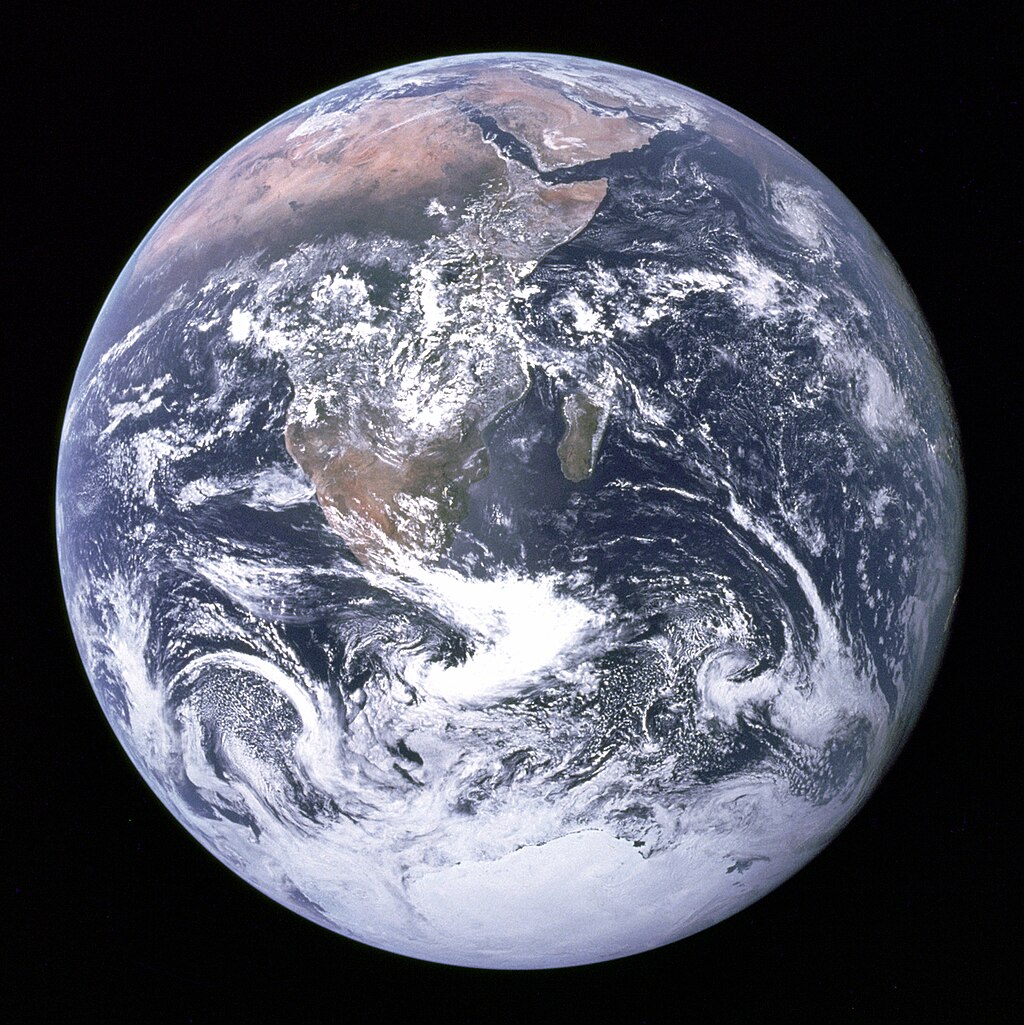
On December 7, 1972, at 5:39 a.m. EST, someone aboard Apollo 17 pointed a Hasselblad camera back toward Earth and clicked the shutter. That single frame—cataloged as AS17-148-22727—became the most reproduced photograph in human history. The blue marble earth photo apollo 17 captured wasn't just another space shot. It was the first time humans had photographed our entire planet fully illuminated, a swirling sphere of blue oceans, white clouds, and rust-colored continents suspended against the infinite black. No human has traveled far enough to take a similar picture since.
What makes this image extraordinary isn't just its beauty. It's the convergence of technical circumstances, cosmic timing, and sheer luck that made it possible. The crew was five hours and six minutes into their journey to the Moon, traveling at 29,000 kilometers from Earth's surface—far enough for the entire planet to fit within the camera's frame.1 The Sun sat directly behind the spacecraft, flooding Earth with light and eliminating the shadows that would have darkened a partial view. This alignment—spacecraft, Earth, Sun—happens rarely and requires precise trajectory planning.
But here's what most people don't know: the version you've seen hanging in classrooms and printed on posters is upside down from how it was actually taken. The original orientation had Antarctica at the top. We flipped it because humans prefer their north-south orientation, even when there's no up or down in space.2
The Technical Serendipity Behind the Shot
Let's talk about the camera that made this possible. The Apollo 17 crew carried a Hasselblad 500EL Data Camera equipped with an 80mm Zeiss Sonnar lens—a modified version of the medium-format camera beloved by professional photographers on Earth.3 The film was Kodak Ektachrome color reversal stock, chosen for its stability in the extreme temperatures of space and its ability to render Earth's colors with remarkable fidelity.
But having the right equipment means nothing without the right conditions. Apollo 17 launched on December 7, 1972, at 12:33 a.m. EST—a night launch, the only one in the Apollo program.4 The trajectory took the spacecraft on a path that, five hours later, positioned it perfectly between Earth and the Sun. This wasn't planned for photography. It was orbital mechanics doing what orbital mechanics does.
The Sun's position behind the spacecraft meant Earth appeared fully illuminated—what photographers call "front lighting." No terminator line dividing day from night. No shadows creeping across continents. Just the entire visible hemisphere bathed in sunlight. This happens only when you're traveling away from Earth with the Sun at your back, and only if you're far enough away to see the whole sphere. Apollo missions heading to the Moon offered this opportunity, but the timing had to align.5
Why This View Was Unique to Apollo 17
Earlier Apollo missions photographed Earth, sure. Apollo 8's "Earthrise" in 1968 showed our planet rising above the lunar horizon—stunning, iconic, but only a partial view. Apollo 17's trajectory and timing gave its crew something no previous mission had: the chance to photograph Earth as a complete, fully lit sphere. And because Apollo 17 was the last crewed mission beyond low Earth orbit, it was also the last chance. No human has traveled far enough since 1972 to replicate this perspective.6
Think about that. The most famous photograph of our planet was taken during humanity's last deep space voyage. It's been more than five decades, and we haven't gone back.
The Photographer Mystery: Who Actually Took the Blue Marble?
Here's where it gets interesting. NASA officially credits the Apollo 17 crew collectively for the blue marble earth photo apollo 17, but that hasn't stopped decades of debate over who actually pressed the shutter. The crew consisted of three men: Eugene Cernan (Commander), Ronald Evans (Command Module Pilot), and Harrison "Jack" Schmitt (Lunar Module Pilot and the only scientist-astronaut to walk on the Moon).7
Most evidence points to Schmitt. He had the window position at the time the photograph was taken, and his scientific training made him more likely to recognize the photographic opportunity. But Cernan has suggested he might have taken it. Evans was at the controls. Without definitive documentation of who held the camera at that exact moment, we can't say for certain.8
Does it matter? In one sense, no—the image exists regardless of whose finger triggered the exposure. But in another sense, it matters tremendously. Photography is an act of seeing, of choosing what to frame and when to capture it. Someone aboard that spacecraft looked back at Earth and recognized that moment as worth preserving. That choice, that human decision to turn around and photograph home, is as important as the technical specifications of the camera.
NASA's solution has been to credit the crew collectively, which feels appropriate. All three men were there. All three contributed to the mission that made the photograph possible. The image belongs to them as a team, and to the thousands of people who built the spacecraft, planned the mission, and made human spaceflight possible.9
Visual Analysis: Why This Image Resonates
Let's look at what makes this photograph work aesthetically. The composition is deceptively simple: a sphere centered in the frame against a black background. But that simplicity is what gives it power. There's nowhere for the eye to escape. You're confronted with Earth in its entirety, complete and finite.
The color palette is extraordinary. Deep cobalt blues of the oceans dominate, punctuated by the brilliant whites of cloud systems swirling across the Atlantic and over Antarctica. The African continent appears in tones of rust and ochre—the Sahara Desert particularly striking in its vastness. Madagascar sits like a teardrop off Africa's southeastern coast. The Arabian Peninsula extends into the frame at the top (remember, this is the inverted version). You can trace the coastline of Asia barely visible at the edge.10
The cloud formations aren't just white noise—they reveal Earth's atmospheric dynamics. You can see cyclonic patterns, the Intertropical Convergence Zone, weather systems in motion. For anyone who understands meteorology, this photograph is a textbook of atmospheric science captured in a single frame.
The Antarctica Surprise
Antarctica's prominence in the original orientation surprised many viewers. We're so accustomed to seeing world maps with north at the top that having the south pole dominate the frame feels disorienting. But from the Apollo 17 trajectory, this was the natural view. The spacecraft's path and the time of year (early December, summer in the Southern Hemisphere) meant Antarctica was fully illuminated and prominently positioned.11
The decision to flip the image for popular distribution reflects our cultural biases more than any photographic necessity. In space, there is no up or down. The orientation we choose is entirely arbitrary. Yet we can't help but impose our terrestrial reference frames onto extraterrestrial views. This speaks to how we construct meaning through visual representation—even the most objective documentary photograph is shaped by human choices and cultural assumptions.
From Film Canister to Global Icon: The Distribution Story
The photograph didn't become instantly famous the moment the shutter clicked. The film remained in the camera, which remained aboard the spacecraft, which continued to the Moon, landed, conducted its mission, launched back into lunar orbit, and finally returned to Earth. The crew splashed down in the Pacific Ocean on December 19, 1972, twelve days after the photograph was taken.12
NASA processed the film and began distributing images from the mission. AS17-148-22727 was one of many photographs released to the public. But this one caught fire. Media outlets picked it up. Environmental organizations adopted it. Within months, it had become the visual symbol of the environmental movement, which was gaining momentum in the early 1970s.13
Why this image and not others? Timing played a role. The first Earth Day had been held in 1970, just two years earlier. Environmental awareness was surging. The publication of "Silent Spring" by Rachel Carson in 1962 had sparked concerns about human impact on ecosystems. The emerging environmental consciousness needed a visual representation, and the Blue Marble provided it perfectly: Earth as a single, integrated system, beautiful and fragile, floating alone in space.
The photograph appeared on album covers, posters, logos, and book jackets. The Whole Earth Catalog had already popularized the concept of seeing Earth from space, but this was the definitive image. It showed our planet not as a political map with borders and nations, but as a unified whole—one atmosphere, one ocean, one interconnected ecosystem.14
Public Domain and Unlimited Reproduction
One reason for the photograph's ubiquity is its legal status. As a work created by NASA, the blue marble earth photo apollo 17 is in the public domain. Anyone can use it, reproduce it, modify it, print it, sell it. No permissions required. No licensing fees.15 This open accessibility accelerated its spread through culture.
Compare this to other iconic photographs that remain under copyright, where usage requires negotiation and payment. The Blue Marble belongs to everyone, which means it can be everywhere. This democratic availability has made it one of the most viewed images in human history.
Technical Specifications for Photographers
Let's get into the technical details that photographers care about. The Hasselblad 500EL was a 70mm medium-format camera—significantly larger than 35mm film. This meant higher resolution and better image quality, crucial for a photograph that would be reproduced at massive scales.16
The 80mm Zeiss Sonnar lens was a standard focal length for the Hasselblad system—roughly equivalent to a 50mm lens on a 35mm camera, or close to human eye perspective. This meant the photograph showed Earth approximately as the astronauts would have seen it with their naked eyes, though the film captured colors and details differently than human vision.17
The Kodak Ektachrome film was a color reversal (slide) film, meaning it produced positive transparencies rather than negatives. This film stock was known for its vibrant color saturation and contrast—characteristics clearly visible in the Blue Marble's rich blues and brilliant whites. The film had to withstand temperature extremes, radiation exposure, and the vacuum of space, all while maintaining color accuracy.18
Exposure Settings and Post-Processing
We don't have definitive records of the exact exposure settings used for AS17-148-22727, but we can make educated guesses based on the conditions. Photographing Earth from space requires balancing the bright, sunlit planet against the absolute black of space. The exposure would have been set for Earth's brightness, which meant space would render as pure black—exactly what we see in the final image.
After the film was processed, NASA made various versions available. Some were color-corrected to enhance certain features. Others were cropped differently. The version that became iconic—the one you've seen countless times—went through some post-processing to optimize it for reproduction. But the core image, the view of Earth as a fully illuminated sphere, remained unchanged.19
For photographers interested in how technical choices shape artistic outcomes, the Blue Marble offers lessons in exposure, composition, and the relationship between subject and background. The decision to expose for Earth rather than trying to capture stars in the background created the stark contrast that makes the image so powerful.
Environmental Impact and Cultural Legacy
The blue marble earth photo apollo 17 arrived at a pivotal moment in environmental history. The early 1970s saw the establishment of the Environmental Protection Agency (1970), the passage of the Clean Water Act (1972), and growing public awareness of environmental issues. This photograph provided a visual anchor for those movements.20
Environmental organizations immediately recognized the image's power. Here was proof—literal photographic evidence—that Earth is a single, integrated system. There are no borders visible from space. No divisions between nations. Just one planet, one atmosphere, one ocean. The photograph made abstract concepts like "global ecosystem" and "planetary boundaries" tangible and visible.
The image appeared in environmental campaigns, educational materials, and advocacy publications. It became shorthand for environmental consciousness itself. When you saw the Blue Marble, you knew you were looking at content related to environmental protection, conservation, or planetary stewardship.21
Comparing Then and Now: Climate Change Visible from Space
More than five decades have passed since Apollo 17. How has Earth changed? Satellite imagery and modern Earth observation systems allow us to compare the planet captured in 1972 with Earth today. The differences are sobering.22
The Antarctic ice cap, so prominent in the original Blue Marble, has experienced significant changes. Arctic sea ice has declined dramatically. Vegetation patterns have shifted. Desert regions have expanded in some areas, contracted in others. The atmosphere itself has changed—carbon dioxide concentrations have increased from about 325 parts per million in 1972 to over 420 ppm today.
These changes aren't always visible in single photographs, but they're measurable through careful comparison and analysis. The Blue Marble serves as a baseline—a snapshot of Earth at a specific moment in history, against which we can measure subsequent changes. It's become not just an icon of environmental consciousness, but a historical document of planetary conditions before the acceleration of climate change.
Why We'll Never See Another Human-Taken Blue Marble
Here's the sobering reality: no human has traveled beyond low Earth orbit since Apollo 17 returned in December 1972. The blue marble earth photo apollo 17 was the last of its kind because it was taken during humanity's last deep space mission.23
Modern satellite imagery can create composite images of Earth that look similar to the Blue Marble. NASA's 2012 "Blue Marble" update used data from multiple satellite passes to create a high-resolution image of Earth. But it's not the same. It's a composite, a digital construction assembled from many observations. The original Blue Marble is a single photograph taken by a human being looking back at home.24
That human element matters. Someone aboard that spacecraft made the decision to turn around and photograph Earth. That act of looking back, of pausing during a mission focused on reaching the Moon to document where we came from—that's profoundly human. Satellites don't make those choices. They follow programmed instructions.
Will we see another human-taken photograph like the Blue Marble? Possibly, if NASA's Artemis program succeeds in returning humans to the Moon. If SpaceX or other private ventures send people beyond low Earth orbit. But as of now, more than fifty years later, the Blue Marble remains the last photograph of its kind. It captures not just Earth, but a moment in human history when we briefly ventured into deep space, looked back, and saw ourselves from a perspective no one had seen before.
The Apollo 17 Context: Last Mission of an Era
Apollo 17 was the culmination of the Apollo program—the sixth and final crewed lunar landing. The mission lasted twelve days and included three moonwalks in the Taurus-Littrow valley, a geologically significant site chosen specifically because Harrison Schmitt, a trained geologist, was part of the crew.25
The mission was successful by all measures. The crew collected 110.5 kilograms of lunar samples, conducted experiments, and returned safely. But it was also the end of an era. Budget constraints, shifting political priorities, and public fatigue with space exploration meant no more Apollo missions. The hardware existed for Apollo 18, 19, and 20, but they were cancelled. The Saturn V rockets were retired. The focus shifted to low Earth orbit projects like Skylab and eventually the Space Shuttle.26
This makes the Blue Marble not just a photograph of Earth, but a photograph from the end of an era. It's a view that was possible only during a brief window of history when humans ventured into deep space. That window closed in 1972 and hasn't reopened. The photograph is a reminder of what we achieved and what we've lost—not just the capability to travel to the Moon, but the perspective that such travel provided.
Common Misconceptions About the Blue Marble
Let's clear up some persistent myths about this photograph. First, it's not the first photograph of Earth from space. That honor goes to a V-2 rocket launched from White Sands, New Mexico, in 1946, which captured grainy black-and-white images from about 65 miles up. The Blue Marble is the first photograph showing Earth as a fully illuminated sphere taken by humans in deep space.27
Second, it's not a composite or digitally manipulated image in the modern sense. Yes, NASA processed the film and made copies with various color corrections, but the core image is a single photographic exposure. Modern "Blue Marble" images created by NASA using satellite data are composites—they're assembled from multiple observations. The 1972 original is one photograph, one moment, one click of the shutter.
Third, the photograph doesn't show the entire Earth—it shows the hemisphere facing the spacecraft. The other side of the planet was in darkness or out of view. But because Earth appears as a complete sphere in the frame, it creates the impression of seeing the whole planet. It's a powerful illusion that contributes to the image's impact.
Fourth, contrary to some claims, you can't see the Great Wall of China or other human structures in the photograph. From 29,000 kilometers away, the resolution isn't sufficient to resolve human-made features. What you see are natural geographic features—continents, oceans, clouds, ice caps. This actually reinforces the photograph's environmental message: from space, Earth appears as a natural system, not a human-dominated one.28
The Photograph in Contemporary Context
What does the blue marble earth photo apollo 17 mean today, more than five decades after it was taken? Its significance has evolved. In 1972, it represented humanity's technological achievement and the new perspective space exploration provided. Today, it's also a historical document—a snapshot of Earth before decades of accelerated environmental change.
The photograph appears in contemporary contexts ranging from climate change advocacy to discussions of space exploration's future. It's used in documentary photography exhibitions, environmental education, and even commercial advertising. Its meaning shifts depending on context, but its visual power remains constant.
For photographers, the Blue Marble offers lessons that transcend its specific subject matter. It demonstrates how technical excellence, timing, and compositional simplicity can combine to create an image that transcends its immediate context. It shows how a photograph can become a symbol, carrying meanings and associations far beyond what was intended at the moment of capture. And it illustrates how visual storytelling can shape consciousness and inspire action.
The photograph also raises questions about photography's relationship to truth and representation. Is this an objective document of Earth's appearance, or is it shaped by technical choices, processing decisions, and cultural interpretations? The answer is both. Like all photographs, the Blue Marble is simultaneously a record of reality and a constructed representation shaped by human choices and technological constraints.
Conclusion: The Photograph That Changed How We See Home
The blue marble earth photo apollo 17 remains one of the most powerful photographs ever taken. It showed humanity something we'd never seen before: our entire planet as a single, complete sphere floating in space. That perspective—the overview effect, as astronauts call it—fundamentally changed how we think about Earth and our place in the universe.
The photograph succeeded because it combined technical excellence with perfect timing and profound subject matter. The Hasselblad camera, the Ektachrome film, the sun-Earth-spacecraft alignment, the distance of 29,000 kilometers—all these factors had to converge. And they did, for one brief moment on December 7, 1972.
More than fifty years later, we still haven't taken another photograph like it. The Blue Marble remains the definitive image of Earth from deep space, captured during humanity's brief venture beyond low Earth orbit. It's a reminder of what we achieved, what we saw, and what we learned: that Earth is beautiful, fragile, and alone in the cosmos. That perspective matters today more than ever.
For photographers and visual artists, the Blue Marble demonstrates photography's power to change consciousness. One image, taken in a fraction of a second, has influenced environmental policy, inspired artistic creation, and shaped how billions of people understand their relationship to the planet. That's the potential of photography at its highest level—not just to document what exists, but to transform how we see and understand our world.
What's your relationship to this iconic image? How has seeing Earth from space shaped your understanding of photography's power and purpose? Share your thoughts in the comments below, and explore more stories about photography's historical impact and how images shape our perception of reality.
Frequently Asked Questions
Who actually took the Blue Marble photograph?
NASA credits the Apollo 17 crew collectively—Eugene Cernan, Ronald Evans, and Harrison Schmitt. Most evidence suggests Schmitt took the photograph based on window position and timing, but without definitive documentation, the exact photographer remains uncertain. The image is officially attributed to the crew as a whole.29
Why is the Blue Marble usually shown upside down from how it was taken?
The original photograph had Antarctica at the top because that's how Earth appeared from Apollo 17's trajectory. NASA and media organizations typically invert the image to show north at the top, matching conventional map orientations. In space there's no inherent up or down, but we impose terrestrial reference frames on the image for cultural familiarity.30
Can I use the Blue Marble photograph freely?
Yes. As a NASA image created by government employees, the Blue Marble is in the public domain. You can use it, reproduce it, modify it, or sell products featuring it without permission or licensing fees. This open status has contributed significantly to the image's widespread distribution and cultural impact.31
Why hasn't anyone taken a similar photograph since 1972?
No humans have traveled beyond low Earth orbit since Apollo 17. The distance required to photograph Earth as a fully illuminated sphere—approximately 29,000 kilometers—is only achievable from deep space missions. Modern satellite imagery creates composite images that look similar, but they're assembled from multiple observations rather than single photographs taken by humans.32
What camera and settings were used to take the Blue Marble?
The photograph was taken with a Hasselblad 500EL Data Camera equipped with an 80mm Zeiss Sonnar lens using Kodak Ektachrome color reversal film. Specific exposure settings weren't recorded, but the camera would have been set to expose for Earth's brightness, rendering space as pure black. The medium-format film provided high resolution and excellent color reproduction.33
What geographic features are visible in the Blue Marble?
The photograph shows the African continent prominently, with the Sahara Desert clearly visible. Madagascar appears off Africa's southeastern coast. The Arabian Peninsula extends into the frame. Antarctica's ice cap is visible (at the top in the original orientation). Cloud systems cover much of the Atlantic Ocean, and portions of the Asian coastline are barely visible at the edge. No human-made structures are visible from this distance.34
- The distance of approximately 29,000 km (18,000 miles) placed Apollo 17 at the optimal position to capture Earth as a complete sphere, as detailed by NASA's Earth Observatory.
- The original orientation with the south pole at the top reflects how the astronauts actually saw Earth from their spacecraft position.
- The Hasselblad 500EL was specially modified for space use with enhanced film magazines and a data recording system that imprinted frame numbers and other information directly onto the film.
- The night launch timing, while dramatic, was calculated for optimal lunar landing site lighting conditions rather than for Earth photography opportunities.
- Earlier Apollo missions captured partial Earth views, but the sun-Earth-Moon alignment on December 7, 1972, created unique conditions for a fully illuminated photograph.
- The end of the Apollo program meant no subsequent human missions ventured beyond low Earth orbit, making the Blue Marble the last human-taken photograph of Earth at this distance and illumination, as noted by The Phoblographer.
- The crew composition included geologist Harrison Schmitt, whose scientific background made him particularly attuned to Earth observation opportunities during the mission.
- The photographer controversy persists because mission protocols didn't require documenting which crew member took each photograph, focusing instead on the scientific and documentary value of the images themselves.
- NASA's collective crediting reflects the collaborative nature of space missions, where individual achievements are inseparable from team efforts.
- The visible geographic features include the African continent, Madagascar, the Arabian Peninsula, and the Antarctic ice cap, with cloud patterns revealing atmospheric dynamics across the Atlantic Ocean, as documented by NASA's Visible Earth.
- The December timing meant the Antarctic region was experiencing continuous daylight, making the ice cap fully visible and prominent in the photograph's original composition.
- The Apollo 17 mission timeline included the lunar landing at Taurus-Littrow valley and three moonwalks before the crew returned to Earth with their photographic documentation.
- The environmental movement was already established by 1972, with Earth Day having been founded in 1970, but the Blue Marble provided a powerful new visual symbol for planetary consciousness.
- The cultural impact extended across multiple domains, with the image appearing in environmental campaign materials, educational publications, and popular media throughout the 1970s and beyond, as documented by Engelsberg Ideas.
- NASA's public domain policy for images created by government employees in the course of their official duties has made the Blue Marble freely available for unlimited reproduction and use worldwide.
- Medium format film's larger negative size provided superior resolution and detail compared to 35mm, allowing for high-quality enlargements that preserved the image's clarity and impact.
- The 80mm focal length on medium format provided a natural perspective without significant wide-angle distortion or telephoto compression, creating a view that felt authentically human-scale.
- Ektachrome's chemical composition was selected for stability in space conditions, with special attention to maintaining color balance despite radiation exposure and temperature fluctuations.
- NASA's image processing enhanced contrast and color saturation for optimal reproduction while maintaining the photograph's documentary integrity and scientific accuracy.
- The EPA's founding and major environmental legislation of the early 1970s created a policy context in which the Blue Marble's message of planetary unity and environmental fragility resonated powerfully.
- The adoption of the Blue Marble as an environmental symbol was so rapid and widespread that by the mid-1970s it had become the de facto visual representation of Earth-centered environmental thinking.
- Climate change impacts visible from space include reduced ice coverage in polar regions, changes in vegetation patterns, and alterations to cloud formation and atmospheric circulation patterns.
- The end of the Apollo program marked the conclusion of human exploration beyond low Earth orbit, a situation that has persisted for over five decades despite various proposals for lunar and Mars missions.
- Modern Earth imagery relies on geostationary satellites and composite techniques that combine multiple observations, fundamentally different from the single-exposure photograph taken by Apollo 17.
- The selection of Taurus-Littrow as the landing site reflected NASA's shift toward scientific objectives in the later Apollo missions, with Schmitt's geological expertise enabling more sophisticated sample collection and analysis.
- The cancellation of Apollo 18-20 reflected political and budgetary decisions that redirected NASA's focus from lunar exploration to near-Earth activities and international cooperation projects.
- Earlier Earth photographs include both suborbital rocket launches and orbital missions, but none captured the complete, fully illuminated sphere visible from Apollo 17's distance and position.
- The inability to see human structures from this distance emphasizes Earth's natural features and the scale difference between human activities and planetary systems.
- The lack of specific photographer attribution reflects mission protocols that prioritized scientific documentation over individual photo credits, a common practice in NASA missions.
- The orientation preference reflects human cognitive bias toward north-up map conventions established over centuries of cartographic tradition.
- Public domain status applies to original NASA imagery but not to derivative works or versions that have been substantially modified by third parties, which may carry separate copyrights.
- The end of crewed deep space missions means no human has had the opportunity to replicate the viewing distance and sun angle that made the original Blue Marble possible.
- The Hasselblad 500EL's automatic exposure system likely selected settings around 1/250 second at f/11 based on typical space photography parameters for sunlit Earth.
- The geographic coverage represents approximately one hemisphere of Earth, with the opposite hemisphere either in darkness or out of the frame based on the spacecraft's position and viewing angle.