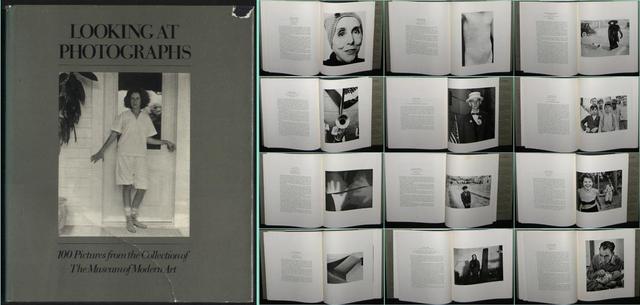
In 1973, John Szarkowski published what would become photography education's most enduring masterclass. Looking at Photographs: 100 Pictures from the Collection of The Museum of Modern Art wasn't just another museum catalog—it was a radical experiment in teaching people how to see. Szarkowski, MoMA's Director of Photography since 1962, selected 100 images spanning over a century and wrote intimate, 200-word essays for each one. The result? A book that taught America how to look at photographs with the same seriousness reserved for paintings and sculpture.1
What makes Looking at Photographs by John Szarkowski so remarkable isn't just the images—it's Szarkowski's voice. He writes like he's standing beside you in the gallery, pointing out details you'd otherwise miss. No academic jargon. No pretension. Just clear-eyed analysis that makes you understand why a photograph matters. For students, critics, and photographers who came of age in the 1970s and beyond, this book became the Rosetta Stone for decoding photographic meaning.
The Book That Changed How We See: Context and Creation
Why 1973? The timing wasn't accidental. Photography was still fighting for legitimacy in the art world, despite MoMA's photography department existing since 1940.2 Galleries were beginning to take photography seriously. Collectors were starting to pay real money for prints. And Szarkowski was at the center of this transformation, using MoMA's institutional authority to argue that photographs deserved the same contemplation as any other art form.
The book emerged from Szarkowski's decade of thinking about what makes photographs work. He'd already published The Photographer's Eye in 1966, which laid out his formalist approach to understanding photographic seeing. But that book was theoretical, organized around concepts like "the thing itself" and "the frame." Looking at Photographs took a different approach—it was personal, specific, grounded in individual images.3
The original 1973 edition was published as a hardcover by MoMA, approximately 216 pages of carefully reproduced photographs paired with Szarkowski's essays. Each spread typically featured one image with facing text—a design that forced readers to move between looking and reading, between visual experience and verbal analysis. This wasn't a coffee table book meant for casual browsing. It demanded engagement.
Szarkowski's Curatorial Philosophy: Formalism Meets Accessibility
Szarkowski's approach to photography was unapologetically formalist. He cared about how photographs looked—their structure, their tonal relationships, their use of the frame. But unlike academic formalists who wrote in impenetrable prose, Szarkowski wrote for regular people who wanted to understand why one photograph succeeded where another failed.4
Take his essay on Eugène Atget's "Versailles" (1901). Szarkowski doesn't launch into art historical context or biographical detail. Instead, he describes what's actually in the picture: "The photograph is almost square, and the tree is almost in the center of it. The tree's shadow is also almost in the center, but not quite; it falls a little to the left. This slight imbalance gives the picture its tension."5 That's it. That's the insight. The genius is in noticing what creates visual tension and articulating it simply.
The Essay Format: Writing as Visual Training
Each essay runs about 200 words—just enough space to make one or two sharp observations. Szarkowski understood that writing about photographs requires restraint. Say too much and you obscure the image. Say too little and you add nothing. His essays hit that sweet spot where words illuminate without overwhelming.
Consider his approach to Walker Evans's "Alabama Tenant Farmer Wife" (1936). Szarkowski acknowledges the social documentary context but quickly pivots to formal analysis: "The picture's power comes not from what it tells us about poverty, but from the woman's direct, unflinching gaze and the way Evans positioned her face against the vertical boards." He's teaching you to see the photograph as a constructed thing, not just a window onto reality.6 This approach influenced how documentary photography would be discussed for decades.
The Selection: 100 Pictures That Defined Photography
How do you choose 100 photographs to represent photography's essence? Szarkowski's selections reveal his values and MoMA's institutional priorities during his directorship. The book spans from 19th-century pioneers to contemporary 1970s work, though the emphasis tilts heavily toward American photography from 1920-1960—the period Szarkowski considered photography's modernist golden age.7
The canonical figures are all here: Eugène Atget, Alfred Stieglitz, Paul Strand, Edward Weston, Dorothea Lange, Robert Frank, Diane Arbus. But Szarkowski also includes lesser-known photographers whose work exemplified particular visual ideas. Timothy O'Sullivan's 19th-century Western surveys appear alongside anonymous vernacular photographs. This mix was deliberate—Szarkowski believed great photographs could come from anywhere, not just acknowledged masters.8
Notable Inclusions and What They Reveal
Let's look at specific examples that demonstrate Szarkowski's curatorial thinking:
- Henri Cartier-Bresson's "Hyères, France" (1932): Szarkowski focuses on the geometric perfection of the composition—the cyclist descending spiral stairs. He writes about how Cartier-Bresson found order in chaos, how the decisive moment isn't just about timing but about recognizing when form achieves clarity.9
- Garry Winogrand's "World's Fair, New York" (1964): Here Szarkowski addresses photography's relationship to time and gesture. He describes how Winogrand captured bodies in motion, creating compositions that feel both chaotic and precisely structured. The essay teaches you to see how snapshot aesthetics can be sophisticated formal strategy.10
- Dorothea Lange's "Migrant Mother" (1936): Surprisingly, Szarkowski downplays the image's iconic status. He writes about the formal relationship between the mother's face and her children's bodies, how Lange created a modern pietà through careful positioning. It's a lesson in reading photographs for their visual structure, not just their emotional content.11
The selections also reveal what Szarkowski valued less: pictorialism gets minimal representation, as does most European photography outside the modernist canon. His taste skewed toward straight photography—images that embraced the camera's mechanical nature rather than mimicking painting. This reflected MoMA's institutional position but also limited the book's scope in ways contemporary critics have noted.12
Structure and Organization: How the Book Teaches
The book's organization is deceptively simple. Photographs are arranged roughly chronologically, though Szarkowski occasionally groups images thematically. This structure allows readers to trace photography's evolution while also seeing recurring visual problems that photographers addressed across decades.13
Early sections feature 19th-century work—O'Sullivan's Western landscapes, Mathew Brady studio portraits, Eadweard Muybridge's motion studies. Szarkowski uses these to establish photography's foundational characteristics: its relationship to time, its descriptive precision, its ability to reveal things invisible to casual observation. He's building a visual vocabulary that will apply to later, more complex images.14
The middle sections concentrate on modernist masters—Stieglitz, Strand, Weston, Ansel Adams. Here Szarkowski explores how photographers developed conscious aesthetic strategies, treating the medium as fine art rather than just documentation. His essays become more complex, addressing how photographers like Strand used sharp focus and close framing to transform ordinary objects into abstract forms.15 Understanding portrait photography aesthetics becomes crucial in these sections.
Later sections address postwar photography—Robert Frank's gritty social observation, Diane Arbus's confrontational portraits, Lee Friedlander's fragmentary urban landscapes. Szarkowski doesn't judge these against modernist standards but shows how they expanded photography's possibilities. His essay on Frank's "Trolley—New Orleans" (1955) celebrates how Frank used the frame to create social commentary through visual juxtaposition—white passengers in front, Black passengers in back, all captured in one decisive slice.16
Physical Qualities and Design: The Book as Object
In an era before digital archives, Looking at Photographs democratized access to MoMA's collection. Most people couldn't visit New York to see these images in person. The book brought them into living rooms, classrooms, and studios across America and beyond.17
The reproductions are excellent for 1973 printing technology—crisp, well-toned, printed large enough to study details. Each photograph gets a full page or spread, allowing the image to breathe. The facing essay creates a rhythm: look, read, look again. This physical design reinforces Szarkowski's pedagogical method—he wants you to move between visual experience and analytical understanding, training your eye through repeated practice.18
The 2009 paperback edition (ISBN 978-0870705151) maintains this design integrity while making the book more affordable and accessible. Earlier editions from 1999 and the original 1973 hardcover have become collectibles, with first editions commanding significant prices among photography book collectors.19
Influence and Legacy: Teaching Generations to See
Walk into any university photography program and you'll likely find Looking at Photographs on the required reading list. The book has educated countless photographers, critics, and curators over five decades. Why has it endured when so many photography books fade into obscurity?20
First, Szarkowski's writing hasn't aged. His observations about visual structure remain valid because he focused on fundamental aspects of how photographs work, not trendy theoretical frameworks. Second, the images themselves represent photography's canon—understanding these 100 photographs means understanding photography's history and aesthetic development. Third, the book models a way of looking that students can apply to any photograph, not just the ones Szarkowski selected.21
The New York Times review from 1973 called it "a connoisseur's anthology" that "tells something crucial about each picture." That assessment holds up. Szarkowski was indeed a connoisseur—someone who'd spent years looking at photographs with obsessive attention. But he made connoisseurship accessible, showing that careful looking wasn't reserved for experts.22
The Book's Place in Szarkowski's Trilogy
Photography scholars often discuss Szarkowski's three major books as a trilogy: The Photographer's Eye (1966), Looking at Photographs (1973), and Mirrors and Windows (1978). Each approaches photography from a different angle.23
The Photographer's Eye established theoretical principles. Looking at Photographs applied those principles to specific images, showing how theory manifests in practice. Mirrors and Windows then proposed a framework for understanding photography's split between documentary and expressive impulses. Together, these books defined how photography would be taught and discussed for the next several decades. The influence extends to how we think about post-documentary photography today.
Critical Perspectives: What Szarkowski Emphasized and Omitted
No book is without blind spots, and Looking at Photographs reflects both Szarkowski's strengths and limitations. His formalist approach brilliantly illuminates how photographs create meaning through visual structure. But it sometimes downplays social, political, and historical contexts that also shape photographic meaning.24
Contemporary critics point out that the selection skews heavily male and Western. Women photographers appear but are underrepresented relative to their actual contributions. Non-Western photography is almost entirely absent. This wasn't unique to Szarkowski—it reflected broader institutional biases in 1970s museums. But it means the book presents a partial history, one that privileges certain photographic traditions over others.25
Szarkowski's emphasis on straight photography also marginalizes experimental approaches. Photomontage, manipulation, and conceptual photography get limited attention. His taste was modernist, favoring photographers who worked within photography's "inherent" characteristics rather than those who pushed against medium boundaries. This shaped what counted as serious photography for decades, sometimes narrowing possibilities.26
Yet these limitations don't invalidate the book's achievements. Szarkowski taught people to look carefully, to notice visual relationships, to understand how photographers make choices. Those skills apply regardless of which photographs you're examining. The book works best when understood not as definitive history but as one influential curator's perspective—brilliant, limited, and profoundly educational. Similar debates continue in discussions of contemporary Chinese photography and other non-Western traditions.
Practical Value: Using the Book Today
What can contemporary photographers and students gain from a book published over fifty years ago? More than you might expect. The images Szarkowski selected remain powerful examples of photographic thinking. His essays model how to write about photographs—a skill many photographers need but few develop.27
Try this exercise: Choose any photograph you've made or admire. Study it for five minutes. Now write 200 words describing what makes it work (or not work) as a photograph. Focus on visual elements—composition, light, tone, spatial relationships. Avoid biographical information about the photographer or narrative interpretation of the content. You'll quickly discover how difficult this is. Szarkowski makes it look easy, but that ease comes from decades of practice.28
The book also provides a masterclass in sequencing and selection. Photographers constantly face decisions about which images to include in portfolios, exhibitions, or books. Szarkowski's choices demonstrate how to build a collection that's both comprehensive and focused, representing range without losing coherence. His selections balance familiar and surprising, canonical and obscure—principles applicable to any photographic project.
For those interested in criticism and curation, the book shows how institutional power shapes photographic canons. Szarkowski's position at MoMA gave his opinions enormous weight. The photographers he championed gained market value and historical importance. Understanding this dynamic matters for anyone working in photography's institutional structures today. The lessons apply whether you're considering AI photography or traditional approaches.
1973 vs. Now: What's Changed in Photographic Taste
Reading Looking at Photographs today is like examining a time capsule of photographic values. What seemed important in 1973 doesn't always match contemporary priorities. This gap reveals how photographic taste evolves, shaped by technological change, social movements, and shifting aesthetic values.29
In 1973, color photography was still fighting for artistic legitimacy. Szarkowski includes minimal color work, reflecting the period's black-and-white bias. Today, color is thoroughly accepted, and many photographers work exclusively in color. Similarly, snapshot aesthetics and vernacular photography have gained respect that they lacked in Szarkowski's formalist framework. What once seemed crude now appears sophisticated in its directness.30
Contemporary photography also emphasizes identity, representation, and social justice in ways that weren't central to 1970s formalism. Photographers today are more likely to interrogate power relationships, question documentary truth claims, and explore photography's role in constructing social categories. Szarkowski's approach seems apolitical by comparison, though his emphasis on formal excellence was itself a political stance—an argument for photography's autonomy as art.31
Digital technology has transformed what photographs can be and do. Szarkowski's selections all assume photography's indexical relationship to reality—the idea that photographs are traces of things that existed before the camera. Digital manipulation and AI-generated images complicate this assumption fundamentally. Would Szarkowski's analytical methods work for images that never had a referent in physical reality? The question remains open, though his emphasis on visual structure might still apply.32
Acquiring and Experiencing the Book
The book remains in print and readily available. The 2009 paperback edition offers the best value for students and photographers, typically priced between $20-30. Original 1973 hardcovers appear regularly on rare book sites, commanding higher prices ($100-300) depending on condition.33
But here's the thing: this book demands physical interaction. You can't get the same experience reading PDFs or viewing images on screen. The book's design creates a specific relationship between image and text, between looking and reading. The physical act of turning pages, moving between photographs, returning to earlier images—this matters. It's a different kind of attention than scrolling through digital files.34
For educators, the book works beautifully in classroom settings. Assign students to choose one essay, study it carefully, then write their own 200-word analysis of a different photograph using Szarkowski's approach. The exercise teaches close looking, precise description, and economical writing—skills photographers need regardless of their aesthetic orientation. It connects to broader discussions about image critique and visual literacy.
Why This Book Still Matters
Photography has changed enormously since 1973. We've moved from film to digital, from scarcity to abundance, from specialized knowledge to universal practice. Yet Looking at Photographs John Szarkowski MoMA remains relevant because it addresses something fundamental: how to see photographs as constructed objects rather than transparent windows.35
Szarkowski teaches you to notice choices—where the photographer stood, when they released the shutter, how they framed the scene, what they included and excluded. These decisions shape meaning whether you're looking at a 19th-century albumen print or a contemporary digital image. The technology changes, but the fundamental question remains: what makes this photograph work?
The book also matters as historical document. It shows how one influential curator thought about photography at a pivotal moment. Szarkowski's taste shaped photography's institutional acceptance, for better and worse. Understanding his perspective helps us grasp how photographic canons form and why certain photographers gained prominence while others remained obscure. This critical awareness is essential for anyone working seriously with photography today, whether exploring nostalgic film techniques or cutting-edge digital approaches.
Perhaps most importantly, Looking at Photographs demonstrates that careful looking is a skill you can develop. Szarkowski wasn't born seeing photographs differently than anyone else. He trained his eye through years of sustained attention. His essays show that process, modeling how to move from casual glance to deep observation. That's the book's enduring gift—not just showing you what to see, but teaching you how to look.
If you're serious about photography—making it, teaching it, writing about it, curating it—this book belongs on your shelf. Not as scripture, but as a tool for sharpening your vision. Read it slowly. Study the images. Try writing your own analyses. Argue with Szarkowski's interpretations. The book works best when it provokes active engagement, not passive acceptance. That's exactly what Szarkowski intended.
Frequently Asked Questions
What makes Looking at Photographs different from other photography books?
Unlike comprehensive histories or technical manuals, Looking at Photographs focuses on teaching visual literacy through specific examples. Each of the 100 photographs gets a short, accessible essay that demonstrates how to analyze photographic meaning through formal observation. Szarkowski writes for general readers, not specialists, making sophisticated visual analysis accessible without dumbing it down. The book's pedagogical approach—pairing images with concise essays—created a model that countless photography educators have adopted.36
Which edition of Looking at Photographs should I buy?
The 2009 paperback edition (ISBN 978-0870705151) offers the best combination of quality and affordability for most readers. It maintains the original's design and reproduction quality while costing significantly less than first editions. Collectors or those wanting the historical artifact might seek the 1973 hardcover, but the content is identical across editions. The 1999 reprint is also excellent if you find it at a good price. Avoid bootleg PDFs—the book's physical design is integral to its function as a teaching tool.37
Is Szarkowski's formalist approach still relevant in contemporary photography?
Szarkowski's formalism remains valuable for understanding how photographs create meaning through visual structure, though it's no longer the dominant critical approach. Contemporary photography criticism emphasizes social context, representation politics, and photography's institutional functions—aspects Szarkowski sometimes downplayed. The most complete understanding comes from combining formalist attention to visual structure with awareness of social and historical contexts. Szarkowski's method teaches you to see what's actually in the photograph, which remains essential even if it's not sufficient for complete interpretation.38
How did this book influence photography education?
Looking at Photographs became a standard text in university photography programs and remains widely assigned five decades later. It established a pedagogical model: teach visual literacy through close analysis of specific images rather than abstract theory. The book's 200-word essay format has been adopted by countless educators as a teaching exercise. Szarkowski's accessible writing style also influenced how photography criticism is written, encouraging clarity over jargon. Perhaps most significantly, the book helped establish photography as a subject worthy of serious academic study, contributing to photography's integration into art history curricula.39
What photographers are featured in the book?
The book includes canonical figures like Eugène Atget, Alfred Stieglitz, Edward Weston, Walker Evans, Dorothea Lange, Henri Cartier-Bresson, Robert Frank, Diane Arbus, and Garry Winogrand, among many others. Szarkowski also includes lesser-known photographers and anonymous vernacular work, demonstrating that great photographs come from diverse sources. The selection spans from 19th-century pioneers through contemporary 1970s work, emphasizing American photography while including significant European photographers. The mix reflects MoMA's collection strengths under Szarkowski's directorship and his formalist values prioritizing visual innovation over fame or historical importance.40
How does Looking at Photographs relate to Szarkowski's other books?
Looking at Photographs sits between The Photographer's Eye (1966) and Mirrors and Windows (1978) in Szarkowski's trilogy of influential works. The Photographer's Eye established theoretical principles about photography's unique formal characteristics. Looking at Photographs applied those principles to specific images from MoMA's collection, demonstrating theory in practice. Mirrors and Windows then proposed a framework for understanding photography's split between documentary and expressive approaches. Together, these books defined how photography would be taught, collected, and discussed for decades. Looking at Photographs is the most accessible of the three, making it an ideal entry point for readers new to Szarkowski's thinking.41
- Szarkowski served as MoMA's Director of Photography from 1962 to 1991, fundamentally reshaping how museums collected and exhibited photography.
- The Museum of Modern Art established its photography department in 1940 under Beaumont Newhall, but photography's status as fine art remained contested through the 1970s.
- The Photographer's Eye (1966) established Szarkowski's formalist framework, emphasizing photography's unique formal characteristics separate from other visual arts.
- Formalism in photography criticism emphasizes the medium's intrinsic visual qualities—composition, light, tone, texture—over narrative or documentary content.
- Eugène Atget (1857-1927) documented Paris and its environs with systematic dedication, creating an archive that profoundly influenced subsequent photographers.
- Walker Evans (1903-1975) worked for the Farm Security Administration documenting Depression-era America, producing some of the period's most iconic images.
- The book's chronological span extends from the 1840s through the early 1970s, though concentration is heaviest in the mid-20th century.
- Timothy O'Sullivan (1840-1882) photographed the American Civil War and later joined geological survey expeditions, creating some of the 19th century's most striking landscape images.
- Henri Cartier-Bresson (1908-2004) pioneered the concept of the "decisive moment," capturing fleeting instances when visual elements aligned perfectly.
- Garry Winogrand (1928-1984) photographed American social life with energetic, tilted compositions that influenced street photography's evolution.
- "Migrant Mother" became the most reproduced image from the Great Depression, though Lange later expressed ambivalence about its fame.
- Pictorialism, the late 19th/early 20th-century movement that made photographs look like paintings through soft focus and manipulation, fell from favor as modernist straight photography gained dominance.
- The chronological arrangement spans from daguerreotypes through 1970s color work, showing photography's technical and aesthetic evolution.
- Eadweard Muybridge (1830-1904) pioneered motion photography, using multiple cameras to capture movement sequences that revealed how animals and humans actually move.
- Paul Strand (1890-1976) pioneered straight photography's modernist aesthetic, emphasizing sharp focus, geometric composition, and the camera's unique way of seeing.
- Robert Frank's The Americans (1958) revolutionized documentary photography with its subjective, often harsh vision of American society.
- Before digital archives, museum photography collections were accessible primarily through exhibitions and published catalogs like this one.
- The book's design by MoMA's in-house team emphasized clarity and reproduction quality, essential for teaching visual literacy through printed images.
- The 2009 edition retains the original's design and content, making Szarkowski's teaching accessible to new generations at reasonable cost.
- The book remains widely used in photography education programs at universities and art schools worldwide.
- Szarkowski's formalist approach, while sometimes criticized for insufficient attention to social context, provided a replicable method for analyzing photographic meaning.
- Contemporary reviews praised Szarkowski's ability to write accessibly about complex visual ideas without condescension or oversimplification.
- Mirrors and Windows (1978) divided photography into two camps: mirrors (subjective, expressive) and windows (objective, documentary), though Szarkowski acknowledged most work contained both tendencies.
- Critics have noted that Szarkowski's formalism, while valuable, sometimes treated photographs as autonomous aesthetic objects disconnected from their social production and use.
- Feminist and postcolonial critics have challenged the predominantly white male canon that Szarkowski and MoMA helped establish, arguing for more inclusive photography histories.
- Szarkowski's preference for straight photography influenced which photographers MoMA collected and exhibited, affecting their market value and historical reputation.
- Writing about one's own work or analyzing others' photographs remains essential for photographers seeking grants, gallery representation, or academic positions.
- The 200-word essay format Szarkowski used has become a standard teaching tool in photography education, forcing students to articulate visual observations concisely.
- Photographic taste shifts with broader cultural changes, technological developments, and evolving understandings of photography's social functions.
- Color photography gained fine art acceptance gradually through the 1970s-1980s, with William Eggleston's 1976 MoMA exhibition marking a turning point.
- Contemporary photography theory emphasizes how photographs construct meaning through social contexts, not just formal properties—a shift from Szarkowski's formalism.
- Digital photography and AI image generation challenge photography's traditional indexical nature—its presumed connection to physical reality.
- First edition prices vary based on condition, dust jacket presence, and market demand among photography book collectors.
- The physical book's design creates a specific viewing rhythm and encourages sustained attention that differs from digital image consumption.
- The shift from analog to digital photography represents one of the medium's most significant technological and cultural transformations.
- The book's essay-per-image format became widely influential in photography education, offering a replicable model for teaching visual analysis.
- Reproduction quality matters significantly for a book teaching visual observation, making legitimate printed editions preferable to digital copies.
- Contemporary photography theory integrates formalist analysis with social, political, and institutional critique, offering more comprehensive interpretive frameworks.
- The book's influence on photography pedagogy extends globally, with translations in multiple languages and use in international educational programs.
- The selection represents both MoMA's collection priorities and Szarkowski's personal taste, which emphasized formal innovation and straight photography approaches.
- The three books work as a cohesive body of thought, with each addressing different aspects of photographic theory and practice.