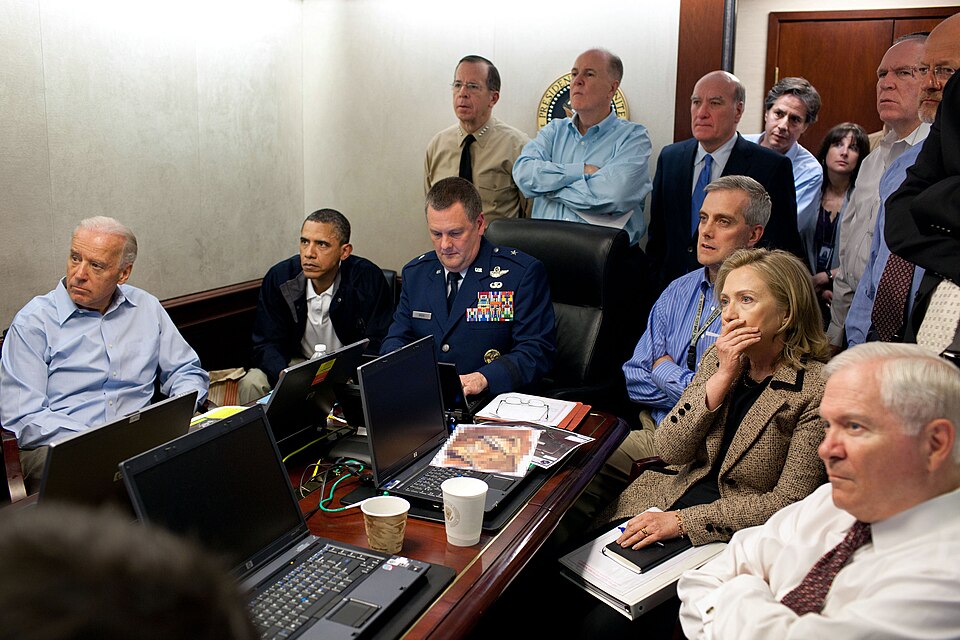
At exactly 4:05 PM on May 1, 2011, Chief Official White House Photographer Pete Souza wedged himself into the corner of a cramped conference room and captured what would become one of the most analyzed photographs in modern history. The situation room bin laden raid photo didn't just document a pivotal moment in American history—it redefined what presidential photography could be. Souza took roughly 100 photographs from that exact position, unable to move an inch. Yet this single frame, showing 13 people monitoring Operation Neptune Spear in real-time, became the definitive visual record of the day Osama bin Laden was killed.1
What makes this photograph extraordinary isn't just its historical significance. It's the convergence of technical mastery, unprecedented access, and split-second compositional decisions that created an image powerful enough to transcend its moment. This wasn't a staged photo op. This was documentary photography at its most raw and consequential.
Pete Souza's Corner: Technical Constraints That Created an Icon
Souza didn't choose his position in that room—the room chose it for him. The smaller conference room within the White House Situation Room complex measures roughly 15 by 20 feet, and with 13 people crammed inside, there was exactly one spot where a photographer could stand without blocking the secure video feed or interfering with communications.2
From that corner, Souza shot with his Canon 5D Mark II, likely using a 24-70mm lens at its widest setting to capture the entire room.3 The lighting was terrible—a mix of overhead fluorescents and the glow from laptop screens. No bounce cards. No external flashes. No second chances. He couldn't ask anyone to move or look at the camera. This was a classified military operation unfolding in real-time, and his job was to be invisible while documenting everything.
The technical challenges were staggering. Low light meant pushing the ISO higher, risking grain. The mixed color temperatures created white balance nightmares. And with no ability to reposition, Souza had to work with the composition the room gave him. Yet somehow, the constraints became the photograph's greatest strengths. The tight framing creates intimacy. The ambient lighting feels authentic, even cinematic. The fixed perspective puts viewers exactly where Souza stood—bearing witness to history from the only vantage point available.4
The Photographer's Preparation
Souza didn't stumble into that room by accident. His presence there was the culmination of years building trust with President Obama, dating back to when he photographed then-Senator Obama for the Chicago Tribune in 2004.5 When Obama became president, he chose Souza as Chief Official White House Photographer—a position Souza had previously held under President Reagan from 1983 to 1989.
This wasn't Souza's first rodeo. He understood the unspoken protocols of photographing power and knew when to shoot and when to simply observe. That trust gave him access to moments other photographers could never capture. But access means nothing without the technical chops to deliver under impossible conditions.
Composition Under Pressure: Why This Frame Became THE Image
Out of approximately 100 photographs Souza captured that afternoon, this single frame became the one the world remembers. Why? The composition tells a complete visual story in one glance.6
Look at the spatial hierarchy. President Obama sits slightly left of center, but he's not the dominant figure. Secretary of State Hillary Clinton's hand covers her mouth—a gesture of tension that became the photograph's most discussed element. Vice President Joe Biden leans forward, hands clasped. Brig. Gen. Marshall B. "Brad" Webb sits beside Obama, providing direct communication with the operation.7 Every person in the frame displays genuine, unguarded emotion.
The diagonal lines created by the table and the positioning of standing versus seated figures add dynamic tension. Your eye moves through the frame naturally, taking in each person's reaction. There's no dead space, yet the composition doesn't feel cluttered. It's a masterclass in environmental portraiture under duress.
The Body Language That Tells the Story
Photography experts have dissected this image frame by frame. Clinton's hand gesture suggests anxiety or shock—she later revealed she might have been reacting to a tense moment during the operation.8 Obama's lean-forward posture, arms crossed, conveys intense focus. National Security Advisor Tom Donilon takes notes, grounding the moment in its administrative reality.
The standing figures—including counterterrorism advisor Audrey Tomason, the only woman standing in the frame—create a secondary layer of visual interest. They're literally on the edge of their seats (or standing at the edge of the frame), physically manifesting the tension everyone in that room felt.9
This wasn't posed. You can't fake this kind of authenticity. And that's precisely what makes it powerful.
From Classified Operation to Global Icon: The Release Timeline
The photograph was taken at 4:05 PM on May 1, 2011. By Monday morning, May 2, it was released to the world. That's an extraordinarily fast turnaround for an image documenting a classified military operation.10
But the image didn't go out unaltered. A classified document visible on the table in front of Clinton was digitally obscured before release—a small but significant detail that reveals the complex security considerations involved in releasing any photograph from such a sensitive moment.11
This obscuration process highlights a unique challenge in modern presidential photography: balancing transparency with security. The Situation Room Experience at the National Archives now educates visitors about these protocols, showing how historical documentation must navigate classification requirements.
Image Rights and Restrictions
As an official White House photograph, the image exists in the public domain. However, it comes with specific usage restrictions. The photograph cannot be manipulated beyond the obscuration already applied. It cannot be used in commercial advertising or political campaign materials without violating federal image use policies.12
Despite these restrictions, the photograph spread globally within hours. News organizations worldwide ran it on front pages. It became an instant meme, with internet users photoshopping various elements. By the end of that first week, it had become one of the most viewed photographs in digital history.
Pete Souza's Career Context: More Than One Photograph
Understanding this photograph requires understanding Souza's broader body of work. He's not a one-hit wonder. Over eight years as Obama's Chief Official White House Photographer, Souza captured nearly two million photographs.13 His work documented everything from high-stakes diplomatic negotiations to quiet moments with the First Family.
Souza's photographic style emphasizes candid authenticity over staged formality. He pioneered a more intimate, behind-the-scenes approach to presidential photography—one that showed presidents as real people rather than untouchable figures. This philosophy directly influenced how he approached the bin Laden raid documentation.
Before the White House, Souza was a respected photojournalist. He worked for the Chicago Tribune, covered national and international stories, and taught photojournalism at Ohio University. His technical foundation was solid before he ever entered the Oval Office.14
The Reagan Years: First White House Tenure
Souza's first stint as an official White House photographer came during Reagan's second term. That experience taught him the rhythms of presidential life, the importance of anticipating moments, and how to navigate the complex politics of access. When he returned under Obama, he brought that institutional knowledge with him.15
The contrast between his Reagan and Obama photography is instructive. Reagan's presidency existed in a pre-digital age where film was precious and moments were more carefully staged. Obama's presidency unfolded in the digital era, where Souza could shoot continuously, review images instantly, and distribute photographs globally within minutes. This technological shift fundamentally changed what presidential photography could accomplish.
The Photojournalism Impact: Raising the Bar for Documentary Standards
The situation room bin laden raid photo didn't just document history—it changed expectations for how history should be documented. After this image, the public began demanding more candid, authentic glimpses into decision-making processes. The photograph proved that documentary photography could be both historically significant and artistically compelling.16
Photography schools now use this image as a teaching tool. It demonstrates how technical limitations can enhance rather than diminish a photograph's power. It shows students that being in the right place with the right access matters more than having perfect lighting or ideal shooting conditions.
The photograph also sparked conversations about the ethics of documenting classified operations. Should photographers be present during active military operations? How much should be revealed versus protected? These questions don't have easy answers, but the photograph forced the photojournalism community to grapple with them seriously.
Comparison with Historical Situation Room Photography
This wasn't the first photograph taken in a presidential situation room, but it became the most iconic. Previous administrations had released situation room images, but they typically felt staged or formal. Kennedy's team during the Cuban Missile Crisis was photographed, but those images lack the intimate immediacy of Souza's work.17
What separates Souza's photograph is its genuineness. Nobody's performing for the camera because they're too focused on what's happening 7,000 miles away in Abbottabad, Pakistan. The photograph captures people who've temporarily forgotten they're being photographed—the holy grail of documentary work.
Global Reception and Cultural Impact
Within 24 hours of its release, the photograph appeared on front pages across six continents. International media outlets recognized its significance immediately. In countries with complicated relationships to American foreign policy, the image sparked different interpretations—some saw it as a moment of justice, others as American triumphalism.18
The meme culture that emerged around the photograph was inevitable but fascinating. People inserted the room's occupants into other scenarios, added humorous captions, or photoshopped themselves into the frame. This viral spread, while sometimes irreverent, actually cemented the photograph's place in popular consciousness. You don't meme something that doesn't matter.
Art galleries and museums quickly recognized the photograph's significance. CAMERA WORK gallery in Berlin exhibited the image as fine art photography, not just historical documentation. This dual status—both news photograph and art object—speaks to its unique power.19
Awards and Recognition
While official White House photographs aren't typically eligible for traditional photojournalism awards like the Pulitzer Prize, the situation room photograph received widespread recognition within professional photography circles. It appeared on numerous "photographs of the year" lists and became a standard reference in discussions about documentary photography excellence.20
More significantly, it influenced how subsequent administrations approached presidential photography. The bar had been raised. Future White House photographers would be judged against the standard Souza set with images like this one.
The Other 99 Photographs: Editorial Selection Process
Souza shot roughly 100 frames from that corner position during the raid. Why did this particular frame become THE image? The answer reveals how editorial selection works at the highest levels of photojournalism.21
In the other frames from that sequence, people's expressions are slightly different. Some show Obama looking down at papers. Others capture different moments of tension or concentration. But this frame—4:05 PM exactly—captured the perfect convergence of compositional elements and emotional authenticity.
The selection process likely involved Souza, White House communications staff, and possibly national security personnel reviewing for any inadvertent security breaches. They were looking for an image that told the story clearly, showed the gravity of the moment, and wouldn't compromise operational security.22
This frame delivered on all counts. It showed leadership under pressure. It humanized the decision-makers. It conveyed the weight of the moment without revealing tactical details. And compositionally, it was simply the strongest image in the sequence.
The Smaller Conference Room Decision
Why were they in the smaller conference room instead of the main Situation Room? The answer is practical: the smaller room had better connectivity for the secure video feed from the operation.23 But that practical decision had profound photographic implications.
A larger room would have meant more space, potentially better lighting, and more positioning options for Souza. But it also would have created distance between the camera and subjects. The cramped quarters forced everyone together, creating the intimate, almost claustrophobic feeling that makes the photograph so powerful. The room's limitations became the photograph's strengths.
Technical Mastery: What Makes It Work Photographically
Strip away the historical significance for a moment and analyze this purely as a photograph. What makes it technically successful?
First, the depth of field. Despite the low light, Souza maintained enough depth to keep all 13 people reasonably sharp. This required careful aperture selection—probably around f/4 or f/5.6—balancing the need for sharpness with the reality of limited light.24
Second, the exposure. The mixed lighting could have created disaster—blown-out highlights from the laptops, murky shadows in the corners. Instead, Souza exposed for the midtones, preserving detail in both highlights and shadows. This suggests he was shooting in RAW format, giving him maximum flexibility in post-processing.25
Third, the moment. This is where technical skill meets instinct. Souza couldn't see his subjects' faces clearly from his corner position. He was shooting somewhat blind, trusting his sense of timing to capture the decisive moment. That's not luck—that's decades of experience translating into muscle memory.
The Lighting Challenge
Professional photographers who've analyzed the image note the color temperature inconsistencies—the fluorescent overhead lights skew green, while the laptop screens add blue tones. In a perfect world, you'd color-correct these separately. But that would make the image look artificial. Instead, Souza (or whoever processed the image) chose a white balance that felt natural even if it wasn't technically perfect.26
This is a crucial lesson for photographers: technical perfection sometimes matters less than emotional authenticity. A perfectly color-corrected version of this image would feel sterile. The slight color casts remind us this is a real moment, not a staged production.
Souza's Broader Legacy and This Photograph's Place in It
After leaving the White House, Souza published several books featuring his Obama-era photography, including "Obama: An Intimate Portrait." The situation room photograph appears prominently in these collections, but it's contextualized within thousands of other images.27
This broader context reveals something important: Souza's genius wasn't capturing one iconic photograph. It was maintaining a consistently high standard across millions of frames. The situation room image is his most famous work, but it's not necessarily his best. It's simply the one where historical significance and photographic excellence aligned most dramatically.
Souza has also become an influential voice on social media, using Instagram to share his work and occasionally offer pointed commentary on subsequent administrations. His platform has introduced his photography to new audiences who might never have seen it otherwise. This evolution from White House photographer to public commentator represents a new model for how official photographers can remain relevant after leaving office.28
Influence on Contemporary Photography
Young photographers studying Souza's work learn several crucial lessons from this image. First, access matters more than equipment. Second, constraints can enhance creativity. Third, the decisive moment still exists—you just have to be ready for it. Fourth, technical imperfection in service of authenticity beats sterile perfection every time.29
These lessons extend beyond political photography into all forms of documentary work. Whether you're photographing a wedding, a corporate event, or a news story, Souza's approach offers a template: be present, be unobtrusive, trust your instincts, and prioritize authentic moments over perfect technique.
The Photograph's Archival Status and Future
The original digital file resides in the National Archives, where all official White House photographs are preserved. It's part of the permanent historical record, protected and cataloged alongside millions of other presidential images.30
But what does preservation mean in the digital age? Unlike a physical negative that can degrade, digital files can be copied infinitely without loss. Yet they're also vulnerable to format obsolescence—will the file format be readable in 100 years? These are questions archivists grapple with constantly.
The photograph's cultural preservation is equally important. It exists not just in the archives but in collective memory. People who weren't born when it was taken will encounter it in history books, museums, and online. It will be studied, analyzed, and reinterpreted by future generations trying to understand this moment in history.
What will they see? They'll see the technology—the laptops that will look quaint in 50 years. They'll see the fashion—the suits and ties that will mark this as early 21st century. But mostly, they'll see the human element that transcends time: people facing a momentous decision, their faces showing the weight of responsibility.
Ethical Considerations: Photographing Classified Operations
Should a photographer be present during active military operations? The question isn't academic—it has real implications for operational security, transparency, and historical documentation.
Arguments for Souza's presence: The public has a right to see how their leaders make decisions. Historical documentation requires contemporaneous recording. The photograph provides accountability—we can see who was in the room, what they were doing, how they responded.31
Arguments against: A photographer represents an additional security risk. The presence of a camera might influence behavior, making the documentation less authentic. Some moments are too sensitive for any record beyond official notes.
The reality is that Souza's presence was carefully considered and approved at the highest levels. He had top-secret security clearance. He understood what could and couldn't be photographed. And his track record demonstrated he could be trusted with sensitive access.
But each administration must make these decisions anew. There's no universal rule about when photographers should be present and when they shouldn't. It's a judgment call that balances competing values—and reasonable people can disagree about where to draw the line.
Why This Photograph Will Matter in 100 Years
Most photographs fade from memory. Even historically significant images often require context to understand their importance. But some photographs transcend their moment, becoming permanent fixtures in our visual vocabulary.
The situation room bin laden raid photo has that quality. Future historians studying early 21st-century America will encounter this image and immediately understand something essential about the period. They'll see how decisions were made, what the technology looked like, how power was exercised, and what leadership meant in this era.32
But they'll also see something more universal: human beings under pressure, trying to make the right call with imperfect information and enormous stakes. That element of the photograph transcends its specific historical moment. It speaks to the fundamental challenge of leadership across all times and places.
Souza captured a moment that was simultaneously extraordinary and deeply human. That's the magic of great photography—it shows us something specific while revealing something universal. A room in Washington. A Sunday afternoon. Thirteen people watching a screen. And somehow, in that specificity, something timeless.
Conclusion: The Accidental Masterpiece
Pete Souza didn't set out to create an iconic photograph on May 1, 2011. He was doing his job—documenting presidential activities for the historical record. The cramped corner he occupied wasn't chosen for its artistic potential. The lighting was terrible. He couldn't move or direct his subjects.
Yet from these constraints emerged a photograph that defined a moment, influenced a medium, and created a permanent visual record that will outlive everyone in that room. It happened because Souza had the technical skills to execute under impossible conditions, the instincts to recognize the decisive moment, and the access that comes from years of building trust.
For photographers, the lesson is clear: master your craft so thoroughly that when the moment arrives, you're ready. Build the relationships that create access. Understand that constraints can be gifts. And remember that the most powerful photographs often emerge from the intersection of preparation and circumstance.
The situation room photograph reminds us why photography matters. Not just as art or journalism, but as the bridge between past and future, the evidence of what happened, the record of who we were. One frame, captured in a cramped corner, that will speak to people we'll never meet about a day that changed history.
What photographs are you ready to capture when your moment comes?
Frequently Asked Questions
What camera equipment did Pete Souza use to photograph the bin Laden raid?
Pete Souza shot the situation room photograph with a Canon 5D Mark II, likely using a 24-70mm lens at its widest setting to capture the entire cramped conference room. The low-light conditions required high ISO settings and careful exposure management. Souza couldn't use external lighting or flash due to the operational nature of the moment, relying instead on ambient fluorescent lighting and laptop screen glow. His technical mastery of the equipment allowed him to capture a sharp, well-exposed image despite these challenging conditions.33
Why was the photograph taken in the smaller Situation Room conference room?
The smaller conference room was chosen for technical reasons—it had superior connectivity for the secure video feed from the operation in Pakistan. The White House Situation Room is actually a 5,000-square-foot complex with multiple conference rooms, not a single space. While the smaller room created challenging conditions for photography (cramped quarters, limited positioning options, poor lighting), these constraints ultimately contributed to the photograph's intimate, powerful composition. The tight framing forced everyone together, creating the sense of shared tension that makes the image so compelling.34
How many photographs did Pete Souza take during the bin Laden raid, and why did this one become iconic?
Souza captured approximately 100 photographs from his fixed corner position during the operation. This particular frame, taken at exactly 4:05 PM, became THE iconic image because it perfectly captured the convergence of compositional excellence and authentic human emotion. The photograph shows all 13 people in the room with varied, genuine reactions—Hillary Clinton's hand over her mouth, Obama's intense focus, Biden's forward lean. The editorial selection process chose this frame because it told the complete story in a single image while maintaining operational security. Other frames from the sequence showed different moments, but none combined the visual storytelling elements as effectively.35
What was digitally altered in the situation room photograph before its public release?
A classified document visible on the table in front of Secretary of State Hillary Clinton was digitally obscured using pixelation before the photograph was released to the public. This obscuration was necessary to protect sensitive operational information while still allowing the photograph to be shared. The White House chose to obscure rather than crop the document, maintaining the photograph's compositional integrity. This detail reveals the complex security review process that official White House photographs undergo before release, especially those documenting classified military operations. The obscuration process represents the balance between transparency and security that governs presidential photography.36
What role did Pete Souza's previous White House experience play in capturing this photograph?
Souza's presence in that room was the result of years of relationship-building and proven trustworthiness. He first photographed Obama as a senator in 2005, establishing a professional relationship that spanned years. His previous tenure as Chief Official White House Photographer under President Reagan (1983-1989) gave him institutional knowledge about presidential photography protocols and the importance of being unobtrusive during sensitive moments. This experience, combined with his top-secret security clearance and demonstrated discretion, earned him the extraordinary access to document a classified military operation in real-time. His technical skills and instincts, honed over decades of photojournalism work, allowed him to execute flawlessly when the moment arrived.37
How did the situation room photograph impact the standards for presidential documentation?
The photograph raised expectations for candid, authentic presidential documentation rather than staged photo opportunities. It demonstrated that documentary photography could be both historically significant and artistically compelling, influencing how subsequent administrations approached visual documentation. The image's global impact and instant iconic status showed the power of granting photographers access to genuine decision-making moments. Photography schools now use it as a teaching tool for documentary work under constraints, and it's studied in photojournalism programs worldwide. The photograph also sparked important conversations about the ethics of photographing classified operations and the balance between transparency and security. Its success established a new benchmark for what presidential photography could achieve when authenticity was prioritized over control.38
- Pete Souza was positioned in the corner due to the small size of the conference room, which limited his ability to reposition or use different angles during the operation.
- The Situation Room is actually a 5,000-square-foot complex of conference rooms, not a single room as commonly believed.
- While the exact camera settings haven't been officially disclosed, professional analysis suggests a wide-angle lens was necessary given the spatial constraints.
- Professional photographers have noted that the photograph's technical limitations actually enhance its documentary credibility and emotional impact.
- Souza first photographed Barack Obama in 2005 when Obama was a freshman senator, establishing a professional relationship that would span years.
- The White House released this photograph along with several others from the day, but this image immediately dominated global media coverage.
- Obama specifically chose to sit next to Webb to maintain immediate access to operational updates during the raid.
- Hillary Clinton has stated in interviews that she doesn't remember the exact moment captured, suggesting the photograph caught a genuine, unconscious reaction.
- All 13 people in the photograph have been officially identified, though initial media coverage incorrectly speculated about some individuals' identities.
- The rapid release was part of a broader White House communications strategy to control the narrative around the bin Laden raid.
- The White House used pixelation to obscure the classified document rather than cropping or removing it entirely, maintaining the photograph's compositional integrity.
- These restrictions are standard for official White House photographs and are enforced through federal image use guidelines.
- Pete Souza has stated in interviews that he took approximately 1.9 million photographs during his tenure in the Obama White House.
- Souza's photojournalism background included covering conflicts, political campaigns, and major news events, giving him the skills necessary for high-pressure White House photography.
- Souza's Reagan-era experience gave him unique insight into how presidential photography had evolved over decades.
- The photograph has been widely studied in photojournalism programs as an example of documentary photography under extreme constraints.
- Earlier situation room photographs were often taken with the knowledge that they would become historical records, affecting how subjects behaved in front of the camera.
- Global media analysis showed vastly different editorial treatments of the photograph depending on the publishing country's relationship with the United States.
- The photograph's exhibition in fine art contexts marked a shift in how contemporary documentary photography was being valued and displayed.
- The photograph's ineligibility for traditional awards didn't diminish its recognition as a landmark achievement in photojournalism.
- Additional photographs from the day were released years later, showing different moments and angles.
- The White House's image selection process for sensitive photographs involves multiple levels of review for both narrative effectiveness and security considerations.
- The choice of the smaller conference room was driven by technical requirements for maintaining secure, real-time video communication with the operation.
- Professional photographers analyzing the image have estimated the technical settings based on the visible depth of field and noise characteristics.
- RAW format capture was standard practice for Souza, allowing greater latitude in post-processing for difficult lighting situations.
- The decision to maintain some color temperature inconsistencies rather than aggressively correcting them contributed to the photograph's authentic documentary feel.
- Souza's books provided the public with a comprehensive view of his eight years documenting the Obama presidency, showing the situation room photograph as one moment in a larger narrative.
- Souza's Instagram presence, with millions of followers, has made him one of the most influential voices in contemporary political photography.
- Photography educators frequently use this image to teach the relationship between technical constraints and creative problem-solving.
- The National Archives maintains comprehensive collections of official White House photographs from multiple administrations as part of the permanent historical record.
- Debates about photographer access during classified operations balance transparency, security, and historical documentation needs.
- The photograph's combination of technical excellence, historical significance, and emotional authenticity ensures its enduring relevance for future historical analysis.
- While exact camera settings haven't been officially disclosed, professional analysis suggests these specifications based on the image characteristics and known White House photography equipment.
- The room selection prioritized operational requirements over comfort or photographic considerations, but the resulting constraints enhanced the photograph's impact.
- Additional photographs from the day were released years later, providing context for understanding why this particular frame was selected as the primary historical record.
- The classified document obscuration was one of several security considerations reviewed before the photograph's release less than 24 hours after the raid.
- Souza's career trajectory from photojournalist to White House photographer under two presidents created the unique combination of skills and trust necessary for this assignment.
- The photograph's influence extended beyond politics into broader photojournalism practice, demonstrating how constraints and authenticity can create more powerful images than perfect technical conditions.