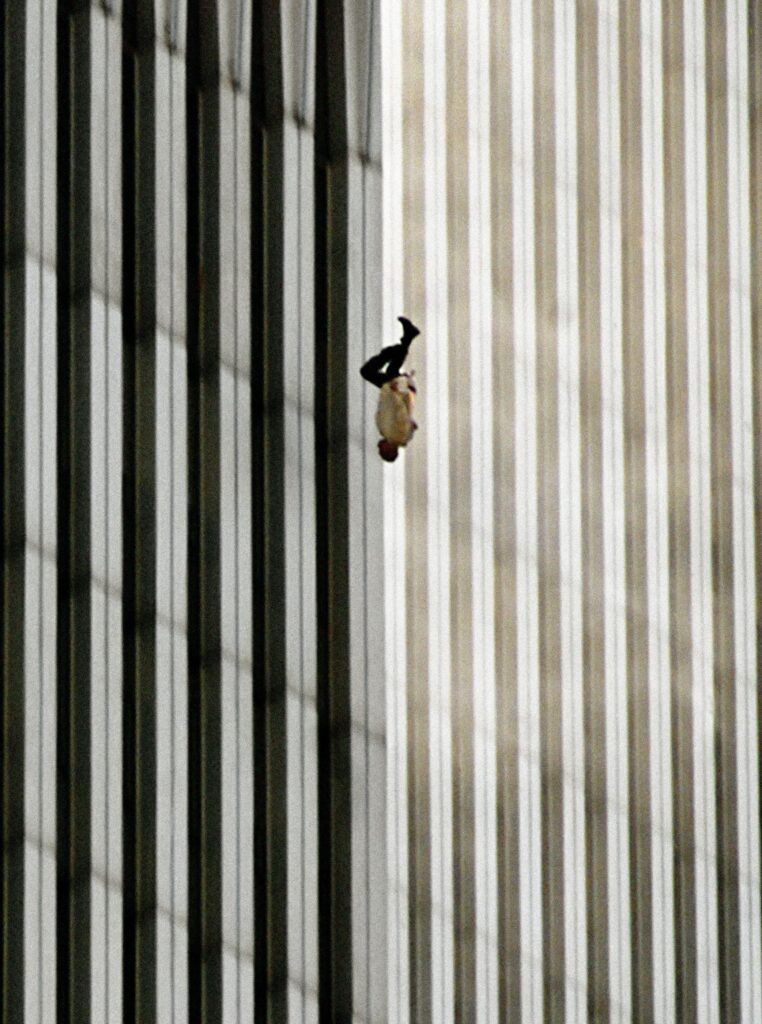
At 9:41:15 AM on September 11, 2001, Associated Press photographer Richard Drew pointed his Nikon D1 camera with a 300mm lens toward the North Tower of the World Trade Center and captured something that would haunt American consciousness for decades. The falling man 9/11 photo shows a figure in vertical descent—arms at his sides, one leg bent at the knee, falling with an eerie composure against the geometric lines of the tower. It's a photograph that newspapers published on September 12, then quickly buried. A photograph that families rejected, that America tried to forget, and that the internet refused to let die.1
What makes this particular image so powerful—and so controversial—isn't just what it shows. It's what it refuses to hide. Among an estimated 200 people who jumped or fell from the towers that morning, this one anonymous figure became the visual embodiment of choices no human should face.2 The photograph Drew captured that morning would spark debates about journalistic ethics, dignity in death, and America's relationship with uncomfortable truths that continue today.
The Technical Perfection Behind an Impossible Moment
Richard Drew wasn't a novice when he arrived at the World Trade Center that morning. His career had already been marked by capturing defining American tragedies—he'd photographed Robert F. Kennedy's assassination in 1968, and his eye for composition in chaos was well-established. But nothing prepared him for what he'd witness and document on 9/11.3
The technical setup was straightforward: a Nikon D1 digital camera, one of the first professional digital SLRs, paired with a 300mm telephoto lens. Digital photography in 2001 was still relatively new to photojournalism, and Drew's choice to shoot digital rather than film meant he could capture sequences rapidly without worrying about reloading.4 This proved crucial. As people began falling from the towers, Drew tracked them with his lens, shooting sequences as they descended.
The sequence that produced the iconic image contains 12 frames. But this one—frame nine, according to some accounts—stands apart. The man appears almost serene, his body vertical, aligned perfectly with the building's facade. One leg bent, arms close to his sides, he seems less like someone falling and more like someone... floating. Suspended. The composition is nearly symmetrical, the figure centered against the tower's vertical lines.5
Why This Frame Among Hundreds?
Drew photographed multiple people falling that morning. Other photographers captured similar images. So why did this particular frame become the falling man 9/11 photo? The answer lies in aesthetics—a word that feels almost obscene when discussing someone's death, yet remains essential to understanding the image's power.
The vertical orientation creates an uncanny echo of religious iconography—crucifixion poses, martyrdom paintings. The figure's apparent composure transforms horror into something that looks almost like choice, like dignity. The sharp focus, the neutral gray-blue of the building providing a canvas, the geometric precision—all contribute to an image that's simultaneously documentary and artistic, unbearable and mesmerizing.6
September 12: Publication and Immediate Backlash
On September 12, 2001, newspapers across America faced an editorial dilemma. The New York Times ran the image on page 7. The Chicago Sun-Times published it. So did papers in smaller markets across the country. And almost immediately, the phones started ringing.7
The reaction was visceral and angry. Readers called it ghoulish, exploitative, disrespectful to the dead. Within days, most newspapers that had published the image issued apologies or explanations. The photograph essentially disappeared from mainstream American media. It wasn't shown on television. It wasn't included in memorial coverage. It became, in effect, censored—not by government decree but by collective cultural revulsion.8
Why such a different reaction than to other 9/11 images? Americans watched the towers collapse repeatedly on television. We saw the planes hit. We saw dust-covered survivors fleeing. But the jumpers—that was different. The jumpers represented individual agency in the face of death, and acknowledging them meant confronting the impossible choices people faced in those towers. It meant imagining yourself in that position. What would you do with flames at your back and smoke filling your lungs, temperatures exceeding 1,000°F, and a window as your only exit?9
The Cultural Taboo of Acknowledging Jumpers
America's 9/11 narrative quickly coalesced around heroism, sacrifice, and resilience. Firefighters rushing into buildings. Passengers fighting back on Flight 93. First responders working at Ground Zero. These stories were bearable, even inspiring. But the jumpers? They didn't fit the narrative. They represented pure desperation, impossible choices, and a kind of death that couldn't be reframed as heroic.
News broadcasts on 9/11 showed people falling in real-time, but by September 12, that footage had been edited out. The official death toll didn't distinguish between those who jumped and those who died in the collapse—all were victims of homicide, as the medical examiner correctly ruled. But in public discourse, the jumpers became invisible. The falling man 9/11 photo became the visual representation of this suppressed reality, which is precisely why it generated such intense backlash.10
The Quest for Identity: Jonathan Briley and Others
Who was the falling man? This question haunted investigators, journalists, and families for years. In 2003, Esquire writer Tom Junod published an extensive investigation that brought the photograph back into public consciousness and attempted to identify the man in the image.11
The most likely identity: Jonathan Briley, a 43-year-old audio technician who worked at Windows on the World restaurant on the North Tower's 106th and 107th floors. The evidence was compelling. Clothing analysis suggested the man wore the white jacket and dark pants that matched Windows on the World's uniform. Body measurements and proportions aligned. Briley's workplace location—above the impact zone—meant he would have been trapped with no possibility of rescue.12
But Briley's family never confirmed the identification. Some members believed it was him. Others adamantly rejected the possibility. And that rejection speaks volumes about the stigma surrounding the jumpers. For families, having a loved one identified as the falling man meant having their death defined by this single, horrifying moment—replayed, analyzed, debated by strangers forever.
Norberto Hernandez and the Pain of Misidentification
Another potential identity emerged: Norberto Hernandez, a pastry chef at Windows on the World. Hernandez's family initially believed the photograph showed their loved one, based on clothing similarities. But further analysis—and the family's own painful scrutiny—led them to conclude it wasn't him. The process of identification and rejection traumatized the family, forcing them to study images of someone's final moments, comparing details, living with uncertainty.13
Other names have been suggested over the years, including employees of Michael Lomonaco, the executive chef of Windows on the World who survived because he was running late that morning. But no definitive identification has ever been confirmed. The falling man remains, officially, anonymous.14
Richard Drew's Burden: The Photographer's Perspective
In interviews, Richard Drew has spoken about that morning with a mixture of professional detachment and evident emotional weight. He was doing his job—documenting history as it unfolded. But he also captured someone's death, and that photograph became his legacy.
"I didn't see the person," Drew explained in one interview. "I saw a story unfolding." It's the photographer's necessary distance, the professional mindset that allows you to keep shooting when everything in you wants to look away. But Drew has also acknowledged the controversy and pain the image caused. Unlike his photograph of RFK's assassination, which won awards and recognition, the falling man brought criticism and accusations of exploitation.15
Drew's career spans decades of documentary photography, capturing everything from celebrity portraits to historic tragedies. But he's become inextricably linked to this single image. It's a burden many photographers of iconic images carry—being defined by one moment, one frame, one person's story that becomes everyone's symbol.
The 2006 Documentary and Cultural Re-emergence
In 2006, British filmmaker Henry Singer produced "The Falling Man," a documentary that explored the photograph, the investigation into the man's identity, and the broader cultural taboo around the jumpers. The documentary brought the image back into public discourse in a more sustained way than Junod's article had.16
The documentary interviewed families, photographers, journalists, and ethicists, creating a comprehensive examination of why this image provoked such extreme reactions. It also contextualized the falling man within the broader reality of that morning—an estimated 200 people jumped or fell from the towers, yet this aspect of 9/11 remained largely unacknowledged in official narratives and memorials.17
By 2006, enough time had passed that public discourse around 9/11 could accommodate more complex, uncomfortable truths. The documentary didn't resolve the question of identity, but it validated the importance of acknowledging what happened—all of what happened, including the aspects that don't fit comfortable narratives of heroism.
The Digital Age Factor: Preservation Through Circulation
While mainstream media suppressed the image, the internet preserved it. The falling man 9/11 photo circulated on websites, forums, and eventually social media. Each September 11th anniversary, it would resurface, shared and debated anew. This digital immortality ensured the image couldn't be completely erased from public consciousness, regardless of editorial decisions by newspapers or television networks.18
This digital circulation has had complex effects. It's democratized access to historical documentation, preventing sanitized versions of history from becoming the only versions. But it's also meant the image circulates without context, sometimes used in conspiracy theories or manipulated for various agendas. The falling man has appeared in art installations, political commentary, and memorial projects—not always with sensitivity to the human being at its center.19
Ethical Debates: Publishing Images of Death
The falling man photograph sits at the intersection of multiple ethical questions that have plagued photojournalism for decades. When is it appropriate to publish images of people dying? What's the photographer's responsibility to subjects who cannot consent? Does the historical importance of an image override concerns about dignity and family trauma?
Compare the falling man to other controversial photographs of death and suffering. The Vietnam War's "Napalm Girl" photograph by Nick Ut showed a naked child fleeing a napalm attack—horrifying, but ultimately accepted because it revealed war's impact on civilians and contributed to changing public opinion. Kevin Carter's photograph of a starving Sudanese child with a vulture nearby won a Pulitzer Prize but haunted Carter until his suicide. These images share a common thread: they document human suffering in ways that make viewers uncomfortable but serve a journalistic purpose of revealing truth.20
But the falling man occupies a unique position. It doesn't reveal government wrongdoing or war crimes. It doesn't expose hidden suffering. Everyone knew people jumped from the towers on 9/11—we watched it happen live. The photograph's purpose wasn't revelation but documentation, creating a permanent record of what America watched but wanted to forget.
International vs. American Media Response
The stark difference between American and international media responses to the falling man reveals cultural attitudes toward death, tragedy, and photojournalism. European newspapers continued publishing the image with less controversy. Asian media treated it as a significant documentary photograph. But in America, the image became almost taboo.21
This divergence reflects different traditions in photojournalism and different cultural relationships with displaying death. American media has historically been more protective—or more sanitizing—in its coverage of American deaths, while being less restrained about showing deaths from foreign conflicts or disasters. The falling man challenged this double standard by forcing Americans to confront American deaths in unvarnished detail.
The 9/11 Memorial Museum and Institutional Memory
The 9/11 Memorial Museum, which opened in 2014, faced its own ethical dilemmas about how to represent the jumpers. The museum includes the falling man photograph in its collection, but it's not prominently displayed. Audio recordings of bodies hitting the ground—captured by emergency responders that morning—are available to hear, but only in a separate alcove with warnings about the content's disturbing nature.22
This careful curation represents a compromise between historical completeness and sensitivity to families and visitors. But it also perpetuates the marginalization of the jumpers' stories. By treating these images as too disturbing for main galleries, the museum implicitly reinforces the idea that some deaths are more acceptable to acknowledge than others.
Other institutions have been bolder. The Museum of Modern Art included the photograph in exhibitions exploring photojournalism and contemporary history. Art galleries have displayed it as part of examinations of trauma, representation, and cultural memory. In these contexts, the falling man functions as both documentary evidence and artistic object—a duality that makes some critics uncomfortable but reflects the photograph's actual cultural role.23
The Paradox of Anonymity: Universal and Personal
The falling man's unknown identity creates a strange paradox. Without a confirmed name, the photograph becomes universal—this could be anyone, which makes it everyone. Every family who lost someone in the towers above the impact zones can see their loved one in that figure. Every person who imagines themselves in that situation sees themselves falling.
But anonymity also provides distance. We can contemplate the image without confronting a specific person's biography, family, dreams, and final moments. The falling man becomes a symbol rather than an individual, which makes the photograph easier to discuss, analyze, and display. If Jonathan Briley's identity were definitively confirmed, would the image become unbearable in a different way? Would it transform from universal symbol to specific tragedy, making its circulation feel more like violation?24
This tension between the universal and the personal appears in how different people respond to the photograph. Some see it as a powerful memorial to impossible choices. Others see it as exploitation of someone's worst moment. Both interpretations are valid, and the photograph's power lies partly in its ability to provoke both reactions simultaneously.
Class, Race, and Whose Stories Get Told
The investigation into the falling man's identity raised uncomfortable questions about class and race in 9/11 narratives. Jonathan Briley was Black, working in food service. Norberto Hernandez was Latino, a pastry chef. Many of the people who worked above the impact zones in the North Tower were restaurant workers, custodians, support staff—not the financial executives and traders who dominated media coverage of 9/11 victims.25
The falling man photograph inadvertently highlighted these workers' stories, but in a way that some families found problematic. Being identified as the falling man meant being remembered primarily for how you died rather than how you lived. For working-class families and communities of color, this felt like another erasure—their loved ones' lives reduced to a symbol of tragedy rather than celebrated as individuals with full, complex lives.
Twenty-Plus Years Later: Evolution of Public Discourse
More than two decades after September 11, 2001, the falling man 9/11 photo has undergone a remarkable evolution in public consciousness. What was once almost entirely taboo has become, if not fully accepted, at least discussable. Anniversaries of 9/11 now sometimes include acknowledgment of the jumpers. Articles and documentaries explore this aspect of the tragedy with less immediate backlash than in 2001.26
This shift reflects several factors. Time creates distance, making traumatic images somewhat easier to confront. The generation that has grown up with 9/11 as history rather than lived experience approaches the photograph differently than those who watched the towers fall in real-time. And perhaps there's been a broader cultural reckoning with the sanitization of tragedy—a recognition that honoring victims means acknowledging the full horror of what they experienced, not just the parts that fit comfortable narratives.
The photograph has been used in educational contexts, in discussions about photojournalism ethics, and as a reference point for how societies process collective trauma. It appears in academic papers, museum exhibitions, and memorial projects. The falling man has become, paradoxically, both more visible and more contextualized than in the immediate aftermath of 9/11.
Use and Misuse in Art and Activism
The photograph's iconic status has led to its appropriation in various contexts, not all of them respectful or appropriate. Artists have referenced the image in paintings, sculptures, and installations—sometimes as genuine attempts to grapple with 9/11's meaning, sometimes as shock value or political statement. Conspiracy theorists have analyzed the image for supposed evidence of their various theories. Political activists have used it to argue for or against military interventions, surveillance policies, and other post-9/11 political developments.27
This circulation and recontextualization raises questions about who owns iconic images and what responsibilities come with using them. The falling man is simultaneously a copyrighted photograph, a historical document, a symbol of tragedy, and—most importantly—a representation of a real person's death. Balancing these different aspects remains contentious.
Why This Image Matters: Counter-Narrative to Sanitized History
Ultimately, the falling man photograph matters because it refuses to let us look away from uncomfortable truths. American culture has a tendency to sanitize tragedy, to focus on heroism and resilience while minimizing the actual horror of traumatic events. This sanitization serves psychological purposes—it makes trauma more bearable, creates narratives we can live with, allows us to move forward.
But sanitization also distorts history. It creates incomplete records that serve emotional needs rather than documentary truth. The falling man stands as a counter-narrative to this sanitization. It says: this happened. People faced choices no one should face. They died in ways that are unbearable to contemplate. And we owe it to them to acknowledge that reality rather than constructing more comfortable fictions.28
The photograph also challenges our notions of dignity in death. Is dignity found in hiding how someone died, or in acknowledging their impossible situation with honesty? The families who rejected identification of their loved ones as the falling man were protecting their own conception of dignity—remembering the person's life rather than their death. But there's also dignity in the photograph itself: in the figure's apparent composure, in the documentation of human beings facing the unimaginable with whatever grace they could muster in those final seconds.
Lessons for Contemporary Photography and Documentation
For photographers, particularly those working in documentary and photojournalism, the falling man offers crucial lessons about the power and responsibility of the camera. Richard Drew made a split-second decision to photograph what he saw rather than looking away. That decision gave us a historical record, but it also created lasting controversy and pain for families.
The photograph demonstrates how compositional choices affect meaning. Drew's use of a telephoto lens compressed the perspective, isolating the figure against the building. The vertical framing emphasized the fall's trajectory. The moment captured—when the figure appeared most composed—created an image that looked almost peaceful despite depicting someone's death. These weren't accidents; they were the result of a skilled photographer's instinctive choices about framing, timing, and composition.29
The photograph also illustrates the limits of photographer control over how images are received and used. Drew couldn't control newspapers' decisions to publish or remove the image. He couldn't prevent its circulation online or its appropriation for various purposes. Once you release a photograph into the world, particularly one of such intense subject matter, it takes on a life beyond your intentions. This reality should inform how photographers approach sensitive subjects, though it doesn't provide easy answers about when to shoot and when to lower the camera.
The Digital Age and Trauma Photography
In 2001, Drew was one of a limited number of professional photographers at the scene. Today, any major event involves hundreds or thousands of people with cameras in their phones, all potentially documenting tragedy. The falling man photograph's controversial history offers warnings about this democratization of trauma photography. Not every moment needs to be photographed. Not every photograph needs to be shared. And the ease of digital circulation doesn't eliminate ethical considerations about consent, dignity, and the impact on those depicted and their families.30
Yet the photograph also demonstrates why documentation matters. Without images like the falling man, future generations would have an incomplete understanding of 9/11. They'd know the towers fell, but they might not fully grasp the individual human choices and suffering involved. Documentary photography serves history, even when—especially when—it makes us uncomfortable.
Conclusion: An Image That Won't Let Us Forget
The falling man 9/11 photo remains one of the most controversial and significant photographs of the 21st century. Twenty-plus years after Richard Drew captured that sequence of frames at 9:41:15 AM, the image continues to provoke intense reactions, ethical debates, and profound questions about how we document and remember tragedy.
It's a photograph that American culture tried to suppress but couldn't erase. An image that families rejected but that history demanded. A document that serves both as memorial and as uncomfortable reminder of truths we'd prefer not to confront. The figure falling against the North Tower's facade represents not just one person but an estimated 200 people who faced impossible choices that morning, and beyond them, all the victims whose deaths we've sanitized into more comfortable narratives.
For photographers, the falling man offers lessons about the power of composition, the responsibility of documentation, and the lasting impact of images we create. For viewers, it challenges us to confront our discomfort with death, our tendency toward sanitized history, and our responsibility to acknowledge the full truth of tragic events.
The photograph's evolution from immediate suppression to gradual acceptance reflects a broader cultural reckoning with how we process collective trauma. Perhaps we're learning, slowly, that honoring victims means acknowledging the full horror of their experiences, not just the aspects that fit comfortable narratives of heroism and resilience.
What do you think about the falling man photograph? Should it have been published? Does its historical importance outweigh the pain it causes families? How do we balance documentation with dignity? These questions don't have easy answers, which is precisely why the image remains so important. It forces us to grapple with complexities rather than settling for simple narratives. And in that grappling, we come closer to understanding not just 9/11, but how we document, remember, and make meaning from the tragedies that define our collective history.
Frequently Asked Questions
Who was the falling man in the famous 9/11 photograph?
The falling man's identity has never been definitively confirmed. The most likely identification is Jonathan Briley, a 43-year-old audio technician who worked at Windows on the World restaurant in the North Tower. Evidence including clothing analysis and workplace location support this identification, but Briley's family never officially confirmed it. Another potential identity, Norberto Hernandez, was investigated but later ruled out by his family. The photograph's subject remains officially anonymous, which has contributed to its power as a universal symbol of 9/11's impossible choices.31
Why was the falling man photograph so controversial?
The photograph sparked immediate controversy because it showed an individual's death in graphic detail, forcing viewers to confront the impossible choices people faced in the towers. When newspapers published it on September 12, 2001, they received hundreds of complaints from readers who found it exploitative and disrespectful. The image was quickly pulled from most publications. The controversy reflected America's cultural discomfort with acknowledging the jumpers—an estimated 200 people who fell or jumped from the towers—because these deaths didn't fit comfortable narratives of heroism and sacrifice. The photograph made individual suffering unavoidably visible rather than subsumed into abstract casualty numbers.32
What camera equipment did Richard Drew use to capture the falling man?
Richard Drew used a Nikon D1 digital camera with a 300mm telephoto lens to photograph the falling man. The Nikon D1, released in 1999, was one of the first professional digital SLRs and had a 2.7-megapixel sensor. The telephoto lens allowed Drew to capture the sequence from ground level while compressing the perspective and isolating the figure against the building's facade. Drew shot a sequence of 12 frames of this individual, with the iconic image being approximately the ninth frame in the sequence. The digital format allowed him to shoot rapidly without reloading film, which proved crucial for capturing multiple sequences of different people falling that morning.33
How many people jumped from the World Trade Center on 9/11?
An estimated 200 or more people jumped or fell from the World Trade Center towers on September 11, 2001, though the exact number is uncertain. Many bodies were never recovered or couldn't be definitively classified as having jumped versus fallen during the collapse. People jumped primarily from the North Tower above the impact zone, where temperatures exceeded 1,000°F and smoke made breathing impossible. The medical examiner classified all jumpers as homicides rather than suicides, recognizing they were forced to this choice by impossible circumstances. Despite the significant number of jumpers, this aspect of 9/11 was largely suppressed in media coverage and official narratives, making the falling man photograph one of the few widely circulated images acknowledging this reality.34
Is the falling man photograph displayed at the 9/11 Memorial Museum?
The 9/11 Memorial Museum includes the falling man photograph in its collection, but it's not prominently displayed in the main galleries. The museum has taken a cautious approach to imagery of jumpers, acknowledging this aspect of the tragedy while being sensitive to families and visitors who find such images traumatic. Audio recordings of impacts from falling bodies are available to hear in a separate alcove with warnings about the disturbing content. This careful curation represents a compromise between historical completeness and sensitivity, though some critics argue it perpetuates the marginalization of the jumpers' stories. Other institutions, including the Museum of Modern Art, have exhibited the photograph more prominently in contexts exploring photojournalism, contemporary history, and collective trauma.35
What was the Tom Junod Esquire article about the falling man?
In September 2003, Esquire magazine published "The Falling Man," an extensive investigative article by writer Tom Junod that brought the photograph back into public consciousness two years after it had been suppressed. Junod's article explored the photograph's history, investigated the possible identity of the man in the image, interviewed families of potential victims, and examined why the image provoked such intense controversy. The article presented evidence suggesting the man was likely Jonathan Briley and documented the painful process families went through examining the photograph to determine if it showed their loved one. Junod's work sparked renewed public discussion about the photograph and the broader issue of how America remembered—or failed to remember—the jumpers. The article won widespread acclaim for its sensitive handling of a difficult subject and its willingness to confront aspects of 9/11 that mainstream media had avoided.36
- Richard Drew shot a sequence of 12 frames of this individual, but this single image became the iconic representation.
- The medical examiner classified all jumpers as homicides, not suicides, acknowledging they were forced to this decision by impossible circumstances.
- Drew took hundreds of photographs that day, but the falling man sequence would become his most recognized and controversial work.
- The Nikon D1, released in 1999, had a 2.7-megapixel sensor—primitive by today's standards but revolutionary for news photography at the time.
- The apparent calmness of the pose is likely due to the physics of free fall and body positioning during the approximately 10-second descent from 1,300+ feet.
- Art critics have noted the photograph's formal qualities mirror classical portraiture, which paradoxically makes the content more disturbing.
- Some newspapers received hundreds of complaints within hours of publication, with readers describing the image as exploitative, disrespectful, and traumatizing.
- International newspapers, particularly in Europe and Asia, showed less hesitation about publishing the image and continued to use it in coverage.
- Forensic analysis suggested people jumped to escape unbearable heat and smoke rather than as a conscious choice of death method.
- Psychologists have noted that images of individual deaths often provoke stronger reactions than images of mass casualties, making the jumper photographs particularly difficult for viewers to process.
- Junod's article, "The Falling Man," won widespread acclaim and sparked renewed debate about the photograph and the broader issue of jumpers on 9/11.
- Windows on the World employees were among those facing the most dire circumstances, with the restaurant located above where American Airlines Flight 11 struck the tower.
- The Hernandez family's experience highlighted the ethical complications of attempting to identify victims from such photographs without definitive proof.
- Some family members of potential victims have requested that identification efforts cease, preferring to remember their loved ones in other ways.
- The image won no major photography awards, reflecting the industry's own discomfort with the photograph despite its technical and compositional excellence.
- Singer's documentary aired on Channel 4 in the UK and later on Discovery Times in the US, reaching new audiences who had never seen the photograph.
- The exact number of jumpers remains uncertain because many bodies were never recovered or could not be definitively classified as having jumped versus fallen during the collapse.
- The photograph has become one of the most searched and shared 9/11 images online, despite—or perhaps because of—its controversial nature.
- Media ethics scholars have debated whether repeated online circulation constitutes continued exploitation or necessary historical documentation.
- The evolution of documentary photography ethics has increasingly emphasized subject dignity and informed consent, complicating the justification for publishing images like the falling man.
- Cultural scholars have attributed American squeamishness partly to a cultural emphasis on optimism and closure, making images of inescapable death particularly difficult to integrate into national narratives.
- The museum's decision to include but not prominently feature jumper imagery reflects ongoing cultural discomfort with this aspect of 9/11.
- The photograph's exhibition in art museums has sparked debates about whether displaying tragedy as art constitutes exploitation or appropriate commemoration.
- Richard Drew has stated he believes the anonymity allows the image to represent all victims, not just one individual.
- Windows on the World employed a diverse workforce, many of whom were immigrants or people of color working in service positions.
- Journalism retrospectives increasingly treat the photograph as an important historical document rather than an exploitative image.
- The photograph's use in contexts divorced from its original meaning has troubled both Richard Drew and families of potential victims, who feel the image has been exploited beyond its documentary purpose.
- Historians studying collective trauma have noted that societies that acknowledge the full scope of traumatic events, including uncomfortable aspects, generally process trauma more completely than those that suppress difficult truths.
- Photography instructors often use the falling man as a case study in how technical and aesthetic choices carry ethical implications, particularly in documentary work.
- The rise of smartphone photography and social media has exponentially increased the volume of trauma imagery while decreasing the editorial gatekeeping that once moderated what reached public view.
- The lack of definitive identification reflects both the difficulty of forensic analysis from a photograph and families' reluctance to have loved ones remembered primarily through this image.
- International media showed less hesitation about publishing the image, highlighting cultural differences in attitudes toward displaying death in news coverage.
- The technical specifications of the equipment contributed to the photograph's aesthetic qualities, including the compression of space and the sharp focus that makes the image so striking.
- Emergency responders at the scene reported hearing bodies hitting the ground throughout the morning, a traumatic aspect of the tragedy that has received limited public acknowledgment.
- The museum's approach reflects ongoing cultural debates about how to memorialize all aspects of 9/11, including those that don't fit comfortable narratives of heroism.
- Junod's article directly influenced the 2006 documentary "The Falling Man" by Henry Singer, which further explored the photograph's significance and controversy.