Glass negatives, egg-white paper and a card the size of a calling card: how the carte de visite turned the portrait from a rare luxury into a collectible habit.
The carte de visite looks modest. It is a small albumen print, about the size of a business card, pasted onto a stiff mount. Yet in the 1860s it did what the daguerreotype never could. Indeed, it made portraits cheap, repeatable and endlessly shareable. Families swapped them, collectors filled albums with them, and strangers bought cards of actors, politicians and royalty.
This article tells that story from the glass plate up. It explains how wet collodion made the carte de visite possible, why a Paris studio owner named André-Adolphe-Eugène Disdéri became the format's great salesman, and how the craze spread from Paris to Yokohama and Hong Kong. If you are following the series, the previous chapter on the invention of photography explains why a reproducible negative mattered so much.
Wet Collodion: The Glass Plate Behind the Carte de Visite
In March 1851, the English sculptor Frederick Scott Archer published a new method in the journal The Chemist. It used collodion, a syrupy solution of guncotton in ether and alcohol, to hold light-sensitive silver salts on a sheet of glass. Archer did not patent it. In fact, that decision is one reason the process spread so fast.1
How a wet plate worked
The method was messy and quick. First, the photographer poured collodion containing iodide over a clean glass plate. Next, the photographer dipped the plate in a bath of silver nitrate, which made it sensitive to light. Then it went into the camera while still wet. After a short exposure, the photographer developed and fixed the image immediately.
The window for all this was brief. If the coating dried, the plate lost its sensitivity. As a result, photographers working outdoors dragged portable darkrooms behind them, and studio operators kept a laboratory a few steps from the camera. Even so, the reward was great. Exposures could last only a few seconds in good light, and the glass negative recorded far more detail than a calotype.2
One negative, many prints
Wet collodion combined the best of the two rivals from the 1840s. Like the daguerreotype, it was sharp. Like the calotype, it produced a negative that could be printed again and again. The prints were usually made on albumen paper, a thin sheet coated with egg white and silver salts. Louis-Désiré Blanquart-Évrard had introduced the albumen print in 1850, and it stayed the standard photographic paper until gelatin silver papers displaced it around 1890.
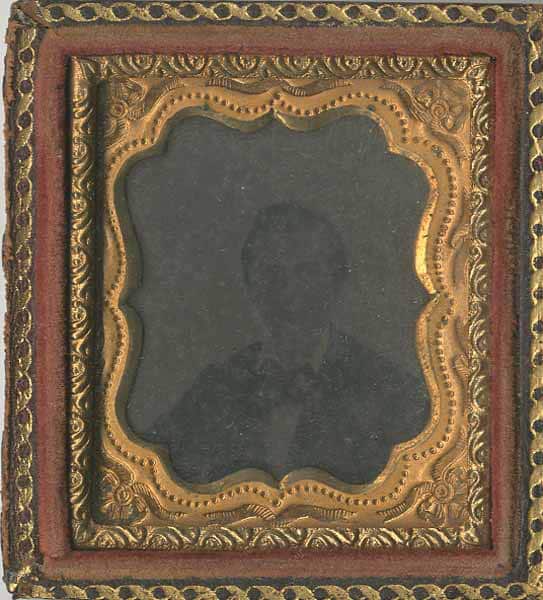
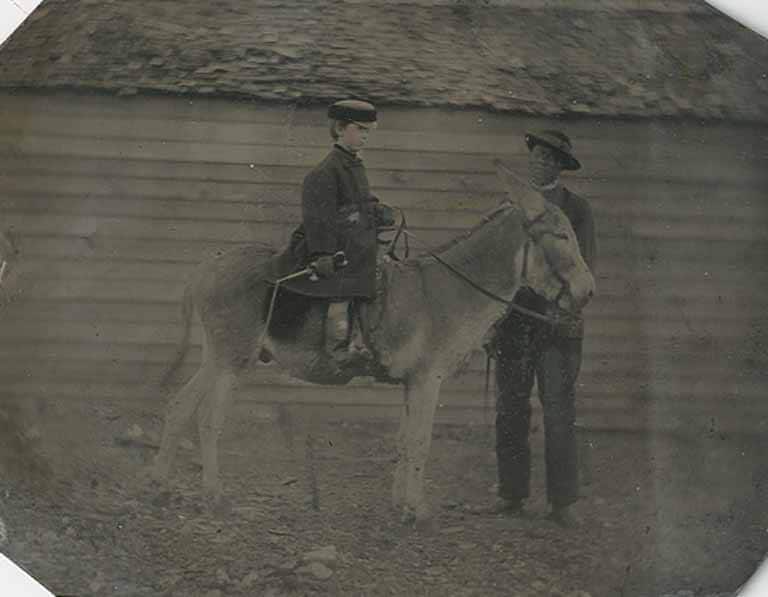
Wet collodion also led to two cheaper cousins. The ambrotype was a collodion negative on glass that looked like a positive when backed with something dark. Likewise, the tintype, also called the ferrotype, used a thin sheet of black-lacquered iron, not tin. The French inventor Adolphe-Alexandre Martin described the principle in 1853, and Hamilton Smith patented a version in the United States in 1856.
Disdéri and the Carte de Visite Patent of 1854
Disdéri was not the first person to dream of a photographic visiting card. He was, however, the first to make a factory of the idea. On 27 November 1854, he patented a system for producing small portrait photographs in quantity.3
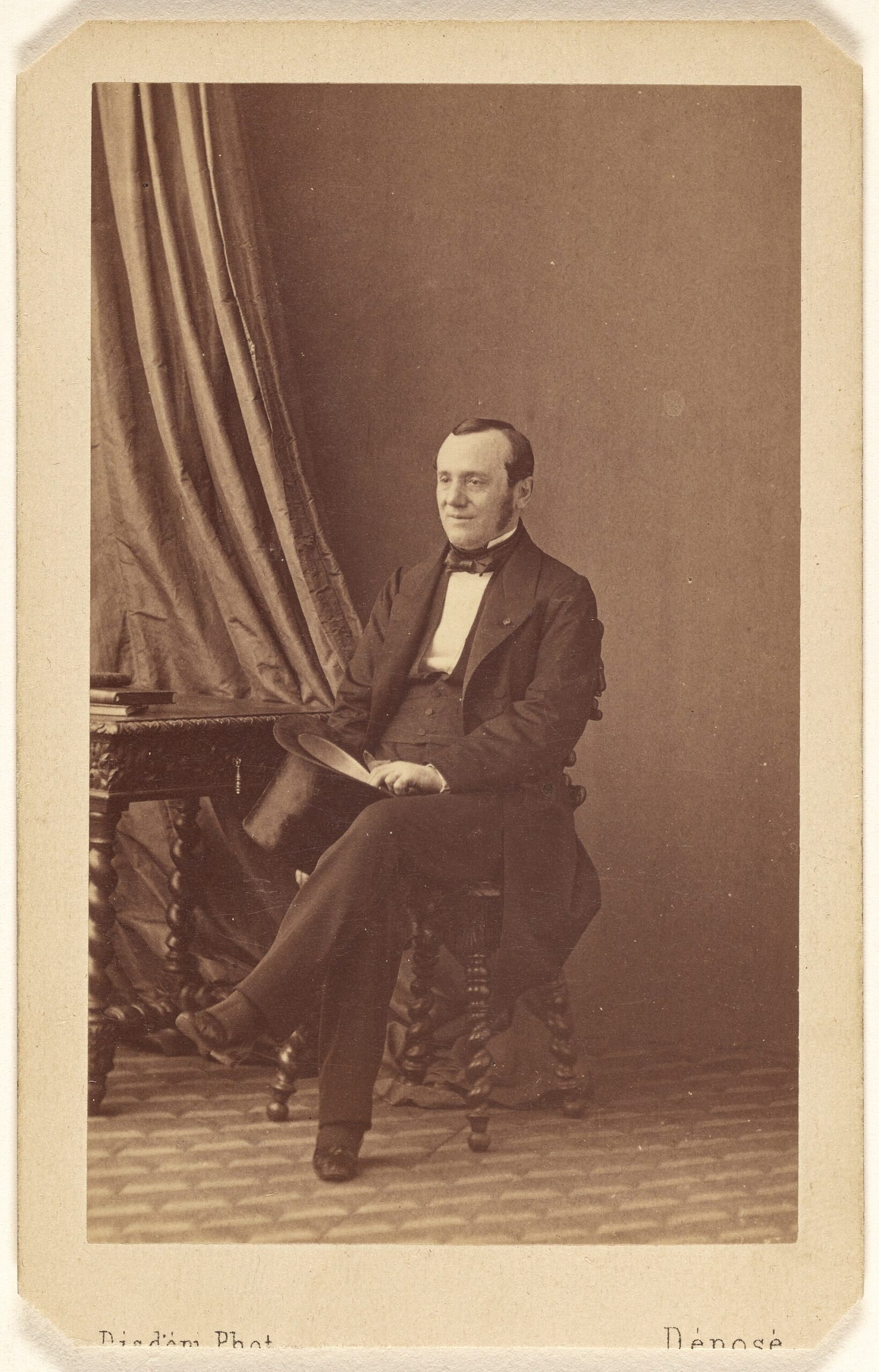
The trick was a camera with several lenses. In practice, it exposed eight small poses on a single glass plate, so one session produced a full sheet of images. Studios then printed the sheet in one go and cut it into individual cards. The usual image measured about six by nine centimeters, mounted on card roughly 6.4 by 10.4 centimeters. As a result, each portrait cost a fraction of a cased daguerreotype, and the price fell again as studios competed.
The Napoleon legend
A famous story says that Napoleon III stopped his army in 1859 to have his portrait taken in Disdéri's studio on the way to the Italian campaign. It makes a lovely anecdote. Unfortunately, it is probably apocryphal. Disdéri did photograph the emperor and did benefit from imperial patronage, but historians treat the dramatic stop with suspicion.
What is certain is that the card captured the imagination of the Paris middle class. As Elizabeth Anne McCauley shows in her study of Disdéri, the carte de visite let families record their own faces and also let them look at the faces of politicians, actors and writers at home.4
A portrait was no longer a rare family event. It was a purchase, and a repeatable one. Blank cartes were even sold to miniature painters, who tinted them to imitate ivory miniatures, according to a conservation study in the Journal of the American Institute for Conservation.
A day in the studio
Imagine a visit to a Paris studio in 1860. You climbed a staircase to an upper floor, where a glass roof flooded the room with daylight. An assistant arranged you beside a column or a painted garden. A metal brace, hidden behind your collar, kept your head from moving. The operator removed the lens cap, counted the seconds and slid the plate into a darkroom.
A few days later, you collected your cards. The studio had already stored the negative, so reordering was easy. Friends who liked your portrait could ask for more copies, and the studio could sell prints of the same image to anyone willing to pay. In effect, the carte de visite turned each sitting into a small production run.
Why albumen paper looked so glossy
The egg white in albumen paper formed a smooth layer on top of the fibers. Silver salts sat in that layer rather than sinking into the paper, so details stayed crisp. Moreover, prints took on a warm, purplish brown that faded to yellow over time. Many surviving cartes look pale for that reason, although they once looked rich and glossy.
Cartomania: Why the Carte de Visite Became a Craze
By 1860, the craze had crossed the Channel. In Britain, the photographer John Jabez Edwin Mayall published carte de visite portraits of Queen Victoria and Prince Albert, and the public bought them in great numbers. Albert's death in December 1861 sent demand soaring again, partly for mourning portraits. Contemporaries called the fashion cartomania, and it soon reached the United States.
The album as an early social network
The cards came with a ready-made home. Publishers sold albums with slotted pages designed to hold them, and these books sat on parlor tables like a visible friends list. You placed relatives next to celebrities and swapped cards with visitors. Guests, in turn, judged a household by the faces it displayed.
That sounds familiar. In fact, the habits of the carte de visite album anticipate modern feeds, as we argue in our piece on the visual grammar of Instagram. In both cases, an image functioned as a social token before it functioned as a memory.
Celebrity cards and the first fan culture
The carte de visite did not only record private lives. It also created the first modern fan culture. Studios issued cards of actors, politicians, preachers and generals, and customers collected them like trading cards. During the American Civil War, soldiers carried cartes of their families into camp, and civilians bought portraits of Union leaders. As a result, photographs of the famous were suddenly as common as newspapers.
This new market had consequences. For example, celebrities gained a new kind of visibility, and photographers argued over who owned a likeness. In other words, the carte de visite foreshadowed today's disputes over image rights and publicity.
Poses, props and class
The carte de visite also standardized how people looked. For instance, studios used painted backdrops, columns, balustrades and a few chairs. Posing stands held the sitter's head still. In the same period, studio owners built glass-roofed rooms to collect daylight, and recent architectural history has shown how these salons de pose shaped city streets.5
However, props and backdrops were not neutral. They told viewers that a sitter was respectable, prosperous or at least aspirational. Research on mid-nineteenth-century Dublin, for instance, shows that studios sold middle-class status to people who wanted to look like they belonged.6 A carte could therefore flatter, and it could also exclude those who could not afford even a shilling's worth of dignity.
Nadar and the Art of the Portrait
Not everyone wanted the factory approach. In Paris, Gaspard-Félix Tournachon, known as Nadar, built a rival reputation on the opposite principle. He opened a celebrated studio at 35 boulevard des Capucines in 1860. Instead, his portraits of writers, actors and artists were plain, close and psychologically sharp. To learn more about him, see our profile of Nadar.
Do not exaggerate the contrast with Disdéri. Both men sold portraits, and both courted celebrity. Still, Disdéri built a system of standardized, multi-pose cards, whereas Nadar cultivated a studio associated with prestigious individual portraiture. In 1874, the first Impressionist exhibition took place in the vacated premises at the same address, which is a nice reminder of how closely Paris portraiture and avant-garde art overlapped.
From carte de visite to cabinet card
By the mid-1860s, the small card had a larger sibling. The cabinet card, introduced around 1866 by the London firm Windsor and Bridge, used a mount of roughly 4¼ by 6½ inches. It suited framing and display on a shelf rather than pasting into an album. By the 1880s, it had largely replaced the carte de visite in many markets, though the smaller card lived on for decades.
The Carte de Visite in Asia: Studios, Colorists and Local Owners
The story of the carte de visite is often told as a French and British tale. That is far too narrow. Within a few years of Disdéri's patent, the format and the wet plate were being used in Asian port cities, and local photographers were shaping the market from the start.
Yokohama and Nagasaki
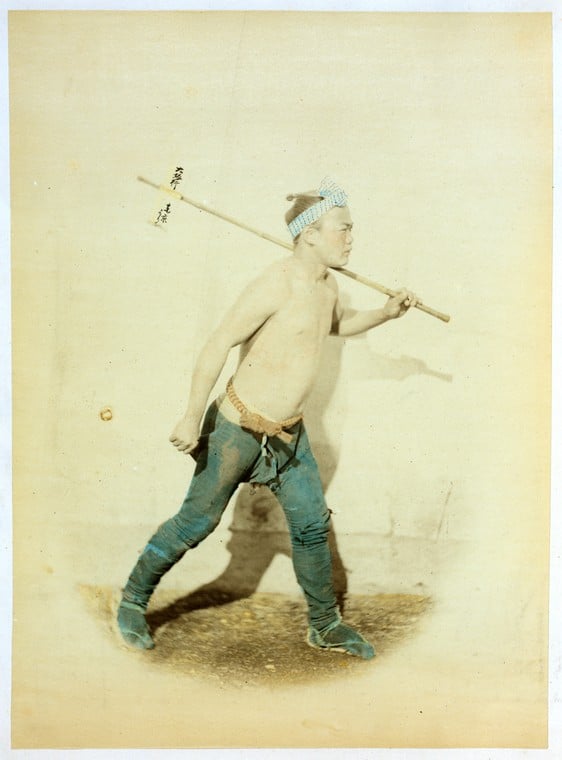
Felice Beato, a naturalized British photographer, arrived in Yokohama in 1863 and ran a successful studio there until the late 1870s. Beato aimed his albums of Japanese views and portraits at Western merchants and tourists. According to the MIT Visualizing Cultures project on Beato, many of the albumen prints were hand-colored by Japanese artists trained in watercolor and woodblock traditions, which gave the pictures their soft, luminous palette.7
Japanese photographers were not just assistants. In 1862, Ueno Hikoma opened a studio in Nagasaki, and Shimooka Renjō opened one in Yokohama. Ueno's studio, often described as one of the first professional studios in Japan, produced portraits of local lords, scholars and visitors on cartes de visite. These businesses show that Japanese sitters and studio owners adopted the format, rather than merely receiving it.
Hong Kong and the China coast
On the China coast, studios competed hard for sitters. In Hong Kong, the Chinese photographer Lai Afong built one of the most successful commercial studios of the 1870s. According to the Science Museum Group, the studio specialized in portraits, including cartes de visite, as well as scenic views.8 His cards, with their embossed borders and printed backs, look much like their European counterparts. They remind us that the visual language of the carte de visite quickly became global.
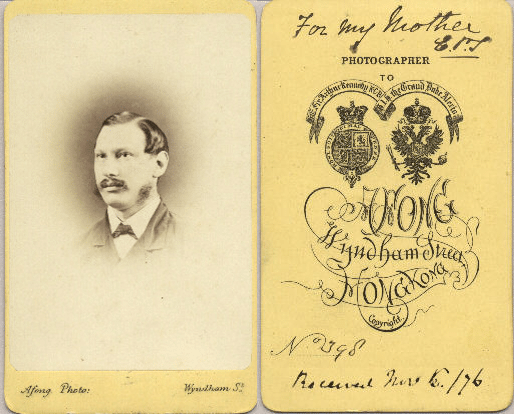
For the wider arc of photography in China, including imperial courts and the later studio trade, read our history of photography in China.
Who Made the Carte de Visite? Women Behind the Camera
History has a habit of erasing the people who kept studios running. Recent research on Disdéri's partner and wife, Elisabeth Francart, who is sometimes called Madame Disdéri, argues that she worked as a photographer and administrator, and that someone scraped her name from many card mounts.9 Her case is one of many. Women ran studios, retouched negatives, colored prints and mounted cards, even when advertising credited a husband.
One woman did become famous in her own name. Julia Margaret Cameron took up wet collodion in 1863 and made large, soft, close-up portraits that broke every studio rule. They were not cartes de visite. Instead, they were something else, and they belong in the story of the next generation, which we will meet in our guide to pictorialism.
The Carte de Visite and the Civil War Tintype
Meanwhile, cheaper processes carried the same impulse to less wealthy sitters. In the United States, tintype portraits became popular with soldiers, who could have one made in minutes at a camp studio or a traveling wagon. Also, the image was a small black plate that survived rough handling, which made it ideal for a pocket or a letter home. A family might own a carte de visite album in the parlor and a tintype in the soldier's kit bag.
Retouching, Mourning and the Afterlife of the Carte de Visite
In addition, studios routinely retouched negatives with pencil and etching tools to smooth skin and sharpen eyes. Meanwhile, colorists added pink to cheeks, as in the tintype above. Customers expected to look their best, not to look like themselves.
The carte de visite also found a role in grief. Likewise, families kept portraits of the dead, and some commissioned photographs after death. Not every memorial image showed a corpse, however. Instead, many were ordinary portraits that a family later placed in an album or frame as a keepsake.
Taken together, these practices show what the format industrialized. It industrialized the face, the pose and the habit of collecting people. Then, in the 1880s and 1890s, the dry gelatin plate and the roll film would industrialize the camera itself, a story we pick up in the next chapters of our History of Photography series.
Key Dates in the Carte de Visite Story
| Date | Event | Why it matters |
|---|---|---|
| 1850 | Blanquart-Évrard introduces albumen printing | The standard paper for the next forty years |
| March 1851 | Archer publishes wet collodion | Sharp glass negatives, unpatented |
| 1853–1856 | Martin, Cutting and Smith describe or patent collodion positives | Cheaper ambrotypes and tintypes |
| 27 November 1854 | Disdéri patents the carte de visite system | Eight poses on one plate |
| 1860 | Nadar opens at 35 boulevard des Capucines; Mayall's royal cartes appear | Art portraits and cartomania |
| 1862 | Ueno Hikoma and Shimooka Renjō open studios | Local studios in Nagasaki and Yokohama |
| 1863 | Beato settles in Yokohama; Cameron takes up wet collodion | Hand-colored albums and art portraits |
| c. 1866 | Cabinet card introduced | A larger, display-oriented format |
| 1870s | Lai Afong's Hong Kong studio thrives | Chinese-owned studios on the coast |
| Late 1870s–1880s | Dry gelatin plates replace wet collodion | The camera becomes easier to use |
Frequently Asked Questions
What is a carte de visite?
A carte de visite is a small albumen photograph, roughly six by nine centimeters, mounted on a card about the size of a visiting card. Disdéri patented the multi-pose system for producing it in 1854.
Who invented the carte de visite?
André-Adolphe-Eugène Disdéri patented the system in 1854, but earlier proposals existed. His real contribution was industrial-scale production and marketing.
What is the difference between a carte de visite and a cabinet card?
The cabinet card, introduced around 1866, is larger, at roughly 4¼ by 6½ inches. Studios designed it for display, whereas the smaller carte de visite was meant for albums and exchange.
What is wet collodion?
Wet collodion is a process published by Frederick Scott Archer in 1851 in which a glass plate coated with collodion and silver salts is exposed and developed before it dries. It produced the sharp negatives behind most cartes de visite.
Is a tintype really made of tin?
No. A tintype is a collodion image on a thin sheet of black-lacquered iron. The name is a later misnomer, and the process is also called ferrotype.
Did Napoleon III really stop his army to be photographed by Disdéri?
Probably not. Many repeat the story of 1859, but historians generally treat it as apocryphal, although Disdéri did photograph the emperor and benefited from imperial patronage.
- Archer published his method in The Chemist in March 1851 and left it unpatented. For a practical modern guide to the process, see Jill Enfield, "Wet Plate Collodion," in Jill Enfield's Guide to Photographic Alternative Processes (New York: Routledge, 2020), doi:10.4324/9781315390369-10.
- For a technical study of the chemistry and its limits, see Skladnikiewitz, Hertel and Schmidt, "The Wet Collodion Process: A Scientific Approach," Journal of Imaging Science and Technology 42, no. 5 (1998), doi:10.2352/j.imagingsci.technol.1998.42.5.art00015.
- Elizabeth Anne McCauley's study A. A. E. Disdéri and the Carte de Visite Portrait Photograph (New Haven: Yale University Press, 1985) remains the standard account of his career and business. Details of the 1854 patent vary slightly between sources; the specification is usually cited as 27 November 1854.
- McCauley's book, cited above, also argues that the format influenced painters of the next generation. For the view from a conservator, see Mervyn Ruggles, "Paintings on a Photographic Base," Journal of the American Institute for Conservation 24, no. 2 (1985), which discusses how blank cartes were sold to miniature painters. The article is hosted by the AIC's online archive.
- On studio architecture, see Zeynep Coşkun, "Architecture in the Service of Photography," History of Photography (2026), doi:10.1080/03087298.2026.2697121. On posing and the sitter's body, see Rudd, "Good Subjects, Bad Objects," photographies (2019), doi:10.1080/17540763.2019.1566167.
- Fitzpatrick, "Photography and Leisure: The Rise of the Photographic Studio in Mid- to Late-Nineteenth-Century Dublin," in Leisure and the Irish in the Nineteenth Century (Liverpool: Liverpool University Press, 2015), doi:10.5949/liverpool/9781781381823.003.0005.
- The MIT Visualizing Cultures unit "Felice Beato's Japan" describes the studio, the colorists and the tourist market. Beato sold the business in 1877, after which Baron Raimund von Stillfried and later Adolfo Farsari and Kusakabe Kimbei took over its legacy.
- See the Science Museum Group's catalogue entry for Afong Lai's Queen's Road, Hong Kong (albumen print, 1870s), which notes the studio's range of work and the competitive market of colonial Hong Kong.
- Cano Díaz, "Elisabeth Francart, 'Madame Disdéri', una pionera de la fotografía borrada por la historia (y por un raspador)," Fotocinema 30 (2025), doi:10.24310/fotocinema.30.2025.20549.