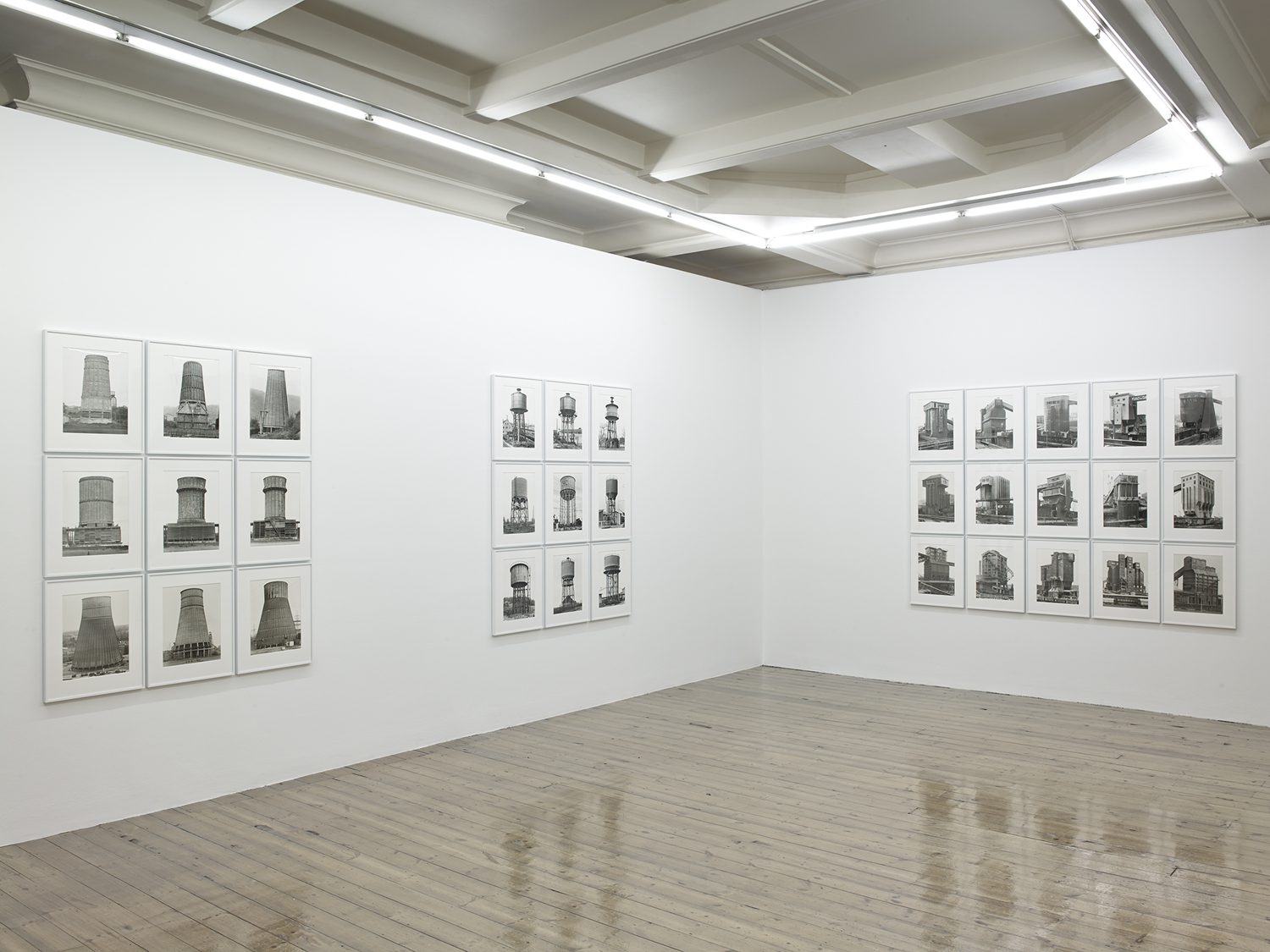
For more than forty years, Bernd and Hilla Becher photographed the same kinds of buildings again and again. Their subjects were water towers, blast furnaces, winding towers, gas holders and cooling towers, as well as the half-timbered houses of the workers who ran them. They shot each one in black and white, from the front, under a flat grey sky. Then they hung the prints side by side in grids they called “typologies”. The result changed how the art world saw photography. It also trained a generation of German photographers who went on to dominate the medium.
Key points
- Bernd Becher (1931–2007) and Hilla Becher (1934–2015) worked as a couple from 1959. They documented industrial structures in Germany, the rest of Western Europe and North America.
- Their “typologies” group photographs of one type of structure in a grid. As a result, the viewer compares form and function, and sees “variation within limits”.
- Their work sits where documentary photography meets contemporary art. It hung alongside Minimal and Conceptual art, won a Golden Lion for sculpture at the 1990 Venice Biennale and shaped students such as Andreas Gursky and Thomas Struth.
Who were Bernd and Hilla Becher?
Bernhard “Bernd” Becher was born on 20 August 1931 in Siegen, in western Germany. He died on 22 June 2007 in Rostock. Hilla Becher, née Wobeser, was born on 2 September 1934 in Potsdam and died on 10 October 2015 in Düsseldorf. For almost fifty years they worked as one artist with two names. In fact, both names appear on almost every photograph they made.
Bernd grew up in the Siegen region, an old centre of mining and iron working. Members of his family worked in heavy industry. He studied painting and lithography at the State Academy of Fine Arts in Stuttgart from 1953 to 1956. After that, he studied typography at the Kunstakademie Düsseldorf. From 1957 he photographed the industrial buildings around his home town, at first as material for drawings and prints. One reason was urgent: demolition had already begun on many of them.
Hilla, by contrast, came to the project as the trained photographer. She learned the trade in Potsdam, worked briefly as an aerial photographer in Hamburg and moved to Düsseldorf in 1959. According to the critic Chris Wiley, she decided to become a photographer as a teenager. Even then, she was interested in machine parts and natural specimens, which she photographed against black backgrounds.
How Bernd and Hilla Becher met
Accounts differ on where the two first met. Some place the meeting at the Troost advertising agency in Düsseldorf, where both worked in the late 1950s. Others place it at the Kunstakademie. All accounts agree on the essentials, however: they began photographing together in 1959 and married in 1961. Their son Max Becher, born in 1964, also became an artist.
From then on, the couple shared every stage of the work. In the darkroom, for example, Bernd usually developed the negatives and Hilla made the prints. Even so, writers have often played down Hilla’s role, partly because only Bernd held a teaching post. The Metropolitan Museum’s 2022 retrospective was the first with full access to the artists’ archive. It also showed early work by each of them.
How Bernd and Hilla Becher worked
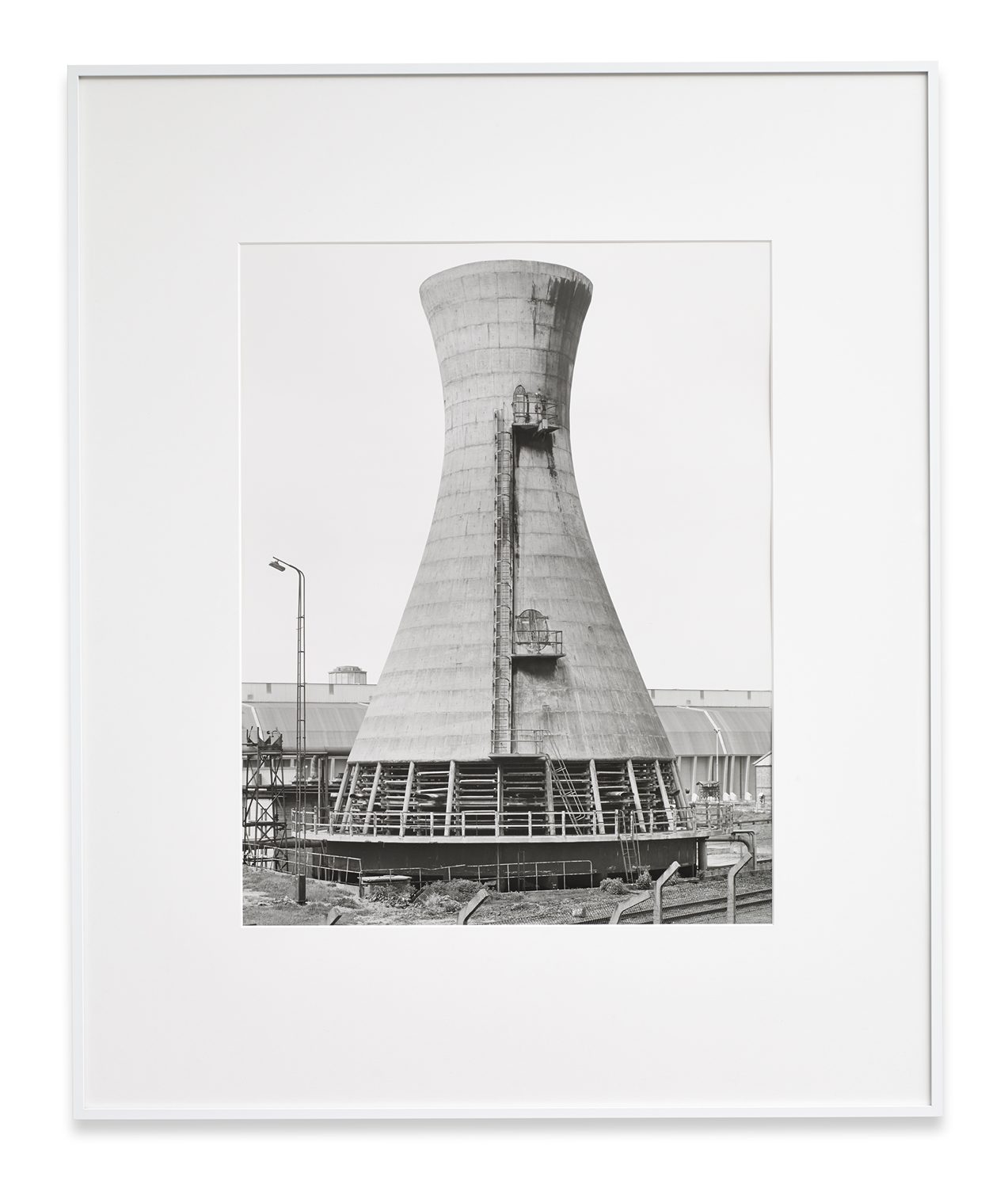
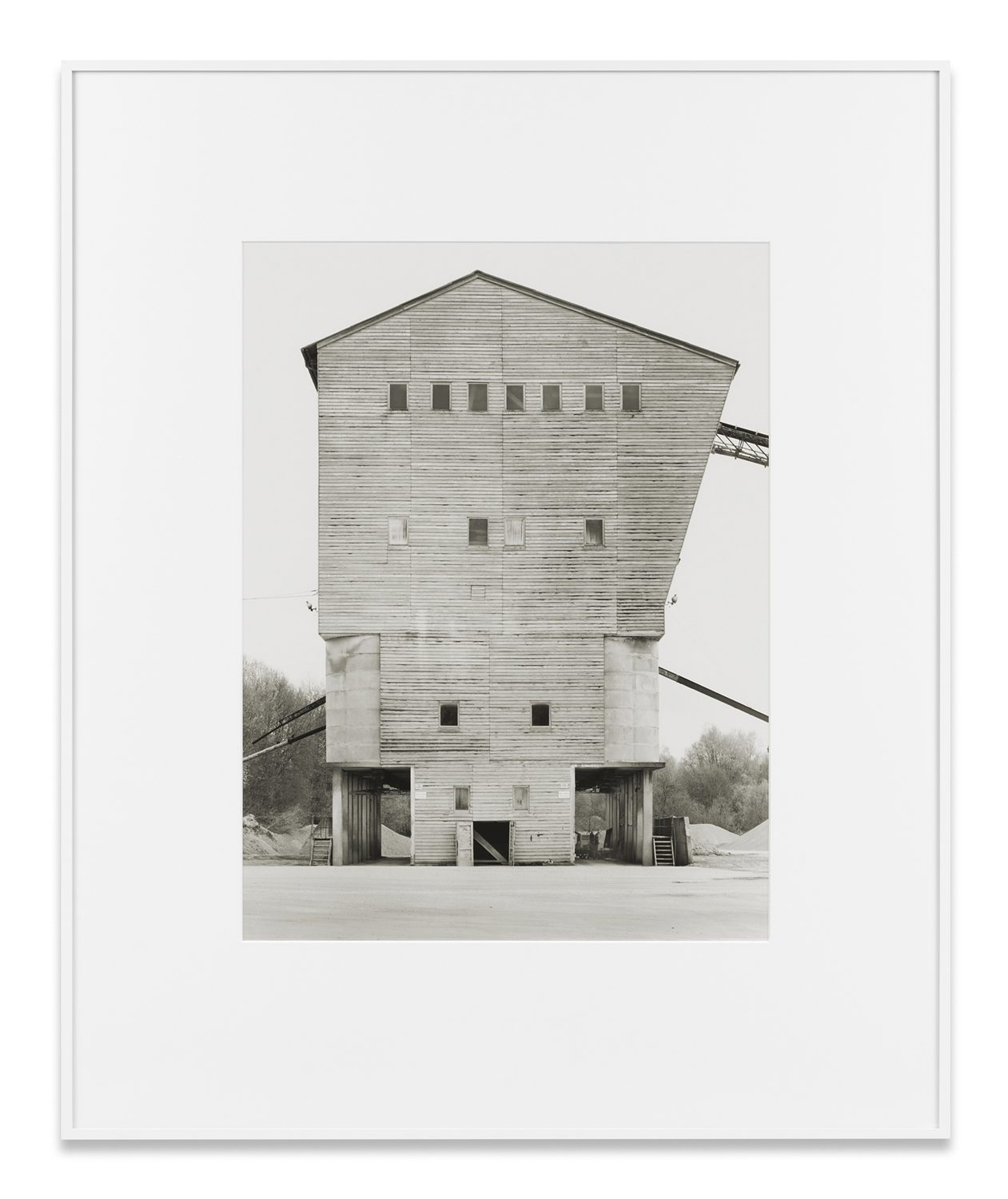
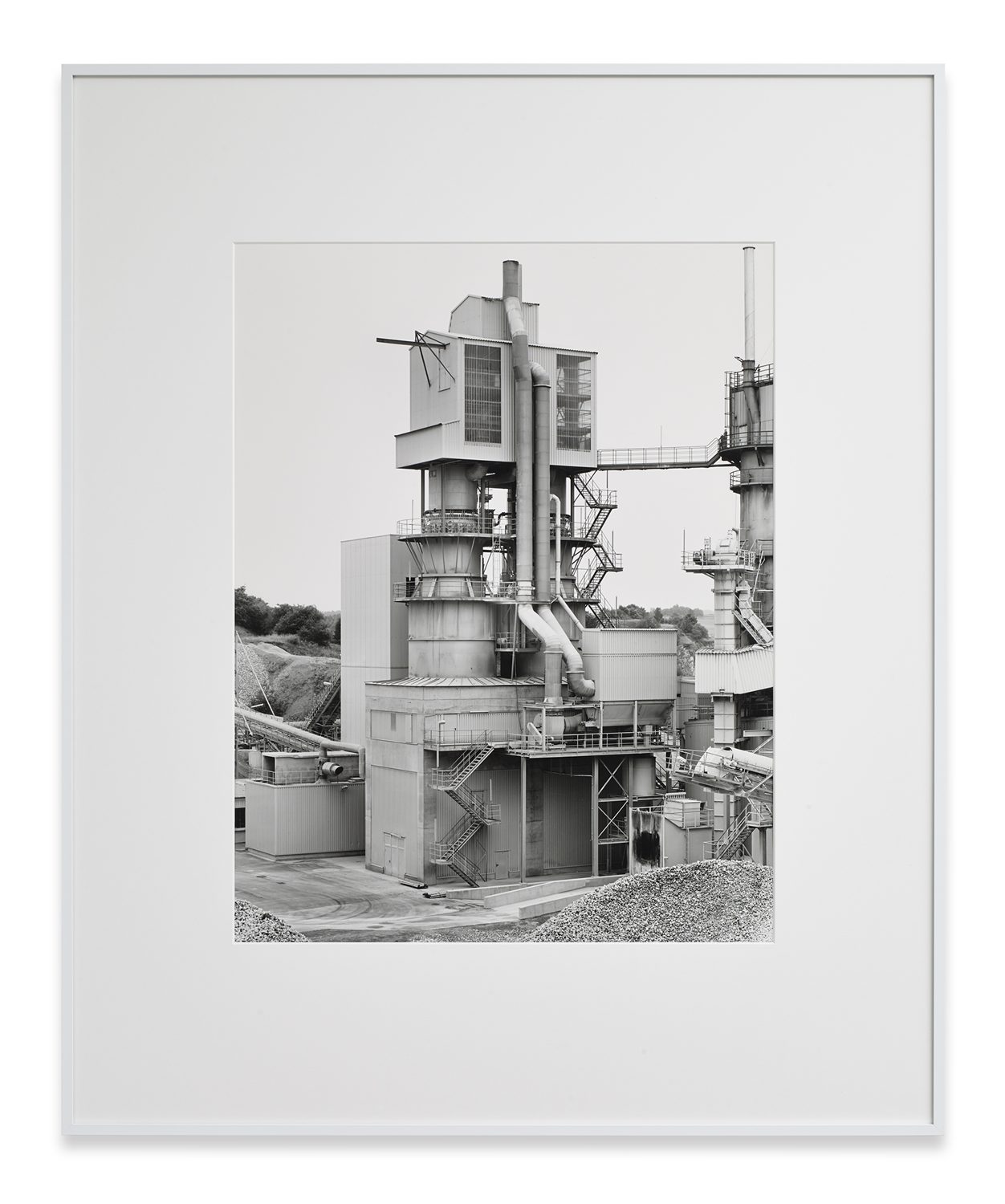
The Bechers settled on a method very early and kept it, with few changes, for the rest of their careers. They used a large-format view camera and chose a fixed, usually frontal viewpoint. They also worked on overcast days, so that no hard shadows would cut across the structure. The aim was to remove “any trace of subjectivity” from the composition. As a result, the building fills the frame, isolated against a pale, almost white sky. There are no people, no weather effects and no dramatic angles.
That neutral look took a great deal of work. The couple travelled in a Volkswagen bus with their heavy camera and stepladders. The ladders let them raise the lens to the right height. In addition, they had to negotiate access with the owners of mines, mills and factories. They often returned to the same region over many years. Sometimes they reached a site only shortly before the wreckers arrived.
Black and white, and other choices
Black and white was a deliberate choice. Above all, it rendered volume and structure clearly, without the distraction of colour. It also suited the comparison of many prints made over decades. Later, in 1971, Bernd summed up the attitude: “We deal with objects, not motifs. The photograph serves as a stand-in for the object—it is useless as a picture in the conventional sense”.
Neutral does not mean automatic, however. Every image involved choices. The couple decided which structure to photograph and from where. Then they chose which print to keep, how large to print it and where to place it in a grid. For this reason, several historians argue that their “objectivity” is itself a carefully built style. The section on critical debates below returns to this point.
What is a typology in the work of Bernd and Hilla Becher?
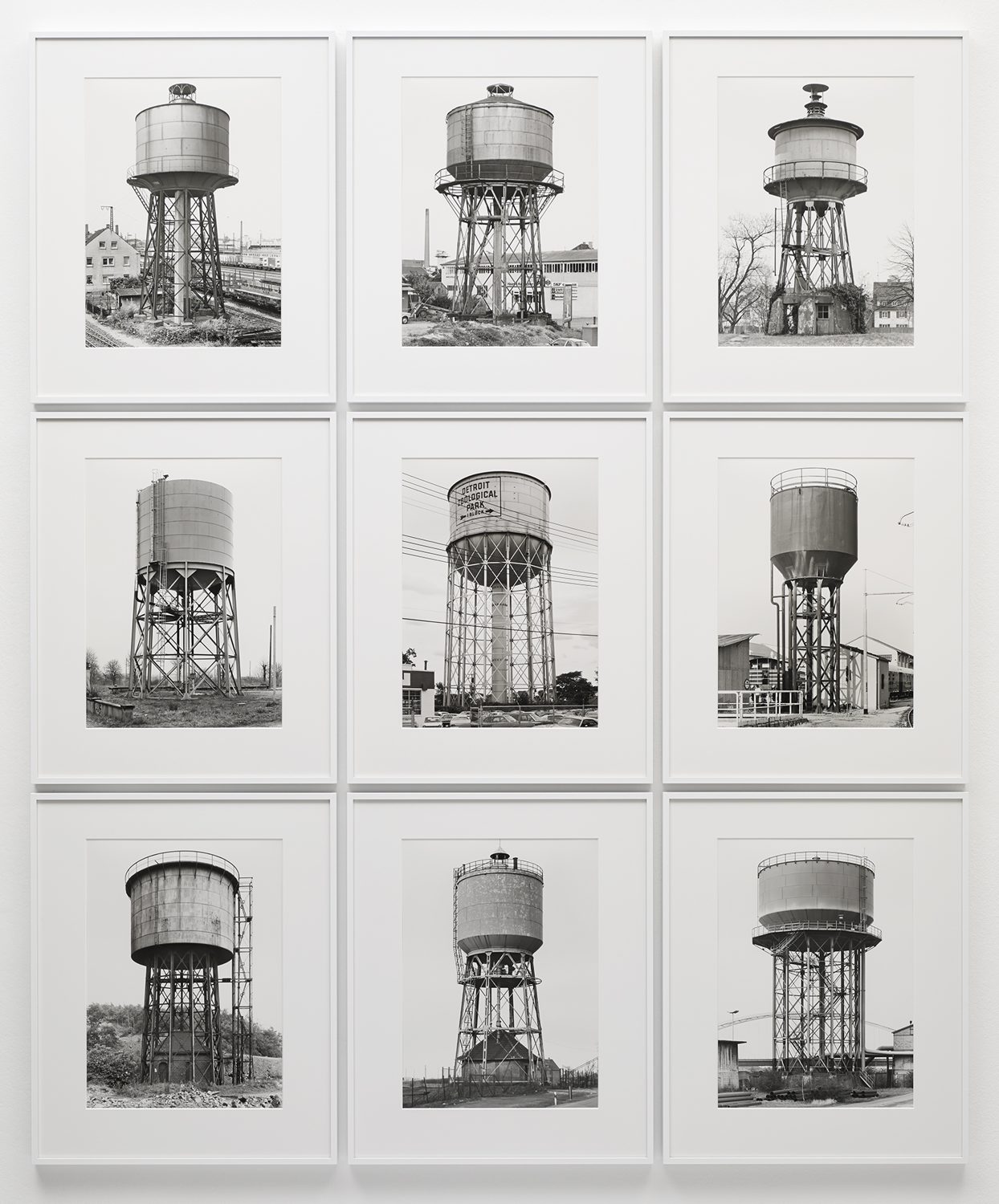
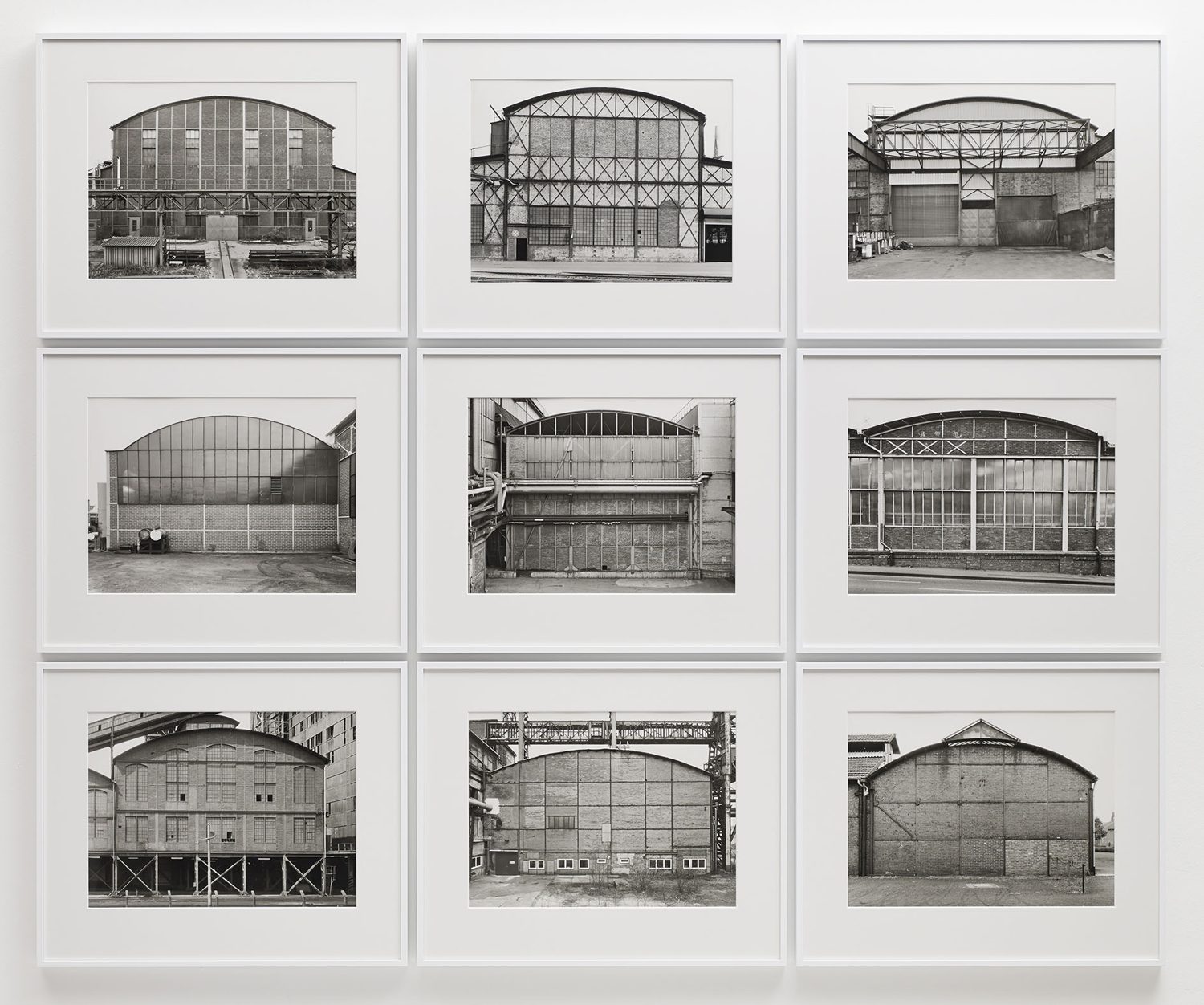
In the Bechers’ sense, a typology is a set of photographs of structures that share the same function. The prints have the same size and hang together in a grid. The grids hold between four and thirty photographs, and many of the best known have nine or fifteen. Within a grid, the couple show every water tower or blast furnace in the same way. As a result, the differences between them become visible: materials, proportions, regional traditions and the age of the structure.
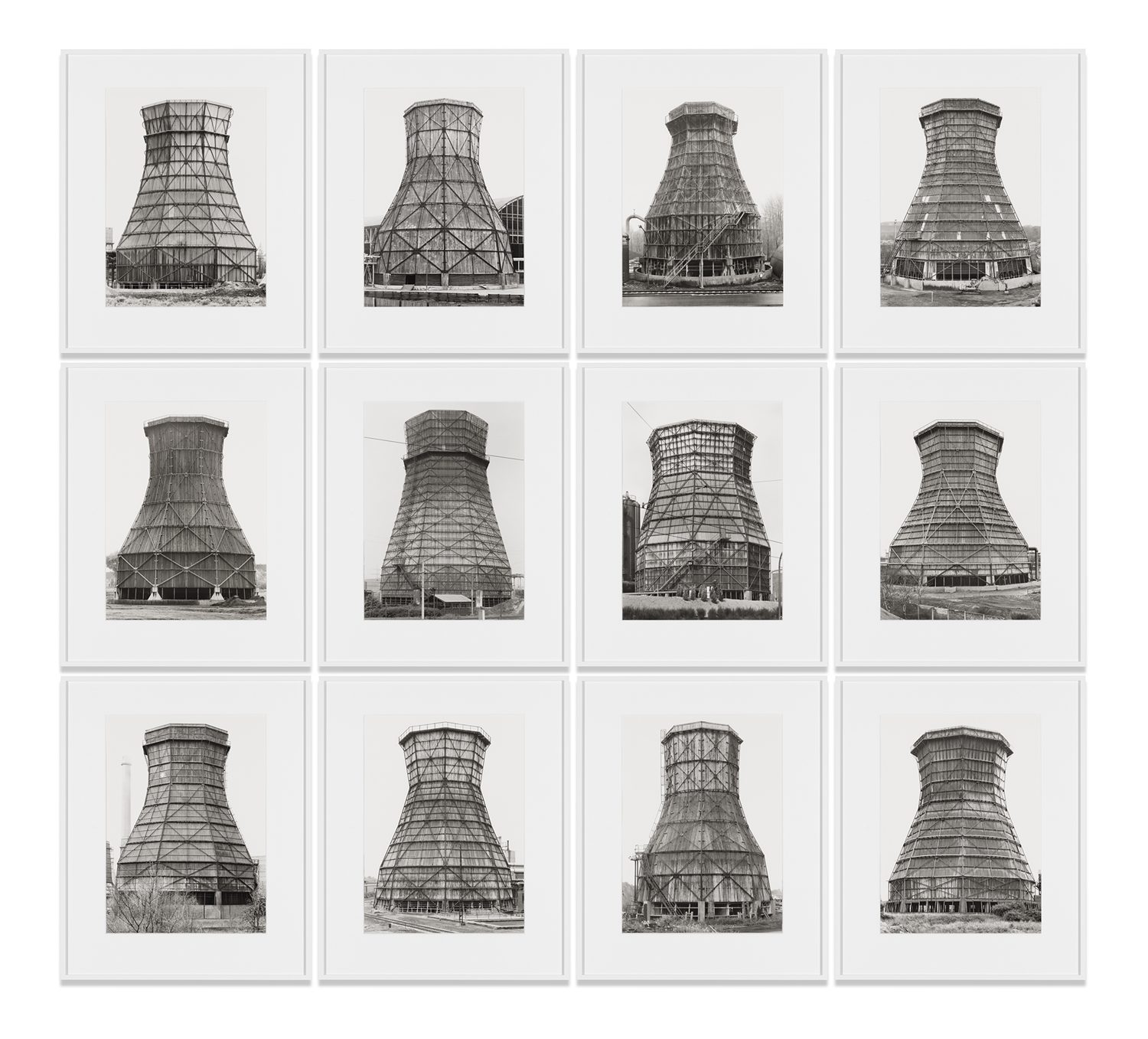
The couple cared about form and function together. The structures in a typology do the same job. Yet engineers solved the same problem in dozens of ways. The groupings form “families of objects”. Similarly, their gallery, Sprüth Magers, describes the underlying theme as “variation within limits”. Hilla Becher explained the effect with a musical image. Placing several cooling towers side by side, she said, produced something “like tonal music”, because “you don’t see what makes the objects different until you bring them together”.
Looking at a grid is therefore an active exercise. The eye moves across the rows, down the columns and diagonally, comparing a ladder here with a tank there. Scholars have compared this to the plates of a natural history book, which lay out specimens of a species for study. The titles help that reading, since they give only the type of structure, the place and the date.
Anonymous Sculptures (1970)
The Bechers’ first book, Anonyme Skulpturen: Eine Typologie technischer Bauten, appeared in Düsseldorf in 1970 from Art-Press. Wittenborn in New York published an American edition the same year, with the English subtitle A Typology of Technical Constructions. Thanks to its trilingual text and its sequence of industrial structures, the work became known well beyond Germany. The title nods to Marcel Duchamp’s readymades. In other words, it presents functional buildings as found objects: sculptures made by no artist in particular.
The phrase “anonymous sculpture” did a great deal for the Bechers’ reputation. Their son Max later recalled that his parents repeated it “like a propaganda campaign”, because they wanted the idea to stick. It stuck so well that in 1990 the Venice Biennale gave them its Golden Lion for sculpture, not for photography.
The series of Bernd and Hilla Becher, one by one
The Bechers worked on many types of structure at once, often for decades, so the boundaries between series overlap. The main groups below are those that recur in their books and exhibitions.
Water towers
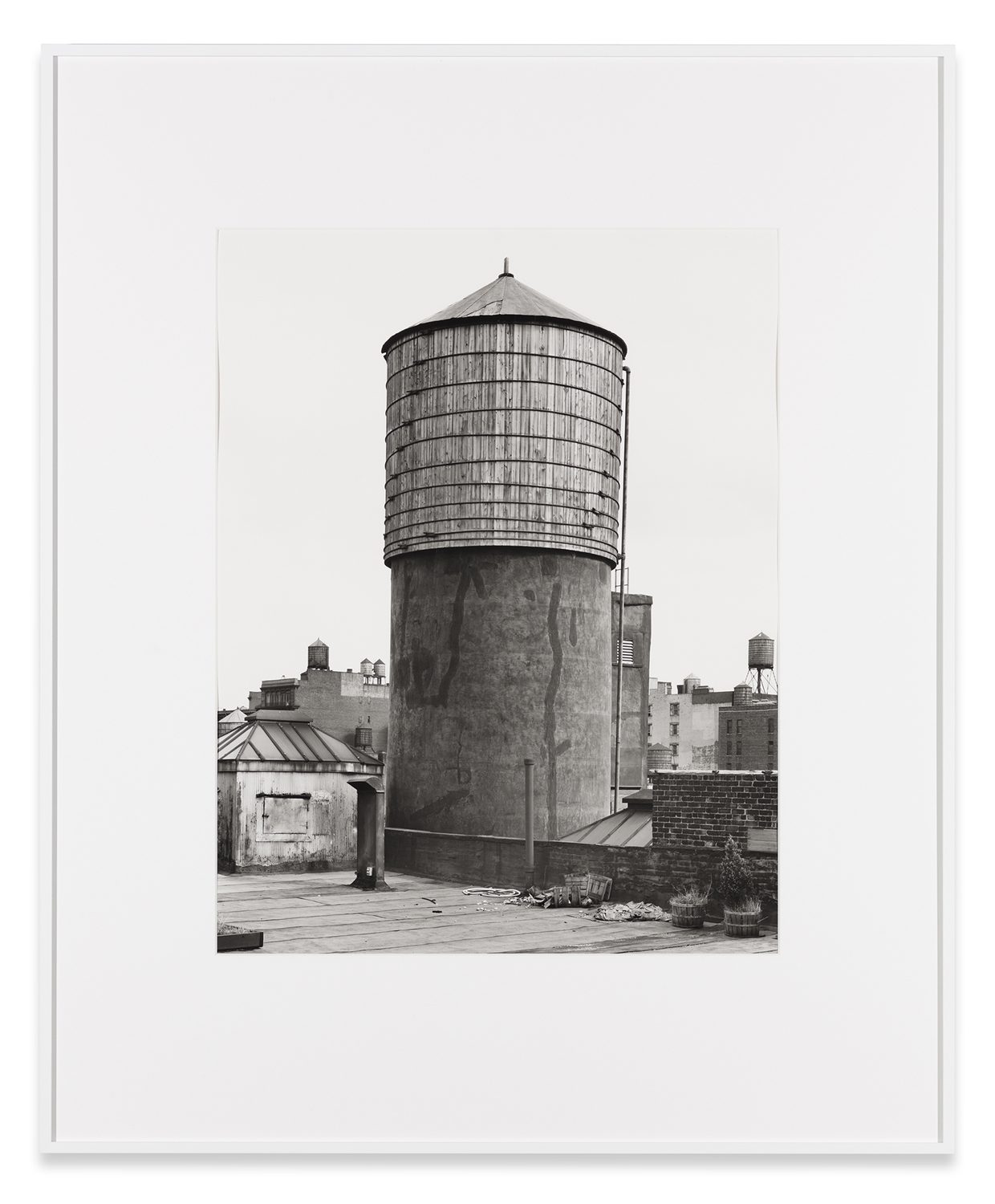
Water towers are among the Bechers’ best-known subjects, and among the most varied. They range from steel tanks on lattice legs to brick towers and concrete funnels. In 1978 and 1979 the couple also photographed the wooden water tanks on the roofs of Manhattan, a distinct group with its own character.
Blast furnaces
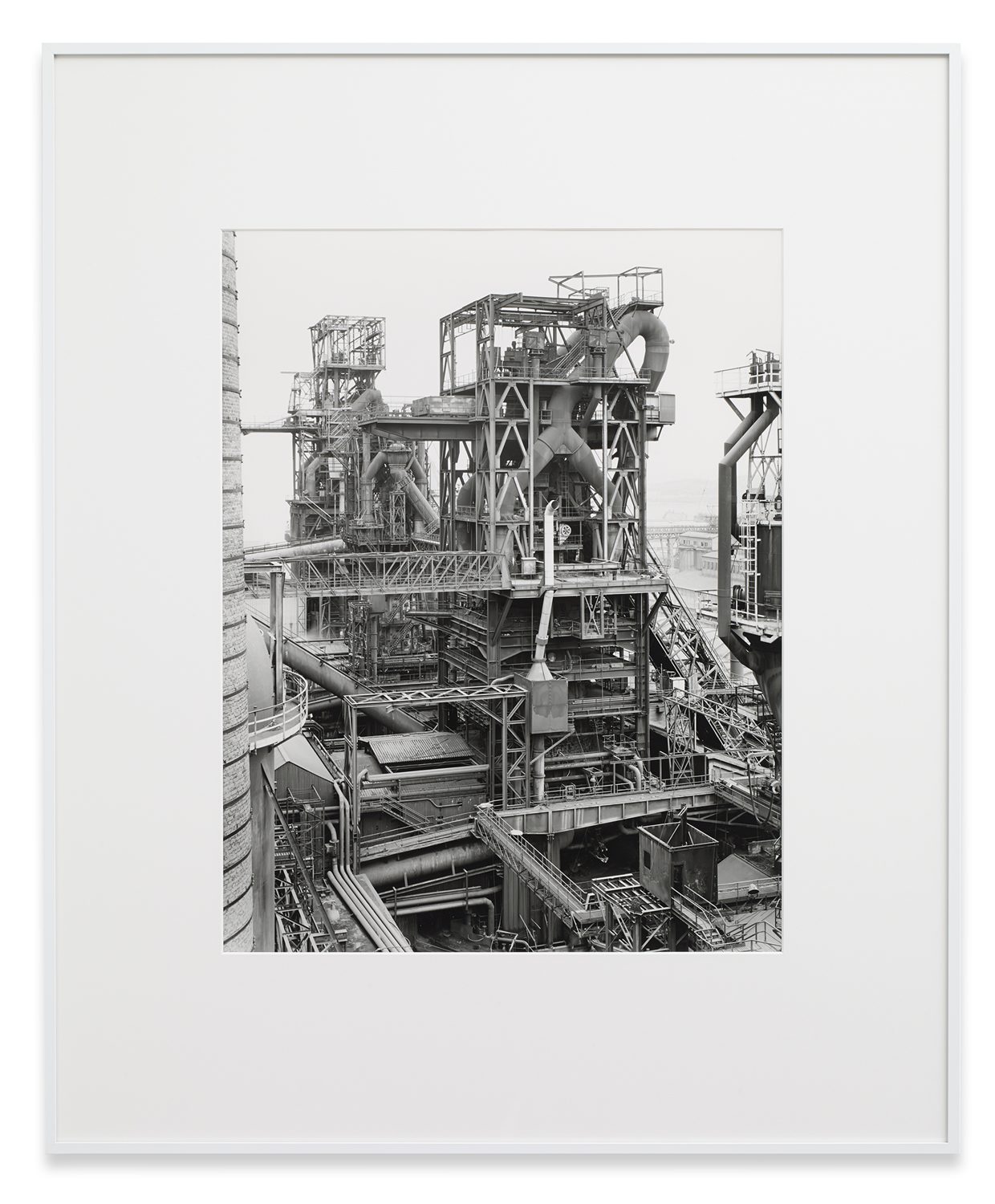
Blast furnaces, where iron ore is smelted, are the most complex structures in the Bechers’ work. They are tangles of pipes, ducts and gantries that seem to change shape from every angle. The couple photographed them in Germany and France, as well as in Belgium and the United States. They often hung them in large grids that emphasise their almost organic variety.
Winding towers
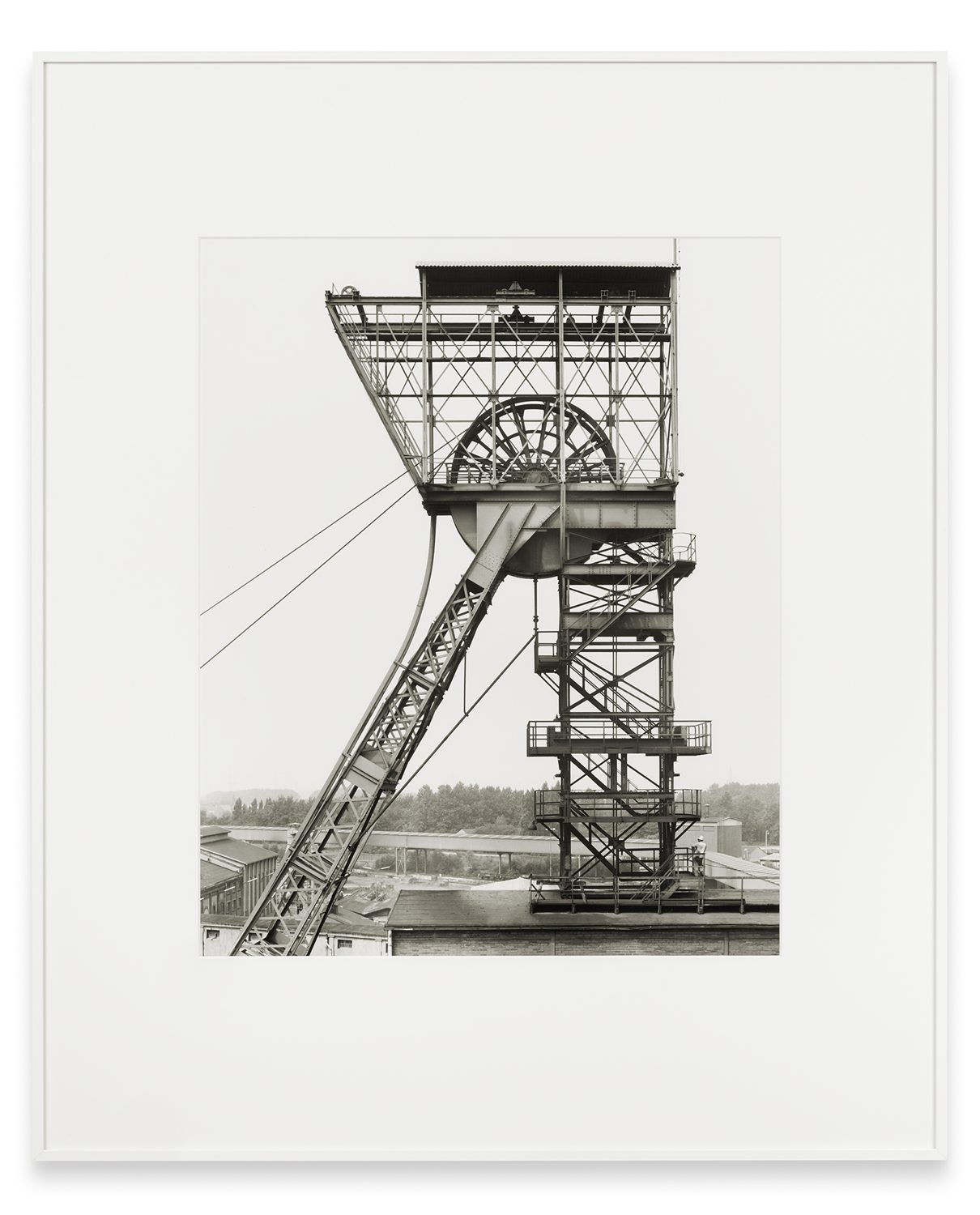
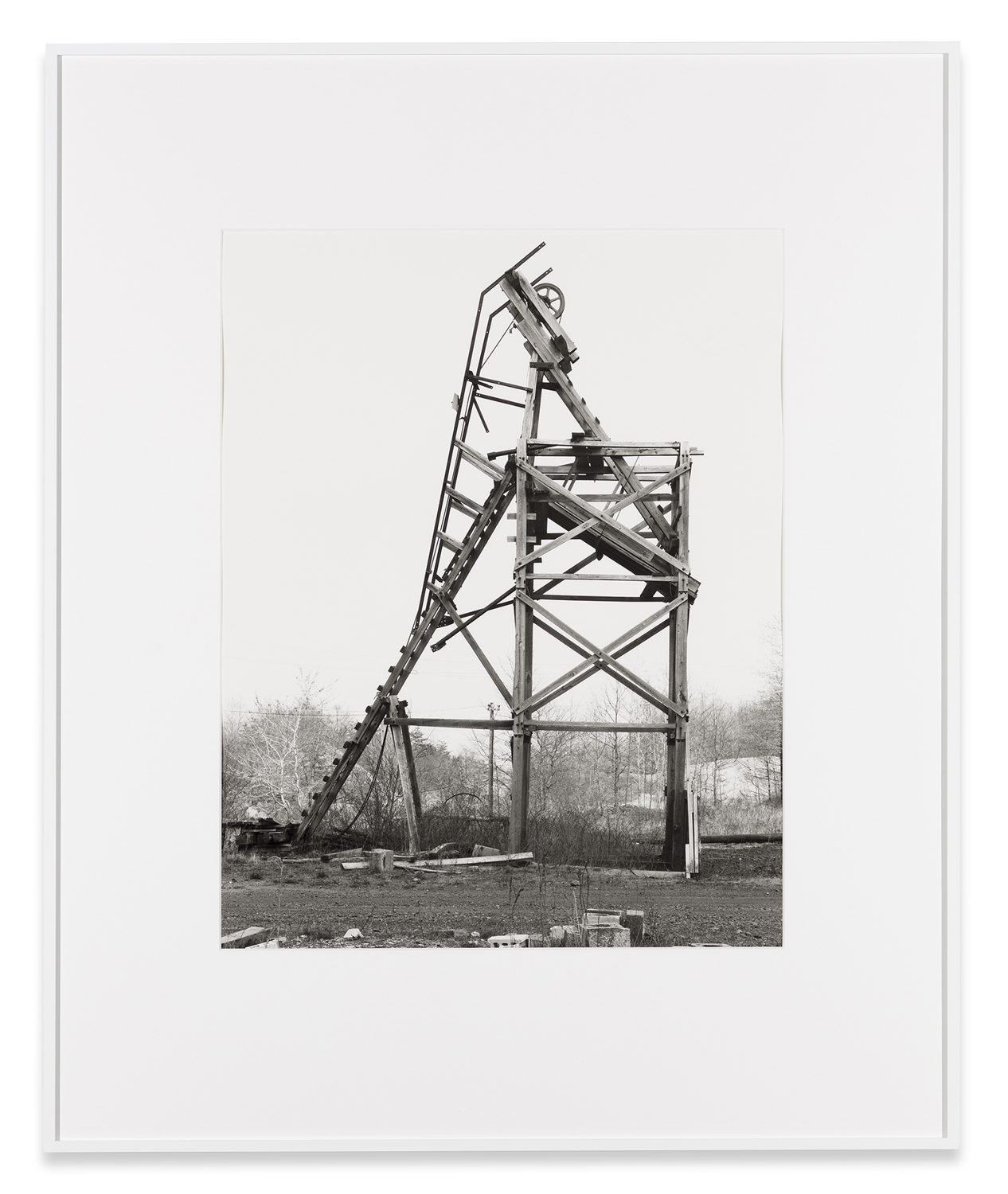
Winding towers, or headframes, stand above mine shafts and carry the wheels that lower and raise the cages. The Bechers photographed them not only in the Ruhr but also in Belgium, France, Britain and North America. Their Winding Towers typology, dated 1966–97, brings together pictures taken more than thirty years apart. It is a measure of the couple’s patience.
Cooling towers
Cooling towers release waste heat from water used in power stations and industrial plants. The Bechers recorded both early wooden towers and later concrete ones. Their cooling-tower grids show more clearly than most how a single function produces a family of shapes.
Gas holders
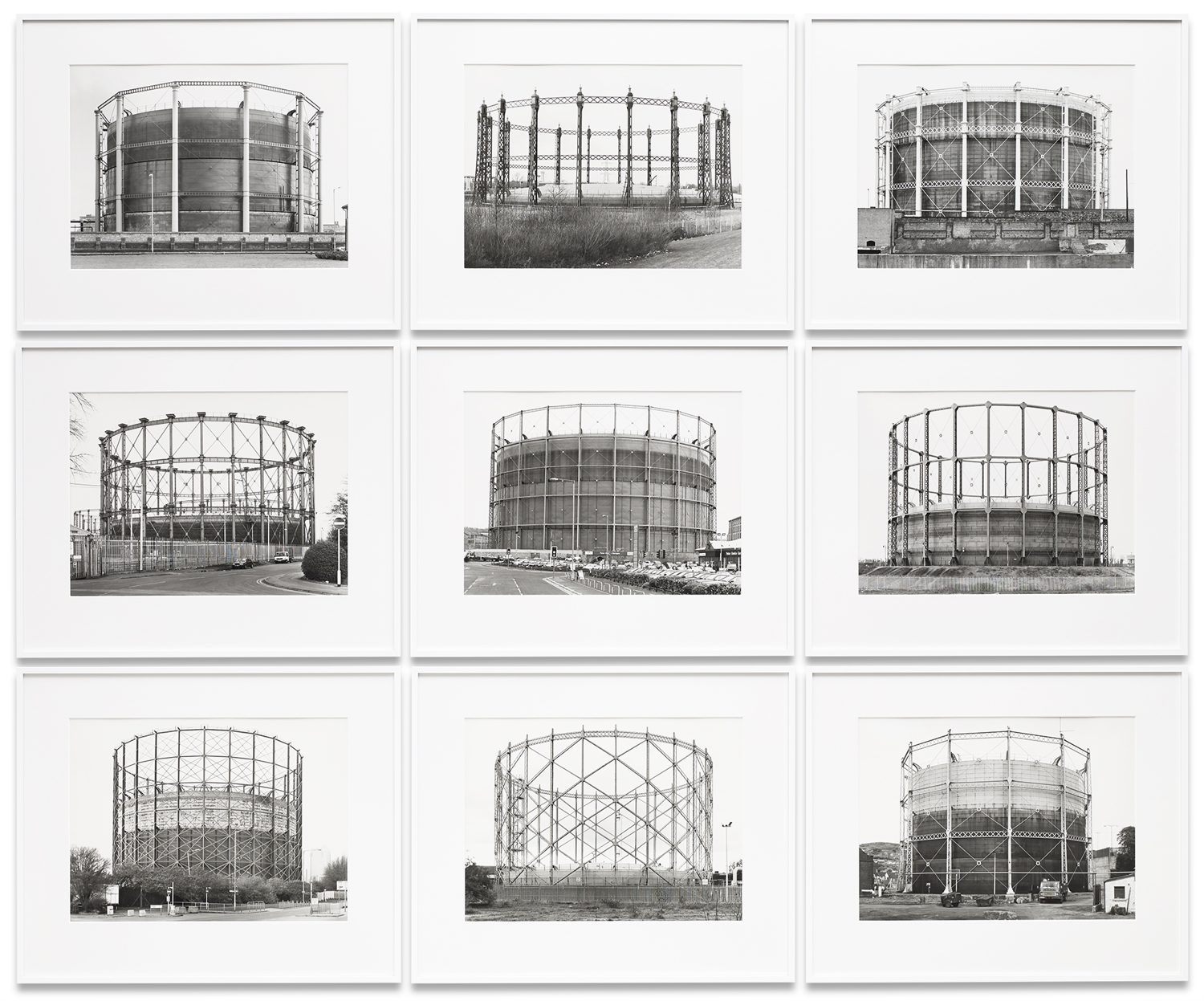
The Bechers photographed several kinds of gas holder. Some are telescoping cylinders that rise and fall inside a steel frame; others are large spherical tanks.
Framework houses
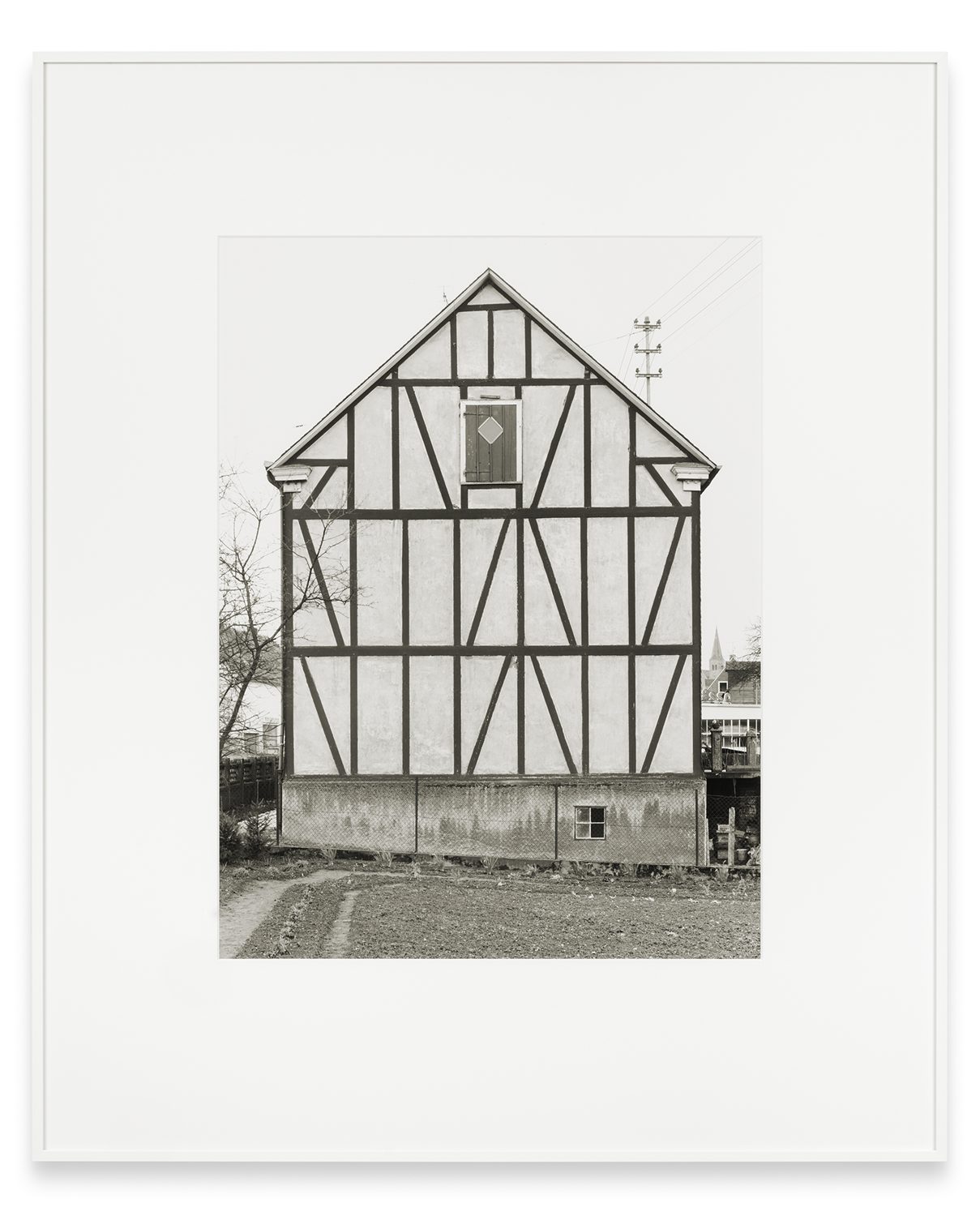
However, not every subject was industrial in the strict sense. From 1959 the Bechers photographed the half-timbered houses of the Siegen region. Many of these houses belonged to workers in the local mines and ironworks. The couple photographed them face-on, like the industrial structures. In 1977 the series appeared as a book, Fachwerkhäuser des Siegener Industriegebietes (Framework Houses of the Siegen Industrial Region).
Grain elevators, lime kilns, coal bunkers and industrial facades
Similarly, other series follow the same logic. The grain elevators, photographed in France and across the American Midwest, show how storage silos vary from region to region. Lime kilns and coal bunkers, meanwhile, belong to the world of mining and quarrying. Industrial facades, the front walls of factory halls, are more architectural than sculptural. Unlike a furnace, they hide their function rather than display it.
Pennsylvania coal tipples and site views
In the 1970s the Bechers photographed the small coal tipples of Pennsylvania’s Schuylkill County. Independent miners, who often built them by hand, used them to load coal. Alongside the isolated structures, the couple also made wider views of whole plants and their surroundings. These site views are less famous than the typologies. Still, they show how the structures related to one another and to the landscape. Later publications, such as Coal Mines and Steel Mills (2010), gave them more attention.
Before Bernd and Hilla Becher: Sander, Blossfeldt and New Objectivity
The Bechers’ sharp, factual style has roots in the New Objectivity (Neue Sachlichkeit) photography of Weimar Germany in the 1920s. Photographers such as August Sander, Karl Blossfeldt and Albert Renger-Patzsch rejected the soft, painterly look of Pictorialism. Instead, they made clear, detailed images of things as they are.
August Sander matters most. His vast project People of the Twentieth Century sorted portraits of Germans into social and professional types. Bernd Becher admired it, and the Bechers applied a similar logic of types to buildings. Likewise, Blossfeldt’s close-up studies of plant forms offered a model of disciplined, comparative looking. Wiley also links Hilla’s taxonomic eye to her love of natural science and of the drawings of the German biologist Ernst Haeckel. This link is best understood as an affinity rather than a documented source.
The Bechers’ return to “straight” photography was also a reaction to their own time. The art historian Blake Stimson contrasts it with the subjective, expressive photography that Otto Steinert promoted in postwar Germany. He also sets it against the humanism of the 1955 exhibition The Family of Man.
Between documentary and Conceptual art
The Bechers always described themselves as documentary photographers. Yet from the late 1960s, curators and critics placed their work alongside Minimal and Conceptual art. The two seemed to share serial structures, systems and an impersonal look. Minimalist artists such as Carl Andre and Sol LeWitt championed the couple. Andre also wrote one of the first important texts on them, “A Note on Bernhard and Hilla Becher”, which Artforum published in December 1972.
Their work has a double nature. Their seemingly objective style recalled nineteenth- and early twentieth-century precedents, “but also resonated with the serial approach of contemporary Minimalism and Conceptual art”. Moreover, it “challenged the perceived gap between documentary and fine-art photography”. Their gallery goes further: their typological approach, it says, “gave rise to the idea of photography as conceptual art”. Critics also often compare their grids with Ed Ruscha’s photobooks of gas stations and parking lots, which treat everyday structures in a similarly deadpan way.
The Bechers themselves were wary of labels. Bernd once said their pictures “just happened to fall into this context—for better or worse”. When someone asked whether their photographs were art, Hilla reportedly replied that the question was “not very interesting” for them.
New Topographics (1975)
In 1975 the Bechers took part in New Topographics: Photographs of a Man-Altered Landscape. William Jenkins organised the show at the George Eastman House in Rochester, New York. It brought together photographers who recorded the built environment in a cool, impersonal way. The exhibitors were Robert Adams, Lewis Baltz, Joe Deal, Frank Gohlke, Nicholas Nixon, John Schott, Stephen Shore, Henry Wessel and the Bechers, the only Europeans. Today, historians see it as a turning point for landscape photography, away from the romantic tradition of Ansel Adams. Our article on the New Topographics exhibition tells the full story.
Bernd and Hilla Becher and the Düsseldorf School
In 1976 Bernd Becher became the first professor of photography at the Kunstakademie Düsseldorf. He held the post until 1996. Hilla had no formal appointment, but she worked alongside him. Students also met at the couple’s home.
Their students included Andreas Gursky, Thomas Struth, Thomas Ruff, Candida Höfer and Axel Hütte. Each developed a distinct style, often in colour and on a monumental scale. However, they shared the Bechers’ seriousness, their interest in series and their distance from the subject. Critics grouped them as the “Becher School” or the Düsseldorf School of Photography. The label is a critical convenience rather than a formal movement. Even so, it reflects how much photography in Germany owed to the class.
Eventually, the Düsseldorf photographers became some of the most successful artists of the 1990s and 2000s. Their large prints then entered museums and auction rooms. Charlotte Cotton’s survey of art photography traces the “deadpan” aesthetic that runs from the Bechers to their students. Our article on The Photograph as Contemporary Art discusses her book.
How critics have read Bernd and Hilla Becher
“Real-estate photographs”
Not everyone liked the work. According to Chris Wiley, the critic Hilton Kramer wrote in The New York Times in 1977 that the Bechers’ photographs “look like the sort of pictures one sees in a real estate office”. Hilla reportedly answered, “That’s O.K. We like real-estate photographs”. In short, the exchange sums up a recurring charge: that the pictures are dull, repetitive and closer to an archive than to art.
Andre and Masheck
Carl Andre’s 1972 note read the Bechers through the lens of Minimal art. A few months later, in March 1973, the critic Joseph Masheck answered in the same magazine. His essay, “Unconscious Formalism: A Response to Andre’s Note on the Bechers”, argued among other things that their method resembled the work of an architectural historian more than an artist’s. Clearly, critics disagreed from the start about what kind of work this was.
How objective is “objective”?
Later scholars have questioned the idea that the photographs are neutral records. Blake Stimson, for instance, describes a “photographic comportment”: a way of holding oneself towards the world, rather than a simple absence of style. He develops the idea in a book that sets the Bechers beside The Family of Man and Robert Frank’s The Americans. Similarly, the art historian Sarah E. James draws on Theodor Adorno’s idea of mimesis to read the Bechers’ rejection of subjectivity. She links it to the anti-ideological climate of 1950s West Germany. Others, such as Lucy Soutter, instead read the neutrality as a deliberate rhetoric that gives the work its seriousness. Michael Fried, finally, gives the Bechers a chapter in a much-cited study of recent art photography, where he pairs them with James Welling and Jeff Wall under the heading of “good” versus “bad” objecthood.
History, memory and politics
A more political debate concerns what the photographs leave out. Their captions give only place and date, and their images remove people, work and history from view. Some critics see this as an aestheticised, ahistorical vision of industry. Thomas Heise, writing in 2025, argues instead that the photographs resist capitalism’s stories of progress, because they hold on to forms that were meant to disappear. In a German context, the question is sharper still, since some of the industries they photographed had served the war economy. On the other hand, defenders reply that the work’s refusal of comment is itself a response to that history.
There is also the question of nostalgia. While the structures still stood, the photographs looked cool and analytical. Now that most of them have gone, the pictures can feel melancholy. The Bechers insisted, however, that the sense of loss comes from the world, not from the pictures.
Hilla Becher’s recognition
Finally, recent exhibitions and scholarship have corrected an old imbalance. For years, writers often presented Bernd as the thinker and Hilla as the technician. Today, scholars recognise her training, her darkroom work and her role in teaching as central. They now understand the work as the product of a genuine partnership.
Key exhibitions and awards
| Year | Exhibition or award | Why it matters |
|---|---|---|
| 1963 | First gallery exhibition, Galerie Ruth Nohl, Siegen | Bernd’s home town, where the project began |
| 1969 | Anonyme Skulpturen, Städtische Kunsthalle Düsseldorf | The first major exhibition under the “anonymous sculptures” idea |
| 1970 | Anonyme Skulpturen (book), Düsseldorf and New York | Makes the typologies known internationally |
| 1972 | Documenta 5, Kassel | Places the Bechers in the international contemporary art world |
| 1975 | New Topographics, George Eastman House, Rochester | The only Europeans in a landmark landscape exhibition |
| 1990 | Golden Lion for sculpture, 44th Venice Biennale | Their photographs honoured as sculpture |
| 2002 | Erasmus Prize | Recognises their work and their role as teachers |
| 2004 | Hasselblad Award | One of photography’s most prestigious prizes |
| 2008 | Landscape/Typology, Museum of Modern Art, New York | Typologies shown alongside wide views of whole sites (curator: Peter Galassi) |
| 2022 | Bernd & Hilla Becher, The Metropolitan Museum of Art, then SFMOMA | The first retrospective with full access to their archive |
| 2025–26 | Bernd & Hilla Becher – History of a Method, Die Photographische Sammlung/SK Stiftung Kultur, Cologne | Drawn from the Bernd and Hilla Becher Archive in Cologne |
The legacy of Bernd and Hilla Becher
The Bechers’ legacy runs in several directions. In photography, they made the series, the grid and the neutral frontal view central tools of the medium. Their students then carried that approach into colour and onto museum walls. In contemporary art, they showed that a photograph could stand as a work of art in its own right, not only as a document or a reproduction.
Their work also mattered beyond art. Above all, their documentation drew attention to the cultural value of industrial architecture. For example, they were among the small group of campaigners who saved the Zollern II/IV colliery in Dortmund-Bövinghausen, which the state moved to protect at the end of 1969. Their pictures have also become a reference for industrial heritage and architectural history. Today, since many of the structures they photographed have gone, the typologies serve as both art and archive.
Where to see Bernd and Hilla Becher and what to read
Many major museums hold the Bechers’ photographs. They include the Museum of Modern Art and the Metropolitan Museum of Art in New York, Tate in London and the Guggenheim. The San Francisco Museum of Modern Art and the J. Paul Getty Museum in Los Angeles also hold their work. In Cologne, Die Photographische Sammlung/SK Stiftung Kultur, a partner of the Met retrospective, holds the Bernd and Hilla Becher Archive. Sprüth Magers represents their estate.
Useful books for a first approach:
- Bernd and Hilla Becher, Anonyme Skulpturen: Eine Typologie technischer Bauten (Düsseldorf: Art-Press, 1970), the first book.
- Bernd and Hilla Becher, Typologien industrieller Bauten (Typologies of Industrial Buildings, Munich: Schirmer/Mosel, 2003), a large overview.
- Susanne Lange, Bernd and Hilla Becher: Life and Work, translated by Jeremy Gaines (Cambridge, MA: MIT Press, 2007). It is the standard monograph in English; Lange directs Die Photographische Sammlung/SK Stiftung Kultur in Cologne.
- Jeff L. Rosenheim and others, Bernd & Hilla Becher (New York: The Metropolitan Museum of Art, 2022), the catalogue of the retrospective.
FAQ: Bernd and Hilla Becher
Who were Bernd and Hilla Becher?
Bernd Becher (1931–2007) and Hilla Becher (1934–2015) were German photographers who worked as a couple from 1959. They are best known for black-and-white photographs of industrial structures, arranged in grids called typologies. They also taught the Düsseldorf School of Photography.
What is a typology in photography?
In the Bechers’ work, a typology is a group of photographs of structures with the same function, such as water towers or blast furnaces. Each picture also follows the same rules. The prints then hang side by side, so that the viewer can compare their forms.
How did the Bechers explain the concept of typology?
They presented their typologies as a way of comparing “families of objects”. When similar structures sit together, the small differences between them become visible. Hilla Becher compared the effect to tonal music.
What camera did Bernd and Hilla Becher use?
They worked with a large-format view camera on a tripod, often raised on stepladders. This let them control perspective and record fine detail in black and white.
Why are their photographs called “anonymous sculptures”?
The Bechers used the phrase for the industrial buildings they photographed. Unknown engineers designed these structures, yet they have strong sculptural forms. It was also the title of their first book, published in 1970.
Which famous photographers studied with the Bechers?
Bernd Becher’s students at the Kunstakademie Düsseldorf included Andreas Gursky, Thomas Struth, Thomas Ruff, Candida Höfer and Axel Hütte.
Sources
Museums, institutions and press
- The Metropolitan Museum of Art, Bernd & Hilla Becher, exhibition, 15 July – 6 November 2022
- Naomi Blumberg, “Bernd Becher and Hilla Becher”, Encyclopaedia Britannica
- Tate, “Who are Hilla and Bernd Becher?”
- Chris Wiley, “What Bernd and Hilla Becher Saw in the Remnants of Industry”, The New Yorker, 8 November 2022
- Sprüth Magers, Estate Bernd & Hilla Becher
- Museum of Modern Art, Bernd and Hilla Becher: Landscape/Typology, 21 May – 25 August 2008
- San Francisco Museum of Modern Art, Bernd & Hilla Becher, 17 December 2022 – 2 April 2023
- Solomon R. Guggenheim Museum, Bernd and Hilla Becher, Water Towers, collection entry
- Praemium Erasmianum Foundation, Erasmus Prize 2002: Bernd and Hilla Becher
- Hasselblad Foundation, Bernd and Hilla Becher, Hasselblad Award 2004
- LWL-Museum Zeche Zollern, “History”
- Die Photographische Sammlung/SK Stiftung Kultur, Bernd & Hilla Becher – History of a Method, 5 September 2025 – 1 February 2026
Books and scholarship
- Blake Stimson, “The Photographic Comportment of Bernd and Hilla Becher”, Tate Papers, no. 1, 2004
- Carl Andre, “A Note on Bernhard and Hilla Becher”, Artforum, vol. 11, no. 4, December 1972
- Joseph Masheck, “Unconscious Formalism: A Response to Andre’s Note on the Bechers”, Artforum, vol. 11, no. 7, March 1973
- Sarah E. James, “Subject, Object, Mimesis: The Aesthetic World of the Bechers’ Photography”, Art History (Oxford University Press)
- Thomas Heise, “The Infrastructure of Memory: Bernd and Hilla Becher’s Historical Forms”, ASAP/Journal, 2025
- Lucy Soutter, Why Art Photography?, 2nd edition (Routledge, 2018)
- Blake Stimson, The Pivot of the World: Photography and Its Nation (Cambridge, MA: MIT Press, 2006)
- Michael Fried, Why Photography Matters as Art as Never Before (New Haven: Yale University Press, 2008)
- Susanne Lange, Bernd and Hilla Becher: Life and Work (MIT Press, 2007)