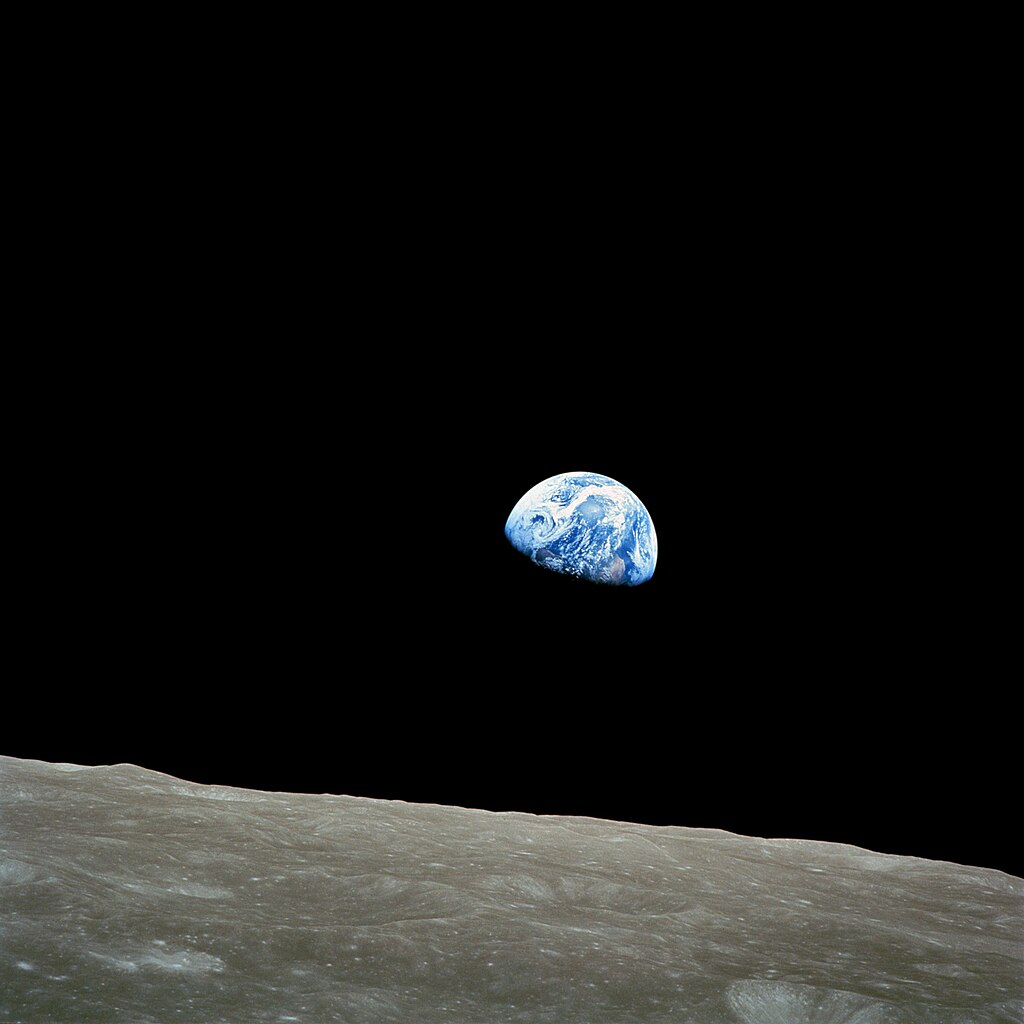
On Christmas Eve 1968, three men orbited the Moon—and one of them captured an image that would fundamentally alter humanity's relationship with its home planet. The earthrise photo Apollo 8 astronaut William Anders took that day wasn't part of the mission plan. It was an accident, a spontaneous reaction to an unexpected sight. Yet this single frame of 70mm film became what photographer Galen Rowell would later call "the most influential environmental photograph ever taken."1
What makes a photograph change the world? It's not just technical excellence or aesthetic beauty—though Anders' image possesses both. It's timing, context, and the collision of visual power with cultural readiness. The earthrise photo arrived at a moment when Americans desperately needed to see something hopeful, something that transcended the violence and division of 1968.2 What they got instead was a vision of Earth as a fragile, solitary marble floating in an infinite void.
The Accidental Masterpiece: How an Unplanned Photo Became History
Apollo 8 wasn't supposed to photograph Earth rising over the Moon. The mission's primary objectives were technical: test the Saturn V rocket, practice lunar orbital insertion, scout landing sites for future missions. Photography was secondary, almost an afterthought. Yet at 16:40 UTC on December 24, 1968, during the spacecraft's fourth orbit, something unexpected happened.3
The crew—Commander Frank Borman, Command Module Pilot Jim Lovell, and Lunar Module Pilot William Anders—had been focused on photographing potential landing sites on the lunar surface. Their spacecraft was oriented with its windows facing down toward the Moon's gray, cratered terrain. Then Borman executed a roll maneuver, and suddenly Earth appeared above the lunar horizon.4
"Oh my God! Look at that picture over there!" Anders exclaimed. "Here's the Earth coming up. Wow, is that pretty!"
What followed was a frantic scramble. Anders grabbed a modified Hasselblad 500 EL camera loaded with 70mm Ektachrome color film. He quickly switched from the 80mm lens to a 250mm Sonnar telephoto—the only lens long enough to capture Earth with sufficient detail from 240,000 miles away.5 The camera settings? Best estimates suggest 1/250th second at f/11, though NASA's records don't definitively confirm the exposure data.6
Anders shot rapidly, bracketing exposures as Earth continued rising. He captured multiple frames, but one—catalogued as AS8-14-2383—would become the definitive version. The composition was nearly perfect: Earth positioned in the upper third of the frame, partially illuminated against the black void of space, with the Moon's barren surface anchoring the bottom. The contrast couldn't be starker—life versus desolation, color versus monochrome, home versus alien landscape.
The Photographer's Controversy: Who Actually Took the Photo?
Here's where things get complicated. For years, there was genuine debate about whether Anders or Borman actually captured the famous image. Mission transcripts reveal both astronauts were shooting during those crucial moments.7
"Give me a color, quick, would you?" Anders said.
"Just grab me a color. A color exterior," Lovell responded, trying to help locate the right film magazine.
Borman, meanwhile, was also photographing Earth's appearance. The sequence of frames shows both astronauts capturing the moment from slightly different angles. But in 2015, NASA's Lunar Reconnaissance Orbiter team used modern orbital mechanics to reconstruct the exact spacecraft position and timing. Their detailed analysis confirmed that Anders took the iconic color image, while Borman captured earlier black-and-white frames.8
Anders himself later reflected on the confusion with characteristic humility: "I'm not sure I want to be known for taking a picture, but it's better than being known for not taking one."9
The Technical Detective Story
The reconstruction revealed something fascinating about why this particular frame worked so perfectly. Earth's position relative to the lunar horizon, the spacecraft's orientation, the angle of sunlight illuminating Earth's surface—all these elements aligned for perhaps thirty seconds. Miss that window, and the composition falls apart. Anders didn't have time to think about rule of thirds or leading lines. He was shooting on instinct, relying on the visual training NASA had provided but also on something deeper: an innate sense of what mattered.10
The Hasselblad's technical specifications mattered enormously. The 250mm lens compressed the scene, making Earth appear larger relative to the lunar horizon than it would have with a standard lens. The Ektachrome film, despite its limitations in the extreme contrast of space, captured Earth's blues and whites with surprising fidelity. And the camera's motorized advance allowed Anders to shoot multiple frames quickly, increasing his odds of capturing the perfect moment.
Why 'Earthrise' Is Actually a Misnomer
Here's an irony: Earth doesn't actually "rise" from most locations on the Moon. The Moon is tidally locked to Earth, meaning the same side always faces our planet. If you're standing on the Moon's near side, Earth hangs perpetually in roughly the same position in the sky. It doesn't rise or set—it just sits there, rotating slowly as days pass.11
The Apollo 8 crew saw Earth "rise" only because they were orbiting the Moon. As their spacecraft moved across the lunar surface at about 3,600 miles per hour, different lunar landscapes passed below them. From their perspective, Earth appeared to rise above the horizon—but this was an artifact of their motion, not any actual rising of Earth itself.12
This orbital mechanic created something rare: a perspective no human had ever witnessed before. Earlier unmanned missions—Luna 3 in 1959, Lunar Orbiter 1 in 1966—had captured images of Earth from lunar orbit, but those robotic photographs lacked the immediacy and aesthetic power of Anders' image.13 The difference between a programmed camera and a human photographer making split-second decisions about composition and timing proved decisive.
The Original Orientation and Publication Choices
Look at the original, unrotated version of the earthrise photo Apollo 8 captured, and you'll notice something disorienting: Earth appears to the side, not above the lunar horizon. This is how Anders actually saw it through the spacecraft window—with the Moon's surface running vertically along one edge of the frame and Earth positioned to the right.14
Why the confusion? In space, there's no "up" or "down." The spacecraft's orientation was dictated by mission requirements, not by aesthetic considerations. When NASA and media outlets published the image, they rotated it 90 degrees to create a more intuitive composition—one that matched our terrestrial understanding of horizons and rising objects.15
This rotation transformed the image's psychological impact. With Earth "above" the lunar surface, the photo evokes sunrise, hope, emergence. The original sideways orientation, while technically accurate, lacks that uplifting quality. It's a reminder that even documentary photography involves editorial choices that shape meaning. The facts remain the same—Earth, Moon, space—but the emotional resonance shifts dramatically based on how we frame those facts.
Different versions of the photo circulated over the years, with varying color corrections and crops. The film itself required careful processing; Ektachrome in 1968 had limited dynamic range compared to modern digital sensors. The extreme contrast between the sunlit Earth and the black void of space pushed the film to its limits. Some published versions show Earth slightly overexposed to reveal surface detail; others preserve the contrast but lose some atmospheric subtlety.16
Christmas Eve 1968: Context and Cultural Timing
You can't understand the earthrise photo's impact without grasping what 1968 meant to Americans. It was arguably the most turbulent year in modern U.S. history. The Tet Offensive shattered illusions about Vietnam. Martin Luther King Jr. was assassinated in April, Robert Kennedy in June. Cities burned. Students protested. The Democratic National Convention in Chicago descended into violence. The Soviet Union crushed Czechoslovakia's brief flowering of freedom.17
Then, on Christmas Eve, three men read from the Book of Genesis while orbiting the Moon. "In the beginning, God created the heaven and the earth," Borman began, his voice crackling across 240,000 miles of void. An estimated one billion people—one quarter of Earth's population—watched or listened.18
The timing was exquisite. Americans needed hope, unity, something to believe in. The space program provided it. And when Anders' photo appeared in newspapers and magazines in the following days and weeks, it offered a visual counterpoint to the year's chaos. Earth wasn't divided into nations or ideologies in that image. It was simply home—beautiful, fragile, alone.
Anders himself later reflected: "We came all this way to explore the Moon, and the most important thing is that we discovered the Earth."19 The irony wasn't lost on anyone. NASA had spent billions of dollars to reach another world, only to give humanity a new way of seeing its own.
The Military Pilot's Perspective
William Anders came to NASA as an Air Force pilot. His background was in nuclear engineering and fighter jets, not environmental philosophy. Yet his photograph became an icon of the environmental movement. How does a military man capture an image that challenges nationalist boundaries and promotes planetary thinking?
Perhaps it's precisely because Anders wasn't trying to make a political statement that the photo works so powerfully. He was simply documenting what he saw, responding to an unexpected moment of beauty. The image's meaning emerged later, shaped by how audiences interpreted it. This is documentary photography at its finest—objective observation that nonetheless carries profound implications.20
From Film Magazine to Global Icon: The Distribution Story
How did a frame of film shot in lunar orbit reach millions of people in 1968? The technical challenges were substantial. The Apollo 8 crew couldn't simply upload images to the cloud or email them to Houston. The film remained in the camera, unexposed to light, until the spacecraft splashed down in the Pacific Ocean on December 27, 1968.21
Only then could the film magazines be retrieved, shipped to NASA's photo lab, and processed. The Ektachrome film required careful handling; any contamination or processing error could destroy irreplaceable images. Technicians worked methodically through the magazines, developing the film and creating contact sheets. When they reached magazine 38, frame 2383 stood out immediately.22
NASA released the image to the press shortly after processing. It appeared in newspapers worldwide, but its true cultural penetration took months. Life magazine featured it prominently. The U.S. Postal Service issued a 6-cent airmail stamp in 1969 featuring the image, bringing it into millions of homes.23 Environmental organizations adopted it as a symbol. The first Earth Day, held on April 22, 1970, featured the earthrise photo extensively in promotional materials.
The image's public domain status—as a work of the U.S. federal government, it's not copyrighted—accelerated its spread. Anyone could reproduce it without permission or payment. This legal accessibility transformed the photo into a truly public image, belonging to everyone and no one.24
Commercial and Cultural Reproductions
The earthrise photo appeared everywhere: posters, album covers, textbooks, advertisements. It illustrated countless articles about environmentalism, space exploration, and planetary consciousness. Countries around the world issued stamps featuring the image. It became visual shorthand for Earth's fragility and humanity's shared home.25
Some reproductions were faithful to the original; others took liberties with cropping, color correction, or even adding elements. The image's iconic status made it a template for parody and homage. Artists referenced it, filmmakers quoted it, designers borrowed its composition. Like other truly iconic photographs—visual markers of cultural memory—it transcended its original context to become a universal symbol.26
The Environmental Movement's Visual Manifesto
Galen Rowell wasn't exaggerating when he called this "the most influential environmental photograph ever taken." The earthrise photo Apollo 8 captured arrived at precisely the moment the modern environmental movement was coalescing. Rachel Carson's Silent Spring had appeared in 1962, awakening public consciousness about ecological threats. The Santa Barbara oil spill occurred in January 1969, just weeks after Apollo 8's return. The Cuyahoga River caught fire in June 1969.27
Anders' photograph gave the nascent movement something it desperately needed: a visual argument. You can debate environmental policy, argue about pollution standards, dispute scientific findings. But you can't argue with that image. Earth looks vulnerable in that photo—a small, finite sphere surrounded by infinite darkness. There are no backup planets visible in the frame. We're alone out here.
The photo's influence on specific environmental legislation is harder to quantify but undeniably present. The Environmental Protection Agency was created in 1970. The Clean Air Act was strengthened that same year. Earth Day became an annual event. While many factors contributed to these developments, the visual consciousness shift that Earthrise enabled played a role. It's easier to care about protecting something when you've seen it from the outside, when you understand its isolation and fragility.28
Stewart Brand, founder of the Whole Earth Catalog, had campaigned for NASA to release photos of Earth from space even before Apollo 8. He understood the potential consciousness-shifting power of such images. When Earthrise appeared, it exceeded even his expectations. As he later noted, the photo helped people understand Earth as a system, a whole, rather than a collection of separate nations and territories.29
Aesthetic Analysis: Why This Composition Works
Strip away the historical significance and environmental implications for a moment. Why does this photograph work aesthetically? What makes it visually compelling independent of its cultural meaning?
First, the color palette. Earth's blues and whites contrast dramatically with the Moon's grays and browns and the absolute black of space. The color is concentrated in roughly one-sixth of the frame—Earth itself—making it a powerful focal point. Your eye goes there immediately and stays there. The surrounding darkness and lunar surface serve as negative space, emphasizing Earth's isolation and significance.30
Second, the composition follows classical principles despite being captured spontaneously. Earth sits in the upper third of the frame, roughly following the rule of thirds. The lunar horizon creates a strong diagonal line that leads the eye toward Earth. The partially illuminated Earth—showing both day and night sides—adds visual interest and depth. If Earth were fully illuminated, the image would lose some of its three-dimensionality.31
Third, the scale relationships. Earth appears small but not insignificant. It's large enough to see continents and cloud patterns, small enough to grasp as a finite object. The Moon's surface provides scale reference—we know the Moon is huge, so Earth must be even larger. Yet both appear dwarfed by the infinite blackness surrounding them. This nested scale—Earth within the Moon's context, both within space's vastness—creates layers of meaning and visual interest.
Photography experts have noted the image's almost painterly quality. The stark contrasts and limited color palette give it a graphic simplicity that's unusual in documentary photography. It could almost be an abstract composition—circles and curves against darkness—except that we know exactly what we're looking at. That tension between abstraction and documentation adds to its power. As aesthetic theory suggests, the most compelling images often operate on multiple levels simultaneously.32
Light and Shadow
The lighting in the earthrise photo is pure, unfiltered sunlight—no atmosphere to diffuse it, no clouds to soften it. This creates the harsh contrasts visible in the image: the brilliantly lit portions of Earth and Moon versus the absolute black of shadowed areas and space. There are no gradual transitions, no subtle gradations. Everything is either illuminated or dark.
This lighting quality gives the image its documentary authority. We're seeing Earth exactly as it appears from space, without atmospheric filtering or artistic manipulation. The harshness reinforces the reality of the scene—this isn't a romantic vision or idealized landscape. It's what's actually there, revealed by uncompromising light.
The Overview Effect and Consciousness Transformation
Astronauts who've seen Earth from space often report a profound psychological shift. Author Frank White coined the term "Overview Effect" to describe this phenomenon: the cognitive shift that occurs when viewing Earth from orbit or beyond. Borders disappear. Political divisions seem arbitrary. The planet appears as a unified system, beautiful and fragile.33
Anders experienced this directly. So did Borman and Lovell. But through Anders' photograph, millions of people who would never leave Earth's surface experienced a version of the Overview Effect. The image served as a proxy for the actual experience, transmitting some portion of that consciousness shift to viewers on the ground.
This is photography's unique power: the ability to transport perspective, to let us see through another's eyes. When you look at the earthrise photo, you're not just seeing a picture of Earth. You're occupying, for a moment, Anders' viewpoint—240,000 miles from home, seeing your planet as a small, precious object in a vast darkness. That shift in perspective, multiplied across millions of viewers, creates cultural change.34
Modern Recreations and Continuing Legacy
The earthrise photo's influence extends into the 21st century. In 2008, Japan's Kaguya mission captured high-definition video of Earth rising above the lunar horizon—the first moving images of the phenomenon. The footage is stunning, showing Earth slowly emerging in real-time, but it lacks the iconic power of Anders' still image.35
NASA's Lunar Reconnaissance Orbiter, launched in 2009, has captured numerous images of Earth from lunar orbit. In 2015, LRO photographed Earth passing in front of the Moon—essentially the reverse perspective of Earthrise. These modern images, shot with digital cameras far superior to Anders' Hasselblad, are technically impressive. Yet they don't carry the same cultural weight. Why?
Partly it's timing—we've seen Earth from space countless times now. The novelty has faded. But there's something else: the human element. Anders' photo was taken by a person, in a moment of spontaneous recognition, under challenging circumstances. The modern robotic images, however technically superior, lack that human touch. They're data, not discovery.
The 50th anniversary in 2018 brought renewed attention to the photograph. NASA released a detailed reconstruction showing exactly how the photo was taken, using LRO data to recreate the spacecraft's position and orientation. Museums mounted exhibitions. Documentaries explored the image's impact. Anders gave numerous interviews, reflecting on the photograph's legacy and his complex relationship with being known primarily for one image.36
The Photographer's Dilemma
William Anders had a distinguished career. He was a nuclear engineer, Air Force pilot, astronaut, and later chairman of the Nuclear Regulatory Commission and U.S. Ambassador to Norway. Yet when he died on June 7, 2024, in a plane crash at age 90, virtually every obituary led with the earthrise photo. One photograph, taken in a fraction of a second, defined his public legacy.37
Anders seemed to have mixed feelings about this. He acknowledged the photo's importance and was proud of its impact. But he also expressed frustration that his other accomplishments received less attention. It's a common dilemma for photographers who capture a single iconic image: how do you move beyond it? How do you avoid being defined by one moment?
Yet perhaps that's the wrong question. Most people never create anything that influences millions of others, that shifts consciousness, that helps launch a global movement. Anders did that, and the fact that it happened in one moment rather than across a career doesn't diminish the achievement. The earthrise photo Apollo 8 mission produced stands as evidence that sometimes a single moment, properly captured and shared, matters more than decades of conventional success.
Comparison with Other Iconic Space Photographs
How does Earthrise compare to other famous photographs of Earth from space? The most obvious comparison is "The Blue Marble," taken by the Apollo 17 crew in 1972. That image shows Earth fully illuminated, centered in the frame, with Africa and Antarctica visible. It's beautiful and became widely reproduced, but it lacks Earthrise's dramatic context and composition.38
Carl Sagan's "Pale Blue Dot," photographed by Voyager 1 in 1990 from 3.7 billion miles away, shows Earth as a tiny speck in a sunbeam. It's philosophically profound—emphasizing Earth's cosmic insignificance—but visually it's less immediately striking than Earthrise. You need the explanation to understand what you're seeing.39
Earthrise occupies a middle ground: close enough to see Earth as a recognizable world, far enough to grasp its isolation. The lunar context provides scale and drama that pure Earth portraits lack. And the "rising" motion—even though it's an artifact of the spacecraft's orbit—creates narrative momentum. The image tells a story: Earth emerging from darkness, life appearing where only desolation seemed to exist.
Earlier unmanned images, like those from Lunar Orbiter 1 in 1966, anticipated Earthrise's composition but lacked its technical quality and aesthetic refinement. The difference between a robotic camera following programmed instructions and a human photographer responding to an unexpected moment proved decisive. This distinction remains relevant in our age of AI-generated imagery—there's still something irreplaceable about human vision and judgment.40
Scientific Value Beyond Cultural Impact
While Earthrise is celebrated primarily for its cultural and environmental impact, it also provided scientific value. The photo offered a clear view of Earth's atmosphere from an external perspective, showing cloud patterns, weather systems, and the thin blue line of the atmosphere that sustains life. Scientists used Apollo 8's photographs to study Earth's albedo (reflectivity), atmospheric composition, and global weather patterns.41
The image also documented the Earth-Moon system from a unique vantage point. The size relationship between Earth and Moon, the lighting conditions, the orbital mechanics—all these elements provided data for planetary scientists. While later missions would produce more detailed scientific imagery, Earthrise represented an early data point in humanity's systematic observation of Earth from space.
Conservation and Archival Status
Where is the original film now? The physical film strip containing frame AS8-14-2383 is preserved in NASA's archives, stored under controlled conditions to prevent deterioration. Ektachrome film, like all color film, is subject to fading over time, so preservation requires careful temperature and humidity control.42
Multiple high-resolution scans have been made of the original film, ensuring that even if the physical film eventually deteriorates, the image will survive digitally. These scans reveal details invisible in earlier reproductions: subtle gradations in Earth's atmosphere, fine texture in the lunar surface, the precise color balance Anders captured.43
The Metropolitan Museum of Art holds prints of the photograph in its collection, recognizing Earthrise as both a documentary image and a work of art. This institutional validation—placing a space photograph alongside paintings and sculptures—acknowledges photography's role in shaping human consciousness, not just recording events.
Generational Perspectives: How the Image Resonates Differently
Baby Boomers who lived through 1968 remember when the earthrise photo was new, when seeing Earth from space was revolutionary. For them, the image carries nostalgia and historical weight—it represents a moment when space exploration seemed limitless and America could accomplish extraordinary things despite domestic turmoil.
Generation X encountered Earthrise as an established icon, reproduced in textbooks and environmental campaigns. It was already historical by the time they became aware of it, but still carried authority as the original view of Earth from space.
Millennials and Gen Z, growing up with Google Earth and satellite imagery, might find Earthrise less visually shocking. They've seen countless images of Earth from space—it's routine now. Yet the photo still resonates, perhaps differently. In an age of climate crisis and environmental anxiety, Earthrise's message about Earth's fragility feels more urgent than ever. The image has evolved from a revelation about what Earth looks like to a reminder of what we stand to lose.44
This evolution in meaning demonstrates how photographs continue to speak across time, their messages shifting as contexts change. The earthrise photo Apollo 8 captured means something different in 2025 than it did in 1968, yet it remains powerful. That adaptability, the ability to carry multiple meanings across generations, distinguishes truly iconic images from merely famous ones.
The Unfinished Story: What Happened to the Other Frames?
Anders didn't take just one photo during those crucial moments. He shot multiple frames as Earth rose above the lunar horizon, bracketing exposures and adjusting composition. Magazine 38 contained other images of Earthrise, some taken moments before or after the iconic frame, some showing Earth at different positions relative to the lunar horizon.
These other frames are available in NASA's archives but rarely reproduced. Why did AS8-14-2383 become the definitive version? Partly it's composition—Earth's position in that particular frame creates the strongest visual balance. Partly it's exposure—the film captured detail in both Earth's illuminated and shadowed portions without significant over- or underexposure. And partly it's timing—Earth appears to be just emerging, creating that sense of revelation and discovery.45
The other frames serve as interesting comparisons, showing how small changes in timing and composition dramatically affect an image's impact. Photography students could learn much from studying the entire sequence—seeing what works and what doesn't, understanding how minor variations in framing or exposure alter meaning and emotional resonance. This kind of comparative analysis reveals the photographer's craft, even when that craft is exercised under extreme pressure in an unfamiliar environment. Exploring sustainable photography practices today reminds us how images can shape environmental consciousness.
Conclusion: One Image, Infinite Ripples
William Anders aimed a camera at Earth for perhaps thirty seconds on Christmas Eve 1968. That brief action created an image that helped launch the environmental movement, influenced legislation, shifted consciousness, and became one of the most reproduced photographs in history. Not bad for an unplanned shot taken during a mission focused on other objectives.
The earthrise photo Apollo 8 captured reminds us that photography's power lies not just in technical excellence or aesthetic beauty—though Anders' image possesses both—but in timing, context, and the collision of visual information with cultural readiness. The right image at the right moment can change how millions of people think about fundamental questions: Who are we? Where are we? What matters?
Earthrise answered those questions visually. We're the inhabitants of a small, beautiful, fragile planet. We're isolated in a vast darkness, with no backup home visible anywhere. What matters is protecting and preserving the only world we have.
That message resonates differently now than it did in 1968, but it resonates still. As climate change accelerates and environmental challenges mount, Earthrise serves as both warning and inspiration—warning about what we could lose, inspiration to protect what we have. The photo that Anders captured in one spontaneous moment continues to work on us, shaping consciousness, influencing decisions, reminding us what's at stake.
For photographers, Earthrise offers lessons beyond composition and exposure. It demonstrates that the most important images often arrive unexpectedly, that technical excellence serves meaning rather than replacing it, and that a photograph's significance may not be apparent until years or decades later. Anders couldn't have known he was capturing one of history's most influential images. He was just responding to beauty, documenting an extraordinary moment, doing his job.
Sometimes that's enough. Sometimes one frame, properly captured and shared, changes everything.
Frequently Asked Questions
Who actually took the famous Earthrise photo?
William Anders took the iconic color Earthrise photograph (AS8-14-2383) on December 24, 1968, during Apollo 8's fourth lunar orbit. While there was initial confusion because Commander Frank Borman also photographed Earth rising during the same sequence, NASA's 2015 analysis using Lunar Reconnaissance Orbiter data definitively confirmed Anders captured the famous color version with the 250mm lens. Borman took earlier black-and-white frames of the same event.46
What camera and settings were used for the Earthrise photo?
Anders used a modified Hasselblad 500 EL camera with a 250mm Sonnar lens, shooting on 70mm Ektachrome color film. The camera was specially modified for space use, with lubricants replaced to function in vacuum and a motorized film advance. While exact exposure settings aren't definitively documented, estimates suggest approximately 1/250th second at f/11. The film magazine was designated 38/C, though some sources reference 14/B.47
Why was the Earthrise photo rotated from its original orientation?
In space, there's no inherent "up" or "down." Anders captured the image with Earth appearing to the side of the lunar horizon, not above it, based on the spacecraft's orientation during that moment. NASA rotated the image 90 degrees for publication to create a more intuitive composition that matched terrestrial understanding of horizons and rising objects. This rotation made the image more visually accessible and emotionally resonant, suggesting sunrise and emergence rather than a sideways view.48
Is the Earthrise photograph copyrighted?
No, the Earthrise photo is in the public domain. As a work created by U.S. federal government employees (NASA astronauts) as part of their official duties, it's not subject to copyright protection under U.S. law. Anyone can reproduce, modify, or use the image without permission or payment. This public domain status significantly contributed to the image's widespread distribution and cultural impact, allowing environmental organizations, publishers, and others to use it freely.49
How did the Earthrise photo influence the environmental movement?
The Earthrise photo provided the nascent environmental movement with a powerful visual argument for planetary protection. It appeared just before the first Earth Day in April 1970 and was featured extensively in environmental campaigns. The image helped inspire the creation of the Environmental Protection Agency in 1970 and strengthened the Clean Air Act that same year. By showing Earth as a fragile, isolated sphere in the darkness of space, it made abstract environmental concerns tangible and urgent. Photographer Galen Rowell called it "the most influential environmental photograph ever taken," a sentiment widely shared among environmental historians.50
What happened to William Anders after taking the Earthrise photo?
After his Apollo 8 mission, Anders continued a distinguished career. He served as Executive Secretary of the National Aeronautics and Space Council, became the first chairman of the Nuclear Regulatory Commission, and served as U.S. Ambassador to Norway. He also had a successful business career in the aerospace industry. Despite these accomplishments, he remained best known for the Earthrise photograph, which he acknowledged with mixed feelings—proud of its impact but sometimes frustrated that it overshadowed his other achievements. Anders died on June 7, 2024, at age 90 in a plane crash in Washington state, and virtually every obituary led with the Earthrise photo.51
- Rowell's assessment appeared in numerous publications and is widely cited in discussions of environmental photography's impact.
- 1968 witnessed the Tet Offensive, assassinations of Martin Luther King Jr. and Robert Kennedy, riots at the Democratic Convention, and widespread civil unrest.
- The precise timing has been reconstructed using NASA's Lunar Reconnaissance Orbiter data and mission transcripts.
- Mission transcripts reveal the astronauts' excitement at seeing this unexpected sight.
- The Hasselblad 500 EL was extensively modified for space use, with lubricants replaced to function in vacuum and a special film magazine holding 160 exposures.
- Film magazine designation is recorded as 38/C in most sources, though some references cite 14/B, reflecting inconsistencies in mission documentation.
- The conversation includes Lovell asking for color film, Anders requesting a different lens, and Borman also taking photographs.
- The 2013 NASA visualization recreated the scene using LRO data, spacecraft telemetry, and mission photos to determine precise camera positions.
- Anders made this comment in multiple interviews over the decades, acknowledging the photo's overshadowing of his other accomplishments.
- NASA astronauts received photography training from professionals, including instruction on composition and exposure, but space photography remained largely experimental in 1968.
- The Moon's tidal locking occurred over billions of years due to gravitational forces, resulting in synchronous rotation.
- Apollo 8's orbital period around the Moon was approximately two hours, completing ten orbits during the mission.
- Lunar Orbiter 1's 1966 image showed Earth rising above the Moon but was lower resolution and lacked the dramatic composition of the Apollo 8 photo.
- The Metropolitan Museum of Art's collection includes both orientations in its documentation of the photograph.
- The rotation decision was made during the film development and selection process, likely by NASA's photo lab personnel in consultation with public affairs staff.
- Multiple versions exist in NASA's archives, reflecting different scanning and color correction approaches over the decades.
- Historian Michael Beschloss called 1968 "the year that changed everything," a sentiment widely shared among scholars of the period.
- The Apollo 8 Christmas Eve broadcast was one of the most-watched television events in history up to that point.
- This quote has been cited in numerous interviews and publications, becoming one of Anders' most famous observations.
- The relationship between photographic objectivity and subjective interpretation remains a central debate in documentary photography theory.
- Apollo 8 splashed down at 10:51 a.m. EST in the Pacific Ocean, recovered by the USS Yorktown.
- NASA's photo lab personnel were experienced in processing space photography, but each mission brought unique challenges and historic images.
- The 1969 stamp was part of a series commemorating the Apollo 8 mission and space exploration achievements.
- Works created by U.S. federal employees as part of their official duties automatically enter the public domain under U.S. copyright law.
- Dozens of countries issued stamps featuring Earthrise, including Germany, France, Japan, and many others throughout the 1970s and beyond.
- The phenomenon of iconic images becoming templates for cultural reproduction is well-documented in visual culture studies.
- The Cuyahoga River fire, though not the first such incident, became a symbol of industrial pollution and environmental neglect.
- Environmental historians debate the precise causal relationships between cultural shifts and legislative action, but the correlation between Earthrise's publication and environmental policy developments is well-established.
- Brand's campaign for space photos of Earth began in the mid-1960s with buttons asking "Why haven't we seen a photograph of the whole Earth yet?"
- Color theory in photography emphasizes how contrast and concentration of color direct viewer attention and create emotional impact.
- The rule of thirds, while not universally applicable, often creates more dynamic compositions than centered subjects.
- The intersection of documentary accuracy and aesthetic composition remains a key consideration in evaluating photographic excellence.
- Frank White's book The Overview Effect (1987) documents this psychological phenomenon through astronaut interviews and psychological analysis.
- The psychological impact of perspective-shifting through photography has been studied extensively in media psychology and visual communication research.
- The Kaguya mission's Earthrise HD footage demonstrated how technological advances enable new perspectives on familiar phenomena.
- The 50th anniversary commemoration included events at the Smithsonian, NASA facilities, and museums worldwide.
- Anders died when the plane he was piloting crashed into the waters off Washington state's San Juan Islands.
- "The Blue Marble" (AS17-148-22727) was taken on December 7, 1972, during the Apollo 17 mission's journey to the Moon.
- The Pale Blue Dot image inspired Sagan's book of the same name, exploring humanity's place in the cosmos.
- The debate over human versus automated photography continues in contemporary discussions of photographic authenticity and artistic value.
- Albedo measurements from space helped refine climate models and understanding of Earth's energy balance.
- NASA's photographic archives maintain strict environmental controls to preserve historic film and photographs.
- Modern scanning technology can extract more information from vintage film than was possible with earlier reproduction methods.
- Generational differences in perceiving iconic images reflect both changing visual literacy and evolving cultural contexts.
- NASA's photo selection process involved reviewing all frames and choosing those with the best technical quality and visual impact for public release.
- The confusion arose because both astronauts were photographing simultaneously, and mission transcripts show both were actively shooting during those moments.
- NASA extensively modified Hasselblad cameras for space missions, including removing the reflex mirror to reduce weight and potential failure points.
- The rotation decision was made during the film development and selection process to enhance the image's visual impact and public accessibility.
- U.S. copyright law specifically exempts works created by federal employees in their official capacity, making most NASA imagery public domain.
- While direct causal links between a photograph and legislation are difficult to establish, the correlation between Earthrise's publication and major environmental policy developments is well-documented.
- Anders maintained his pilot's license throughout his life and died while piloting his own aircraft off the coast of Washington's San Juan Islands.