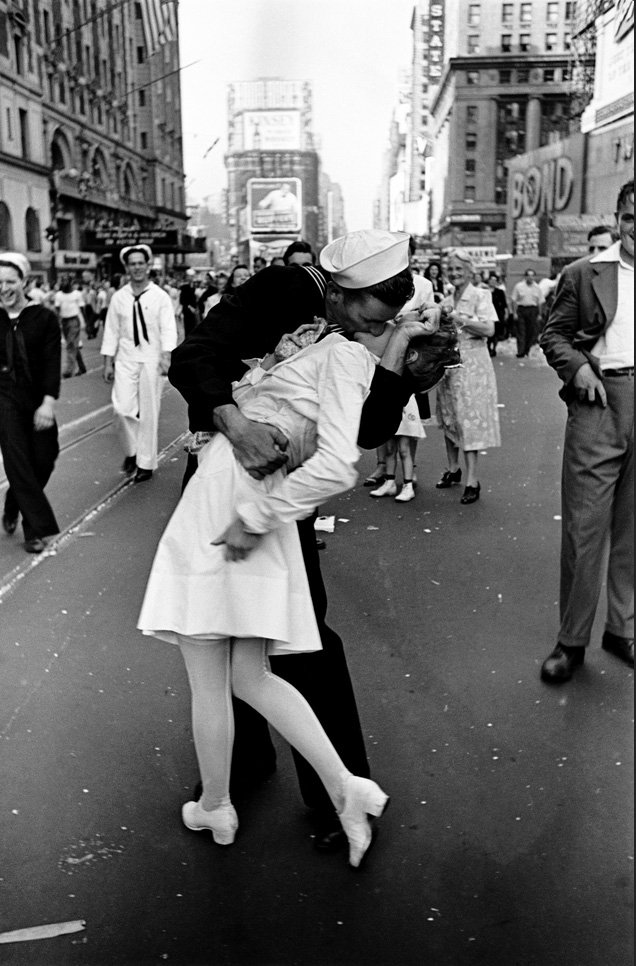
On August 14, 1945, the streets of Times Square erupted into chaos. Japan had surrendered. World War II was over. In that moment of collective euphoria, photographer Alfred Eisenstaedt captured what would become one of the most recognizable images in American history: a sailor in white uniform kissing a woman in a white dress. The VJ Day kiss Times Square photograph seemed to crystallize the joy of an entire nation. But here's the thing—what looked like spontaneous romance was actually something far more complicated. And it would take decades before we'd understand just how complicated.
This isn't just another war photograph. It's a cultural Rorschach test that's been reinterpreted with each passing generation. What Eisenstaedt saw through his Leica viewfinder that day became a symbol of victory, romance, and American optimism. Yet the woman in that iconic embrace would later describe it very differently. She didn't ask to be kissed. She didn't even know the sailor.1
The Photographer Behind the Lens: Alfred Eisenstaedt's Eye for the Decisive Moment
Alfred Eisenstaedt wasn't just wandering Times Square with a camera. He was a master photojournalist who'd already documented some of the twentieth century's most significant moments. Born in Prussia in 1898, Eisenstaedt had fled Nazi Germany in 1935, eventually landing at Life Magazine where he'd become one of their most prolific photographers.2
His approach to photography was deceptively simple. He used a Leica rangefinder camera—compact, unobtrusive, perfect for candid street photography.3 He believed in what Henri Cartier-Bresson called the "decisive moment," that split second when all elements align perfectly. On V-J Day, he was hunting for exactly that kind of moment.
Eisenstaedt described his process that day: he walked through the celebrating crowds, camera ready, looking for images that captured the jubilation. He shot multiple frames of the sailor kissing women—yes, women plural. This wasn't a singular romantic gesture. The sailor was grabbing and kissing multiple women in white.4 But one frame stood out. The composition was perfect. The woman's leg bent back. The sailor's grip firm and decisive. The crowd blurred in the background, giving context without distraction.
The technical execution was flawless. Despite the chaos around him, Eisenstaedt managed to capture sharp focus on his subjects while maintaining enough depth of field to show the celebrating crowd behind them. The natural light—diffused by New York's tall buildings—created soft shadows that emphasized the embrace without harsh contrast. It's street photography at its finest, which makes it all the more important to understand why documentary photography matters in shaping our collective memory.
The Composition That Made History: Visual Analysis of an Icon
Why did this particular frame become iconic when thousands of V-J Day photographs were taken that day? The answer lies in the composition's visual power. Look at the geometry: the sailor and woman form a strong diagonal line that cuts through the frame, creating dynamic tension. Her white dress and his white uniform create a unified tonal mass that immediately draws the eye.5
The woman's bent leg is crucial. It suggests surrender, passion, the kind of dramatic pose you'd see in Hollywood romance films of the era. Whether she intended that pose or not—and we now know she didn't—it read as romantic abandon to 1945 audiences. The sailor's posture is equally telling: he's leaning over her, one arm around her back, the other gripping her. His body language speaks of control, possession, victory.6
The Background: Context in Chaos
What makes the VJ Day kiss Times Square photograph work isn't just the central figures—it's everything else. The blurred faces in the background suggest movement, celebration, a city in motion. You can see other people smiling, watching, caught up in their own moments of joy. The photograph captures both an intimate act and a public celebration simultaneously.
Eisenstaedt's choice to shoot from a low angle added drama. It placed the couple against the sky and buildings of Times Square, making them monumental. They're not just two people kissing—they become symbols, larger than life. The photographer's technical choices transformed a spontaneous street scene into something that felt orchestrated, almost cinematic.7
Two Photographers, One Moment: Eisenstaedt vs. Jorgensen
Here's something most people don't know: Alfred Eisenstaedt wasn't the only photographer who captured that kiss. Navy photographer Victor Jorgensen shot a nearly identical image from a different angle at the exact same moment.8 So why did Eisenstaedt's version become the icon while Jorgensen's faded into relative obscurity?
The differences are subtle but significant. Eisenstaedt's angle shows more of the woman's face and captures her bent leg more dramatically. Jorgensen's version, while technically excellent, doesn't have quite the same compositional punch. The background in Eisenstaedt's frame is also more dynamic, with more visible celebrating figures.9
But composition alone doesn't explain why one image eclipsed the other. Life Magazine's massive circulation and cultural influence played the decisive role. When Eisenstaedt's photograph appeared in Life on August 27, 1945—just two weeks after the event—it reached millions of readers.10 Jorgensen's photo appeared in the New York Times, but it didn't receive the same prominent placement or repeated republication. Life's editorial team recognized they had something special and promoted it accordingly.
The magazine initially published the photograph without identifying the subjects, captioning it simply as a sailor kissing a nurse in Times Square. That anonymity, ironically, made the image more universal. Anyone could project themselves into that moment. It became everyone's victory kiss, not just one couple's story. This approach to visual storytelling connects to broader questions about how documentary photography blurs reality and fiction in shaping cultural narratives.
The Decades-Long Mystery: Identifying the Kissers
For decades, the identities of the sailor and the woman remained unknown. And that's when things got weird. Life Magazine received thousands of letters from people claiming to be the couple in the photograph. At least eleven different men claimed to be the sailor. Multiple women insisted they were the nurse.11
The claims ranged from plausible to absurd. Some had photographic evidence, others just memories. The problem? Memory is unreliable, especially when fame is involved. People genuinely convinced themselves they were in the photograph. Others were outright fabricating. The mystery became a cultural phenomenon in itself.
The Forensic Investigation
Serious attempts to identify the subjects didn't begin until the 1980s. Researchers used increasingly sophisticated methods: facial recognition technology, clothing analysis, examination of background details, witness testimonies. They compared bone structure, dental records, even the way people stood.12
In 1980, Life Magazine published an article featuring several claimants, but remained noncommittal about definitive identification. The breakthrough came later when researchers focused on two individuals: George Mendonsa and Greta Zimmer Friedman.
George Mendonsa, a Navy quartermaster, had been on leave in New York with his future wife Rita when news of Japan's surrender broke. He'd been celebrating at a bar before heading to Times Square. He was wearing his dress whites. The timeline matched. More importantly, his girlfriend Rita confirmed the story—and admitted she was standing just out of frame when George grabbed and kissed the stranger.13
Greta Zimmer Friedman's identification took longer and was more complex. For years, the photograph's caption identified the woman as a nurse. She wasn't. She was a dental assistant, wearing a white uniform because she'd just left work at a dentist's office on Lexington Avenue.14 This misidentification is significant—it shows how easily narratives get constructed around images, how captions shape interpretation regardless of accuracy.
Friedman was born in Austria and had fled the Nazis as a teenager. On August 14, 1945, she was 21 years old, working in Manhattan. When she heard the news about Japan's surrender, she walked outside into the celebrating crowd. That's when the sailor grabbed her.15
The Woman's Perspective: Greta Friedman's Account
Here's where the story gets uncomfortable. In interviews later in life, Greta Friedman was remarkably clear about what happened that day. "It wasn't my choice to be kissed," she told an interviewer in 2005. "The guy just came over and grabbed me."16 She described feeling overpowered, unable to break free from the sailor's grip. She didn't know him. She didn't want to kiss him.
Her testimony challenges everything the photograph seemed to represent. This wasn't a romantic reunion between lovers. It wasn't even a consensual kiss between strangers caught up in celebration. It was, by modern definitions, sexual assault. A man grabbed a woman without permission and kissed her against her will.
Friedman's feelings about the photograph's fame were complicated. She understood its historical significance. She participated in anniversary celebrations and gave interviews. But she also consistently clarified that the kiss was not consensual, not romantic, not what it appeared to be. "I did not see him approaching, and before I knew it, I was in this vice grip," she explained.17
George Mendonsa's recollection was different. He described it as a spontaneous celebration, fueled by alcohol and joy. He'd been drinking. When he saw a woman in white—which he assumed meant she was a nurse who'd been caring for wounded sailors—he grabbed and kissed her as a gesture of gratitude and celebration. He didn't see it as assault. He saw it as sharing joy.18
That disconnect—between his intent and her experience—is crucial. It highlights how consent, context, and power dynamics shape our understanding of human interaction. What seemed acceptable in 1945 looks very different through a 21st-century lens. This evolution in how we interpret historical images relates to broader discussions about critical image analysis and the meanings we construct around photographs.
From Icon to Controversy: The Photograph's Cultural Evolution
For decades, the VJ Day kiss Times Square photograph was unambiguously positive in American culture. It appeared on posters, postage stamps, book covers. It was reproduced endlessly as a symbol of victory, joy, and romance. Statues based on the image were erected in multiple cities, including a 25-foot sculpture called "Unconditional Surrender" in San Diego and Sarasota.19
But cultural interpretation isn't static. By the 2010s, conversations about consent, sexual assault, and women's agency had fundamentally shifted. The #MeToo movement, which gained momentum in 2017, provided a framework for reexamining historical images and events through the lens of consent and power dynamics.20
Suddenly, people were looking at Eisenstaedt's photograph differently. What they saw was a woman bent backward, unable to escape a man's grip. They saw her hands not embracing him but braced against his body, trying to create distance. They saw the physical dynamics of dominance and submission that had always been there but went unquestioned for decades.
The Statue Controversies
The statues became flashpoints. In 2019, the Sarasota statue was vandalized with red paint and the words "#MeToo" spray-painted on the base.21 Some called for the statues' removal, arguing they celebrated sexual assault. Others defended them as historical artifacts representing a different era. The debate revealed how contested the photograph's meaning had become.
This wasn't just academic discussion. Journalism schools began using the photograph as a case study in ethics. Should this image have been published? Should it continue to be celebrated? How do we balance historical context with contemporary values? These questions don't have easy answers, which is precisely why they're worth asking. The discussion connects to larger questions about how photography shapes truth and cultural memory.
Copyright, Commerce, and Public Domain: The Image's Economic Life
Here's an ironic twist: one of the most valuable photographs in American history is in the public domain. When Life Magazine published Eisenstaedt's image in 1945, they failed to include a proper copyright notice as required by law at the time.22 That technical oversight meant the photograph immediately became public property. Anyone could reproduce it, sell it, use it commercially—all without permission or payment.
The economic implications are staggering. While Eisenstaedt and Life Magazine couldn't control the image's use, countless others profited from it. The photograph has appeared on everything from t-shirts to coffee mugs, from jigsaw puzzles to wall art. Conservative estimates suggest merchandise featuring the image has generated hundreds of millions of dollars in sales over the decades.23
Original prints of Eisenstaedt's photograph have sold at auction for significant sums. A signed print sold for $10,000 in 2005. Not astronomical by fine art photography standards, but respectable. The photograph's value lies less in individual prints than in its ubiquity and cultural recognition.24
The public domain status also meant the image could be freely reinterpreted, parodied, and reimagined. Artists have created countless variations, some celebratory, others critical. The photograph has been recreated with same-sex couples, different racial combinations, and in contexts that deliberately subvert the original's meaning. This ongoing reinterpretation keeps the image alive in cultural conversation, which relates to how photographers today navigate monetizing their work in the digital age.
Historical Context: V-J Day Beyond Times Square
To understand why this photograph resonated so deeply, you need to understand what V-J Day meant to Americans in 1945. The war had lasted nearly four years for the United States. Over 400,000 American service members had died. Families had endured rationing, separation, constant fear. The atomic bombings of Hiroshima and Nagasaki—horrific as they were—meant the war was finally ending without the anticipated invasion of Japan that would have cost countless more lives.25
When President Truman announced Japan's surrender on August 14, 1945, celebrations erupted across America. Not just in Times Square—everywhere. San Francisco, Chicago, Los Angeles, small towns across the country. People poured into the streets. Strangers embraced. Church bells rang. It was collective catharsis after years of anxiety and grief.
Hundreds of photographers captured V-J Day celebrations. Most of those images are forgotten. So why did Eisenstaedt's particular frame become the definitive image? Partly composition, as we've discussed. Partly Life Magazine's reach. But also because it seemed to capture something essential about that moment—the release of tension, the joy of survival, the promise of normalcy returning.
The photograph worked as myth even if it didn't work as truth. It told Americans a story they wanted to believe about themselves: that they were romantic, spontaneous, united in victory. Never mind that the woman didn't want to be kissed. Never mind the sailor was drunk. Never mind his girlfriend was standing right there. The myth was more powerful than the reality.26
Technical Photography Analysis: How Eisenstaedt Captured the Shot
Let's talk technique. Eisenstaedt was shooting with a Leica rangefinder, likely loaded with black-and-white film. The exact camera settings aren't documented, but we can make educated guesses based on the image and shooting conditions.27
The depth of field suggests he wasn't shooting wide open. The sailor and woman are sharp, while the background shows motion blur but remains recognizable. This indicates an aperture around f/5.6 or f/8. The shutter speed was fast enough to freeze the central subjects but slow enough to show movement in the background—probably around 1/125th of a second.
The film was likely Kodak Plus-X or Tri-X, standard professional films of the era. The tonal range is excellent—good shadow detail without blown highlights. Eisenstaedt was a master of exposure, able to judge light quickly without a meter. On a bright August afternoon in Times Square, he would have had plenty of light to work with.28
What's remarkable is how he managed to capture this moment while surrounded by chaos. Times Square was packed with celebrating crowds. People were moving constantly. Yet Eisenstaedt found a clear sightline, positioned himself at the right angle, and clicked the shutter at the precise moment. That's not luck—that's skill developed over years of street photography. Understanding these techniques matters for anyone interested in film photography and capturing decisive moments.
Spontaneous vs. Staged: The Authenticity Question
Some have questioned whether Eisenstaedt staged the photograph. The answer is definitively no—but with nuance. He didn't arrange the kiss. He didn't pose the subjects. The moment was spontaneous. However, he did follow the sailor as he moved through the crowd, anticipating that something photographically interesting might happen.29
This raises questions about photojournalistic ethics that remain relevant today. At what point does anticipation become manipulation? If you're following someone expecting them to do something, are you still documenting reality or are you influencing it? These questions don't have clear answers, but they're worth considering when evaluating documentary photography's claims to truth.
Legacy and Lessons: What This Photograph Teaches Us
Greta Friedman died in 2016 at age 92. George Mendonsa died in 2019 at age 95. With their deaths, the last direct connections to that moment in Times Square vanished. What remains is the photograph itself and the ongoing conversation about what it means.
The VJ Day kiss Times Square image teaches us several important lessons about photography and cultural memory. First, that composition and distribution matter as much as the moment itself. Eisenstaedt's technical excellence and Life Magazine's reach combined to make this particular frame iconic when dozens of similar images faded away.
Second, that meaning isn't fixed. The photograph meant something different in 1945 than it did in 1980, and something different again in 2020. Cultural context shapes interpretation. What one generation sees as romantic, another sees as assault. Both readings are valid responses to what's actually in the frame.30
Third, that photographs can be both historically significant and ethically problematic. We don't have to choose. We can acknowledge the photograph's importance in documenting a moment of national celebration while also recognizing it depicts a non-consensual act. Complexity is okay. Actually, complexity is necessary if we're going to think seriously about photography's role in shaping culture.
Finally, the photograph reminds us that images have power—but that power is complicated. Eisenstaedt's frame has brought joy to millions who see it as a symbol of victory and peace. It's also caused pain to the woman who was grabbed against her will and then had that moment replayed endlessly for seven decades. Both of those truths exist simultaneously. The challenge is holding both in mind without diminishing either.
For photographers today, the VJ Day kiss offers crucial lessons about consent, context, and consequence. Every photograph we take has the potential to outlive us, to be reinterpreted by future generations, to mean things we never intended. That's both photography's power and its responsibility. We capture moments, but we can't control what those moments come to mean. This connects directly to contemporary discussions about photography's evolving role in documenting and shaping reality.
Frequently Asked Questions
Who were the people in the VJ Day kiss Times Square photograph?
After decades of investigation, the subjects were identified as George Mendonsa, a U.S. Navy quartermaster, and Greta Zimmer Friedman, a dental assistant (not a nurse as often reported). The identification was confirmed through forensic analysis, witness testimony, and interviews with both individuals. Mendonsa was on leave in New York with his future wife when he grabbed and kissed Friedman, a stranger, during the V-J Day celebrations.31
Was the VJ Day kiss consensual?
No. In interviews later in life, Greta Friedman clearly stated that the kiss was not consensual. She said the sailor grabbed her suddenly, that she didn't know him, and that she couldn't break free from his grip. "It wasn't my choice to be kissed," she explained in a 2005 interview. While George Mendonsa viewed it as a spontaneous celebration fueled by joy and alcohol, Friedman's experience was of being grabbed and kissed against her will. This disconnect between intent and experience is at the heart of modern reinterpretations of the photograph.32
Why is Alfred Eisenstaedt's version more famous than Victor Jorgensen's photograph?
Both photographers captured the same kiss from different angles at the exact same moment. Eisenstaedt's version became iconic primarily because it appeared in Life Magazine, which had a circulation of over 13 million readers in 1945. The composition was also slightly superior—Eisenstaedt's angle showed the woman's bent leg more dramatically and captured more dynamic background details. Life Magazine's editorial team recognized the image's power and promoted it extensively, while Jorgensen's version appeared in the New York Times but received less prominent treatment and fewer subsequent republications.33
Is the VJ Day photograph copyrighted?
No, the photograph is in the public domain. When Life Magazine published it in 1945, they failed to include the proper copyright notice required by U.S. law at the time. This technical oversight meant the image immediately entered the public domain, allowing anyone to reproduce, sell, or modify it without permission or payment. This has resulted in countless commercial uses over the decades, from merchandise to advertisements, with no compensation to Eisenstaedt's estate or the subjects.34
Why has the photograph become controversial?
The photograph's interpretation has evolved significantly, particularly following the #MeToo movement and increased cultural awareness about consent and sexual assault. While it was long celebrated as a romantic symbol of victory and joy, modern viewers increasingly recognize it as depicting a non-consensual act—a man grabbing and kissing a woman without permission. Greta Friedman's own testimony about the experience supports this interpretation. Statues based on the image have been vandalized, and the photograph is now used in journalism ethics courses as a case study about consent, power dynamics, and how cultural values change over time.35
What camera and settings did Alfred Eisenstaedt use?
Eisenstaedt used a Leica rangefinder camera, his preferred tool for street photography due to its compact size and quick operation. While exact settings weren't documented, photographic analysis suggests he shot at approximately 1/125th of a second at f/5.6 or f/8, based on the depth of field and motion blur visible in the image. He likely used Kodak Plus-X or Tri-X film, standard professional black-and-white films of the era. The photograph demonstrates Eisenstaedt's mastery of exposure and composition under challenging street conditions, capturing sharp focus on the subjects while maintaining context through the blurred but recognizable background.36
The VJ Day kiss Times Square photograph remains one of the most recognized images in American history—and one of the most debated. It captured a moment that seemed to represent national joy but actually depicted a non-consensual act. It became a symbol of romance while the woman involved described feeling overpowered. It's celebrated and controversial, iconic and problematic, historically significant and ethically challenging. That's not a contradiction. That's the complexity of photography itself: the way a single frozen moment can contain multiple truths, mean different things to different people, and change meaning across time. Understanding that complexity—holding all those truths simultaneously—is what makes us better photographers and more thoughtful viewers of images.
- Greta Zimmer Friedman stated in multiple interviews that she was grabbed suddenly and the kiss was not consensual.
- Eisenstaedt shot over 2,500 assignments for Life Magazine during his career, more than 90 Life covers.
- The Leica allowed Eisenstaedt to shoot quickly without drawing attention, essential for capturing genuine moments.
- Eisenstaedt photographed the sailor kissing at least four different women that afternoon in Times Square.
- The white-on-white clothing created visual unity that made the subjects stand out against the darker background of the crowd.
- Body language analysis reveals the physical dynamics of dominance and submission in the photograph's composition.
- The low camera angle was a deliberate compositional choice that elevated the subjects to heroic proportions.
- Victor Jorgensen's photograph was taken from the opposite side, showing different background details but the same embrace.
- Comparative analysis from photography historians shows Eisenstaedt's superior framing.
- Life Magazine had a circulation of over 13 million in 1945, giving Eisenstaedt's image unprecedented exposure.
- Life Magazine documented receiving over 1,000 letters from people claiming to recognize themselves or others in the photograph.
- Forensic analysis included comparing facial measurements, ear shapes, and body proportions between claimants and the photograph.
- Rita Mendonsa's testimony provided crucial corroboration that George was indeed in Times Square at that moment.
- The misidentification as a nurse persisted for decades, partly because white uniforms were associated with nursing in public imagination.
- Greta Friedman's background as a Jewish refugee from Nazi Austria added another layer of meaning to her presence in this moment of Allied victory.
- Friedman's quote from a 2005 interview with the Veterans History Project.
- From Friedman's interview with the Library of Congress Veterans History Project.
- Mendonsa stated he'd had several drinks before the kiss and acted on impulse when seeing the white uniform.
- The statue in Sarasota's Bayfront Park stands 25 feet tall and weighs 6,000 pounds.
- The #MeToo movement, beginning in October 2017, sparked widespread reevaluation of historical narratives about gender and consent.
- The vandalism occurred in February 2019, sparking local debate about whether the statue should remain.
- U.S. copyright law in 1945 required explicit copyright notice on published works; without it, works entered the public domain immediately.
- Exact figures are impossible to calculate due to the public domain status, but licensing experts estimate commercial use in the hundreds of millions.
- Eisenstaedt's other works, particularly his celebrity portraits, often command higher prices than the V-J Day kiss at auction.
- Military planners estimated an invasion of Japan would result in over one million Allied casualties.
- Cultural mythmaking through photography often requires editing out inconvenient truths that complicate the desired narrative.
- Based on the depth of field and motion blur, experts estimate Eisenstaedt likely shot at 1/125th second at f/5.6 or f/8.
- Professional photographers of Eisenstaedt's generation often estimated exposure based on experience rather than relying on light meters.
- Eisenstaedt's working method involved following subjects who seemed likely to create interesting moments.
- Photographic meaning is constructed through the interaction of image, context, and viewer interpretation across time.
- Multiple claimants came forward over the years, but forensic evidence and witness corroboration supported Mendonsa and Friedman as the actual subjects.
- Friedman's testimony about the non-consensual nature of the kiss comes from multiple interviews, including with the Library of Congress Veterans History Project.
- The role of editorial selection and distribution in determining which images become iconic cannot be overstated.
- The copyright law requirements in 1945 were strict; failure to include proper notice resulted in immediate loss of copyright protection.
- The 2019 vandalism of the Sarasota statue with "#MeToo" graffiti exemplified the contemporary controversy surrounding the image.
- Eisenstaedt's technical proficiency allowed him to work quickly without meters, estimating exposure based on years of experience.