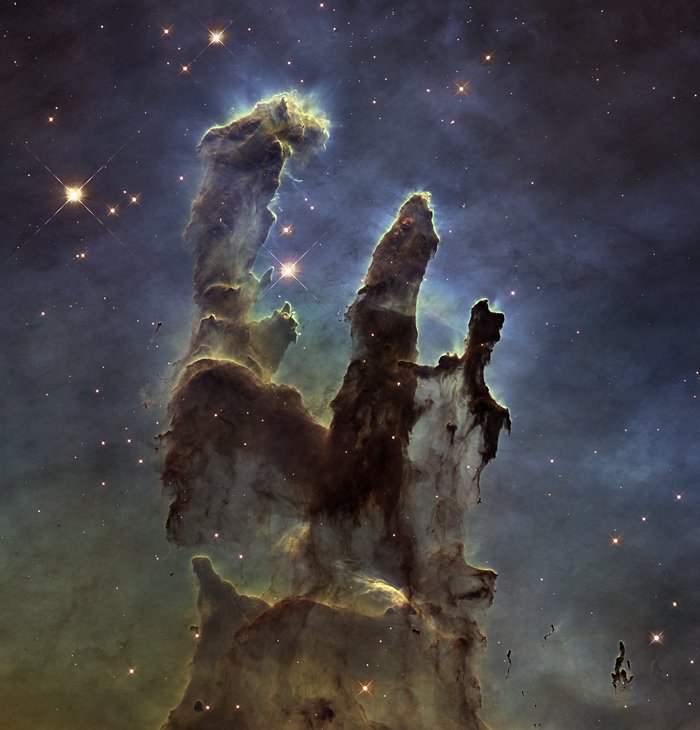
On April 1, 1995, two astronomers from Arizona State University pointed the Hubble Space Telescope toward a seemingly unremarkable patch of the Eagle Nebula. What they captured would become the most recognizable astronomical image in human history. The Pillars of Creation Hubble photo didn't just show us distant clouds of gas and dust—it transformed how humanity visualizes the cosmos itself.1
This wasn't just another space photograph. It was vindication, revelation, and cultural phenomenon rolled into one frame. At a moment when the Hubble program desperately needed to prove its worth after its troubled launch and expensive repair mission, Jeff Hester and Paul Scowen delivered an image so visually arresting that it would appear on everything from t-shirts to postage stamps, from museum walls to heavy metal album covers.2
But here's what makes this story fascinating: the pillars you're looking at might not even exist anymore. They could have been destroyed by a supernova shockwave thousands of years ago—we just haven't seen the light of their destruction yet. That paradox, that tension between creation and destruction, is part of what makes this image so compelling.
The Human Story Behind the Pillars: Hester and Scowen's Vision
Jeff Hester and Paul Scowen weren't household names in 1995. They were working astronomers at Arizona State University, part of the team granted precious observation time on the newly repaired Hubble Space Telescope. Their proposal to image the Eagle Nebula wasn't about creating art—it was about understanding star formation.3
The pair had a specific scientific question: How do massive stars influence the birth of new stars in their vicinity? The Eagle Nebula's star-forming region offered a perfect laboratory. But they needed Hubble's resolution to see what ground-based telescopes couldn't—the intricate details of gas pillars being sculpted by stellar winds and radiation.
What they didn't expect was to capture something so visually stunning that it would transcend astronomy entirely. Hester later recalled that when the processed images came back, the team knew immediately they had something extraordinary. The three towering columns of cold hydrogen gas and dust, backlit by the brilliant light of newborn stars, looked almost sculptural. Almost divine.4
For Hester and Scowen, this image represented years of work and the culmination of a specific research program. For the public, it became something else entirely: a window into cosmic creation itself, rendered in colors that spoke to something primal in the human imagination.
The Technical Alchemy: How the 1995 Image Was Actually Made
Here's where things get interesting from a photographic perspective. The iconic colors in the Pillars of Creation aren't what you'd see if you could somehow float next to them in space. They're the result of careful technical choices that transformed raw telescope data into a visual masterpiece.5
The Wide Field and Planetary Camera 2: Hubble's Eye in 1995
The original Pillars of Creation image was captured using the Wide Field and Planetary Camera 2 (WFPC2), installed during the critical 1993 repair mission that saved Hubble from being a multi-billion-dollar embarrassment. This camera used four CCD chips, each with a resolution of just 640×640 pixels—laughably small by today's standards.6
But it wasn't about pixel count. It was about what those pixels could capture. The WFPC2 used narrow-band filters to isolate specific wavelengths of light corresponding to ionized sulfur, hydrogen-alpha, and doubly-ionized oxygen. Each exposure took considerable time, with the telescope locked onto its target with extraordinary precision.
The False-Color Process: Science Meets Aesthetics
The human eye can't see most of what Hubble captures. The wavelengths of light emitted by ionized gases in space fall outside our visible spectrum or appear too faint to distinguish. So astronomers and image processors make a choice: which wavelengths get assigned which colors?7
For the 1995 Pillars image, the team assigned:
- Singly ionized sulfur (SII) to red
- Hydrogen-alpha to green
- Doubly ionized oxygen (OIII) to blue
This wasn't arbitrary. These assignments create contrast that reveals structure. The green hues highlight regions where hydrogen is being excited by ultraviolet radiation. The blue shows the hottest, most energetic regions. The red reveals cooler gas at the pillars' edges.8
The result? An image that's scientifically accurate in what it shows—the distribution of different elements and temperatures—while being completely "false" in its colors. It's a perfect example of how technical constraints can drive aesthetic innovation, much like how film photographers work within their medium's limitations to create distinctive looks.
From Raw Data to Icon: The Processing Workflow
The journey from telescope to Time magazine cover involved multiple stages of processing that would be familiar to any photographer working with RAW files today. The initial data from Hubble arrived as grayscale images—one for each filter used during the observation.9
Image processors at the Space Telescope Science Institute then had to:
- Align the separate exposures with sub-pixel precision
- Remove cosmic ray hits and detector artifacts
- Combine multiple exposures to reduce noise
- Assign colors to each wavelength channel
- Balance the relative brightness of different channels
- Apply contrast adjustments to reveal subtle details
- Combine the four separate CCD images into a seamless mosaic
This wasn't Instagram. Each decision required understanding both the science and the visual impact. Push the contrast too hard, and you lose subtle detail. Make it too flat, and the dramatic structure disappears. The processors were walking a tightrope between scientific accuracy and visual communication.10
The final 1995 image showed the pillars in their now-iconic color palette: rusty reds fading to deep teals and blues, with bright stars punctuating the darkness. The processing team had created something that was simultaneously a scientific document and a work of art.
November 1995: The Public Unveiling and Immediate Impact
When the Pillars of Creation Hubble photo was officially released at an American Astronomical Society meeting in November 1995, the response was immediate and overwhelming. News outlets that typically gave space photos a cursory mention devoted front-page coverage. The image appeared on the cover of astronomy magazines, science sections, and eventually made its way into mainstream cultural consciousness.11
Why did this particular image resonate so powerfully? Partly it was the composition. The three pillars have an almost architectural quality, like Gothic cathedral spires reaching toward heaven. The scale is incomprehensible—those pillars are light-years tall—yet somehow the image feels intimate, almost tactile.12
The name helped too. "Pillars of Creation" wasn't some dry astronomical designation. It was evocative, almost biblical. The phrase captured both what the image showed—columns of gas where stars are being born—and what it made people feel: awe at the creative forces of the universe.13
For NASA and the Space Telescope Science Institute, the image was a godsend. Hubble had launched in 1990 with a flawed mirror, requiring a risky and expensive repair mission in 1993. The program needed to prove it was worth the investment. The Pillars of Creation did exactly that, becoming the visual ambassador for Hubble's capabilities and, by extension, for space exploration itself.
The Science Within the Beauty: What the Image Revealed
Strip away the aesthetic impact for a moment and focus on what the image actually shows. Those aren't just pretty clouds. They're stellar nurseries—regions where new stars are forming through a process both creative and destructive.14
Photoevaporation: The Sculpting Process
The pillars' distinctive shape results from a process called photoevaporation. Massive, hot stars that formed nearby (just outside the frame of the original image) blast the surrounding gas with intense ultraviolet radiation. This radiation heats the gas, causing it to evaporate away—but not uniformly.15
Denser knots of gas resist the radiation longer, creating the pillar structure. Think of it like wind eroding a cliff face—the harder rock remains while softer material wears away. At the tips of finger-like protrusions, you can see what astronomers call "evaporating gaseous globules" or EGGs. These are cocoons of denser gas where new stars are forming, protected (temporarily) from the destructive radiation by their own density.16
It's a race against time. Can these embryonic stars accumulate enough mass to ignite nuclear fusion before the radiation strips away their protective cocoons? Some will make it. Others won't. The image captures this cosmic drama in progress.
The Destruction Hypothesis: A Cosmic Ghost Story
In 2007, NASA's Spitzer Space Telescope observed the Eagle Nebula in infrared wavelengths and found evidence of a supernova shockwave that may have already destroyed the pillars. The catch? Because the pillars are about 7,000 light-years away, we're seeing them as they existed 7,000 years ago. If they were destroyed 6,000 years ago, we won't see that destruction for another 1,000 years.17
This adds a poignant layer to the image. We're looking at structures that might already be gone, scattered into the interstellar medium. The Pillars of Creation might be a cosmic ghost photograph—a record of something that no longer exists but whose light still travels toward us across the vast emptiness of space.18
It's a reminder that all photography, in a sense, captures the past. But with the Pillars of Creation, that past is measured not in fractions of seconds but in millennia. The philosophical implications are staggering—and they're part of what makes the image so compelling beyond its immediate visual impact.
Cultural Phenomenon: From Science to Pop Culture Icon
By 1997, you could buy the Pillars of Creation on a coffee mug, a poster, a mousepad, or a t-shirt. The image had escaped the confines of astronomy journals and entered the broader cultural consciousness. It appeared in science fiction films, on television shows, in music videos, and as cover art for albums spanning genres from classical to metal.19
What made the Pillars of Creation so commercially successful? Part of it was the composition—those three distinct pillars created a recognizable silhouette. Part of it was the color palette, which worked equally well in full color or simplified to two-tone prints. And part of it was the name, which carried spiritual and philosophical weight that transcended the scientific context.20
The image also became a touchstone for discussions about science funding, space exploration, and humanity's place in the cosmos. When politicians debated NASA's budget, the Pillars of Creation appeared in presentations. When educators wanted to inspire students about astronomy, they showed the Pillars. When filmmakers needed to convey the vastness and beauty of space, they referenced the Pillars.
In this sense, the image succeeded far beyond its original scientific purpose. It became a visual shorthand for cosmic wonder itself—a single frame that could communicate the majesty of the universe to anyone, regardless of their scientific background.21
Evolution of an Icon: 2015 Revision and 2022 Webb Comparison
Twenty years after the original image, Hubble returned to the Pillars of Creation. In 2015, using the upgraded Wide Field Camera 3 installed during the final servicing mission in 2009, astronomers captured a new version with dramatically improved resolution and detail.22
The differences between 1995 and 2015 are striking. The newer image shows finer filamentary structure, more distinct EGGs, and greater tonal range. It's like comparing a good print to an exceptional one—the subject is the same, but the technical execution reveals nuances that were always there but previously invisible.23
Then, in 2022, the James Webb Space Telescope turned its infrared eye toward the pillars. Webb's version looks completely different. Infrared light penetrates dust that blocks visible wavelengths, revealing a dense population of stars invisible in the Hubble images. The pillars themselves appear more translucent, almost ghostly, with hundreds of stars shining through them.24
Comparing the three versions—1995 Hubble, 2015 Hubble, and 2022 Webb—reveals how different wavelengths tell different stories about the same region of space. The 1995 image emphasized the dramatic structure of the pillars themselves. The 2015 image added fine detail and texture. The Webb image reveals the stellar population hidden within and behind the dust.25
Yet the 1995 image remains the iconic one. Why? Perhaps because it was first. Perhaps because its visible-light perspective feels more accessible than infrared views. Or perhaps because sometimes the first impression, even if technically superseded, retains a cultural power that subsequent versions can't quite match.
Legacy and Influence: How One Image Changed Space Photography
The success of the Pillars of Creation fundamentally changed how NASA and other space agencies approached public outreach. Before 1995, astronomical images were primarily scientific tools, with aesthetic considerations secondary. After the Pillars, there was explicit recognition that beautiful images served both scientific and public engagement purposes.26
Subsequent Hubble images were processed with an eye toward visual impact. Color palettes were chosen not just for scientific utility but for aesthetic appeal. Compositions were framed to maximize drama. The line between science and art became deliberately blurred—not to compromise scientific integrity, but to recognize that the two goals could be complementary rather than contradictory.27
For photographers working in other fields, the Pillars of Creation offers lessons about the power of color, composition, and scale. The image works because it balances the familiar (pillar-like structures we can relate to) with the utterly alien (the scale and subject matter). It uses color to guide the eye and create emotional response. And it captures a moment in an ongoing process, suggesting both past and future beyond the frame.28
The image also demonstrated that technical limitations—like the WFPC2's modest resolution and the need for false-color processing—don't preclude creating powerful imagery. In fact, those constraints drove creative decisions that made the image distinctive. It's a reminder that gear matters less than vision, a lesson applicable whether you're imaging nebulae or street scenes.
Accessing the Icon: Usage Rights and Educational Resources
Here's something many people don't realize: the Pillars of Creation image is public domain. As a product of NASA, it's not subject to copyright restrictions. You can download high-resolution versions directly from NASA's image archives and use them for virtually any purpose—educational, commercial, or personal—without seeking permission or paying licensing fees.29
This accessibility has contributed to the image's ubiquity. Unlike many iconic photographs that are tightly controlled by copyright holders, the Pillars of Creation can be freely shared, reproduced, and adapted. Teachers can use it in classrooms. Artists can incorporate it into their work. Publishers can include it in books without negotiating rights.
For educators, the image has proven invaluable. It provides a concrete visual anchor for abstract concepts about star formation, nebulae, and the scale of the universe. Students who might glaze over at descriptions of molecular clouds and photoevaporation pay attention when shown the Pillars. The image makes the invisible visible and the incomprehensible somewhat more graspable.30
The various versions of the image—1995 visible light, 2015 visible light, 2015 infrared, 2022 Webb near-infrared, 2022 Webb mid-infrared—offer opportunities to teach about how different wavelengths reveal different information. It's a masterclass in how the same subject can look radically different depending on how you observe it, a concept with applications far beyond astronomy.
Conclusion: The Enduring Power of Cosmic Photography
Nearly thirty years after its capture, the Pillars of Creation Hubble photo remains the gold standard for astronomical imagery. It's been superseded technically—the 2015 Hubble revision is sharper, the Webb images reveal more detail. Yet the 1995 original retains its cultural primacy, its ability to stop viewers in their tracks and make them contemplate their place in the universe.
What makes a photograph truly iconic? Technical excellence matters, certainly. But the Pillars of Creation succeeded because it combined technical achievement with aesthetic power, scientific significance with emotional resonance. It showed us something we'd never seen before in a way that felt both alien and somehow familiar. It made the cosmos feel less like an abstract concept and more like a place—vast and strange, but real.
For Jeff Hester and Paul Scowen, the image represented the culmination of a specific research program. For NASA, it was validation of a troubled and expensive telescope program. For the public, it became a window into cosmic creation itself. All three interpretations are valid. All three are incomplete. The full significance of the image lies in the intersection of these perspectives—science, technology, and art converging in a single frame.
The next time you see the Pillars of Creation—on a poster, in a documentary, as someone's desktop wallpaper—take a moment to consider what you're actually looking at. Those aren't just pretty clouds. They're stellar nurseries light-years tall, captured by a telescope orbiting Earth, processed by scientists and image specialists who made thousands of technical and aesthetic decisions, and presented in colors that don't correspond to anything your eye could see but which reveal profound truths about the universe's structure and evolution.
That's the power of great photography—whether you're imaging nebulae or neighborhoods. The best images don't just show us what something looks like. They change how we see.
Frequently Asked Questions
Are the colors in the Pillars of Creation real?
The colors are "false" in the sense that they don't represent what your eye would see, but they're scientifically accurate representations of different wavelengths of light. The image combines observations through filters that isolate specific emissions from ionized sulfur, hydrogen, and oxygen. These wavelengths are then assigned visible colors to create contrast and reveal structure. So while the colors aren't literally what you'd see floating next to the pillars, they accurately represent real physical phenomena.31
How big are the Pillars of Creation actually?
The tallest pillar measures approximately 4 light-years from base to tip. To put that in perspective, a light-year is about 5.88 trillion miles. So that single pillar is roughly 23.5 trillion miles tall. If you could travel at the speed of light (which nothing with mass can), it would take four years to traverse the pillar's height. The entire structure shown in the image spans about 5-6 light-years across. These scales are so vast they're almost impossible to truly comprehend.32
Do the Pillars of Creation still exist?
This is a fascinating question with no definitive answer. The pillars are about 7,000 light-years away, meaning we're seeing them as they existed 7,000 years ago. In 2007, infrared observations by the Spitzer Space Telescope found evidence suggesting a supernova shockwave may have destroyed the pillars about 6,000 years ago. If true, we won't see their destruction for another 1,000 years or so. However, this remains speculative—the pillars might still exist, or they might already be scattered across space. We're essentially looking at a cosmic time capsule, seeing the past while the present remains unknown.33
Why is this image called the Pillars of Creation?
The name "Pillars of Creation" was chosen because these structures are stellar nurseries—regions where new stars are being born. The "creation" refers to star formation, one of the fundamental creative processes in the universe. The pillars themselves are columns of cold gas and dust that contain embryonic stars in various stages of formation. The name captures both the literal process occurring (the creation of stars) and the almost spiritual awe the image evokes. It's far more evocative than the technical designation "M16" or "Eagle Nebula star-forming region," and that memorability has contributed significantly to the image's cultural impact.34
How does the 1995 image compare to the newer Webb telescope version?
The 1995 Hubble image and the 2022 Webb image show the same region but in dramatically different ways because they observe different wavelengths of light. Hubble's visible-light image emphasizes the pillars' dramatic structure and the dust that blocks light from stars behind and within them. Webb's infrared view penetrates that dust, revealing hundreds of stars invisible in the Hubble image. The pillars appear more translucent in Webb's view, almost ghostly. Neither image is "better"—they're complementary. Hubble shows the sculptural structure of the gas and dust; Webb reveals the stellar population. Together, they provide a more complete picture than either could alone.35
Can I use the Pillars of Creation image for my own projects?
Yes. As a NASA image, the Pillars of Creation is in the public domain and can be used for virtually any purpose without seeking permission or paying licensing fees. You can download high-resolution versions from NASA's archives and use them in educational materials, commercial products, artwork, or personal projects. The only restrictions are that you can't falsely claim NASA endorsement of your product and you should provide appropriate credit when possible. This accessibility has contributed to the image's widespread cultural presence, appearing on everything from textbooks to t-shirts to album covers.36
- The image was captured using Hubble's Wide Field and Planetary Camera 2 (WFPC2), which had been installed during the 1993 servicing mission.
- The image's cultural impact extended far beyond astronomy, appearing in films, television shows, and commercial products throughout the late 1990s and 2000s.
- The Eagle Nebula (M16) is located approximately 6,500 to 7,000 light-years from Earth in the constellation Serpens.
- The tallest of the three pillars measures approximately 4 light-years from base to tip—nearly the distance from our Sun to the nearest star, Proxima Centauri.
- The image uses false-color representation, where different wavelengths of light are assigned visible colors to highlight specific features and chemical compositions.
- The distinctive "stair-step" appearance in the 1995 image resulted from the WFPC2's four separate CCD chips arranged in an L-shape, with one chip having higher resolution than the others.
- Similar false-color imaging techniques are explored in contemporary digital photography workflows, where technical manipulation serves artistic vision.
- The color mapping decisions for astronomical images balance scientific utility with visual communication, a process detailed in NOVA's documentation of the Pillars.
- Multiple exposures were taken through each filter to ensure adequate signal-to-noise ratio and to eliminate cosmic ray artifacts that could mar the final image.
- The image processing techniques used for astronomical photography have influenced broader aesthetic approaches to digital photography across multiple genres.
- The timing of the release, coming just two years after the successful repair mission, was crucial for demonstrating Hubble's value to both the scientific community and the taxpaying public.
- To put the scale in perspective: if you could travel at the speed of light, it would take four years to traverse the height of the tallest pillar.
- The naming process for astronomical images often involves collaboration between scientists and public affairs offices, balancing scientific accuracy with public engagement.
- The pillars are composed primarily of cold molecular hydrogen gas and dust, with temperatures around -250°F (-157°C).
- The process of photoevaporation is similar to how a sand dune is shaped by wind, except here the "wind" is ultraviolet light from young, massive stars.
- Several EGGs are visible in the high-resolution 2015 Hubble revision of the image, appearing as small bumps at the tips of gas fingers.
- NPR reported on this possibility, noting that the pillars' destruction would occur "in an eye blink in cosmic time."
- The concept of looking into the past when observing distant objects is fundamental to astronomy, as light takes time to travel across cosmic distances.
- The image's widespread commercial and cultural use demonstrates how photography functions in marketing and cultural communication beyond its original intent.
- The Google Arts & Culture archive documents the image's cultural impact and its place in the history of astronomical photography.
- This democratization of astronomical imagery parallels broader trends in documentary photography's role in making specialized knowledge accessible to general audiences.
- The 2015 image revealed previously unseen details, including jets of material streaming from newly forming stars within the pillars.
- The 2015 revision also included an infrared version that penetrated the dust to reveal stars embedded within the pillars.
- Webb's infrared capabilities allowed it to detect cooler stars and protostars that don't emit enough visible light to appear in Hubble's images.
- NASA created a combined visualization showing transitions between Hubble and Webb views, illustrating how different instruments reveal complementary information.
- This shift toward recognizing the aesthetic dimension of scientific imagery reflects broader changes in how we understand the relationship between technical and artistic aspects of photography.
- The European Space Agency's composite imaging work with Webb demonstrates this continued evolution in astronomical image presentation.
- These compositional strategies parallel techniques used in moody photography to create atmospheric and emotionally resonant images.
- High-resolution versions are available through NASA's official image gallery and the Space Telescope Science Institute's archive.
- Educational resources about the Pillars are available through multiple astronomical observatories, including comparison views across different wavelengths.
- ESA's technical documentation explains the filter combinations and color assignments used in the various Pillars images.
- For comparison, the distance from our Sun to the nearest star, Proxima Centauri, is about 4.24 light-years—roughly the height of the tallest pillar.
- The destruction hypothesis is based on infrared evidence of a supernova remnant, but confirmation requires additional observations and analysis.
- The naming process for astronomical images balances scientific accuracy with public engagement, aiming to make complex phenomena accessible and memorable to general audiences.
- Side-by-side comparisons of visible and infrared views demonstrate how different wavelengths reveal different aspects of the same cosmic structure.
- High-resolution downloads are available through NASA's image galleries, with various versions including the 1995 original, 2015 revision, and different wavelength views.