On January 8, 1972, the BBC aired a television series that would fundamentally challenge how we understand images. John Berger's Ways of Seeing wasn't just another art program—it transformed photography theory even though Berger primarily discussed painting. The irony? His most profound insights concerned how cameras and photographic reproduction had already destroyed traditional ways of looking at art.
For photographers today, Ways of Seeing offers something more valuable than technique—a framework for understanding how images create meaning in our image-saturated world.
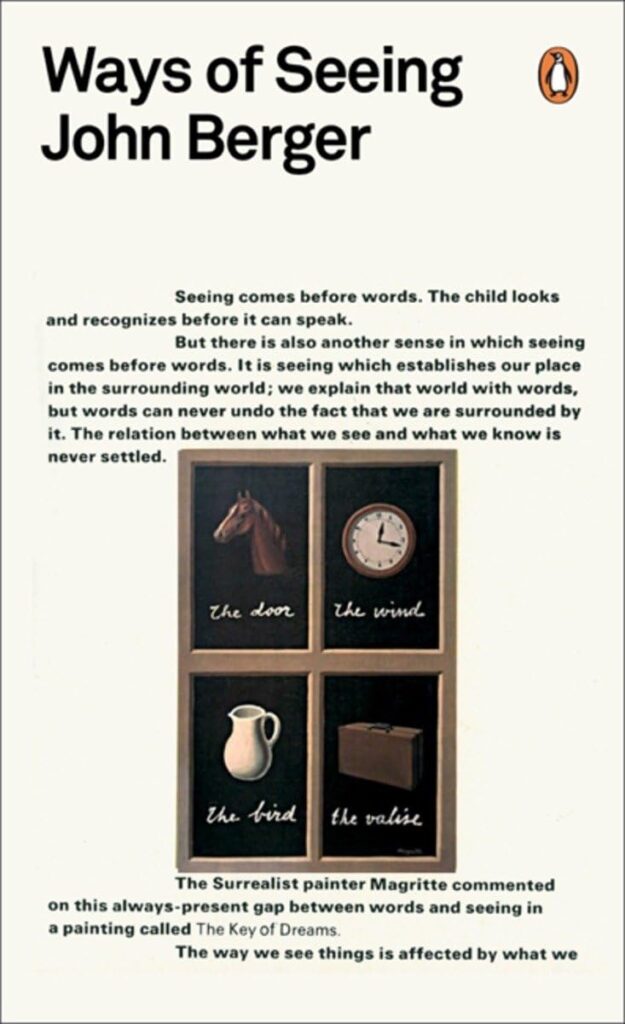
The book opens with a simple declaration: "Seeing comes before words." We experience the world visually before we can articulate it. But what makes this essential reading for photographers isn't what it says about painting—it's what Berger reveals about how mechanical reproduction changed everything about perception.
Photography Versus Photographic Reproduction
Most readers miss this crucial distinction: Berger wasn't writing about photography as art. He was analyzing photographic reproduction—the camera's ability to copy, fragment, and redistribute existing artworks.
Before photography, you had to travel to see a painting. The artwork existed in one specific location, viewed under specific conditions. The camera destroyed that singularity. Suddenly, a Caravaggio could appear in a textbook, a Rembrandt on a postcard, a Botticelli on your television screen.
"The uniqueness of every painting was once part of the uniqueness of the place where it resided," Berger writes. Photography shattered this. An artwork could now exist simultaneously in thousands of locations, reproduced at different sizes, cropped differently, surrounded by different contexts.
But if photographic reproduction destroys the aura of paintings, what happens when the original artwork is itself a photograph? This question becomes increasingly urgent in our digital age of infinite reproduction.
How Cameras Changed Seeing
Berger identified specific ways camera technology transformed visual perception—practical realities every photographer navigates daily.
Fragmentation and Framing
The camera isolates. When you photograph a detail from Michelangelo's Creation of Adam—say, just the hands—you create an entirely new image with its own meaning. Berger demonstrated this throughout the series, using the camera to zoom, pan, and isolate details.
Every time you frame a shot, you're not recording reality—you're constructing a specific way of seeing it. This selective framing is inherently political because it determines what gets seen and what remains invisible.
Mobility and Context
A photograph can appear in a museum, on a billboard, or on Instagram—and its meaning shifts with each context. Berger writes: "When a painting is reproduced by a film camera it inevitably becomes material for the film-maker's argument."
A war photograph in a museum carries different weight than the same image on social media. Context isn't background—it's fundamental to how images communicate. This principle applies whether you're curating an Instagram feed or preparing a gallery exhibition.
Sequencing and Juxtaposition
Place two photographs side by side and they create meaning through comparison, contrast, or narrative connection. This is what Berger did in the pictorial essays that form chapters 2, 4, and 6 of the book. These chapters contain sequences of images that force readers to construct meaning from visual relationships.
The Power of Captions
Berger introduces "mystification"—the process by which art history obscures rather than clarifies meaning. In the BBC series, he demonstrates this brilliantly by showing the same painting with different musical accompaniments. The soundtrack completely transforms perception.
For photographers, the equivalent is the caption. Consider a portrait captioned "terrorist" versus "freedom fighter." The image remains identical, but language directs interpretation.
"The meaning of an image is changed according to what one sees immediately beside it or what comes immediately after it" Berger writes. Where your image appears, what surrounds it, and what text accompanies it fundamentally shapes its meaning. This awareness is essential for ethical documentary practice.
Benjamin's Shadow
You can't understand Berger without Walter Benjamin. Benjamin's essay "The Work of Art in the Age of Mechanical Reproduction" was written in 1935 and published in 1936, providing the theoretical foundation for much of Berger's thinking.
Benjamin argued that mechanical reproduction destroyed what he called the "aura" of artworks—that sense of unique presence when standing before an original. Benjamin noted that "even the most perfect reproduction of a work of art is lacking in one element: Its presence in time and space".
Berger adapted Benjamin's theory for television, making it accessible to mass audiences. He demonstrated that photography's reproducibility fundamentally changed art's social function. But the question remains: if photographic reproduction destroys the aura of paintings, does photography as an original medium possess aura?
Practical Applications
Consider Dorothea Lange's "Migrant Mother." The photograph's subject, Florence Owens Thompson, was Cherokee, born in 1903 in Indian Territory—a crucial detail erased from the historical narrative for decades. Thompson later disputed Lange's account, stating they never sold their tires for food.
When the image appears in an art museum, it becomes "art." In a history textbook, it becomes evidence. Used in advertising, it becomes commodity. The photograph hasn't changed, but its function and meaning shift completely based on context—exactly as Berger predicted.
This has profound implications for contemporary portrait photography, where images circulate across multiple platforms and contexts simultaneously.
Digital Age Relevance
Berger's 1972 analysis predicted our contemporary image culture with uncanny accuracy. He couldn't have imagined Instagram, but he understood the principles that would make it possible.
Every Instagram post exists purely as reproduction—there's no "original." Images circulate, get screenshotted, reposted, and recontextualized constantly. Meaning changes based on what appears in the feed immediately before and after.
And what about AI-generated images? If photographic reproduction challenged the aura of paintings, AI generation challenges the aura of photography itself. When images can be created without cameras, without photographers, without even real-world referents—what happens to photography's claim to authenticity?
The democratization Berger celebrated has materialized—billions can now create and share photographs instantly, whether through professional cameras or smartphones. But this democratization brings new forms of mystification through filters, algorithms, and AI enhancement.
Why Photographers Should Read This
Ways of Seeing teaches photographers to think critically about images—not just how to make them, but how they function in culture. It reveals that photographs aren't neutral records but constructed arguments. It demonstrates that context shapes meaning as much as content.
Most importantly, it cultivates visual literacy. Berger teaches you to question what images show and what they hide, to recognize how framing and context shape interpretation. This skill matters more than any technical knowledge about cameras or software.
Conclusion
More than fifty years after the BBC broadcast, Berger's ideas remain revolutionary. They challenge us to see photography not just as technical craft but as cultural practice embedded in power, ideology, and politics.
Read Ways of Seeing. Watch the BBC series. Apply Berger's framework to your practice and to the images you encounter daily. Question what you see. Recognize how framing, context, and sequence shape interpretation.