Armies, surveys and empires all wanted pictures: how 19th century photography went to war, mapped the American West and tried to catalog the colonized world, and who was holding the camera.
By the 1850s, 19th century photography had left the portrait studio. The wet collodion plate was sharp, and a negative could be printed many times. Governments, publishers and scientific societies noticed. Before long, photographers were following soldiers into the Crimea, mule trains into the Sierra Nevada and regiments into northern India.
Three developments made this possible. Chemically, wet collodion produced detailed negatives that printed well on albumen paper. Commercially, publishers and print dealers had learned from the carte de visite boom that images sold in quantity. Institutionally, armies, geological surveys and colonial governments had budgets and a reason to want visual evidence. When those three forces met, 19th century photography stopped being a private pleasure and became an instrument of public life.
This article follows those journeys. It looks at who paid for the pictures, who made them and who ended up in front of the lens. It also asks a harder question. When a photograph claims to witness events, whose version of events does it carry? If you need the technical background first, our chapter on wet collodion and the carte de visite explains the process behind almost every image below.
19th Century Photography at War: Roger Fenton in the Crimea
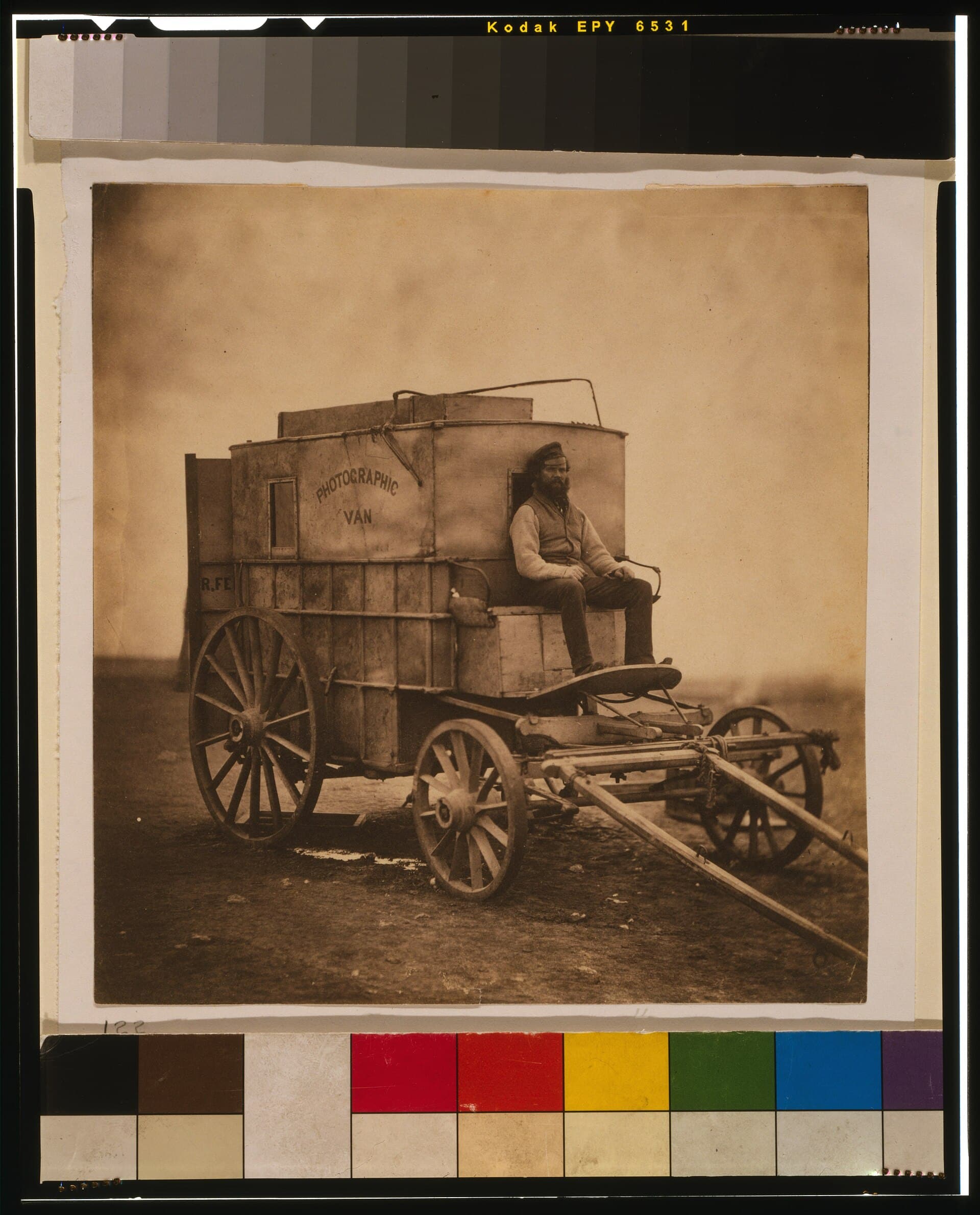
The Crimean War began in 1853 and sent British, French and Ottoman troops against Russia. Indeed, it was the first major war that the public followed in newspapers and in photographs. In March 1855, the English photographer Roger Fenton sailed for the Crimea with a government introduction, a commercial sponsor and a horse-drawn darkroom.
360 negatives and no corpses
According to the Library of Congress, Fenton worked in the Crimea from 8 March to 26 June 1855 and made about 360 photographs. The publisher Thomas Agnew and Sons financed the project, with royal patronage and government assistance.1 For example, Fenton photographed officers, soldiers, camps, horses and landscapes. However, he did not photograph the dead.
The reasons were practical and cultural. Wet collodion plates needed several seconds of exposure, so combat was impossible to capture. Heat, dust and flies spoiled the chemistry. Furthermore, Victorian ideas of decency made corpses unacceptable for sale in a print shop. As a result, the picture of war that reached London was quiet, orderly and strangely empty.
The Valley of the Shadow of Death
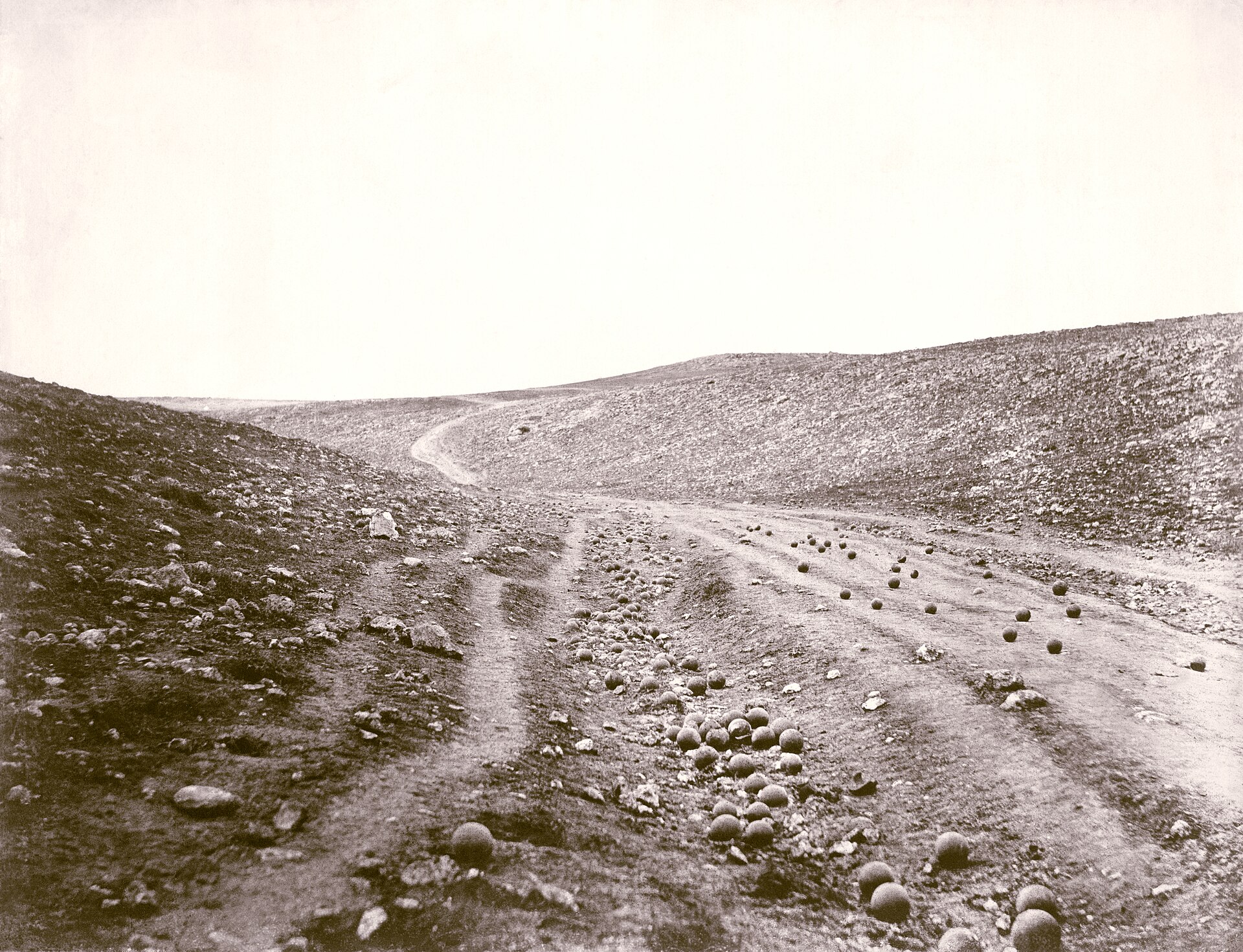
Fenton’s most famous picture shows a dirt road in a ravine, scattered with cannonballs. It exists in two versions. In one, the balls lie beside the road. In the other, they cover it. Historians still argue about which came first and whether Fenton moved the balls, so the image has become a test case for the question of staging in 19th century photography.2
One more correction is worth making. Fenton is often called the first war photographer, but he was not. In fact, the Romanian photographer Carol Szathmari photographed the conflict in 1854. James Robertson and Felice Beato worked in the same theater after Fenton, in 1855 and 1856, and they were far less squeamish about ruins and the aftermath of fighting.
The difference mattered. Fenton’s Crimea is a gentleman’s expedition, full of poised officers and tidy tents, while Robertson and Beato photographed the shattered fortifications of Sebastopol after the siege. Together their pictures show two competing ideas of war photography. One protects the viewer from the cost of conflict. By contrast, the other lets the ruins speak. Both ideas would return in every war that followed.
The American Civil War: Brady, Gardner and the Staged Dead
When civil war broke out in the United States in 1861, photographers faced the same technical limits as Fenton. Even so, they turned war into a commercial subject on a scale nobody had seen. Mathew Brady, a successful portraitist, organized teams of operators and sent them to the front. Many of the most famous images carry his name, although others made them.
Antietam on Broadway
In October 1862, Brady’s New York gallery showed photographs of the dead at Antietam, mostly taken by Alexander Gardner and James Gibson. The show drew crowds, and recent research argues that it worked as a commercial event as much as a moral one.3 Meanwhile, Gardner left Brady in 1862 and set up on his own. In 1865 and 1866, he published a two-volume Photographic Sketch Book of the War, crediting individual photographers by name, which was unusual at the time.
Meanwhile, the war fed a quieter market. Soldiers sat for studio portraits before leaving home, and families bought small prints of them to keep on the mantelpiece. In that sense, the conflict was photographed twice: once on the battlefield and once in thousands of studios, in the format we described in our piece on the carte de visite craze. Battlefield pictures shocked people. Studio portraits, by contrast, consoled them.
Staging in 19th century photography: Gettysburg
The Gettysburg photographs show how documentary and arrangement overlapped. Historian William Frassanito demonstrated that Gardner’s team moved the body of a dead Confederate soldier to a more dramatic spot among the rocks of Devil’s Den and photographed it as a “sharpshooter.” In short, the pose, the blanket and the rifle belonged to a story, not only to a place.
This does not make the pictures worthless. Instead, it means that we should read them as made things. A war photograph from the 1860s can be accurate about what a battlefield looked like and still be shaped by choices about what to show and how to caption it. We return to this theme in our piece on Joe Rosenthal’s Iwo Jima flag raising, another image that is both true and carefully framed.
19th Century Survey Photography of the American West
After the war, the American government turned to the landscape. It sent geologists, surveyors and photographers into the West to measure resources and draw maps. Photography was not an afterthought. Instead, it was part of the argument for settlement.
Watkins and the mammoth plate
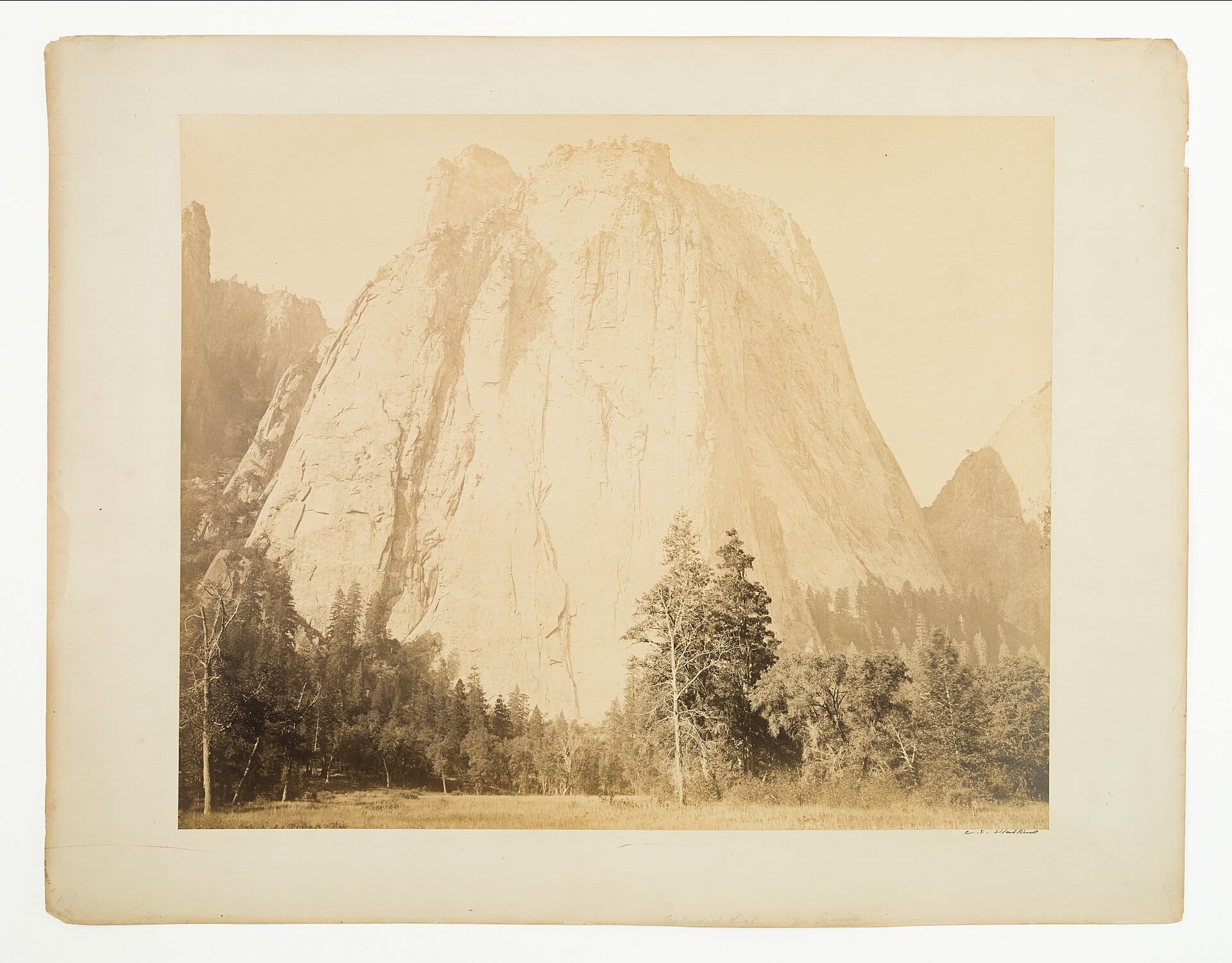
Carleton Watkins first photographed Yosemite in 1861, hauling a glass plate camera that made negatives as large as eighteen by twenty-two inches. For instance, the prints were immense, detailed and calm. Many viewers believed they helped build public support for protecting the valley, which became a state-managed grant in 1864. The photographs mattered, but we should not credit them alone. Lobbying, politics and a growing conservation movement all played a part.
O’Sullivan, Jackson and Muybridge
Timothy O’Sullivan, who had photographed Gettysburg, joined Clarence King’s survey of the Fortieth Parallel in 1867 and later worked for George Wheeler’s surveys. The Smithsonian American Art Museum notes that he worked over six seasons between 1867 and 1874, and that his pictures served both scientific investigation and western expansion.4
William Henry Jackson photographed the Yellowstone region for Ferdinand Hayden’s survey in 1871. His pictures helped argue for federal protection of the area, which Congress approved in 1872. Again, they contributed to a campaign instead of single-handedly creating a park. Meanwhile, Eadweard Muybridge photographed Yosemite from 1867. In 1873, the U.S. Army commissioned him to photograph the Modoc War in California, which shows how quickly landscape photography and military power could overlap.5
Whose West? Native people in 19th century survey photographs
Moreover, survey pictures tended to empty the land. Native nations who lived in these places appear rarely, or as scale figures. The West looked open because the photographs framed it that way.
When Native people did appear, the circumstances were rarely equal. Because photographers worked beside military expeditions, portraits were often made under pressure or for a government file. Scholars of the period therefore read these pictures twice: once for what they show and once for what they leave out. That double reading is one of the most useful habits anyone can bring to 19th century photography.
19th Century Photography and Empire in India: Beato and Bourne
In 1857, Indian soldiers in the East India Company’s army rose against British rule. The conflict spread across northern India and was put down in 1858 with great violence. British audiences saw the aftermath through photography almost at once.
Beato at Lucknow
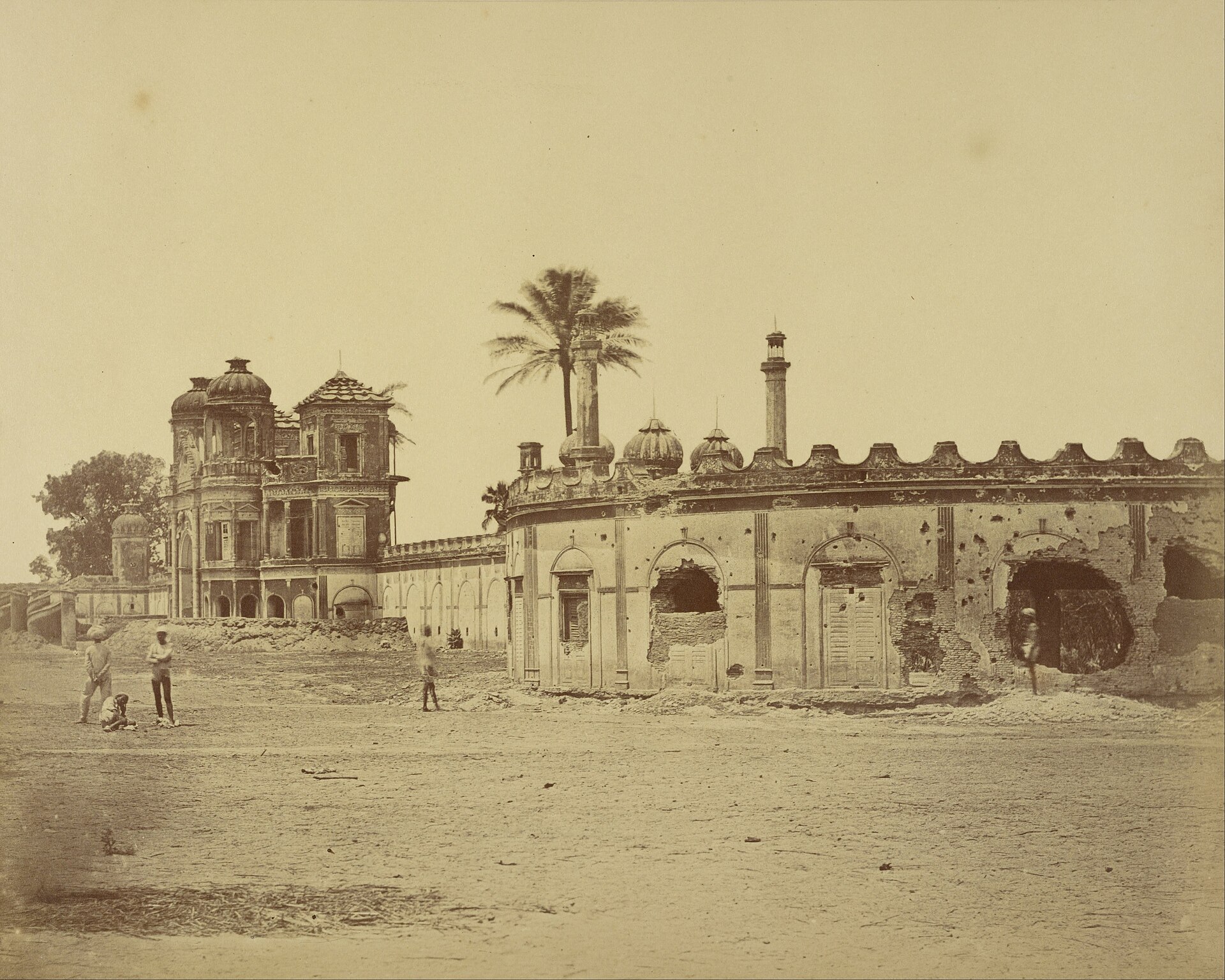
Felice Beato arrived in northern India in 1858 and photographed the ruins of Lucknow. His picture of the Sikandar Bagh, an enclosed garden where many fighters had died, is among the best known. Scholars have argued that human bones in the image were probably dug up or rearranged for the camera. We cannot be certain of the exact circumstances, but the staging seems clear. Ultimately, the photograph presents victory as a grim scene to be read, not simply recorded.6 The exterior view below shows the building, not the scene with the remains.
Bourne and the picturesque
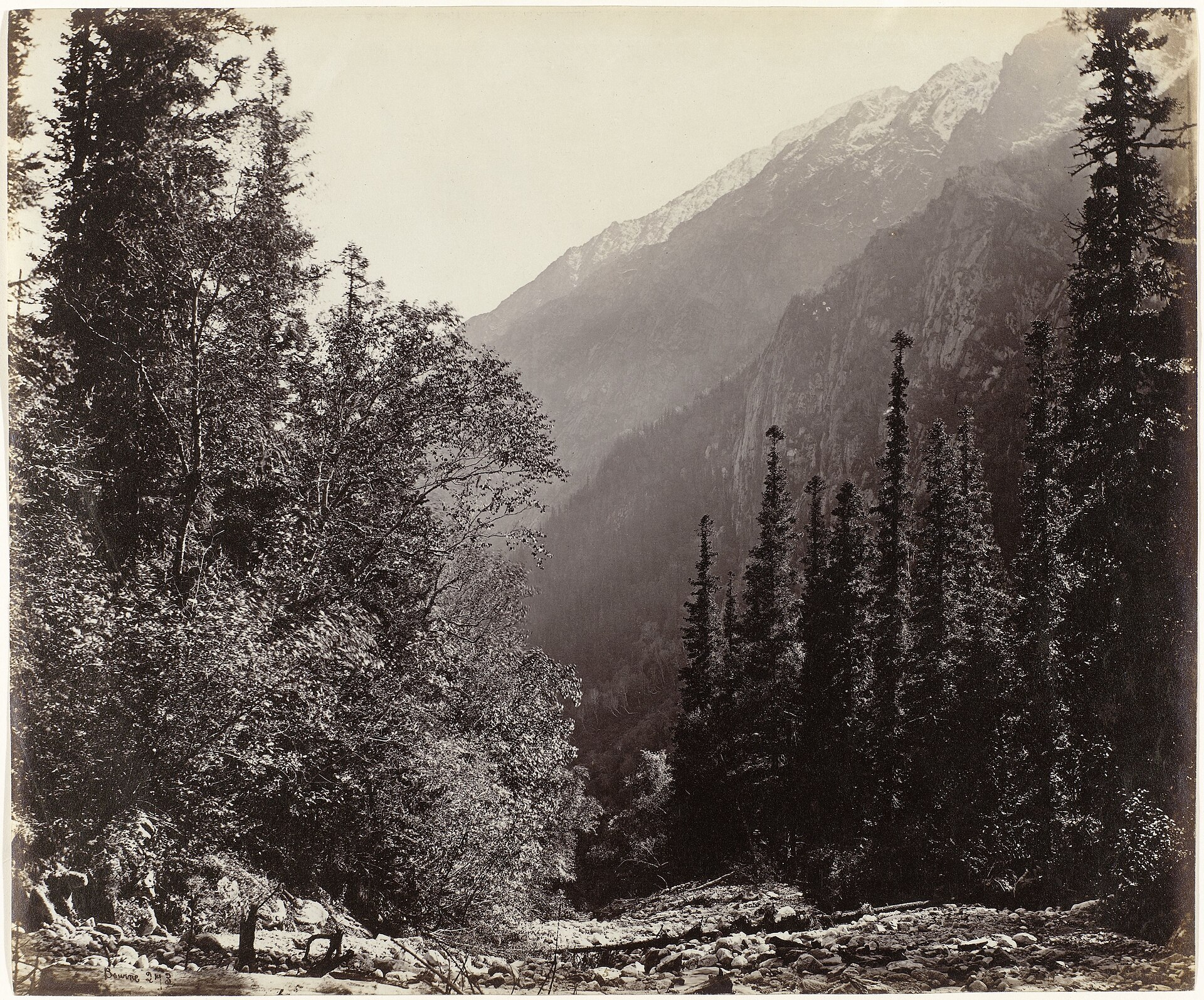
Samuel Bourne arrived in India in 1863 and, with Charles Shepherd, founded the studio Bourne and Shepherd. According to the Duke University Libraries exhibit on royal India and its photographers, he led an expedition into the high Himalayas with about thirty porters and returned with 147 negatives. His mountain views and architectural studies sold widely to colonial officials and travelers. Yet they also framed India as timeless, scenic and curiously unpeopled.7
Bourne returned to England in 1870, but the studio he co-founded kept trading and became one of the best-known photographic businesses in the subcontinent. Its archive had a sad ending. According to the Duke exhibit, a fire in Kolkata in 1991 destroyed more than 2,000 of its plates. That loss is a reminder that the history of 19th century photography depends on fragile objects, and that what survives is only part of what was made.
Photographing for the Archive: Anthropology and Empire
In addition, colonial governments used cameras to classify people. Between 1868 and 1875, the India Office published The People of India, an eight-volume set of mounted albumen prints edited by John Forbes Watson and John William Kaye. It sorted communities into types, with captions that reflected British assumptions. In 1873 and 1874, the Scottish photographer John Thomson published Illustrations of China and Its People, a four-volume work with a more travelogue tone.
Likewise, scientists encouraged the trend. In 1869, the biologist Thomas Henry Huxley advocated systematic anthropological photography as a way to standardize the recording of human variation. Photographs, in this view, were evidence. Scholars such as John Tagg and Christopher Pinney have shown, however, that evidence is never neutral. Consequently, pictures made for an archive carry the power of the person who commissions the archive.8 We have chosen not to reproduce any of these typological portraits here, because their original purpose was to display people as specimens.
Similarly, contemporary scholars stress that photographs in these projects had more than one life. A portrait made for an ethnographic album could later be reused by the sitter’s descendants, a museum or a protest movement, with a completely different meaning. The picture stays the same, but the story told about it changes. For that reason, historians treat captions, album layouts and publishing decisions as part of the image.
Local Photographers in 19th Century Photography: Deen Dayal and Beyond
The story of 19th century photography is often told as if every camera belonged to a European. It did not. Across Asia, the Middle East and Africa, local photographers ran studios, trained apprentices and built their own clientele.
Lala Deen Dayal in India
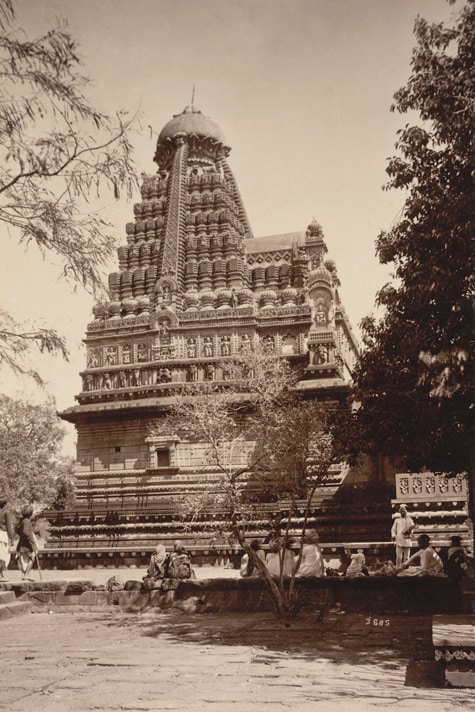
Raja Lala Deen Dayal was born in 1844 and trained as a draftsman in northern India. He began working professionally in the early 1870s, encouraged by the Maharaja of Indore. His main patron became the Nizam of Hyderabad, and he later received a royal warrant from Queen Victoria (1897). He photographed temples, courts and royal tours. Meanwhile, his studio became one of the most successful on the subcontinent.
Istanbul, the China coast and West Africa
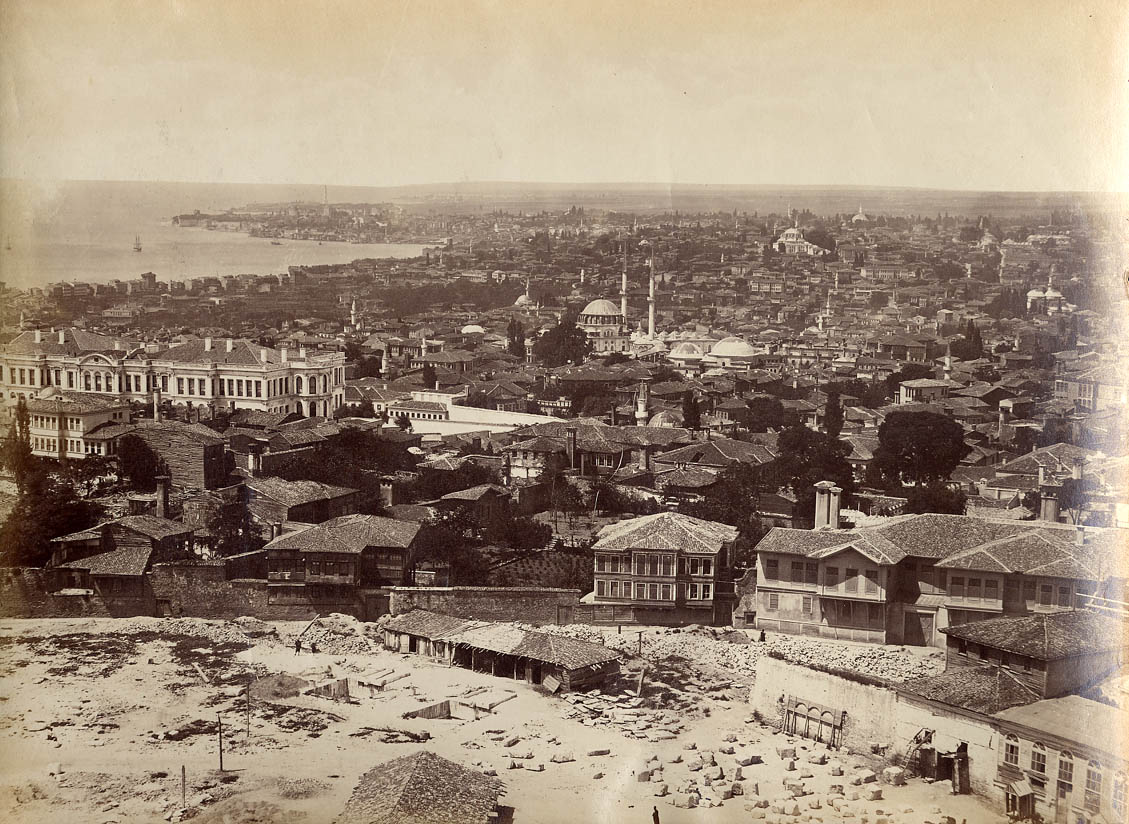
In Istanbul, the Armenian brothers known as the Abdullah Frères became leading studio photographers, producing views of the city and portraits for local and foreign clients. On the China coast, photographers such as Lai Afong built thriving businesses. You can follow that story further in our guide to the history of photography in China.
Finally, photography had African pioneers. The African American daguerreotypist Augustus Washington moved to Liberia in the early 1850s and worked there and in neighboring regions. Historians of West African photography also point to Africa-born professionals active by the late 1860s and 1870s, including John Parkes Decker and Francis W. Joaque, and to members of the Lutterodt family on the Gold Coast.9 Thus, their work reminds us that the camera was never only a tool of outsiders.
The Ethics of Looking: 19th Century Photography Then and Now
It is tempting to sort these pictures into two piles, heroic documents and imperial propaganda. However, the truth is messier. Photographers worked inside institutions, markets, armies and systems of racial classification. Some created fine images. Nevertheless, many served power, even when they did not mean to.
Scholars including Tagg, Pinney, Deepali Dewan, Chaudhary and Sontag have examined those entanglements from different angles. Therefore, a few practical questions follow from their work. Who commissioned the picture? Who wrote the caption? Which archive holds the negative? And who, in the frame, had any say in being there?
A short checklist helps when you meet a photograph from this period in a museum or a book. First, find the date and the maker, and check whether the credit goes to a studio rather than a person, since assistants did much of the work. Second, look for signs of arrangement, such as objects that seem too neatly placed. Third, read the original caption and compare it with modern research. Finally, ask what the photograph cannot show, because 19th century photography, like any medium, had its blind spots.
These questions are not only historical. In an age of synthetic images, our essay on the collapse of photographic truth argues that the old uncertainty about staged and edited pictures has returned. Fenton and Gardner would recognize it.
To go deeper into how photographs claim authority, watch or read about the BBC’s The Genius of Photography, or reread John Szarkowski’s Photography Until Now. When you are ready for the next chapter, the story moves from specialists to everyone: how Kodak made the snapshot.
Key Dates in 19th Century Photography of Empire and War
| Date | Event | Why it matters |
|---|---|---|
| 1854 | Carol Szathmari photographs the Crimean War | Fenton was not the first |
| 8 March–26 June 1855 | Fenton photographs in the Crimea | About 360 photographs, no corpses |
| 1857–1858 | Uprising in India; Beato photographs Lucknow | Photography enters the politics of empire |
| 1861 | Watkins photographs Yosemite; Civil War begins | Landscape and war become photographic subjects |
| October 1862 | Brady’s gallery shows the dead of Antietam | Public confronts the cost of war |
| 1863–1870 | Samuel Bourne works in India | Picturesque colonial landscape |
| 1867–1874 | O’Sullivan works on western surveys | Photography serves science and expansion |
| 1868–1875 | The People of India is published | Photography as colonial classification |
| Early 1870s | Lala Deen Dayal begins professional work | Indian-owned studio success |
| 1873–1874 | Thomson publishes Illustrations of China and Its People | Travel photography in book form |
Frequently Asked Questions
Who was the first war photographer?
Roger Fenton is often named, but Carol Szathmari photographed the Crimean War in 1854, before Fenton arrived. Fenton’s 1855 series was the most widely published of the early war pictures.
Why did 19th century photography avoid combat?
Wet collodion plates needed exposures of several seconds, so moving action blurred. Photographers therefore showed camps, ruins and the aftermath of battle.
Did photographers stage Civil War photographs?
Sometimes. William Frassanito showed that Alexander Gardner’s team moved a dead soldier at Devil’s Den for a Gettysburg photograph. Indeed, staging and arrangement were part of 19th century photography.
Did Watkins’s photographs create Yosemite National Park?
No. His mammoth-plate views of 1861 helped build support for protecting Yosemite, but the 1864 grant resulted from many factors, and the national park came later.
Who photographed the Indian Uprising of 1857?
Felice Beato photographed Lucknow in 1858, after the British recaptured the city. His Sikandar Bagh image is widely discussed because the human remains appear to have been rearranged.
Were there local photographers in 19th century photography?
Yes. Examples include Lala Deen Dayal in India, the Abdullah Frères in Istanbul, Lai Afong in Hong Kong, Augustus Washington in Liberia and Ueno Hikoma in Nagasaki.
- See the Library of Congress blog post “Witness to History: Roger Fenton’s Photographs of the Crimean War”, which also notes that the Library holds 263 of the prints.
- The two versions and the debate about their order are summarized in the Library of Congress post cited above. Susan Sontag argued that Fenton staged the scene in Regarding the Pain of Others (2003), and Errol Morris later investigated the sequence. Historians disagree, and the evidence is not conclusive.
- Hazard, “Marketing The Dead of Antietam: Photographs of Death as a Cultural Commodity,” Civil War History 69, no. 1 (2023), pp. 9–41, doi:10.1353/cwh.2023.0008.
- The Smithsonian American Art Museum’s exhibition “Framing the West: The Survey Photographs of Timothy H. O’Sullivan” (2010, with the Library of Congress) reevaluated these images and the conditions in which they were made. For the rhetoric of survey images, see Wickliff, “Geology, Photography, and Environmental Rhetoric in the American West of 1860–1890,” Technical Communication Quarterly 6, no. 1 (1997), doi:10.1207/s15427625tcq0601_4.
- On Muybridge’s imperial context, see Ahlenius, “Muybridge and the Imperial Pacific: Fashioning Histories of Empire and the Coffee State, 1867–1876,” Interventions 26, no. 8 (2023), pp. 1267–1294, doi:10.1080/1369801x.2023.2288095.
- On the Sikandar Bagh image, see Khorakiwala, “Staging the Modern Ruin: Beato’s ‘Sikander Bagh, Lucknow,'” Thresholds 41 (2013), pp. 138–145, doi:10.1162/thld_a_00105. For the wider argument about empire and photography, see Zahid R. Chaudhary, Afterimage of Empire: Photography in Nineteenth-Century India (Minneapolis: University of Minnesota Press, 2012).
- Guégan, “Visualizing Alienation: Symbolism and Duality in Samuel Bourne’s Photographs of British India,” Visual Culture in Britain 12, no. 3 (2011), pp. 349–365, doi:10.1080/14714787.2011.609393.
- John Tagg, The Burden of Representation: Essays on Photographies and Histories (Minneapolis: University of Minnesota Press, 1993; first published 1988); Christopher Pinney, Camera Indica: The Social Life of Indian Photographs (London: Reaktion Books; Chicago: University of Chicago Press, 1997).
- Biographical details for individual photographers vary between sources and are best checked against museum records.