A dark room, a prism, a pewter plate and a lot of patience: how the camera obscura, chemistry and stubborn curiosity prepared the ground for the first photograph.
The camera obscura is older than any museum that now displays its descendants. Long before anyone owned a camera, people knew that a dark room with a tiny hole in one wall could project the outside world upside down on the opposite wall. In fact, that discovery is the quiet beginning of camera obscura history, and it explains why photography did not appear out of nowhere in the 1820s and 1830s.
This article follows that long runway. We start with the optics of ancient China and the medieval Islamic world, move through the drawing machines of Renaissance and Enlightenment Europe, then watch chemists discover that silver salts darken in sunlight. Finally, we arrive at Nicéphore Niépce's pewter plate. Along the way, one problem keeps returning: how do you make the image stay?
If you read only one section, make it the table of key dates near the end. If you want the full story, read on.
Why "Before Photography" Is a Tricky Phrase
"Before photography" suggests a clean line, with a dark age on one side and a bright invention on the other. However, history is messier than that. Photography needed three ingredients: an optical system that forms an image, a material that reacts to light, and a way to stop that reaction. Moreover, each ingredient has its own past.
In other words, photography was a convergence rather than a eureka moment. Optics came from natural philosophers, chemistry came from apothecaries and experimenters, and the urge to record came from artists, scientists and collectors. Therefore, the most honest way to tell this story is as three braided histories that finally knotted together in the early nineteenth century.
This article is the first of ten in our History of Photography series. It also sets the scene for the bicentenary now being celebrated around the world, which we follow in our guide to the bicentenary of photography.
Camera Obscura History Across Cultures
The Latin words camera obscura simply mean "dark chamber". The phenomenon, however, is a law of physics rather than an invention. As a result, light travels in straight lines. As a result, when it passes through a small aperture, the rays cross, and the scene appears inverted on any surface behind the hole.
Camera Obscura in China and Greece: Earliest Observations
One of the earliest written explanations appears in the Mohist writings attributed to the philosopher Mozi, compiled around the fourth century BCE. They explain that an image turns upside down because light crosses at the aperture.1 Meanwhile, in the Greek world, the Problems attributed to Aristotle asked why sunlight passing through a square gap makes a round image. For instance, both traditions observed the effect. However, neither offered a modern geometric theory, and neither described a camera.
Ibn al-Haytham and the Camera Obscura
The real leap came with Ibn al-Haytham (c. 965 to c. 1040), known in Latin as Alhazen. Working in Fatimid Cairo, he wrote the seven-volume Kitab al-Manazir, or Book of Optics, in the early eleventh century. Scholars still debate the exact dates. In particular, he argued that we see because light enters the eye, not because the eye sends out rays, and he tested his ideas with experiments, including pinhole images.2
His predecessor al-Kindi had already written about light and rays, and in the fourteenth century Kamal al-Din al-Farisi wrote an influential commentary on his optics in Persia. In Latin Europe, the book circulated from the late twelfth or early thirteenth century as De aspectibus. Thinkers such as Roger Bacon, John Pecham and Witelo built on it, and the 1572 Basel edition known as the Opticae thesaurus shows how long it stayed in demand.
Shen Kuo and the Chinese Camera Obscura
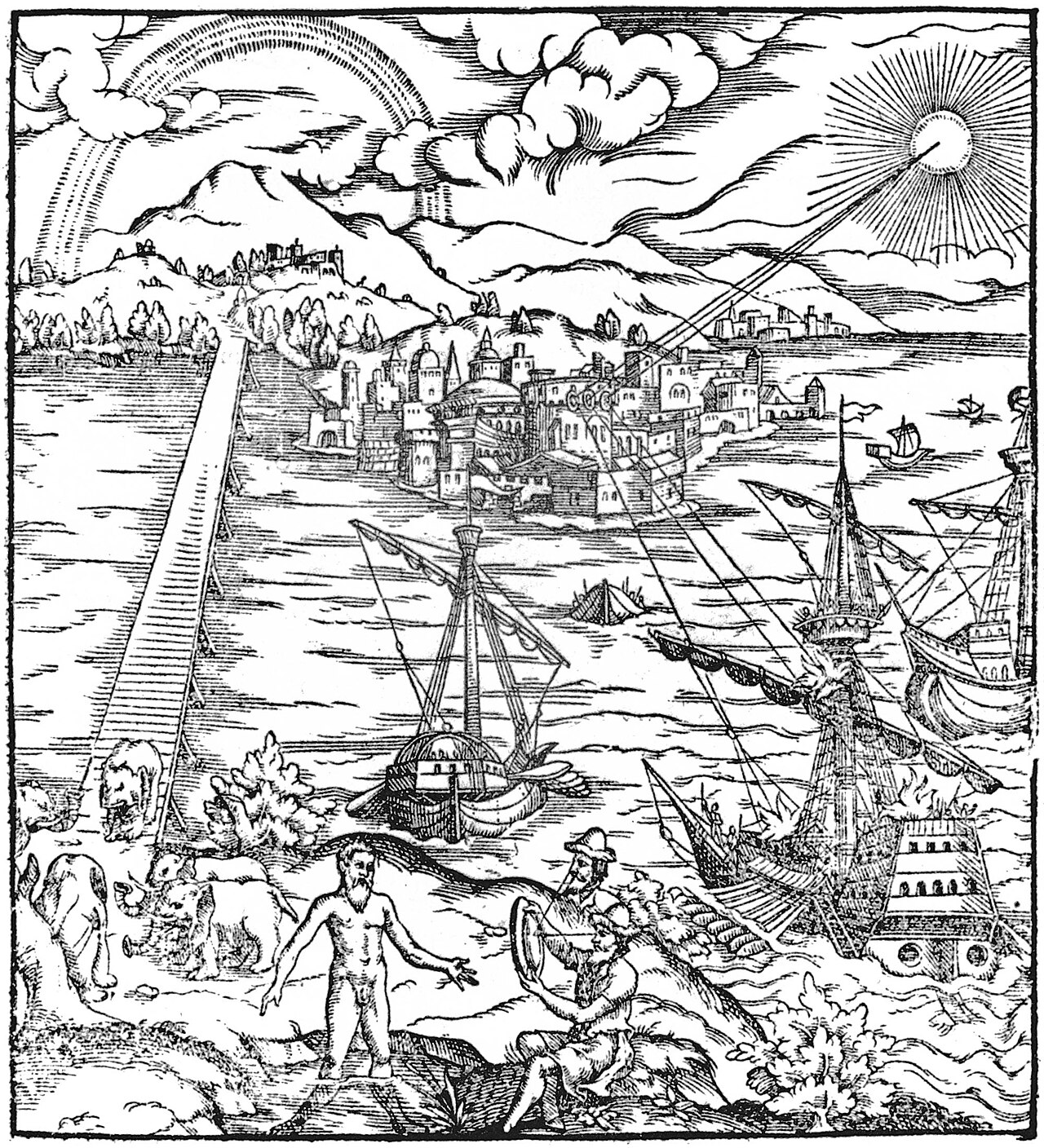
On the other side of Eurasia, the Song dynasty scholar Shen Kuo (1031 to 1095) discussed inverted images in his Dream Pool Essays of 1088. He compared the crossing of rays at a small hole to an oar turning in its rowlock.3 His tradition was independent of the European one. Even so, it deserves a place in any serious account of optics, even though nobody used it to make photographs.
From Camera Obscura to Scientific Instrument
Meanwhile, in Europe, the camera obscura moved from curiosity to tool. Leonardo da Vinci described the principle in his notebooks. Giambattista della Porta wrote about its use for drawing in Magia naturalis (first published in 1558, expanded in 1589). In 1545, Gemma Frisius published the earliest known printed illustration of a camera obscura, showing how it could safely observe a solar eclipse.
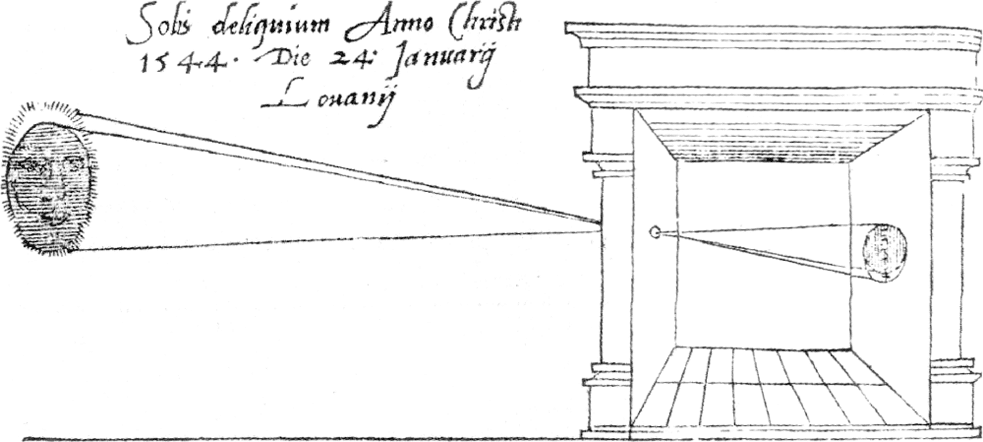
Johannes Kepler then gave the device its Latin name in 1604, and he explained image formation with geometry. From that point on, the camera obscura was not just a trick. Instead, it was an instrument.
Beyond the Camera Obscura: Boxes, Prisms and Tinted Mirrors
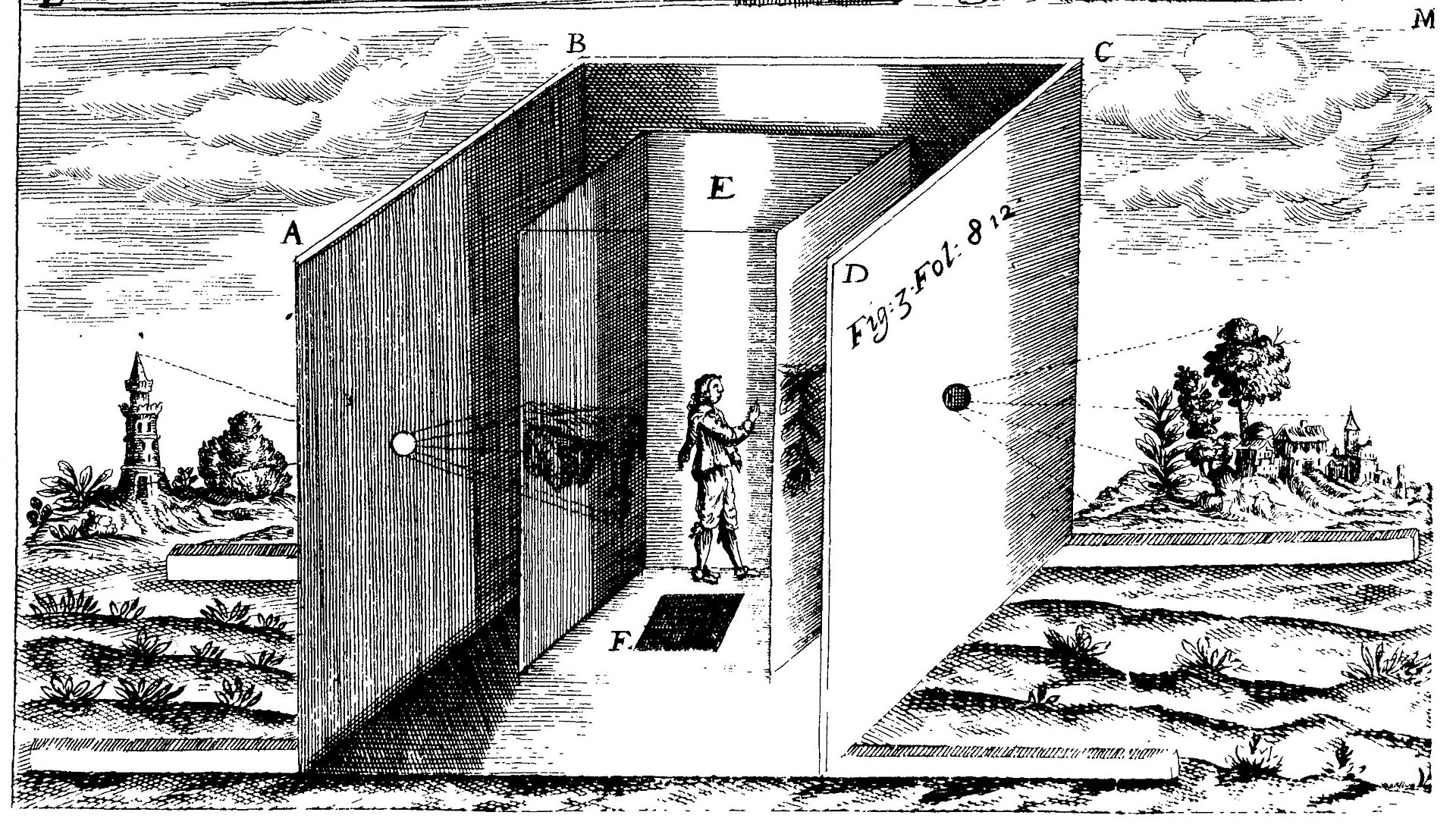
By the seventeenth century, artists and scientists wanted portable versions. In 1646, Athanasius Kircher illustrated a portable camera obscura in his Ars magna lucis et umbrae. Then, over the next century, the design shrank into a wooden box with a lens, an angled mirror and a sheet of tracing paper on top. Still, the draughtsman traced the projected scene by hand.
Two other devices belong in this story, because they are often confused with it.
- The camera lucida, patented by William Hyde Wollaston in 1807, uses a prism so that the artist sees the scene superimposed on the paper. Nothing is projected, and nothing is recorded.
- The Claude glass is a small, tinted, slightly convex mirror that landscape painters and tourists used to frame a view. It was a compositional aid, named after the painter Claude Lorrain.
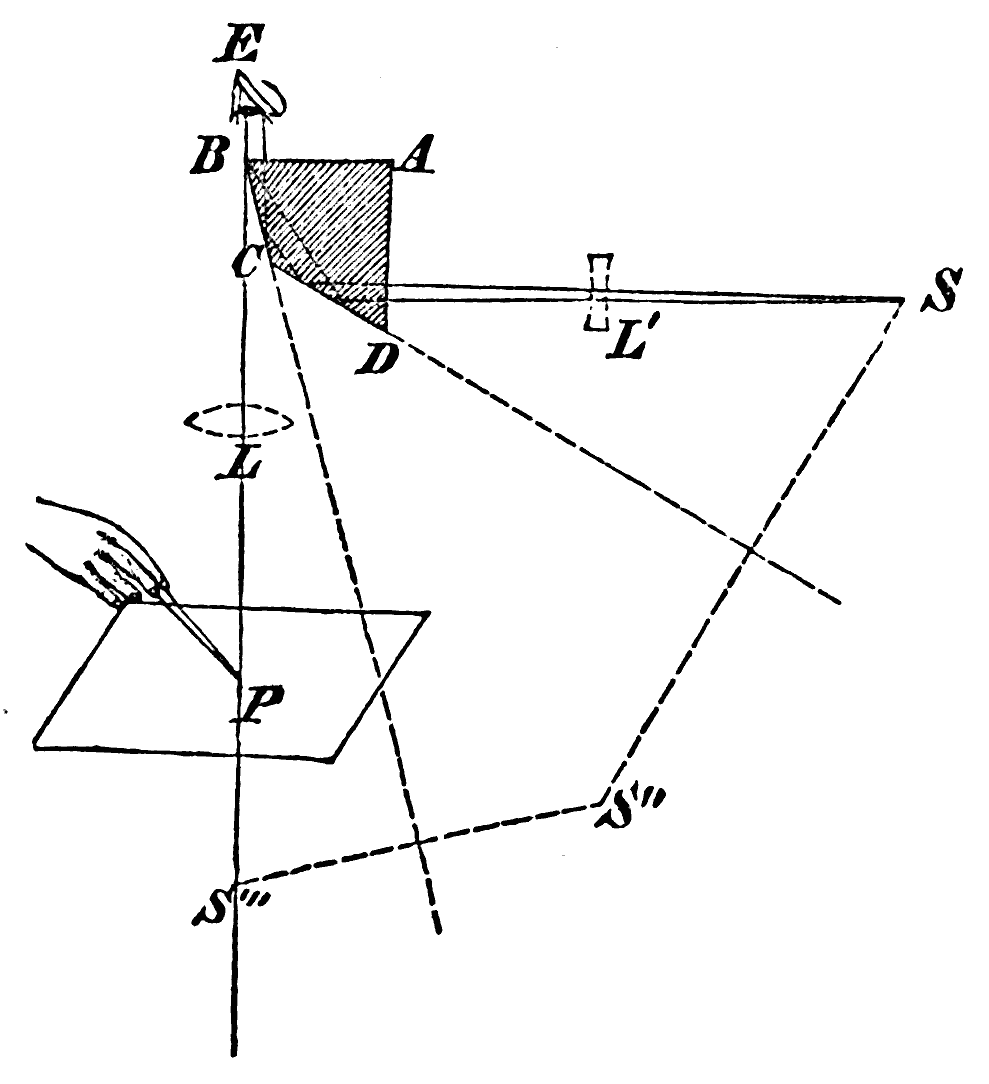
All three devices solved the same problem for a draughtsman: how to copy nature accurately. Yet none of them solved the problem that mattered to photography, which was how to keep the image once the viewer looked away. If you want to feel that frustration yourself, try our DIY pinhole photography guide.
The Chemistry of Light: Silver Salts Begin to Darken
While artists traced projected images, chemists noticed something else. Certain silver compounds darken when light strikes them.
Schulze, Scheele and Ritter
Around 1717, the German physician Johann Heinrich Schulze mixed chalk, nitric acid and silver, and found that the mixture darkened in sunlight rather than from heat. He published the result in 1719. Even so, he even made temporary stencilled lettering with it, but he saw no use for the effect beyond curiosity. In 1777, the Swedish chemist Carl Wilhelm Scheele showed that light blackens silver chloride, and that violet light is especially effective. Then, in 1801, Johann Wilhelm Ritter used silver chloride to detect invisible rays beyond the violet end of the spectrum, now called ultraviolet.
Wedgwood and Davy, 1802
The first serious attempt to turn this chemistry into pictures came in England. Thomas Wedgwood, a son of the potter Josiah Wedgwood, coated paper and white leather with silver nitrate. He then laid leaves, insect wings and painted glass on top and exposed them to sunlight. Likewise, the result was a pale silhouette of the object on a darkening background. Humphry Davy wrote up the experiments, and the account appeared in the Journals of the Royal Institution in 1802.4
Wedgwood also tried to capture camera obscura images. They proved too faint for his materials, so he copied smaller, brighter images from a solar microscope instead. More importantly, the pictures could not be fixed. Davy noted that they had to be kept in the dark or they would darken everywhere.5 Those shadow pictures are what we now call photograms, and you can make them at home with our guide to photograms.
Lake Como, 1833: A Bad Drawing and a Good Idea
In October 1833, a young English polymath named William Henry Fox Talbot sat beside Lake Como on his honeymoon, sketching with a camera lucida. Unfortunately, his drawings were disappointing. In his own recollection, the faithless pencil left only melancholy traces on the paper.6
That frustration sent him back to an older memory, the pretty images thrown by a camera obscura. He wondered whether such natural images could "imprint themselves durably" on paper. Back at Lacock Abbey in 1834, he coated paper with salt and silver nitrate, and he began making what he called photogenic drawings.
By the summer of 1835, he had placed sensitised paper inside small wooden cameras, which his wife nicknamed "mousetraps". One of them, for example, recorded a latticed window in Lacock Abbey's south gallery. Later, the negative is tiny, roughly 3.5 by 2.9 centimetres, and the Science Museum Group describes it as the oldest known surviving paper negative.7 In addition, Talbot noted on the mount that, when it was first made, about two hundred panes of glass could be counted with a lens.
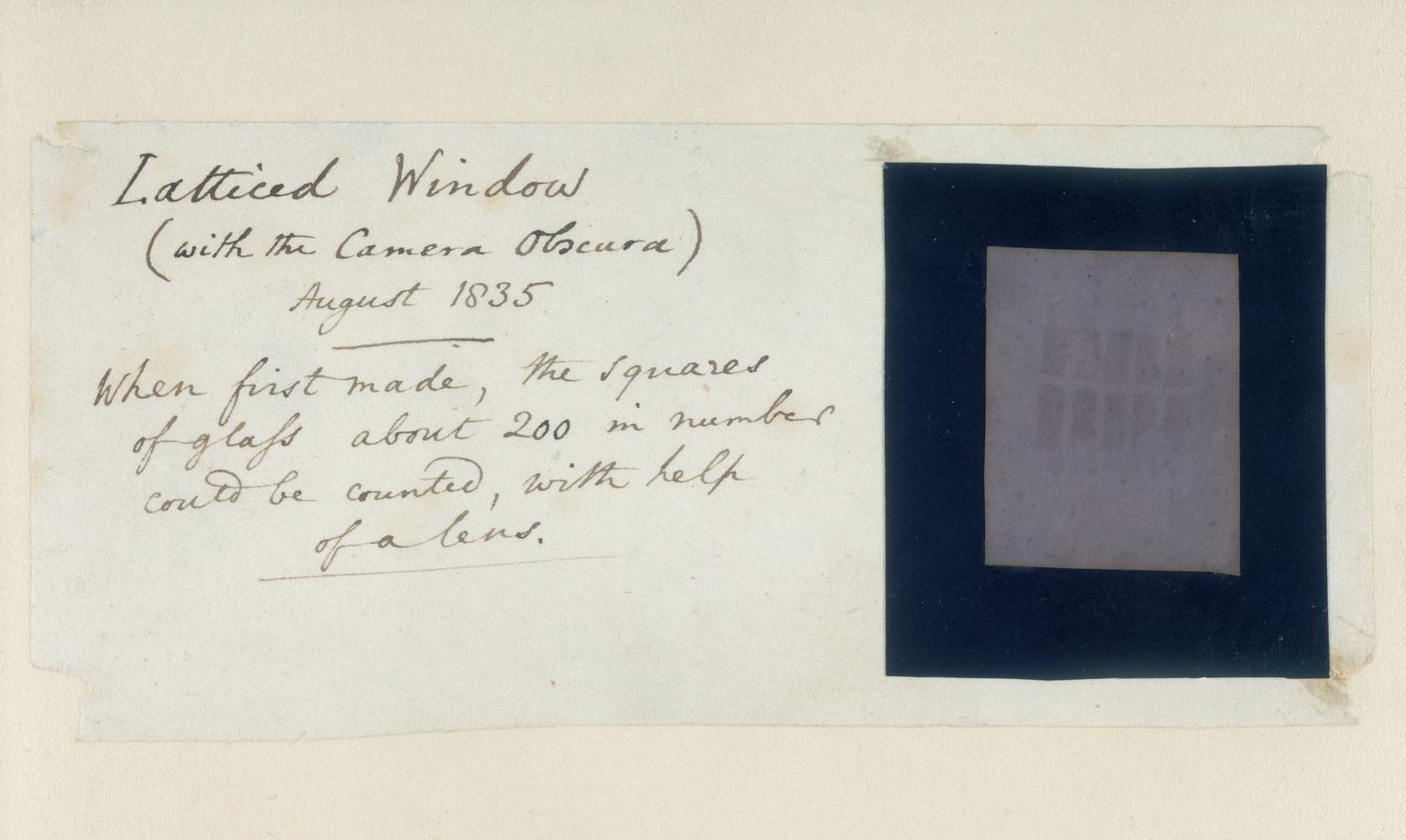
Talbot's later breakthroughs, the latent image and the calotype, belong to the next article in this series. For now, the key point is that his starting question was Niépce's question too.
Niépce and the Sun's Handwriting
Joseph Nicéphore Niépce (1765 to 1833) was not a painter or a chemist by training. He was an inventor from a prosperous Burgundy family who liked tinkering with printing and engines. Besides, he came to photography through lithography, because he wanted a way to copy engravings without relying on a draughtsman.
Heliography: writing with the sun
He called his process héliographie, "sun writing". Niépce dissolved bitumen of Judea, a natural asphalt, in oil of lavender and coated a polished pewter plate with it. Light hardens bitumen. After a long exposure, he washed the plate with a solvent. Above all, the unexposed bitumen dissolved, and the hardened parts remained as a faint image.8
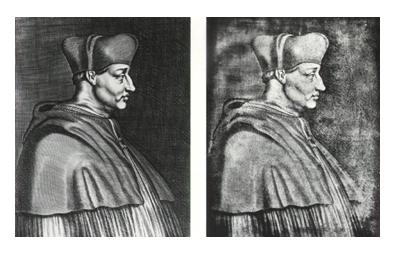
At first, he used the process to copy engravings by contact. One well-known example is a heliographic reproduction of an engraving of Cardinal Georges d'Amboise from 1826. Conservators who later examined the plate found something intriguing: it was deeply etched for printing, yet it had apparently never been inked or printed from.9
View from the Window at Le Gras
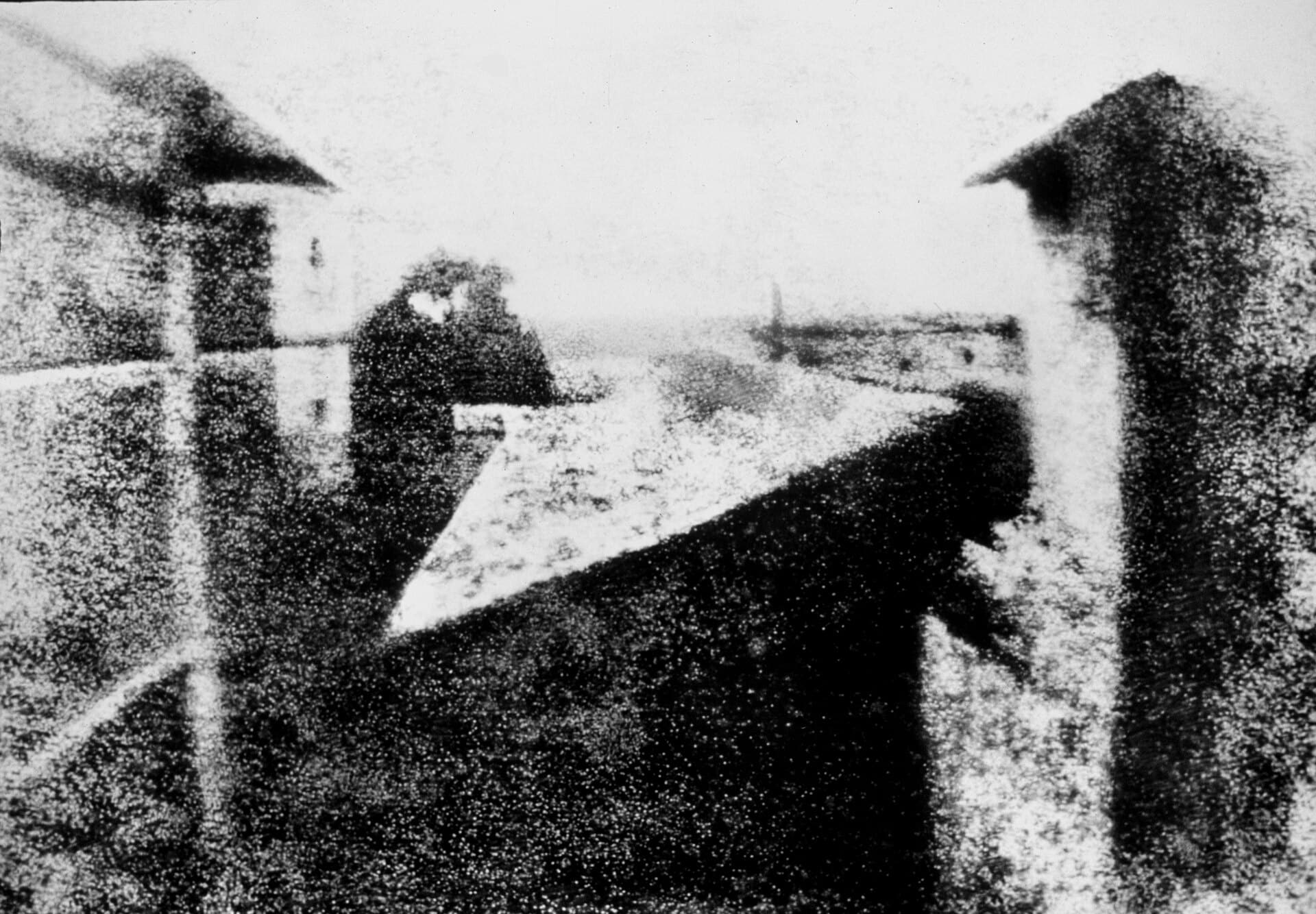
However, the real prize was a picture made in a camera. Niépce put a pewter plate at the back of a camera obscura and pointed it out of an upstairs window at his family estate near Chalon-sur-Saône. The result, now called View from the Window at Le Gras, is the earliest surviving permanent photograph made with a camera. We tell its full story in our article on View from the Window at Le Gras.
Careful historians avoid calling it simply "the first photograph". Two points need nuance:
- The date. Sources give 1826 or 1827, and the exact year remains uncertain.
- The exposure. Tradition says about eight hours. Later researchers who re-created Niépce's process suggested several days.
The plate measures roughly 16 by 20 centimetres. In addition, the Ransom Center attributes the faintness of the image not to fading but to underexposure, which fits the extremely low sensitivity of bitumen.10
Lost, found and tested
In late 1827, Niépce visited England and showed his plates to the botanical illustrator Francis Bauer. However, the Royal Society declined to hear his paper because he would not reveal the details of his process. He left several plates with Bauer, and the Le Gras plate was last seen in public around 1905. Therefore, it then vanished for nearly fifty years.
Photo-historians Helmut and Alison Gernsheim tracked it down in 1952. According to the Ransom Center, the University of Texas bought the Gernsheim Collection in 1963, and Helmut Gernsheim donated the heliograph to the university shortly afterwards. In June 2002, the plate travelled to the Getty Conservation Institute in Los Angeles for its first full scientific examination. Researchers confirmed its pewter support and bitumen image layer, and they used the findings to improve how it is preserved.
A partnership with Daguerre
In 1829, Niépce formed a partnership with the Parisian showman and painter Louis-Jacques-Mandé Daguerre. Niépce died in 1833, and Daguerre carried the work forward and announced his own process, the daguerreotype, in 1839. That story opens the next article.
Why Fixing the Image Was the Real Problem
Looking back, three problems had to be solved, and they were solved by different people at different times.
- Forming an image. The camera obscura, with a lens, already did this superbly.
- Finding a light-sensitive material. Silver salts and bitumen both worked, but at very different speeds.
- Making the result permanent. This was the hardest step. Wedgwood's images faded. Niépce's survived, but only after hours or days in the camera.
Fixing was therefore the decisive breakthrough. Without it, a camera produces a beautiful, fleeting image that disappears as soon as you stop looking. By contrast, with it, the image becomes an object that can be stored, copied, sold and argued over. Similarly, that change, more than the camera itself, is what made photography a new medium.
Key Dates at a Glance
| Date | Event | Why it matters |
|---|---|---|
| c. 4th century BCE | Mohist writings describe inverted pinhole images | Early written explanation of the principle |
| Early 11th century | Ibn al-Haytham writes the Book of Optics | Experimental optics, including pinhole images |
| 1088 | Shen Kuo's Dream Pool Essays | Independent Chinese optical tradition |
| 1545 | Gemma Frisius publishes the earliest known printed camera obscura illustration | Eclipse observation moves into print |
| 1604 | Kepler names the camera obscura | Geometry explains image formation |
| c. 1717 | Schulze shows silver salts darken in light | The chemical principle appears |
| 1802 | Wedgwood and Davy publish their silver nitrate experiments | Photograms, but no fixing |
| 1807 | Wollaston patents the camera lucida | A drawing aid that inspires Talbot |
| 1826-27 | Niépce makes View from the Window at Le Gras | Earliest surviving permanent camera photograph |
| 1829 | Niépce and Daguerre form a partnership | Sets up the daguerreotype |
| 1833-35 | Talbot at Lake Como and Lacock Abbey | Paper negatives begin |
What Camera Obscura History Teaches Us
The story of camera obscura history carries three lessons for anyone who looks at photographs today.
First, photography is a conversation between optics, chemistry and culture. Second, it was never a single European invention. Optical knowledge travelled between China, the Islamic world and Europe over many centuries. Third, the technical problems were always tied to human wishes: to draw accurately, to remember, to prove and to possess.
If you are curious how those wishes shaped the first public photographic processes, continue with the next article, Inventing Photography, 1839-1851: Daguerre, Talbot, Bayard and Herschel. For a broader view, see our reviews of The Pencil of Nature, John Szarkowski's Photography Until Now and the BBC documentary The Genius of Photography.
Frequently Asked Questions
Who invented the camera obscura?
Nobody did, strictly speaking. It is a natural optical effect that people in China, Greece and the Islamic world described independently. Ibn al-Haytham analysed it experimentally in the early eleventh century. Later European scientists and artists turned it into a portable instrument.
What is the oldest surviving photograph?
Niépce's View from the Window at Le Gras is generally regarded as the oldest surviving photograph made in a camera. It dates from about 1826 or 1827, and the plate is held at the Harry Ransom Center in Austin, Texas.
Why did the earliest photographic images fade?
The silver salts on Wedgwood's paper and Talbot's early photogenic drawings kept reacting to light after the exposure. Without a fixing step, the whole sheet slowly darkened. Fixing, which Herschel later made practical with sodium thiosulfate, stops that reaction.
Is a pinhole camera the same as a camera obscura?
They are closely related. A pinhole camera is a camera obscura with a tiny aperture and no lens, usually fitted with light-sensitive material. A camera obscura may use a lens and project onto a screen or tracing paper instead.
- Joseph Needham, Wang Ling and Lu Gwei-Djen, Science and Civilisation in China, vol. 4, part 1 (Cambridge: Cambridge University Press, 1962), discuss Mohist optics and the pinhole image. Dating of the Mohist Canon is approximate and debated.
- Nader El-Bizri, "Arabic classical traditions in the history of the exact sciences: the case of Ibn al-Haytham," The European Physical Journal Plus 133 (2018), doi:10.1140/epjp/i2018-12142-7. See also Robert McQuaid, "Ibn al-Haytham, the Arab who brought Greek optics into focus for Latin Europe," Advances in Ophthalmology & Visual System 9, no. 2 (2019): 44-51, doi:10.15406/aovs.2019.09.00344.
- On Shen Kuo's Mengxi bitan (1088) and his treatment of focal points and inverted images, see Needham, Science and Civilisation in China, vol. 4, part 1, and Nathan Sivin's studies of Shen Kuo.
- Thomas Wedgwood and Humphry Davy, "An Account of a Method of Copying Paintings upon Glass, and of Making Profiles, by the Agency of Light upon Nitrate of Silver," Journals of the Royal Institution of Great Britain 1 (1802): 170-74. A modern reprint is available at doi:10.4324/9781003084976-12.
- Leonard Darwin's entry on Thomas Wedgwood in the Dictionary of National Biography (1899) notes that Wedgwood failed to find any method of fixing his pictures, so the copies had to be kept in the dark. The text is reproduced on Wikisource.
- Department of Photographs, The Metropolitan Museum of Art, "William Henry Fox Talbot (1800-1877) and the Invention of Photography," Heilbrunn Timeline of Art History (October 2004), metmuseum.org.
- Science Museum Group Collection, "Windows From Inside South Gallery, Lacock Abbey" (object 1937-361), collection.sciencemuseumgroup.org.uk. For the object's dimensions and Talbot's inscription, see the William Henry Fox Talbot Catalogue Raisonné, Bodleian Libraries.
- Harry Ransom Center, University of Texas at Austin, news release on the first photograph (3 September 2003), hrc.utexas.edu, which describes the heliograph process and the plate.
- Getty Conservation Institute, "Applied Research of Photographic Processes," getty.edu, reporting on the scientific study of three Niépce plates held at what was then the National Media Museum in Bradford.
- University of Texas at Austin, "Results from the First Photograph Undergoing Scientific Tests" (21 November 2003), news.utexas.edu. The Getty Conservation Institute analysed the plate in 2002 using X-ray fluorescence and infrared spectroscopy, confirming a pewter support and a bitumen image layer made of tiny microdots. For the peer-reviewed studies of Niépce's plates, see "The first scientific investigation of Niépce's images from UK and US collections: image layer and image formation," The Imaging Science Journal 61 (2013), doi:10.1179/1743131X12Y.0000000007, and its companion on the image substrate, doi:10.1179/1743131X12Y.0000000008. On the history of the plate, see Helmut Gernsheim, "The 150th Anniversary of Photography," History of Photography 1, no. 1 (1977), doi:10.1080/03087298.1977.10442876.