In October 1975, something unusual happened at the George Eastman House in Rochester, New York. Ten photographers hung 168 images on gallery walls—pictures that many visitors found, frankly, boring. Parking lots. Suburban tract homes. Industrial buildings. Not a single majestic mountain or pristine wilderness in sight. The exhibition was called New Topographics: Photographs of a Man-Altered Landscape, and it would quietly revolutionize how we see photography, landscape, and America itself.1
The New Topographics 1975 exhibition didn't just document suburban sprawl—it challenged everything photography was supposed to be. While Ansel Adams was still printing his glorious Yosemite vistas, these younger photographers pointed their cameras at strip malls and half-built housing developments. The work looked clinical, detached, almost anti-aesthetic. And that was precisely the point.
William Jenkins and the Birth of a Movement
Curator William Jenkins coined the term "New Topographics" specifically for this exhibition, drawing from 19th-century topographical surveys that documented terrain with scientific precision.2 But Jenkins wasn't interested in nostalgia. He saw something emerging in contemporary photography—a cool, systematic approach to the American landscape that rejected romantic sentiment entirely.
In his catalog essay, Jenkins described these photographs as "anthropological rather than critical, scientific rather than artistic."3 The photographers he selected—Robert Adams, Lewis Baltz, Bernd and Hilla Becher, Joe Deal, Frank Gohlke, Nicholas Nixon, John Schott, Stephen Shore, and Henry Wessel Jr.—shared what Jenkins called a "stylistic anonymity." Their images avoided dramatic lighting, emotional manipulation, and compositional flourishes. They simply showed what was there.
Why did Jenkins organize this particular exhibition at this particular moment? The George Eastman House had established itself as America's premier photography institution, making it the perfect venue for legitimizing this emerging aesthetic. Jenkins recognized that something fundamental was shifting in how photographers engaged with the landscape tradition. He wasn't creating a movement—he was naming one that already existed.
The Photographers and Their Signature Works
Robert Adams: The Moral Weight of Banality
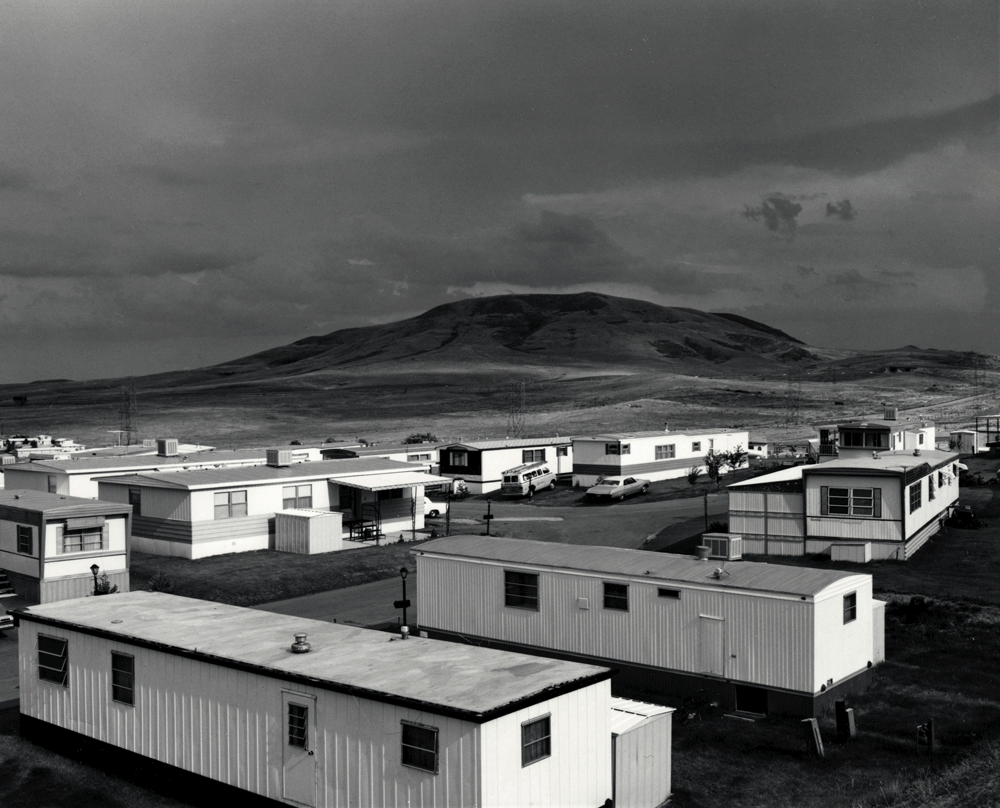
Robert Adams contributed images from his groundbreaking series on Colorado's Front Range, where suburban development was consuming open prairie at an alarming rate.4 His photographs of tract homes against mountain backdrops weren't simply documentary—they carried an implicit ethical question. What are we doing to this land? Adams used a large-format camera and natural light, creating images that felt simultaneously ordinary and profound. His work suggested that beauty could exist even in environmental degradation, a paradox that troubled many viewers.
Lewis Baltz: Industrial Parks and the New American Landscape
If Adams documented residential sprawl, Lewis Baltz turned his attention to industrial parks—those anonymous commercial zones that proliferated in Southern California during the 1970s.5 His photographs showed blank walls, loading docks, and parking lots with such precision that they resembled minimalist sculptures. Baltz worked with an 8x10 view camera, creating images of exceptional clarity that forced viewers to confront the aesthetic poverty of contemporary development. There's something almost brutal about Baltz's work—he refused to find redemptive beauty in these spaces.
Bernd and Hilla Becher: The European Exception
The inclusion of German photographers Bernd and Hilla Becher might seem odd in an exhibition focused on American landscape, but their systematic documentation of industrial architecture provided the theoretical framework for the entire enterprise.6 Working in a deliberately neutral style they called "anonymous sculpture," the Bechers photographed their subjects in consistent lighting conditions, centered in the frame, devoid of context. Their approach demonstrated that systematic documentation could itself be an artistic strategy. The Bechers' influence extended far beyond this exhibition, shaping what would become known as the Düsseldorf School of Photography.
Stephen Shore: Color as Radical Statement
Stephen Shore was the exhibition's outlier—the only photographer working primarily in color. In 1975, color photography was still considered commercial, not serious art.7 Shore's images of ordinary American scenes—intersections, storefronts, motel rooms—used color to emphasize the vernacular landscape's inherent strangeness. His work suggested that America's visual environment was already surreal; photographers just needed to show it clearly. Shore used a large-format camera and natural light, creating images that balanced documentary precision with formal sophistication.
The Other Voices: Deal, Gohlke, Nixon, Schott, and Wessel
Joe Deal photographed Southern California's suburban development with an emphasis on geometric abstraction. Frank Gohlke documented grain elevators and small-town architecture in the Midwest, bringing the New Topographics aesthetic to rural America. Nicholas Nixon's urban views emphasized architectural relationships and spatial dynamics. John Schott focused on California's Central Valley, where agricultural and suburban landscapes collided. Henry Wessel Jr. brought a more intuitive, street photography sensibility to the project, his images capturing the psychological atmosphere of contemporary American life.8
The 1970s Context: Vietnam, Watergate, and the Death of the American Dream
You can't understand the New Topographics 1975 exhibition without understanding the moment it emerged from. America in 1975 was reeling. The Vietnam War had just ended in humiliating defeat. Watergate had destroyed faith in government. The 1973 oil crisis had revealed the fragility of postwar prosperity. A recession was settling in, and the optimism that had fueled suburban expansion suddenly felt hollow.9
The photographers in New Topographics weren't explicitly political—they avoided protest and advocacy. But their work carried an unmistakable critique. These images of half-finished developments and characterless commercial zones suggested that the American Dream had produced a nightmare landscape. The postwar promise—own your home, live in the suburbs, prosper—had resulted in environmental degradation and social isolation. The photographs didn't need to make this argument explicitly. They just showed what suburban America actually looked like.
The exhibition also emerged from broader cultural shifts. The environmental movement was gaining momentum—the first Earth Day had occurred in 1970, and the EPA was established the same year. Conceptual art and minimalism were challenging traditional notions of artistic expression. Documentary photography was evolving beyond social reform toward more ambiguous investigations. New Topographics synthesized these currents, creating something that felt simultaneously documentary and conceptual, political and detached.
Breaking with Tradition: From Ansel Adams to Parking Lots
The New Topographics photographers were staging a generational rebellion. Their parents' generation—photographers like Ansel Adams, Edward Weston, and Minor White—had celebrated wilderness as spiritual sanctuary.10 These earlier photographers used landscape to affirm transcendental values, finding in nature a refuge from industrial modernity.
The New Topographics photographers rejected this entire framework. They weren't interested in pristine wilderness—most Americans didn't live there anyway. They photographed where people actually lived: suburbs, industrial zones, commercial strips. And they refused to romanticize these spaces or condemn them overtly. The work operated in an uncomfortable middle ground, neither celebrating nor denouncing its subjects.
This aesthetic shift had technical dimensions too. While Adams used dramatic lighting and careful printing to create emotional impact, the New Topographics photographers favored flat, even illumination. Adams composed for maximum visual drama; they composed for clarity and information. Adams printed for tonal richness; they printed for neutral description. Every formal choice emphasized detachment over engagement, information over emotion.
The comparison reveals something crucial: the New Topographics photographers weren't rejecting beauty—they were redefining it. They found aesthetic interest in geometric relationships, spatial ambiguities, and the strange poetry of ordinary places. Their work suggested that the contemporary landscape deserved the same serious attention that previous generations had given to Yosemite and the Grand Canyon. This was radical in 1975.
Reception and Recognition: The Slow Burn of Influence
The initial reception of New Topographics was decidedly mixed. Many visitors found the work boring, even offensive. Where was the beauty? The craft? The emotion? Critics were divided. Some recognized the exhibition's importance immediately, while others dismissed it as a passing trend or a conceptual stunt.11
The exhibition traveled modestly after its Rochester debut, but it didn't immediately transform photography. Recognition came slowly, building through the 1980s and 1990s as the work's influence became undeniable. By the 2000s, New Topographics was recognized as one of the most important photography exhibitions ever mounted—a watershed moment that had fundamentally altered the medium's trajectory.
The 2009-2010 restaging at the George Eastman Museum confirmed the exhibition's canonical status.12 A comprehensive catalog published by Steidl, edited by Britt Salvesen, provided extensive documentation and scholarly analysis. The original 1975 catalog had been a modest 48-page publication; the 2009 version was a substantial scholarly tome. This transformation from marginal to canonical is itself revealing—it took decades for the art world to fully absorb what Jenkins and his photographers had accomplished.
Why the delayed recognition? Partly because the work challenged too many assumptions at once. It rejected landscape photography's romantic tradition, documentary photography's social mission, and fine art photography's emphasis on craft and beauty. It occupied an uncomfortable position between art and documentation, critique and neutrality. The art world needed time to develop frameworks for understanding this hybrid approach.
The Paradox of Neutrality: How Detachment Became Political
Here's the thing about the New Topographics photographers' supposedly neutral style: it wasn't neutral at all. By choosing to photograph suburban sprawl and industrial development with the same seriousness that previous generations had given to wilderness, they were making a profoundly political statement. They were saying: this matters. This deserves attention. This is what America looks like now.13
The photographs' emotional flatness was itself a form of critique. By refusing to editorialize, they forced viewers to confront their own responses to these landscapes. Do you find these tract homes depressing? That's your response, not the photographer's manipulation. Do you see beauty in these industrial forms? Again, that's your perception. The work's apparent objectivity was actually a sophisticated rhetorical strategy.
This approach connected to broader developments in conceptual art and minimalism. Artists like Ed Ruscha, Dan Graham, and Robert Smithson were similarly investigating vernacular American landscapes and architectural forms.14 The New Topographics photographers brought this conceptual sensibility into photography, creating work that operated simultaneously as documentation and as art about documentation.
The environmental implications were impossible to ignore, even if the photographers avoided explicit advocacy. These were photographs of environmental transformation, habitat destruction, and resource consumption. They documented what we now call the Anthropocene—the geological epoch defined by human impact on Earth's systems. The exhibition anticipated contemporary concerns about climate change, sustainability, and urban planning by decades. Looking at these 1975 photographs now, you see prophecy.
Legacy and Influence: From 1975 to the Present
The influence of the New Topographics 1975 exhibition on contemporary photography cannot be overstated. It fundamentally altered what landscape photography could be and what subjects deserved photographic attention. Nearly every photographer working with landscape since 1975 has had to reckon with this exhibition's legacy, either building on it or reacting against it.
Direct lineages are easy to trace. Edward Burtynsky's aerial photographs of industrial landscapes extend the New Topographics approach to global scale, documenting mining operations, oil fields, and manufacturing zones with the same detached precision.15 Mishka Henner uses Google Earth and satellite imagery to investigate landscapes from above, pushing the conceptual dimensions of topographic documentation into digital territory. Andreas Gursky, Thomas Struth, and other graduates of the Düsseldorf School extended the Bechers' systematic approach to contemporary subjects.
The exhibition's impact extended beyond individual photographers to institutional and market structures. Photography galleries and museums became more willing to show documentary work as fine art. Collectors began acquiring photographs of ordinary subjects. The distinction between documentary and art photography—never entirely clear—became even more porous. Curators like John Szarkowski at MoMA championed this hybrid approach, further legitimizing it within the art world.
The exhibition also changed how we see the built environment. After New Topographics, suburban sprawl and commercial development became legitimate subjects for serious photography. This shift had cultural implications beyond photography—it influenced how Americans thought about landscape, development, and environmental change. The exhibition helped create a visual vocabulary for discussing these issues.
Contemporary photographers continue to engage with the New Topographics legacy in varied ways. Some extend its documentary precision to new subjects: data centers, logistics hubs, renewable energy installations. Others critique its apparent neutrality, arguing for more explicit political engagement. Still others explore how digital technology has transformed both landscape and photography. The conversation that New Topographics initiated continues, evolving with each generation.
Technical Approaches: Equipment and Methods
The New Topographics photographers shared technical approaches that reinforced their aesthetic goals. Most worked with large-format cameras—4x5 or 8x10 view cameras that produced exceptional detail and tonal range.16 These cameras demanded tripods, careful composition, and patient execution. You can't shoot spontaneously with an 8x10 camera—every image requires deliberation.
This technical choice had aesthetic consequences. Large-format negatives captured extraordinary detail, rendering every element with equal clarity. Nothing was soft or atmospheric—everything was sharp, present, insistent. This democratic focus—where a distant mountain received the same attention as a foreground parking meter—emphasized the photographs' documentary function while creating strange visual tensions.
Most photographers worked in black and white, using traditional gelatin silver printing processes. They generally avoided dramatic printing techniques, preferring neutral tones and even contrast. The prints themselves were often modest in size, emphasizing information over visual impact. Stephen Shore's color work was exceptional in this context, though his technical approach—large-format camera, natural light, precise exposure—aligned with the group's broader methodology.
Lighting was typically natural and unremarkable—overcast days, flat illumination, minimal shadows. The photographers avoided dramatic weather, golden hour light, and atmospheric effects. They wanted clarity, not mood. This approach extended to composition: centered subjects, level horizons, straightforward perspectives. The technical choices consistently emphasized description over interpretation, information over emotion.
The Gender Question: Nine Men and One Woman
It's impossible to ignore that the New Topographics exhibition featured nine male photographers and only one woman—Hilla Becher, who worked collaboratively with her husband Bernd. This gender imbalance reflected broader patterns in 1970s photography and art institutions, where women photographers faced systematic exclusion and marginalization.17
Were there women photographers working in similar modes who could have been included? Absolutely. The exhibition's gender imbalance wasn't inevitable—it reflected curatorial choices and institutional biases. This doesn't diminish the exhibition's importance, but it does complicate its legacy. Canonical exhibitions shape not just aesthetic history but also whose work gets remembered and valued. The New Topographics' male-dominated lineup reinforced existing hierarchies even as it challenged aesthetic conventions.
Contemporary reassessments of the exhibition increasingly acknowledge these limitations while recognizing its achievements. The goal isn't to dismiss New Topographics but to understand it within its historical context—including its blind spots and exclusions. This more nuanced view enriches rather than diminishes our understanding of the exhibition's significance.
The Man-Altered Landscape: Environmental Prophecy
The exhibition's subtitle—"Photographs of a Man-Altered Landscape"—deserves attention. That phrase "man-altered" anticipated what we now call the Anthropocene, the current geological epoch defined by human impact on Earth's systems.18 These photographers were documenting environmental transformation at a scale that would only become fully apparent decades later.
Looking at these 1975 photographs now, you see the origins of contemporary environmental crises. Suburban sprawl consuming agricultural land and natural habitat. Car-dependent development patterns that would contribute to climate change. Commercial zones that prioritized short-term profit over long-term sustainability. The photographers weren't explicitly advocating for environmental protection, but their work created a visual record of transformation that has become increasingly valuable.
The exhibition also documented a specific moment in American development—the post-World War II suburban boom was still expanding in 1975, though the economic conditions supporting it were weakening. These photographs captured the tail end of an era, though nobody knew it at the time. The landscapes they documented would continue evolving: some of these half-built developments were abandoned during subsequent recessions, others completed and expanded. The photographs became historical documents, recording landscapes that no longer exist in quite the same form.
Contemporary environmental photographers like Burtynsky explicitly frame their work as climate advocacy, making the political dimensions that were implicit in New Topographics fully explicit. But the earlier exhibition established the visual vocabulary and aesthetic framework that makes this contemporary work possible. The connection between New Topographics and current environmental photography demonstrates how aesthetic innovations can have political consequences that unfold over decades.
Why This Exhibition Still Matters
Nearly fifty years after its debut, the New Topographics 1975 exhibition remains essential for understanding contemporary photography. It demonstrated that landscape photography could address contemporary life rather than escaping into wilderness nostalgia. It showed that documentary precision and artistic sophistication weren't mutually exclusive. It proved that apparently neutral description could carry profound political weight.
The exhibition also matters because it captured a specific historical moment—1970s America grappling with the consequences of postwar development patterns. These photographs document not just physical landscapes but also cultural attitudes, economic systems, and environmental relationships. They're historical evidence of how Americans lived, built, and altered their environment during a crucial period.
For contemporary photographers, New Topographics offers both inspiration and challenge. It established an aesthetic approach that has become so influential it risks becoming formulaic. The question now isn't whether to document the built environment—that's accepted practice—but how to do so in ways that extend beyond the New Topographics template. The exhibition's legacy includes this productive tension between honoring its achievements and moving beyond them.
The exhibition also reminds us that aesthetic revolutions often appear boring at first. Those 1975 visitors who found the work dull weren't wrong about its surface appearance—they just couldn't yet see what it meant. Sometimes the most radical work is the least immediately dramatic. Sometimes changing how we see requires showing us what we've been looking at all along.
What will you photograph differently after considering the New Topographics approach? How might this exhibition's legacy inform your own practice? The conversation continues—add your voice to it. Share your thoughts in the comments, and explore our related articles on documentary photography's contemporary importance and the ongoing revival of analog photography that connects to this exhibition's technical approaches.
Frequently Asked Questions
What was the New Topographics 1975 exhibition?
The New Topographics 1975 exhibition was a landmark photography show curated by William Jenkins at the George Eastman House in Rochester, New York, running from October 1975 to February 1976. It featured 168 photographs by ten photographers—Robert Adams, Lewis Baltz, Bernd and Hilla Becher, Joe Deal, Frank Gohlke, Nicholas Nixon, John Schott, Stephen Shore, and Henry Wessel Jr.—who documented suburban sprawl, industrial development, and the built environment with detached precision. The exhibition challenged romantic landscape photography traditions and established an influential aesthetic approach that emphasized documentary clarity over emotional manipulation.
Why was the New Topographics exhibition controversial?
The exhibition was controversial because it rejected traditional landscape photography's emphasis on wilderness beauty and dramatic composition. Many viewers found the photographs boring—they showed parking lots, tract homes, and industrial buildings rather than majestic natural scenery. The work's emotional flatness and apparent neutrality troubled critics who expected photography to either celebrate beauty or advocate for social change. The exhibition occupied an uncomfortable middle ground between art and documentation, refusing to clearly condemn or celebrate its subjects. This ambiguity, combined with the work's challenge to established aesthetic values, generated significant debate about what landscape photography should be.
How did New Topographics influence contemporary photography?
New Topographics fundamentally altered contemporary photography by legitimizing the built environment as a subject for serious artistic investigation and establishing documentary precision as an aesthetic strategy. The exhibition influenced photographers like Edward Burtynsky, Andreas Gursky, and Mishka Henner, who extended its approach to global industrial landscapes and digital investigation. It helped blur distinctions between documentary and fine art photography, changed what galleries and museums would exhibit, and created a visual vocabulary for discussing environmental transformation and suburban development. The exhibition's impact extends beyond photography to influence how we see and discuss the contemporary landscape, urban planning, and environmental change.
What technical approaches did New Topographics photographers use?
Most New Topographics photographers used large-format cameras (4x5 or 8x10 view cameras) that produced exceptional detail and required deliberate, systematic working methods. They typically worked in black and white with traditional gelatin silver printing, favoring neutral tones and even contrast over dramatic printing techniques. Stephen Shore was the notable exception, working in color with similar technical precision. The photographers generally used natural, flat lighting—avoiding dramatic weather and golden hour effects—and employed straightforward compositions with centered subjects and level horizons. These technical choices consistently emphasized description over interpretation, creating images that appeared objective while actually constructing sophisticated visual arguments about the American landscape.
Where can I see New Topographics photographs today?
New Topographics photographs are held in major museum collections including the George Eastman Museum, SFMOMA, LACMA, MoMA, and the Getty Museum. The 2009 restaging produced a comprehensive catalog published by Steidl that reproduces many of the original exhibition images and provides extensive scholarly context. Individual photographers' work is widely available through monographs and gallery exhibitions. Many museums maintain online collections where you can view these photographs digitally. The original exhibition's influence means that contemporary photography galleries regularly show work in the New Topographics tradition, making this aesthetic approach accessible to contemporary audiences.
What makes New Topographics different from earlier landscape photography?
New Topographics rejected the romantic wilderness tradition established by photographers like Ansel Adams and the Group f/64, who celebrated pristine natural landscapes as spiritual sanctuaries. Instead, New Topographics photographers documented where most Americans actually lived: suburbs, industrial zones, and commercial developments. They abandoned dramatic lighting, emotional manipulation, and compositional flourishes in favor of flat illumination, neutral perspectives, and systematic documentation. While earlier landscape photography sought to inspire awe and transcendence, New Topographics emphasized information and clarity, creating work that operated between art and documentation. This shift reflected changing cultural attitudes toward landscape, environment, and American development during the 1970s, when faith in postwar prosperity was eroding.
- The exhibition ran from October 1975 to February 1976 at what was then called the International Museum of Photography at George Eastman House.
- Jenkins was then an assistant curator at the George Eastman House, and this exhibition would become his most influential curatorial achievement.
- This description would prove controversial, as many critics argued the work was deeply political despite its apparent neutrality.
- Adams had published "The New West" in 1974, establishing him as a leading voice in this new documentary approach.
- Baltz's series "The New Industrial Parks Near Irvine, California" became one of the most influential bodies of work associated with New Topographics.
- The Bechers had been photographing water towers, blast furnaces, and gas tanks since the 1950s, creating typological grids that influenced an entire generation of photographers.
- Shore's use of color in fine art photography would prove enormously influential, helping legitimize the medium for artistic purposes.
- Each photographer brought distinct concerns to the exhibition, preventing it from becoming stylistically monolithic despite the shared aesthetic approach.
- The economic context of the mid-1970s recession made the exhibition's focus on suburban sprawl particularly pointed.
- The Group f/64, founded in 1932, had established the dominant aesthetic for American landscape photography: sharp focus, dramatic lighting, and pristine natural scenes.
- Contemporary reviews from 1975-1976 ranged from enthusiastic to bewildered, reflecting genuine uncertainty about what these photographs meant.
- The restaging traveled to LACMA, SFMOMA, and other major venues, introducing the work to new audiences and scholars.
- The political dimensions of apparently neutral documentation have been extensively debated in photography criticism and theory.
- Ruscha's artist books, particularly "Twentysix Gasoline Stations" (1963), anticipated the New Topographics aesthetic by more than a decade.
- Burtynsky's work makes the environmental critique more explicit while maintaining the formal rigor of the New Topographics aesthetic.
- Large-format cameras require slower, more deliberate working methods, which suited the systematic documentation these photographers pursued.
- The gender dynamics of the exhibition have been critiqued by feminist scholars who note how canonical exhibitions often reproduce existing power structures.
- The term "Anthropocene" wasn't coined until 2000, but the concept was implicit in the New Topographics photographers' work.