Hiroshi Sugimoto photographs time. His cinema screens glow white because each one holds a whole film. His seascapes, meanwhile, reduce the world to water, air and a horizon. Over fifty years he has also become an architect, a theatre director and a collector of antiquities. This guide follows every major series, explains how the pictures are made, and sets out what critics and scholars have argued about them. It also settles the dates that other accounts get wrong.
Key points
- Born in Tokyo in 1948, Sugimoto studied economics there, then photography in Los Angeles. He settled in New York in 1974.
- He works in series. Each one sets a rule and keeps it: one film per frame, one horizon per picture, one focus beyond infinity.
- He has designed buildings since 2002 and gardens since. His largest work, the Enoura Observatory near Odawara, opened in 2017.
Who is Hiroshi Sugimoto?
Hiroshi Sugimoto was born in Tokyo in 1948. His path to art was indirect, however, and he has told it himself. At secondary school he joined the model railway club, and he borrowed his father’s camera to photograph trains for reference. A lesson on historical materialism then drew him towards Marxian economics. As a result, he chose the College of Economics at Rikkyō University, also known as Saint Paul’s, and graduated in 1970.
That detour matters, moreover. He never trained as an art historian, and he says the gap leaves him free to imagine things a specialist cannot. His seminar teacher, the economic historian Takahito Sakai, taught him to start from a problem, circle it from several angles and return to it. Sugimoto still argues that way, and his series work the same way.
From Los Angeles to a portfolio at the Museum of Modern Art
In 1970 he left Japan for California, partly to see the counter-culture and partly because a student visa was the quickest way in. He entered the Art Center College of Design in Los Angeles to study photography. The school judged his submitted work strong enough to place him directly in the third year. He graduated in 1974 and moved straight to New York.
Once there, he saw contemporary art for the first time, and it startled him: Dan Flavin’s fluorescent tubes, Donald Judd’s boxes. Instead of starting with small galleries, he decided to aim at the top. Consequently, he took his portfolio to the Museum of Modern Art, where John Szarkowski asked to meet him and the museum bought work. The sale paid little. However, the museum’s letter of introduction opened the grant system, and for three or four years he lived, in his own phrase, like a bounty hunter for grants.
The antiques dealer behind the artist
Even so, grants were still not a living. Sugimoto therefore opened a business in Japanese antiques and folk crafts, and he ran it from SoHo at a moment when Judd, Flavin, Isamu Noguchi and Louise Nevelson were buying. In turn, dealing taught him Japanese art history from the objects themselves. Today he is represented by Fraenkel Gallery in San Francisco, Gallery Koyanagi in Tokyo and Lisson Gallery, and he divides his time between Tokyo and New York.
The series of Hiroshi Sugimoto at a glance
In 2026 the National Museum of Modern Art, Tokyo, gathered thirteen series in three chapters for the exhibition Extinction. That grouping is the clearest map of the work, so this guide follows it.
| Chapter | Series | Dates | What it does |
|---|---|---|---|
| Time, light and memory | Dioramas | from 1975 | Natural history displays photographed until the fake looks real |
| Theaters | from 1976 | One film, one exposure, one shining screen | |
| Kegon Waterfall | 1977 | A single waterfall, photographed as a vertical sheet of water | |
| Seascapes | from 1980 | Water, air and a horizon, in seas around the world | |
| Conceptual forms | Architecture | from 1997 | Modern buildings blurred until only their idea survives |
| Conceptual Forms | from 2004 | Mathematical and mechanical models shot as sculpture | |
| Stylized Sculpture | from the late 1990s | Historic couture lit as if it were carved | |
| Extinction | Portraits | from 1999 | Wax figures lit like Renaissance sitters |
| In Praise of Shadow | from 1998 | A candle burning down, measured by the film | |
| Lightning Fields | from 2006 | Electrical discharges applied straight to film | |
| Photogenic Drawing | 2008–09 | Prints made from Talbot’s own 1830s negatives | |
| Opticks | from 2018 | Refracted sunlight photographed as pure colour | |
| Pre-Photography Time-Recording Device | from 2008 | Fossils read as images made before photography |
How Hiroshi Sugimoto works
Remarkably, the method has barely changed in fifty years. Sugimoto uses a large-format view camera and eight-by-ten-inch black-and-white film. He then develops and prints in a wet darkroom, on double-weight gelatin silver paper. Editions are small too: twenty-five for the standard prints, five for the large ones.
Within that fixed technique, each series sets one rule and obeys it. In the Theaters the shutter stays open for exactly one film. For the Seascapes, meanwhile, the horizon falls exactly halfway. With Architecture the focus is pushed past infinity. Because the rule never bends, the differences between pictures become the subject: a change of weather, a change of building, a change of light.
The Hirshhorn Museum puts his project simply. Sugimoto avoids easily identifiable subjects and prefers things intangible, ephemeral, even non-existent. In other words, he photographs what a camera should not be able to record: duration, memory, the idea of a building, the first sight of the sea.
Likewise, he is equally clear about materials. Gelatin silver photography, he argues, is a craft with a beginning and an end, and digital imaging has put that end in view. That thought gives the 2026 exhibition its title and much of his recent work its urgency.
Dioramas (from 1975): when the fake looks real
Sugimoto’s first series began soon after he reached New York. Visiting the American Museum of Natural History, he noticed something odd about the animal displays. The stuffed animals in front of painted backdrops looked plainly fake. Yet when he shut one eye, depth collapsed and the scene turned convincing. Afterwards he said that he had found a way to see the world as a camera does, since a camera has only one eye and no sense of depth.
The model railway club returned at this point. He had spent his adolescence building miniature worlds, so he knew how a constructed scene reads. He decided to photograph the museum’s dioramas so carefully that they would hardly look like dioramas at all. Consequently, Polar Bear (1976) is the result: a wildlife photograph of an animal that was never alive.
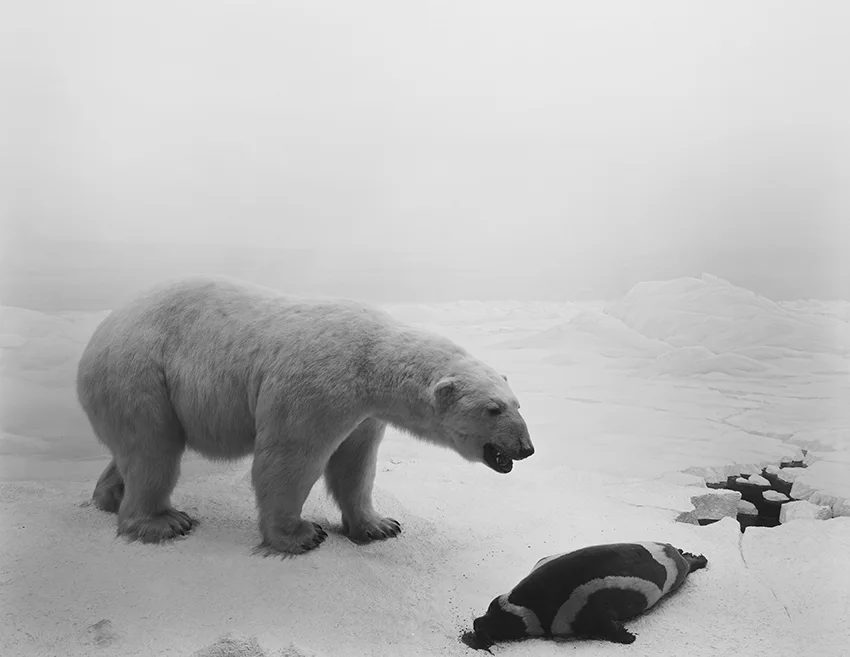
Yet the series is not a closed chapter. Sugimoto returned in 1982, 1994 and 2012, and he was still adding to it in 2026, more than fifty years after the first visit. Recent diorama works are in colour and mounted on screens, which is why accounts that end the series in 2012 are out of date.
The dioramas also set the terms for everything that followed. After all, a museum habitat group is already an argument about truth: it is a reconstruction, assembled by scientists, offered as knowledge. Yet by photographing it straight, Sugimoto neither exposes the fraud nor joins in. Instead he shows that the camera cannot take a side, because however fake the subject, once photographed it is as good as real.
Theaters (from 1976): a whole film in one frame
The Theaters began with a question Sugimoto put to himself. Suppose you shoot a whole movie in a single frame? The answer he guessed was simple: you get a shining screen. To test it, he walked into a cheap cinema in the East Village with a large-format camera.
He therefore opened the shutter at full aperture when the film began. Two hours later, when it ended, he closed it. Afterwards, that evening, he developed the negative, and the vision held. Every frame of the film had been added to every other, and the sum of all of them was white.
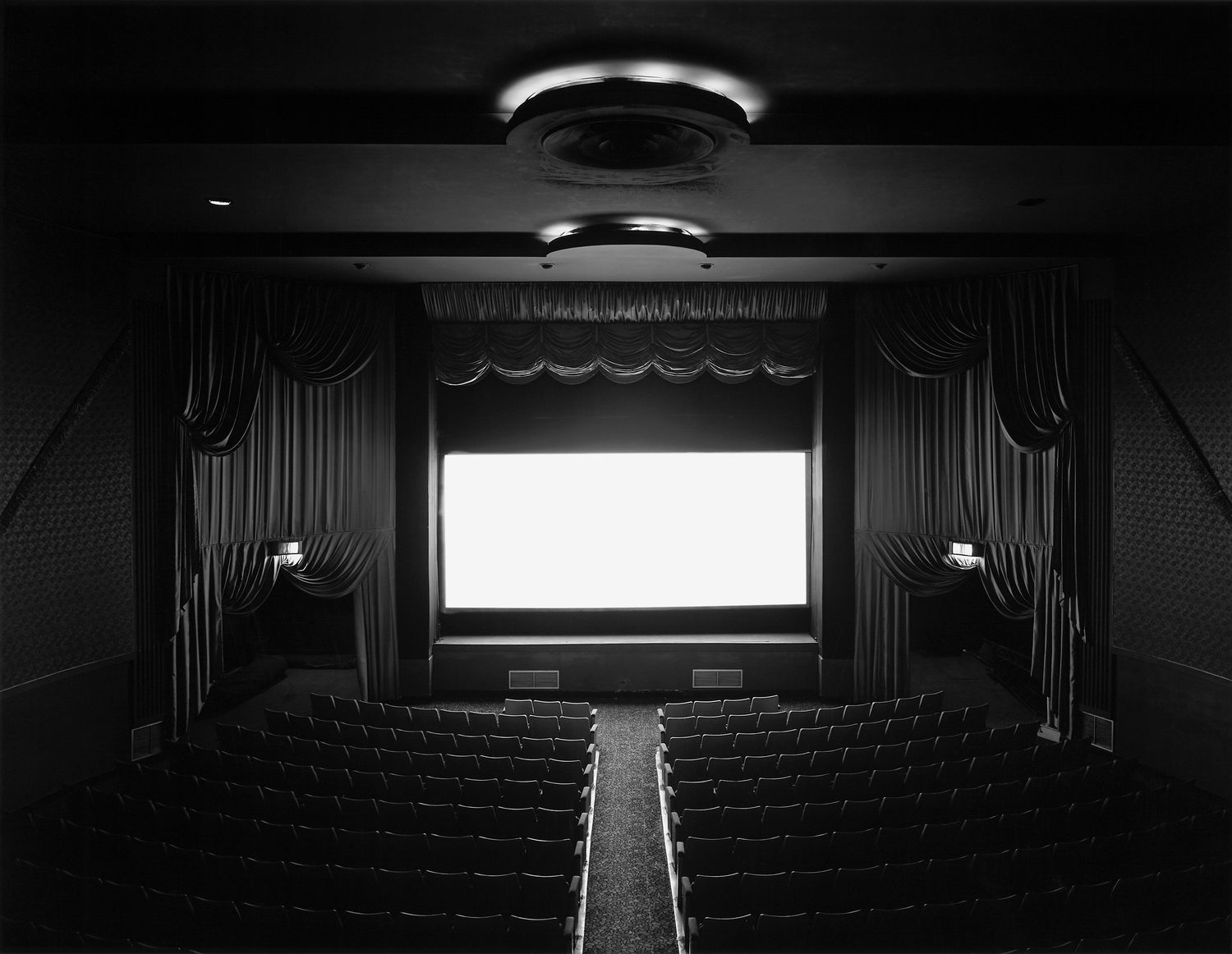
What the white screen lights is the real subject. Indeed, its glow slowly reveals the room: the curtains, the plasterwork, the balconies, the empty rows. The picture therefore records two durations at once. One is the film, compressed to nothing. The other is the building, patiently described.
Drive-ins, opera houses and ruins
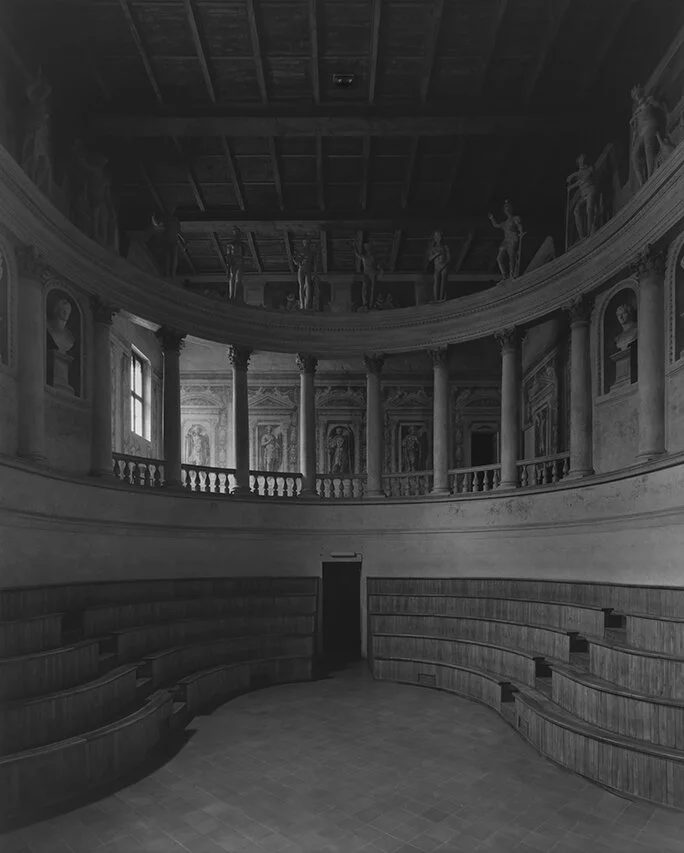
Sugimoto has extended the series for half a century. In 1993 he photographed drive-in cinemas, where the screen burns under an open night sky. From 2014 he worked in historic Italian theatres for the Opera House pictures, exposing for the length of a performance or a film. Those rooms were built for live bodies, so a glowing rectangle in them feels like an intrusion from another century.
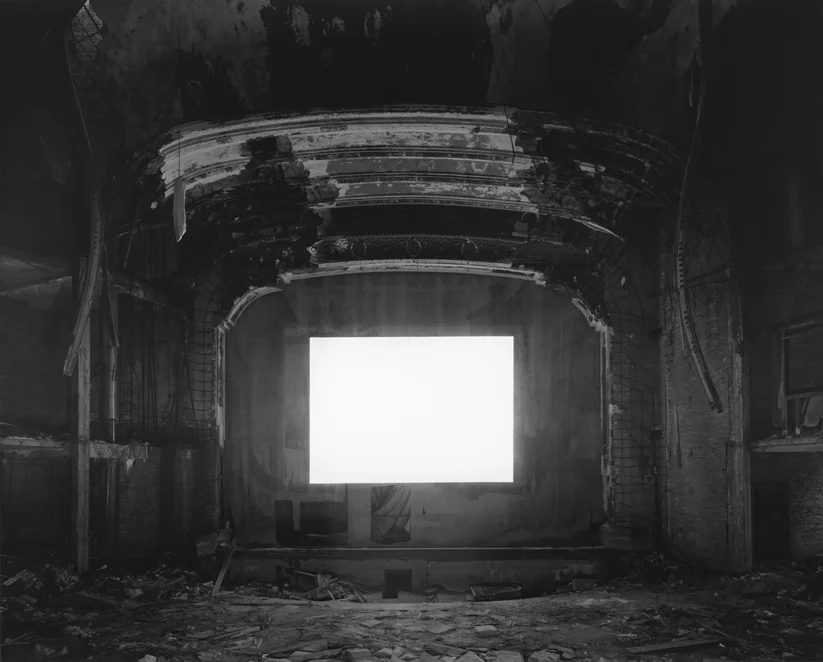
Similarly, he has also worked in ruins. In the abandoned American movie palaces, plaster has fallen and the seats have gone, yet the screen still shines. As a result, the series now reads as a history of how audiences have gathered, and of what happens when they stop.
Seascapes (from 1980): water, air and a horizon
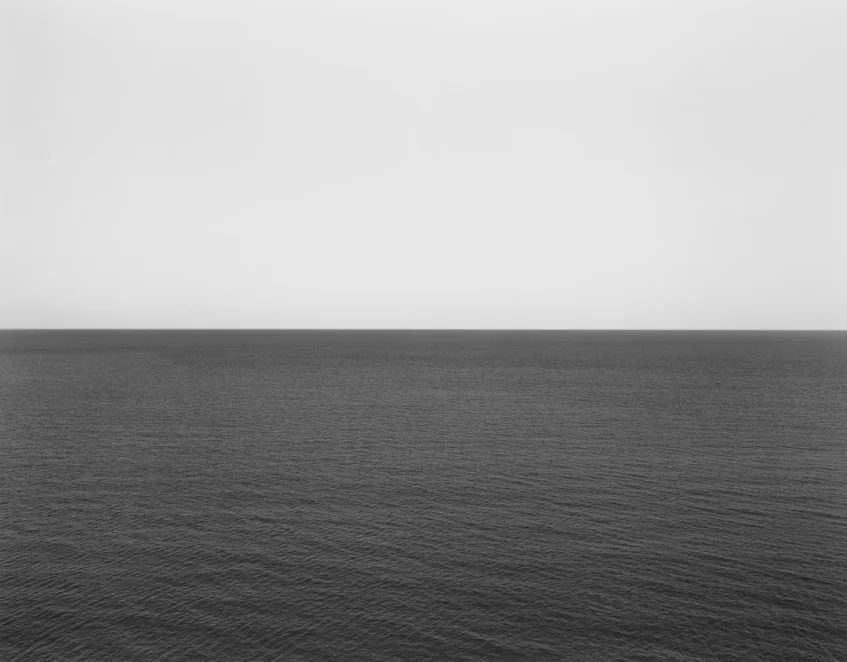
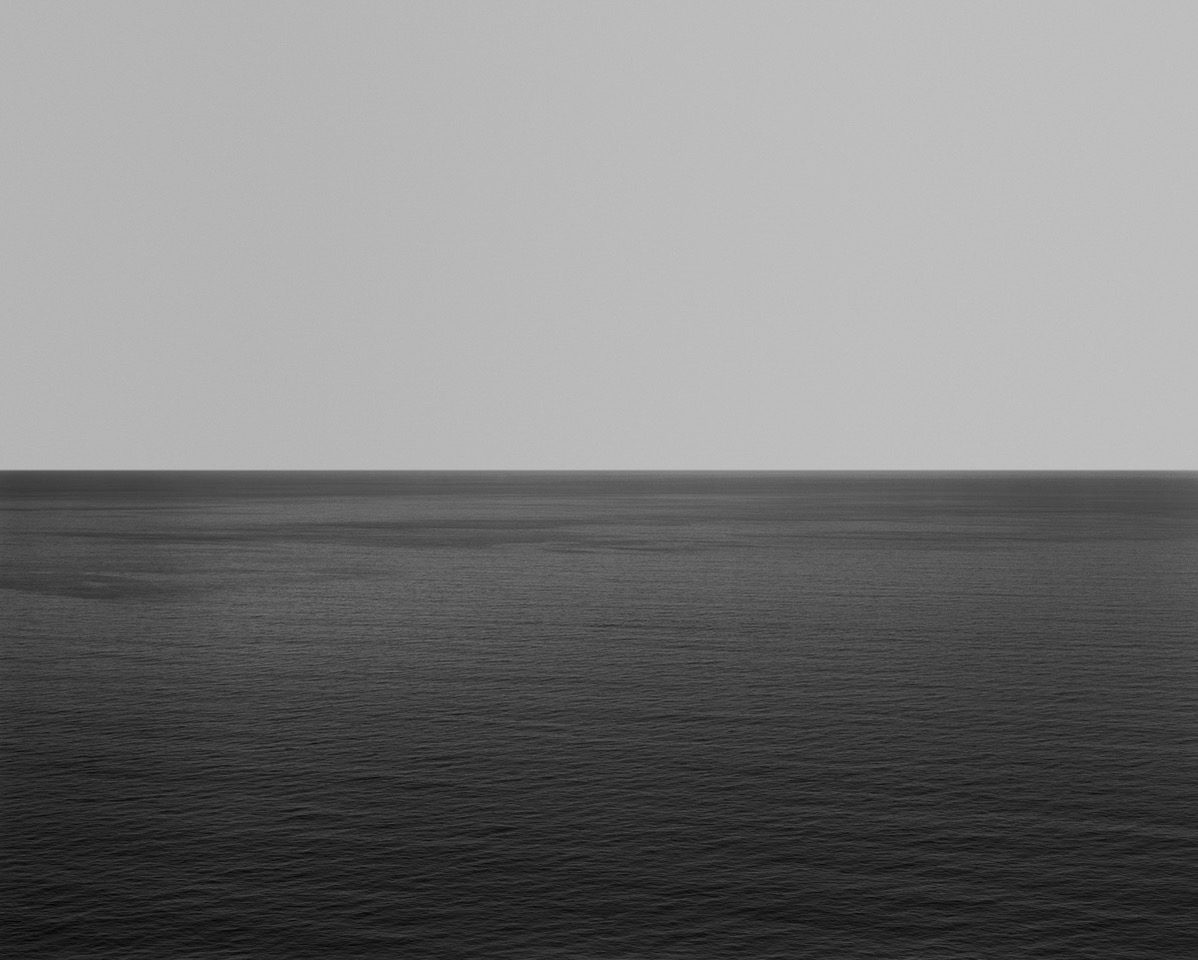
Of all of them, the Seascapes are the longest series. Since 1980 Sugimoto has photographed seas and lakes from the Caribbean to the Baltic, the Sea of Japan and the Tasman Sea. Every picture obeys the same rule: the horizon cuts the frame in half, with water below and air above. There is no shore, no boat and no human trace. Often there is not even a cloud.
Above all, his reason is stated plainly. Water and air are so commonplace that they escape attention, and yet they vouchsafe our very existence. In short, the sea is where both become visible at once. Sugimoto adds that every time he views the sea he feels a calming sense of security, as if visiting an ancestral home.
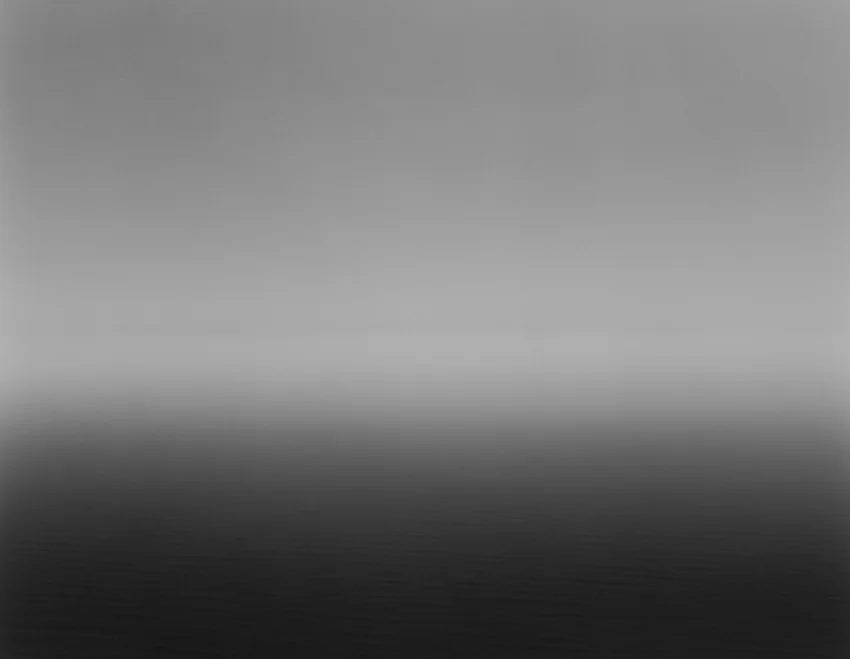
There is a historical claim inside the simplicity. The view has not changed, so the picture shows what the first humans saw and what their successors will see. Sugimoto has said that images of the sea could be shared with primordial people, and that he simply projects his imagination onto the viewer. The series reached a wide public too, since U2 used one seascape for the cover of No Line on the Horizon in 2009.
Time Exposed: a portfolio of fifty-one prints
Incidentally, one object inside the series is often confused with the whole. Time Exposed is a portfolio of fifty-one photolithographs, drawn from seascapes made between 1980 and 1991 and published in 1991. It was shown in two places at once that autumn: at the Carnegie Museum of Art in Pittsburgh from 19 October 1991, and at the IBM Courtyard in Tokyo from 30 October.
Moreover, the portfolio has had a second life. The Parrish Art Museum acquired it in 2022 and exhibited it in 2025. At the Art Institute of Chicago, meanwhile, a curator has read the same prints through the history of migration: the sea belongs to no one and to everyone, and the titles name places that the pictures themselves refuse to show.
Sea of Buddha and Portraits: a long chain of copies
Sea of Buddha (1995)
Sugimoto made this work in 1995, after years of negotiation for access. The subject is Sanjūsangen-dō in Kyoto, a hall of 1266 that holds 1,001 figures of the thousand-armed Kannon. He had the later fittings removed and the fluorescent lights switched off, then photographed for about three hours a day across ten consecutive days, in the light of the morning sun rising over the Higashiyama hills.
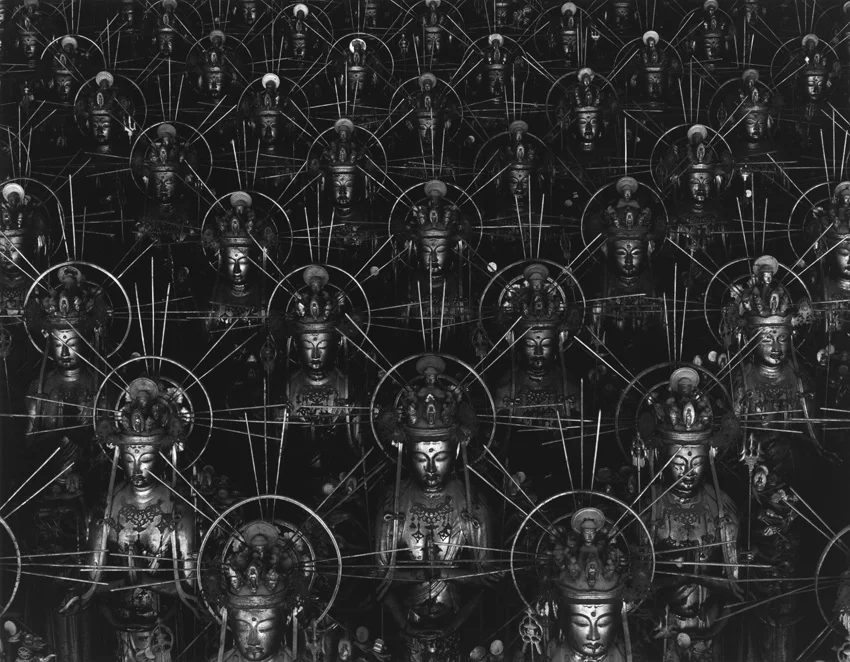
In short, the aim was to see the hall as the Heian aristocracy might have seen it. Rows of almost identical gilded figures repeat across the frame like waves, which is where the title comes from. Sugimoto has said the work makes him wonder whether today’s conceptual art will survive another eight hundred years.
Portraits (1999)
In 1999 he turned to wax museums, and to Madame Tussauds in particular. He photographed wax figures of Henry VIII and his six wives, of Fidel Castro and of Diana, Princess of Wales. The waxworks had themselves been modelled on sixteenth-century portraits, and in the king’s case on the imposing likenesses painted by Hans Holbein the Younger. Sugimoto then lit the wax as a Renaissance painter would have lit a sitter.
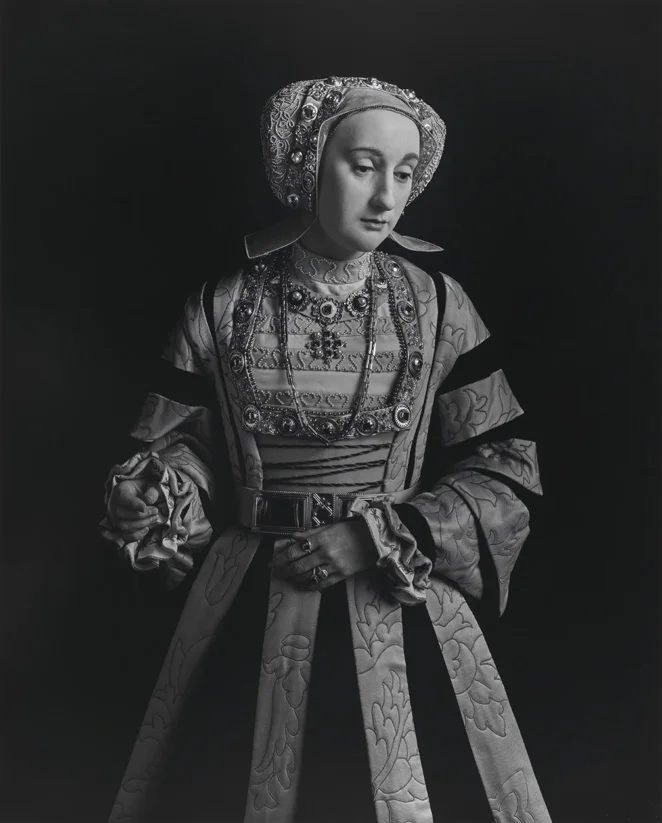
As a result, the picture becomes a chain of copies: a living person, a painting, a wax figure, a photograph. Each link claims to record the one before it. The pictures look uncannily alive, and that is the point, since the Dioramas had already shown that a camera cannot tell the difference.
Architecture, science and the origins of photography
In 1997 the Museum of Contemporary Art in Los Angeles commissioned Sugimoto to photograph famous buildings, for its survey At the End of the Century: One Hundred Years of Architecture. He chose the Seagram Building, the World Trade Center, Tadao Ando’s Church of the Light and Le Corbusier’s chapel at Ronchamp. Then he pushed the focus out to twice infinity, so that the view through the lens was a complete blur.
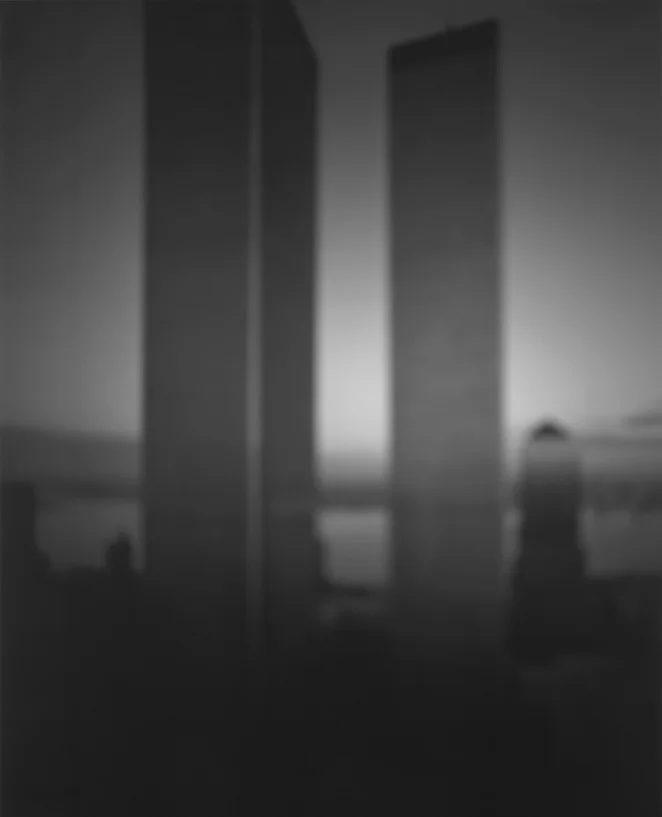
He therefore describes the result as an erosion test. Weak buildings melt away, while superlative architecture survives even when dissolved. The series therefore turns the camera into an instrument of judgement, and it traces the modern age through the forms that outlast their own detail.
Conceptual Forms and Stylized Sculpture
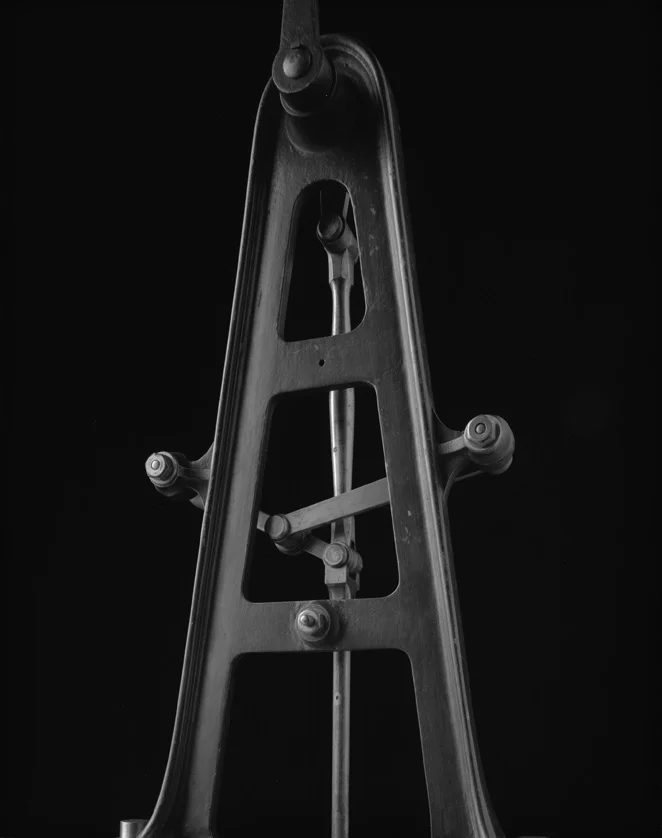
From 2004 Sugimoto photographed plaster and metal models of mathematical functions, made for nineteenth-century teaching collections, together with machine parts. Lit against black, they look instead like modernist sculpture. He later had his own versions machined in metal, some of them several metres tall and installed outdoors.
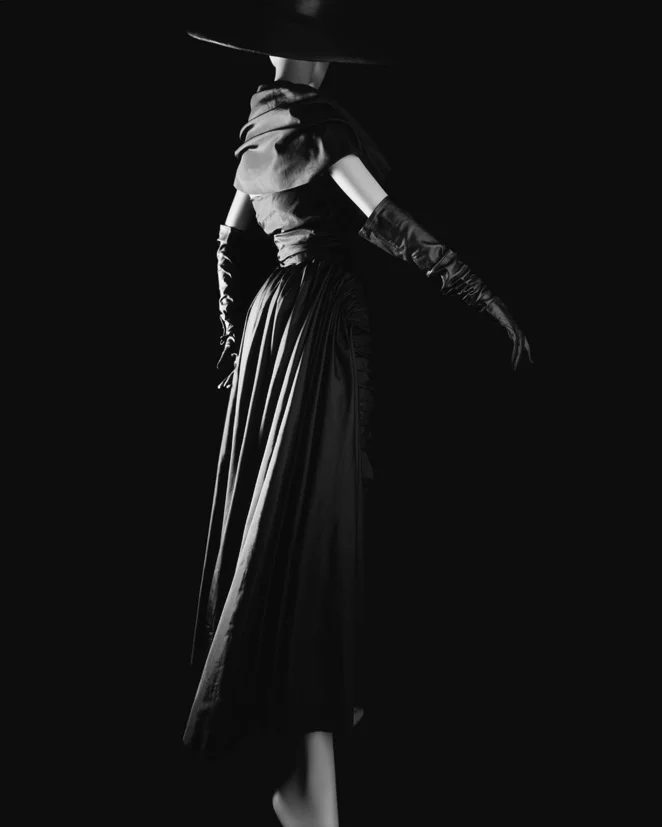
Similarly, a parallel series treats clothing the same way. In Stylized Sculpture he photographed historic couture, from Gabrielle Chanel to Balenciaga and Yohji Yamamoto, on invisible supports in deep shadow. As a result, fabric becomes form, and fashion joins the museum display and the wax figure as another way of standing in for a body.
Lightning Fields (from 2006)
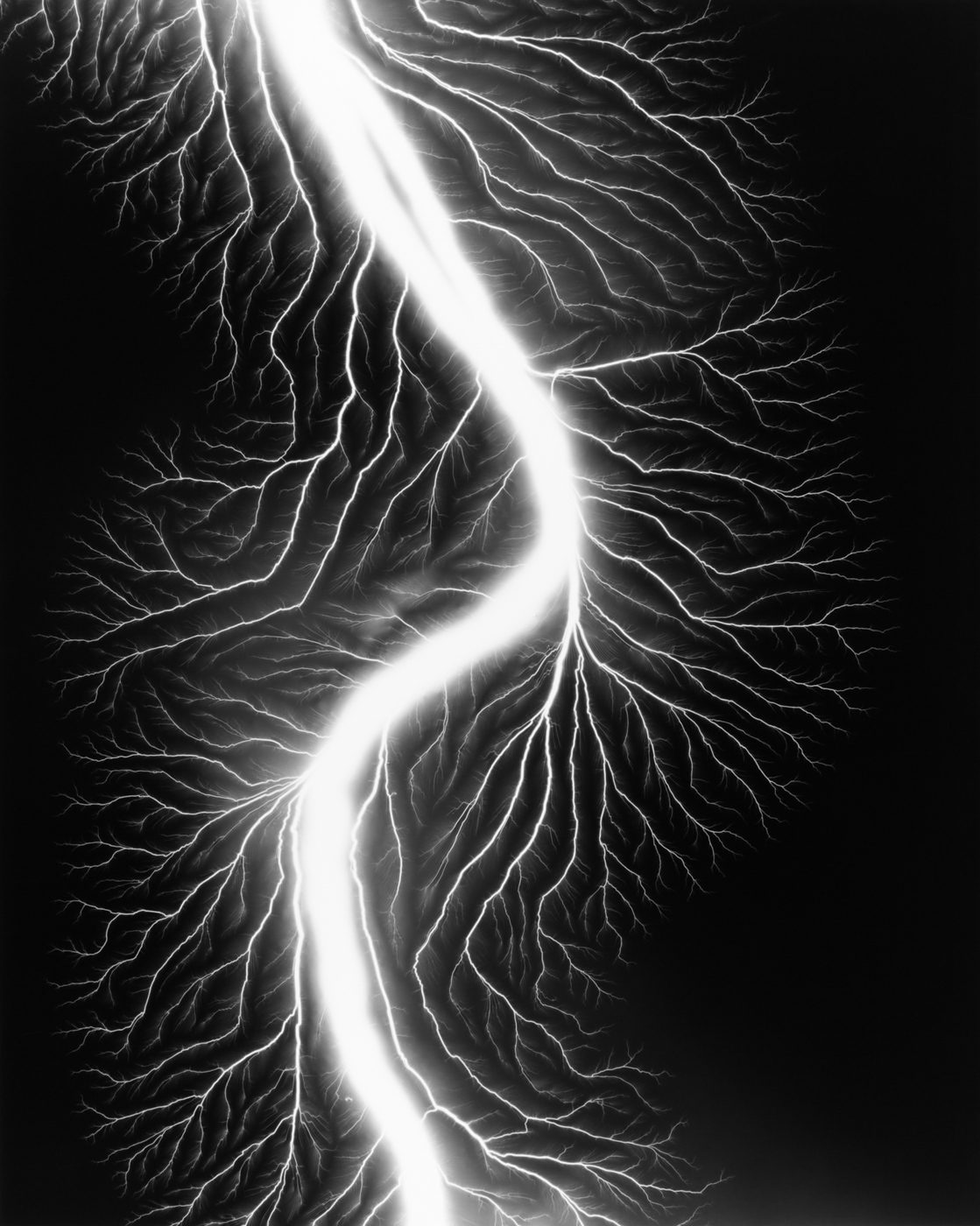
For Lightning Fields Sugimoto put the camera aside. Instead he applied an electrical charge of four hundred thousand volts directly to unexposed film. Consequently, the images branch like lightning, like trees, like nerves. He links the experiment to the electrical researches of Benjamin Franklin and Michael Faraday, and to William Henry Fox Talbot, and he has said he wanted to verify their discoveries with his own eyes.
Photogenic Drawing (2008–09)
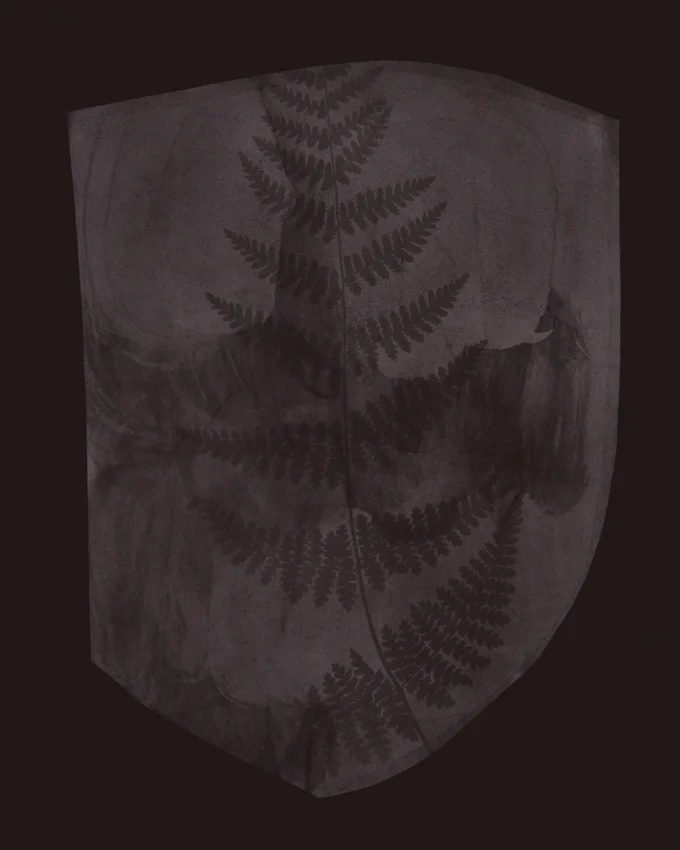
Afterwards he went back to the beginning of photography. He acquired paper negatives made by Talbot in the 1830s and 1840s, and printed from them. The resulting pictures show ferns, the rooflines of Lacock Abbey and a woman believed to be the family governess. In effect, Sugimoto printed photographs that Talbot himself never saw. For the story of Talbot’s own book, see our article on The Pencil of Nature.
Colour, at last
Sugimoto is known for black and white, and he has said that he lives in the shadow. Nevertheless, colour has occupied him for more than twenty years, and the sequence is often reported wrongly.
Colors of Shadow, begun in 2004, came first of all. It is less a set of photographs than an apparatus: he built curved white walls in his Tokyo studio and recorded the colours that appear within apparently neutral daylight. Notably, the prints are pigment prints, not gelatin silver, and the subject is the shadow rather than the thing.
Next, Polarized Color followed in 2009 and 2010. Here Sugimoto split sunlight with a prism and photographed the spectrum on Polaroid film. He presents the work as an argument on Goethe’s side against Newton: colour is not simply a property of light, but something that happens where light meets a surface and an eye.
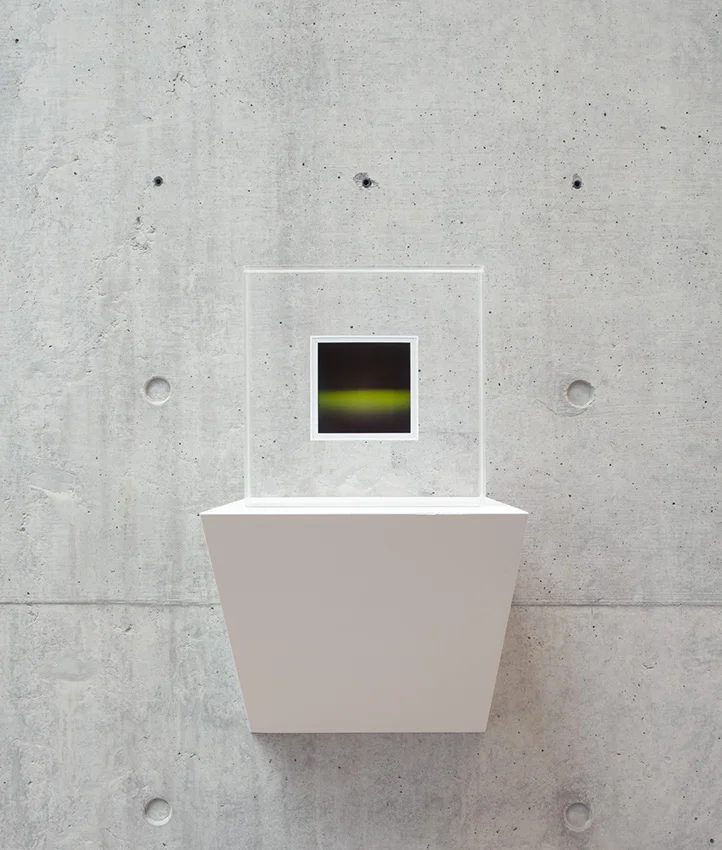
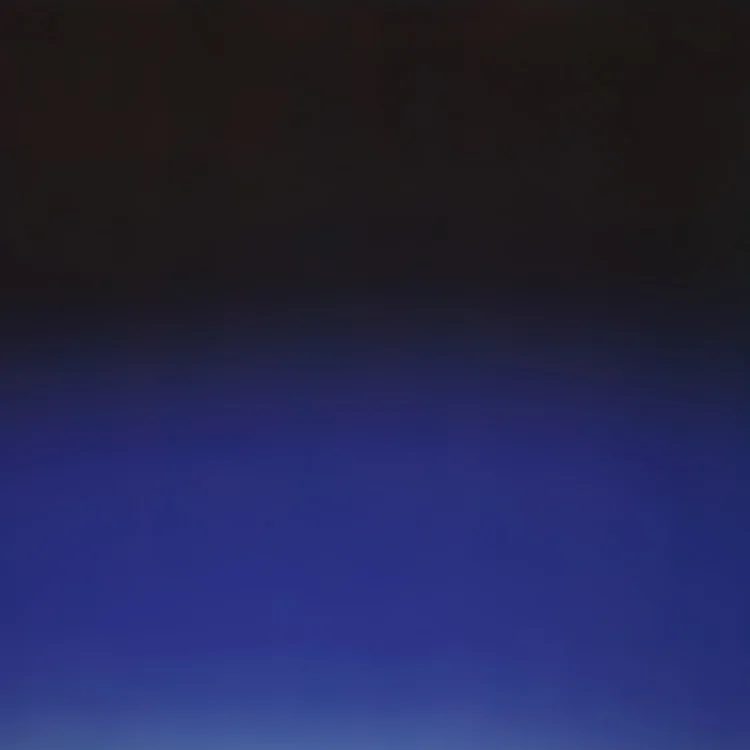
Opticks, from 2018, is the monumental version of the same experiment, printed large and glowing. It is frequently called his first work in colour. That is incorrect, as the two earlier series show, and the error is worth naming because it recurs across otherwise reliable pages.
After 2020: screens, brushes and Extinction
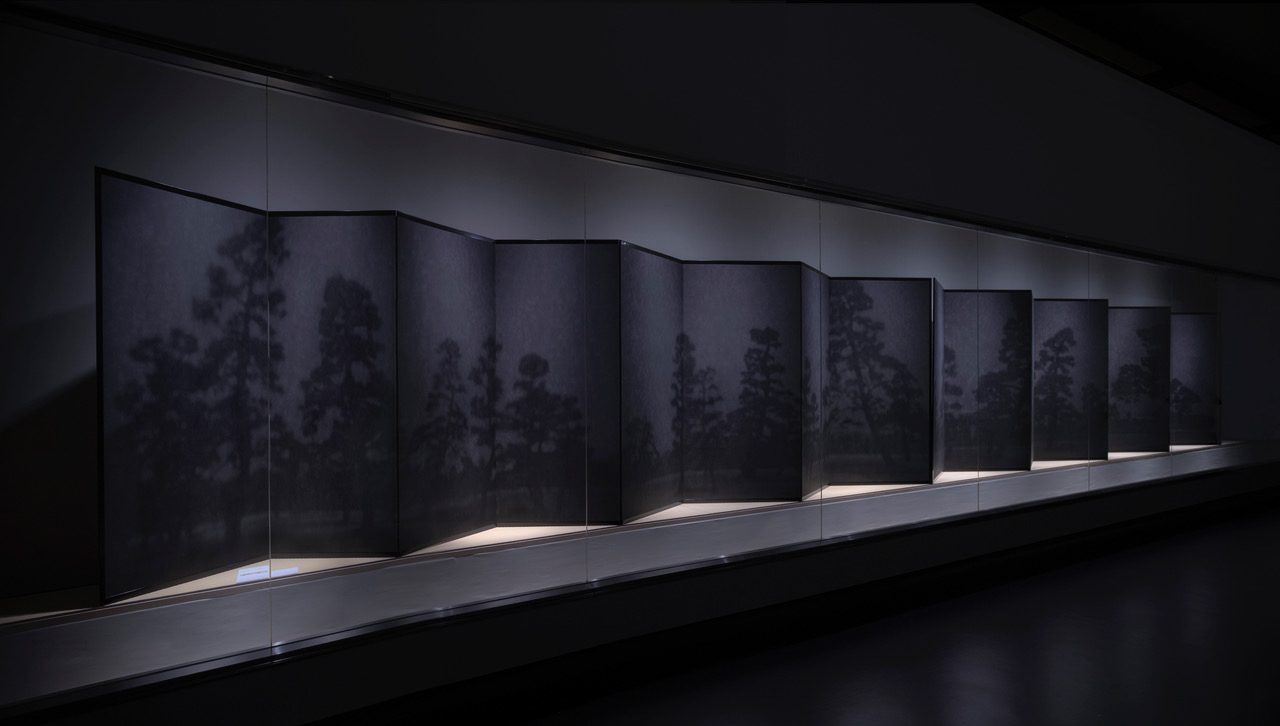
The recent work moves photography onto Japanese formats. Since 2021 Sugimoto has printed images on Japanese rice paper and mounted them on folding screens: pine trees, Mount Fuji, the Kasuga shrine at dawn, even a lightning field. Crucially, a screen is read by walking along it, so the pictures regain the duration that a framed print hides.
Brush Impression, from 2024, goes further still from the camera. Sugimoto writes classical Buddhist text in photographic developer, brushing it straight onto expired photographic paper, then fixes the result. No negative and no lens is involved, yet the work is unmistakably a photograph. Calligraphy, like the long exposure, records the time a hand took.
In 2026 the National Museum of Modern Art, Tokyo, showed Hiroshi Sugimoto: Extinction from 16 June to 13 September. It was his first large exhibition of photographs in Japan since 2005, and its argument was blunt. Gelatin silver photography is itself endangered, and so are older ways of seeing. Extinction, in this reading, is not a theme he observes but a condition he works inside.
Hiroshi Sugimoto as a builder
Sugimoto has made buildings for almost as long as he has made pictures. In 2002 he rebuilt the Go’o Shrine on Naoshima for the Art House Project, adding a staircase of optical glass that runs from the underground chamber to the shrine above. Later came a glass tea house, first shown in Venice in 2014, restaurants and gardens in Tokyo, and in 2022 a gallery on Naoshima called Time Corridors.
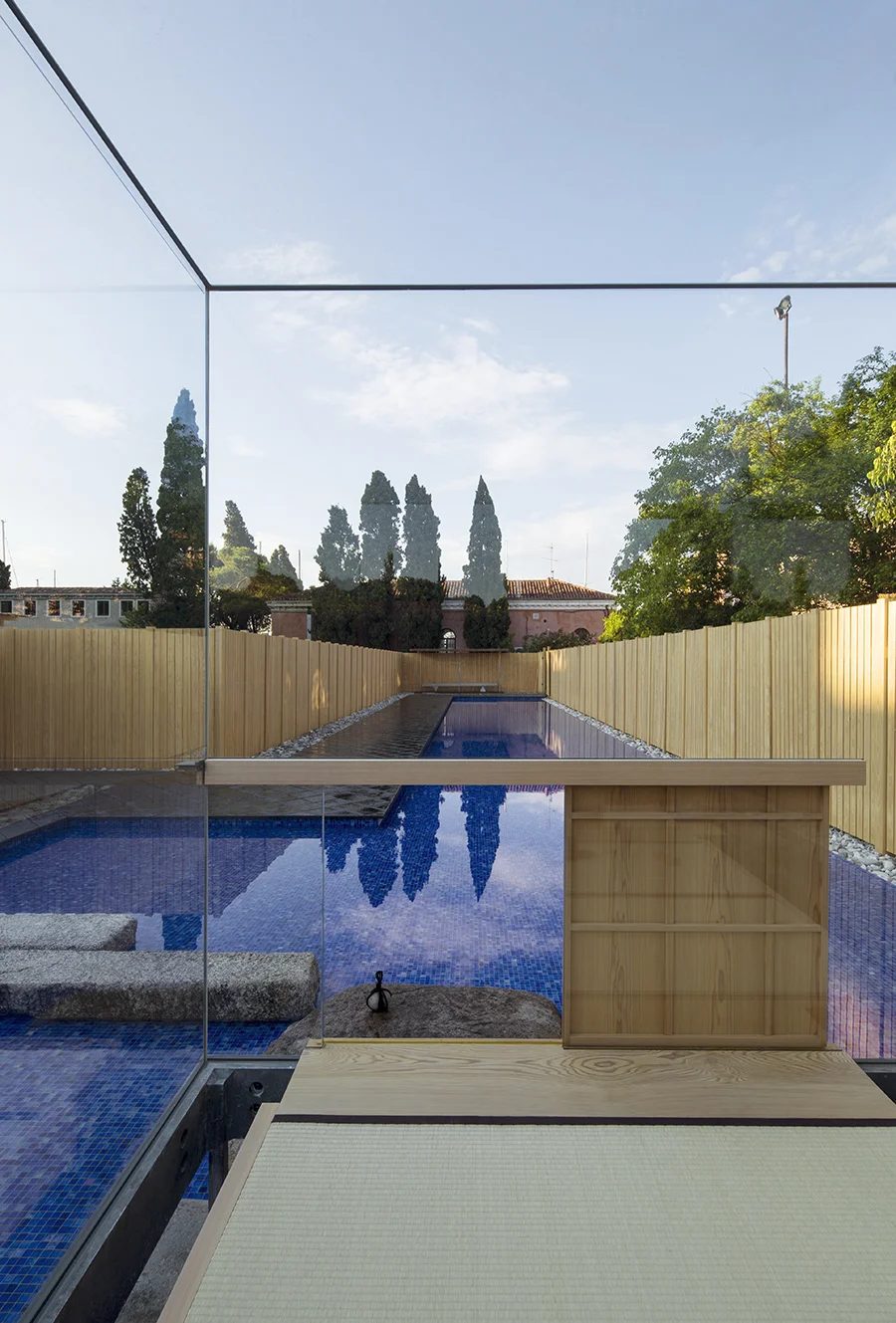
Accordingly, he formalised the practice in 2008 by founding the New Material Research Laboratory, whose name is a joke: the laboratory researches old materials. Then he set up the Odawara Art Foundation the following year. In 2018 he redesigned the lobby of the Hirshhorn Museum in Washington, and a commissioned reworking of its sculpture garden followed.
The Enoura Observatory (2017)
His largest work stands on the coast south-west of Tokyo, above a bay he first saw as a small child from a train. After ten years of work it opened in 2017. A gallery one hundred metres long faces the sunrise of the summer solstice, while a stone tunnel is aligned with the winter solstice. Finally, a stage of optical glass sits above the sea.
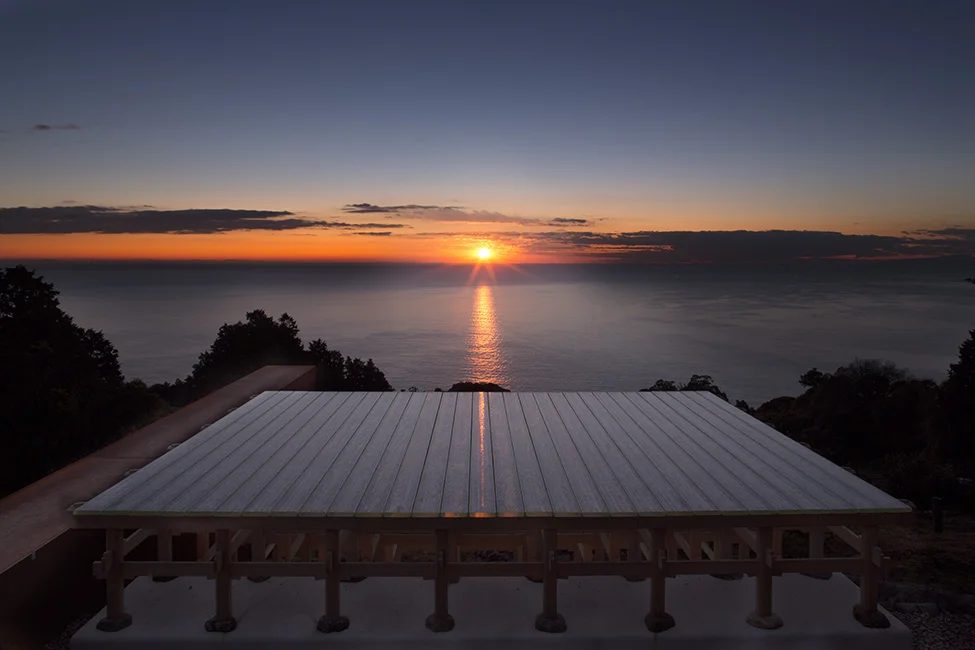
The site also houses his collection of Japanese antiquities and a Noh stage, and it is the one place where his pictures, his architecture and his theatre meet. Sugimoto has staged productions as well. In 2019 he directed and designed At the Hawk’s Well at the Palais Garnier in Paris, a dance work drawn from the play by W. B. Yeats, which Yeats himself had written under the influence of Noh.
Enoura is not a museum of his own work, and he is careful about that. He describes it instead as a way of giving something back to art, and he wants other artists and performers to make work there. Above all, the ambition is explicitly long: the buildings are aligned to the sun, so the site keeps its meaning for as long as the solstices return. A photograph that lasts two hours and a building that is set by the sky turn out to be the same project at different scales.
How critics and scholars read Hiroshi Sugimoto
Exposure against snapshot
Curiously, the most useful frame is older than the work. Writing in 1978, the art historian Thierry de Duve argued that the photograph is a paradox divided between the time exposure and the snapshot: one pulls the image towards duration and the picturesque, the other towards the frozen event and shock. Sugimoto therefore takes that division and makes it visible. The Theaters are nothing but exposure, and the event they record has vanished into light.
That inversion also explains why the pictures feel so unlike reportage. For example, a snapshot claims to have caught one instant, and it borrows its authority from that claim. A Sugimoto exposure makes the opposite claim. It says that the camera was present for two hours, or for a whole morning, and that everything which moved during that time has cancelled itself out. In the end, what remains is only what stayed still.
Absorption, and the arguments against it
Michael Fried placed Sugimoto beside Candida Höfer and Thomas Struth in an influential study of recent art photography, reading large-scale photographs through the categories of absorption and theatricality that he had developed for eighteenth-century painting. The art historian Vered Maimon has challenged that account directly. For her, the turn to large colour prints in the 1980s owes less to a revived problem of beholding than to the legacy of conceptualism and minimalism, and to the conceptual document.
That disagreement is useful for reading Sugimoto, because both readings fit parts of the work. The Seascapes invite the long, absorbed looking Fried describes. The series structure, the fixed rule and the deadpan titles, by contrast, come straight from the conceptual tradition that Maimon emphasises, and from the typologies of Bernd and Hilla Becher whose work preceded his at the same New York gallery.
Perspective after Duchamp
Hans Belting has set Sugimoto beside Marcel Duchamp and Jeff Wall in a history of perspective in modern art. Indeed, Sugimoto calls Duchamp his mentor, and the debt is visible: the interest in machines and models, the readymade subject found in a museum vitrine, and the steady attention to the line between an original and its copy.
The sea, modernity and Japan
Finally, a scholarly reading of the Seascapes complicates the serenity. In History of Photography, Joshua Petitto argues that Sugimoto’s oceanic images seek to counter the forces of modernity and restore a sense of the religious in the profane. He also shows that they borrow the visual and rhetorical structures of a 1930s Japanese ideology that tied cultural renewal to death and repose, even as they disturb it. Reading Sugimoto only as a Zen artist, as many introductions do, misses both halves of that argument.
Common misunderstandings about Hiroshi Sugimoto
Unfortunately, published accounts contradict each other constantly, usually because they date different things: the first idea, the first photograph, or the first exhibition. The table below gives what the primary sources say.
| Often read | What the sources say |
|---|---|
| He moved to the United States in 1974 | In fact he entered the Art Center College of Design in Los Angeles in 1970, then moved to New York in 1974, after graduating |
| He studied politics and sociology in Tokyo | Rather, he graduated in 1970 from the Department of Business, College of Economics, at Rikkyō University |
| The Dioramas began in 1976 | 1974 is the first museum visit and 1976 the usual catalogue date for Polar Bear; the artist dates the first photographs to 1975 |
| The Dioramas ended in 2012 | He was still working on the series in 2026, now partly in colour |
| The Theaters began in 1978 | Prints dated 1976 and 1977 exist, and the auction and gallery record gives 1976 |
| Time Exposed is the Seascapes series | It is one portfolio of fifty-one photolithographs, published in 1991 |
| Opticks (2018) was his first work in colour | Colors of Shadow dates from 2004 and Polarized Color from 2009–10 |
| Lightning Fields began in 2009 | The best-known prints are dated 2009, but the earliest works in the series are dated 2006 |
| He is essentially a Zen artist | His sources are equally conceptual art, museum history, cinema, science and Western modernism |
Exhibitions, prizes and the market
| Year | Exhibition or award | Why it matters |
|---|---|---|
| 1977 | Minami Gallery, Tokyo | First solo exhibition |
| 1981 | Movie Theaters, Sonnabend Gallery, New York | First showing of the Theaters |
| 1991–92 | Time Exposed, Carnegie Museum of Art and IBM Courtyard, Tokyo | The seascape portfolio, shown in two countries at once |
| 1995 | Metropolitan Museum of Art, New York | Wider recognition in the United States |
| 2001 | Hasselblad Award | One of photography’s most prestigious prizes |
| 2005–07 | End of Time, Mori Art Museum, then Hirshhorn Museum and Fort Worth | First major retrospective |
| 2009 | Praemium Imperiale (painting) | Japan’s major international arts prize |
| 2017 | Enoura Observatory opens; Person of Cultural Merit | His largest built work, and national recognition |
| 2023–24 | Time Machine, Hayward Gallery, then UCCA Beijing and MCA Sydney | Largest survey to date |
| 2026 | Extinction, National Museum of Modern Art, Tokyo | First large photographic survey in Japan since 2005 |
In practice, the market follows the editions rather than single images. Standard prints appear in editions of twenty-five and the large works in editions of five. At Christie’s in autumn 2026, for example, a large Strait of Gibraltar of 1995 carried an estimate of 200,000 to 300,000 dollars, while a Marion Palace, Ohio of 1980 was estimated at 15,000 to 25,000. Reported auction records vary between sources, so this guide gives published estimates instead.
How to look at a Hiroshi Sugimoto photograph
Admittedly, students often find the pictures forbidding, because so little happens in them. These four questions open most of the work.
- What is the rule? Each series obeys one constraint. Name it first, then watch what varies inside it.
- How long did this take? Two hours, ten days, a solstice, or a fraction of a second. The answer usually is the subject.
- What is being copied? A diorama copies a habitat, a wax figure copies a painting, a print copies a negative. Count the links in the chain.
- Where does the viewer stand? In the Theaters you sit in the audience, in the Seascapes you stand at the shore the picture refuses to show.
The legacy of Hiroshi Sugimoto
Sugimoto showed that a photograph can be an argument as much as an image. First, his series turned plain rules into powerful visual ideas. Second, his return to Talbot and to the darkroom reminded a digital age of photography’s material history. Third, he is one of very few photographers to have moved from making pictures of architecture to building it. Where Andreas Gursky fills the frame with the global crowd, Sugimoto empties it until only light, water and time remain.
Moreover, his influence runs through a generation of photographers of empty and abandoned spaces, and through the renewed interest in historical processes. For a wider view, see our guide to famous contemporary photographers, and our monograph on Cindy Sherman, whose work asks a related question about what a photograph can honestly claim to record.
Where to see the work of Hiroshi Sugimoto
His photographs are held by major museums worldwide, and the Hirshhorn alone has acquired nineteen works since 2003. In Japan, several pieces are permanently installed on Naoshima, including the Go’o Shrine and the Time Corridors gallery. Finally, the Enoura Observatory near Odawara can be visited by reservation.
Books worth reading
- Kerry Brougher and David Elliott, Hiroshi Sugimoto (Ostfildern: Hatje Cantz, 2005), the catalogue of the first major retrospective.
- Hans Belting, Looking through Duchamp’s Door: Art and Perspective in the Work of Duchamp, Sugimoto and Jeff Wall (Cologne: Walther König, 2010), on perspective from Duchamp to Sugimoto.
- Michael Fried, Why Photography Matters as Art as Never Before (New Haven: Yale University Press, 2008), for the debate on absorption in large-scale photography.
FAQ: Hiroshi Sugimoto
What is Hiroshi Sugimoto best known for?
He is best known for three long black-and-white series: the Theaters, where a whole film is exposed in one frame; the Seascapes, which show only water and sky; and the Dioramas, made in natural history museums.
What is Hiroshi Sugimoto’s style of photography?
He works in series with a large-format camera, black-and-white film and gelatin silver prints. Each series follows a single strict rule, and very long exposures are common.
How does Hiroshi Sugimoto photograph a whole film in one frame?
He opens the shutter at full aperture as the film starts and closes it when the film ends. All the frames add up to a blank white screen, which lights the room around it.
What is Hiroshi Sugimoto’s most famous artwork?
No single picture dominates, but the seascapes are the most widely reproduced. Boden Sea, Uttwil of 1993 became familiar when U2 used it for the cover of No Line on the Horizon in 2009.
Does Hiroshi Sugimoto work in colour?
Yes. Colors of Shadow began in 2004, Polarized Color in 2009 and Opticks in 2018. The claim that Opticks was his first colour work is a common error.
Where does Hiroshi Sugimoto live now?
He divides his time between Tokyo and New York, and much of his recent work is based at the Enoura Observatory in Odawara, which he designed.
What is the Enoura Observatory?
It is an art complex near Odawara, opened in 2017 and run by the Odawara Art Foundation. Its gallery and tunnel are aligned with the summer and winter solstices.
Which awards has Hiroshi Sugimoto won?
Among others, the Hasselblad Award in 2001, the Praemium Imperiale in 2009 and the Royal Photographic Society Centenary Medal in 2017. Japan named him a Person of Cultural Merit in 2017.
Sources
The artist, museums and prizes
- Official website of Hiroshi Sugimoto: biography, prizes and exhibition chronology
- “Theaters”, text by the artist on his official website
- Hiroshi Sugimoto, “Seascapes”, official website
- Rikkyo University, “Models, photographs, literature”, interview with Hiroshi Sugimoto, 8 November 2017
- National Museum of Modern Art, Tokyo, Hiroshi Sugimoto: Extinction, 16 June – 13 September 2026
- Hirshhorn Museum and Sculpture Garden, “In Depth: Hiroshi Sugimoto”
- Grace Xiao, “A Voyage of Seeing: On Hiroshi Sugimoto’s Seascapes”, Art Institute of Chicago, 26 March 2024
- Japan Foundation New York, Time Exposed: Hiroshi Sugimoto’s Seascapes, Parrish Art Museum, 13 September 2025 – 8 February 2026
- Benesse Art Site Naoshima, Hiroshi Sugimoto Gallery: Time Corridors
- Fraenkel Gallery, Hiroshi Sugimoto
- Hasselblad Foundation, Hiroshi Sugimoto, Hasselblad Award 2001
- Praemium Imperiale, Hiroshi Sugimoto, laureate in painting 2009
- Mori Art Museum, Hiroshi Sugimoto: End of Time, 17 September 2005 – 9 January 2006
- Southbank Centre, Hiroshi Sugimoto: Time Machine, Hayward Gallery, 11 October 2023 – 7 January 2024
- Christie’s, “A panoramic overview of Hiroshi Sugimoto”, 9 October 2026
Books and scholarship
- Thierry de Duve, “Time Exposure and Snapshot: The Photograph as Paradox”, October 5 (1978), 113–25
- Joshua Petitto, “The Oceanic Vision of Sugimoto Hiroshi”, History of Photography 40, no. 2 (2016), 107–28
- Vered Maimon, “Michael Fried’s Modernist Theory of Photography”, History of Photography 34, no. 4 (2010), 387–95
- Michael Fried, Why Photography Matters as Art as Never Before (New Haven: Yale University Press, 2008)
- Hans Belting, Looking through Duchamp’s Door: Art and Perspective in the Work of Duchamp, Sugimoto and Jeff Wall (Cologne: Walther König, 2010)
- Kerry Brougher and David Elliott, Hiroshi Sugimoto (Ostfildern: Hatje Cantz, 2005)