Andreas Gursky makes photographs the size of walls, and then he removes whatever disturbs the pattern. A river becomes horizontal bands. Then a discount store becomes rows of colour, and finally a stadium of gymnasts becomes one moving surface. In November 2011 his Rhein II sold for $4,338,500 at Christie's in New York, a record for a photograph that still stood in 20171.
This article follows him from the Düsseldorf Kunstakademie to the Hayward Gallery. It explains how the pictures are built and how scholars read the digital intervention. It also asks what the sale prices prove, and it says where to see the work now. Every date and figure carries a note, and the notes record where sources disagree.
Andreas Gursky at a glance
| Born | 1955, Leipzig; grew up in Düsseldorf, where his father, a commercial photographer, introduced him to the medium2 |
| Training | Folkwangschule, Essen (late 1970s); Bernd Becher's class at the Kunstakademie Düsseldorf (early 1980s); Meisterschüler in 19873 |
| Method | Colour, large formats and digital composition4 |
| Major shows | MoMA, New York (2001); Hayward Gallery, London (2018); Museum der bildenden Künste, Leipzig (to August 2021); Fondazione MAST, Bologna (2023–24)5 |
| Auction record | Rhein II, $4,338,500, Christie's New York, November 20116 |
| Recent honour | State Prize of North Rhine-Westphalia, announced November 20257 |
| Next | A retrospective at the Kunstsammlung NRW (K21) in Düsseldorf, planned for 2027; no dates yet8 |
From Düsseldorf to the Bechers' class
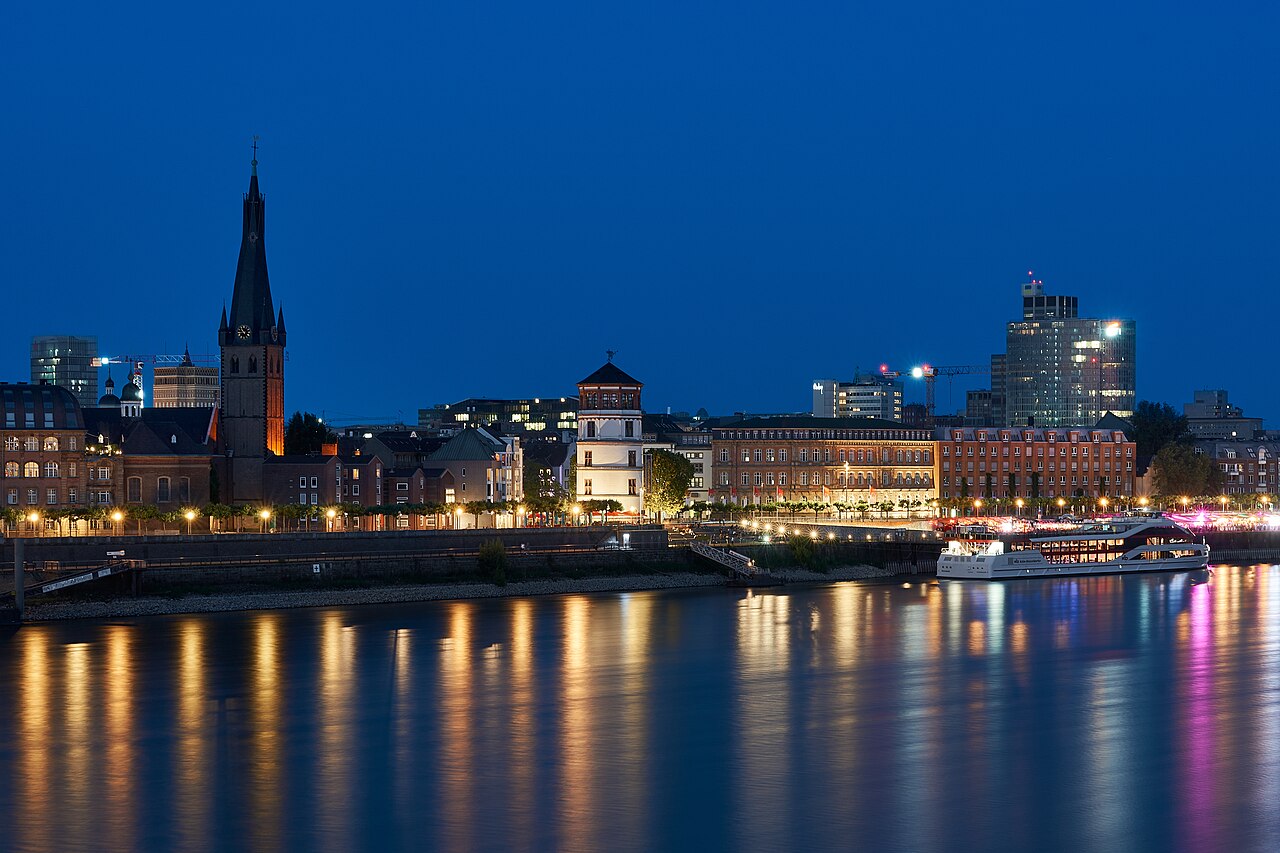
Gursky was born in 1955 in Leipzig and grew up in Düsseldorf.9 In the late 1970s he studied at the Folkwangschule in Essen, a school of traditional photography. Then, in the early 1980s, he joined Bernd Becher's class at the Kunstakademie in Düsseldorf. He then earned the title of Meisterschüler in 198710.
Bernd Becher (1931–2007) and Hilla Becher (1934–2015) taught photography at the Kunstakademie. From 1959 they photographed industrial structures such as water towers, blast furnaces and silos. They also usually showed them in grids called typologies. In 1990 they won a Golden Lion at the Venice Biennale. Gursky was one of several students, alongside Candida Höfer, Axel Hütte, Thomas Ruff, Thomas Struth and Elger Esser11.
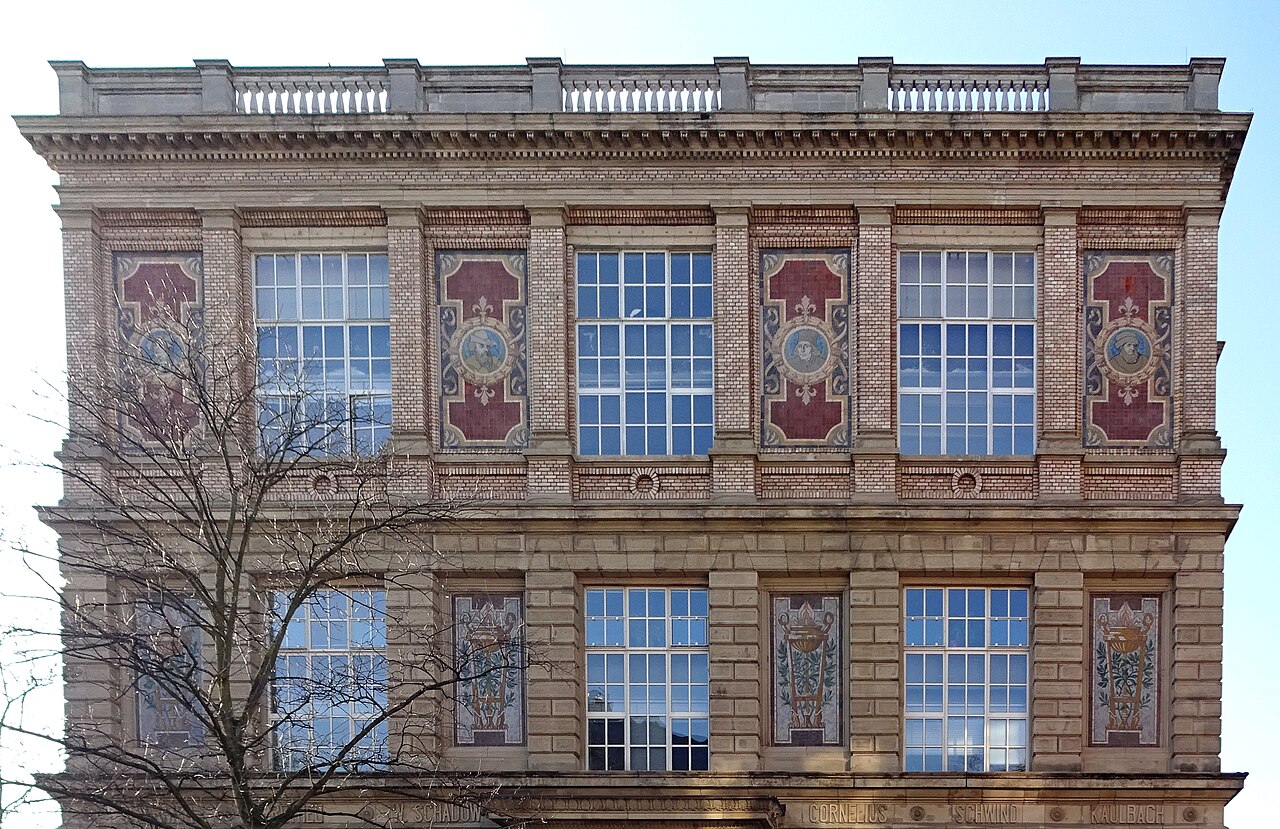
In the 1980s he made documentary-style colour photographs of office workers, leisure scenes and landscapes. He later moved away from the Bechers' systematic approach by adopting colour and large-format cameras12.
What Gursky kept, and what he dropped
Matthew Biro reads the Bechers' work as a deliberate project of objectivity: consistent viewpoints, level camera positions, diffused light and reduced contrast all minimise the photographer's personality. By contrast, Gursky intends his work as art rather than documentation. It is formally rigorous, but it lacks the Bechers' method and archive13.
However, Biro warns against a radical divide between analogue and digital. He argues that the Bechers' analogue work is not simply objective. Likewise, Gursky's digital work is not simply false, because both practices combine symbolic, indexical and manipulative elements. His conclusion is that the photograph is "always profoundly heterogeneous"14.
How Andreas Gursky builds an image
The digital turn came early. According to Claus Gunti, Gursky adopted digital tools, together with Jörg Sasse, a few years after Thomas Ruff's retouching of 1987. Until the mid-1990s he used them mainly to retouch and compose. Paris, Montparnasse (1993) is an early example, because it results from the horizontal stitching of two photographs15.
From the late 1990s, Gunti adds, Gursky increasingly builds images on a recurring grid and turns to globalised subjects such as advertising, architecture and Formula 116.
Rhein II, a case study
Rhein II dates from 1999. Its largest print measures about two by three metres, and it is one print in an edition of six. MoMA and Tate hold copies17.
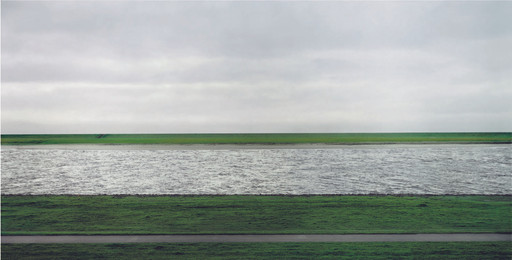
Accounts differ on what Gursky did to the river. Ocula says he digitally removed dog walkers and a factory18, while CNN says he erased buildings on the far bank, which leaves the horizon unnaturally flat and empty19. Biro adds that the compressed depth and the missing buildings push the scene toward abstraction. As a result, the river reads as a metaphor for nature and technology rather than as a specific place20.
Gunti goes further. He argues that Gursky had already retouched Rhein I (1996) heavily. Rhein II, in his view, is a horizontally stretched version of it. He also argues that Gursky generated Rhein II on a computer instead of assembling it from two photographs, as is often claimed21.
Atlanta, 1996: the impossible view
Biro describes Atlanta (1996) as a merger of two viewpoints of a hotel atrium into one physically impossible view. In his reading, the picture exposes its own manipulation. It also unsettles the viewer's trust in the photograph and in their own perception22.
Pyongyang, 2007
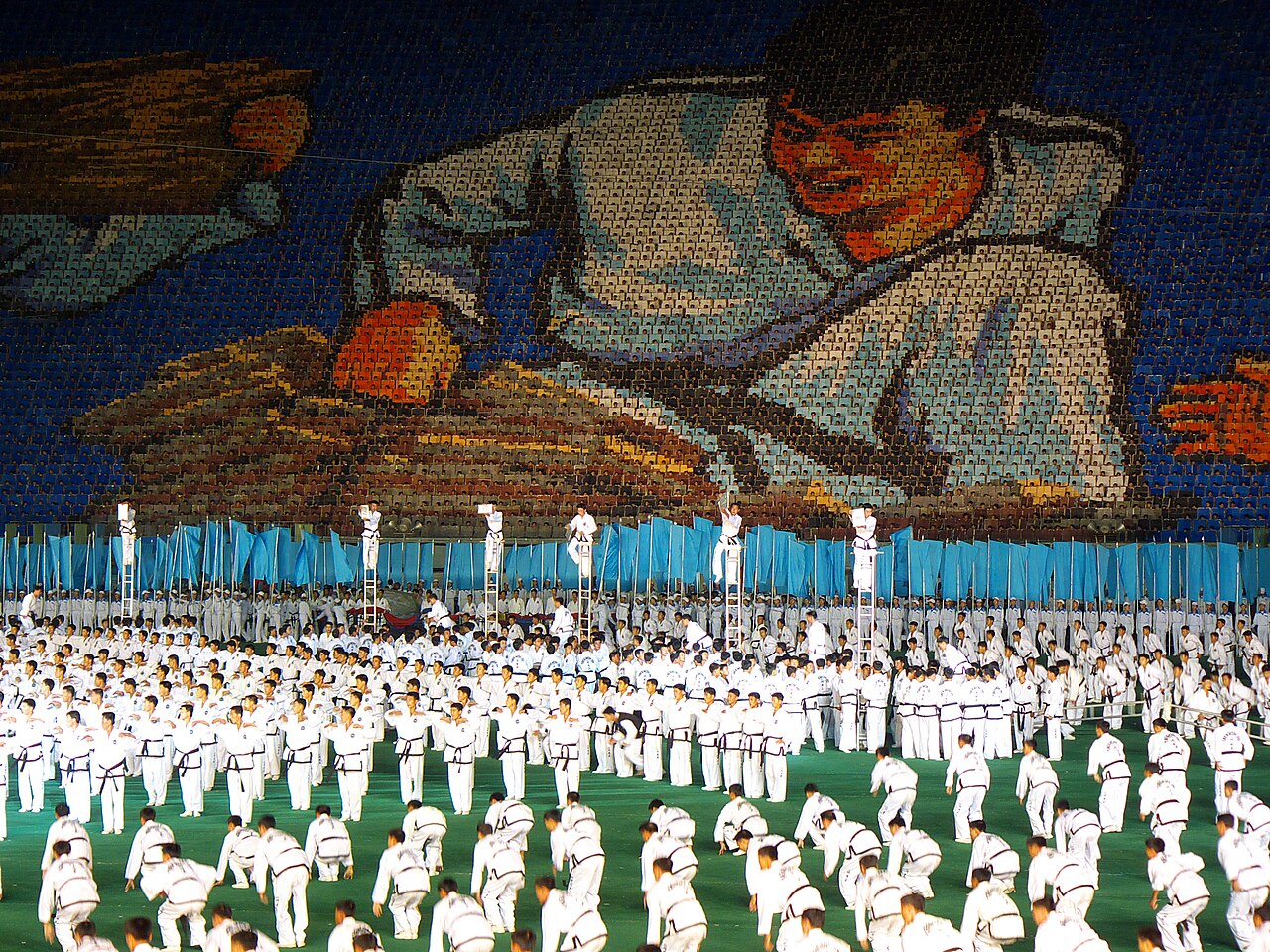
Gursky's Pyongyang pictures turn to a North Korean gymnastics festival, one of the subjects of the Hayward retrospective23. The artist's website dates Pyongyang I to 2007, and it appeared in a 2026 group show at the Kunsthal Rotterdam24. Gunti also cites the repeated gymnasts of the series as an example of digital aesthetics25.
Are Andreas Gursky's photographs real?
Not in the sense of a single exposure, and Gursky does not hide the fact. The sources describe several kinds of intervention. First, he retouches, erasing elements that disturb a composition, as the accounts of Rhein II above show. Second, he stitches shots together, and Paris, Montparnasse (1993) results from the horizontal stitching of two photographs26.
Third, he can stretch an image, and Gunti describes Rhein II as an extruded version of Rhein I27. Fourth, from the 2000s, he increasingly builds pictures from fragments. According to Gunti, the F1 Boxenstopp series of 2007 combines numerous shots in composites more than five metres wide. Likewise, Hamm, Bergwerk Ost (2008) is a painstakingly reconstructed tableau that starts from photographs of miners' clothes28.
Gursky has also explained the logic. Commenting on Rhein I, he says that a view of the Rhine like his cannot be obtained on the spot, and that a “fictitious construction” is needed to give an accurate image of a modern river29. The answer is therefore yes and no. The subjects exist, but the pictures are constructed, and scholars disagree about what follows from that.
What scholars say about Andreas Gursky
The central question is whether digital intervention makes a photograph untrue. Biro answers that it does not, at least not in a simple way. Drawing on Michael Fried, he argues that digital manipulation undermines indexicality. However, it also makes the image seem more intentional and more controlled by the photographer. He adds that analogue photomontage and falsification existed long before digital tools. Moreover, digital images still carry evidentiary weight, as the Abu Ghraib snapshots show30.
Gunti makes a related point about reception: readers often take Gursky's digital work as documentary, even as enhanced documentary, rather than as post-photographic31. The Hayward's own text agrees that the pictures blend documentary character with invention, and that they are often ambiguous despite their technical precision32. In the same spirit, the gallery's director Ralph Rugoff says Gursky has "reinvented the language of photography"33.
How the debate over Andreas Gursky began
Gunti's chapter on digital stitching shows how that question was first framed. He notes that catalogue writers of the 1990s tended to read Gursky's digital tools as a way of showing a pre-existing reality that no single exposure could capture. He cites Fiona Bradley's introduction to the 1995 Tate Liverpool catalogue, Martin Henschel's claim that the montage falsifies nothing, and Stefan Gronert's reading, in which Gursky guides the gaze toward something already there34. However, Gunti argues that Gronert's reading derives from a preconception that ties Düsseldorf photography to an objectivist paradigm35.
Super-documentary: Gunti's answer
Gunti then makes his own proposal in the chapter's conclusion. In his view, the digital tools do not abandon the documentary claim. Gursky's pictures rest on verisimilitude and a shared visual memory instead of strict indexicality, and Gunti calls the result “super-documentary”. In other words, Gursky documents the world by producing images that represent it, which alters the status of the photographic36.
Gunti also describes a change over time. Until the late 1990s, Gursky's pictures depended heavily on a depicted reality that he then retouched. From the 2000s, building images from fragments describes his work better, and saturated colour and geometric space set the later composites apart from the older pictures37.
Two further essays take up the subject: Alix Ohlin on the contemporary sublime (Art Journal, 2002) and Carsten Strathausen on the photographer's gaze (Genre, 2003). I know both only from their bibliographic records38. I also did not find, in the sources I could read, a sustained sceptical critique comparable to the debate over aestheticised suffering in documentary work.
Scale: how large are Andreas Gursky's photographs?
Size is part of the work, and the sources give some figures. The MoMA print of Rhein II measures 155.6 by 308.6 centimetres39. In Gunti's captions, Times Square (1997) measures 186 by 250.5 centimetres and Hamm, Bergwerk Ost (2008) measures 250 by 176 centimetres40. Later composites are larger. The F1 Boxenstopp images exceed five metres in width, and Harry Styles (2025) is about four metres wide41. At Leipzig in 2021, roughly 50 of about 60 photographs were very large42.
Why the scale matters is less well documented. Gunti calls the panorama and its implications for spectatorship paradigmatic of Gursky's strategies, and he says they ought to be explored further43. I did not find, in the sources I could read, a sourced analysis of viewing distance or of how the prints behave on a museum wall.
Exhibitions of Andreas Gursky: from MoMA to the Hayward
MoMA, 2001
The Museum of Modern Art showed Gursky from 4 March to 15 May 2001, under the chief curator of photography, Peter Galassi. The press release counts about 45 photographs from 1984 to the present, many new to the United States. The exhibition page, however, says about forty works. The catalogue had 59 colour plates and an essay by Galassi, and the show was to travel to Madrid, Paris and Chicago44.
The Hayward, 2018
The Hayward Gallery in London presented Gursky from 25 January to 22 April 2018. It was the first exhibition after the gallery's refurbishment and the first major UK retrospective of his work45. According to CNN, the show included 68 works from 1984 onward, and eight appeared for the first time. They ranged from factories and trading floors to a North Korean gymnastics festival and a French housing block. Key pieces were Amazon (2016), Les Mées (2016), Ocean II (2010), 99 Cent II and Bahrain I (2005)46.
Leipzig, Bologna and London
The Museum der bildenden Künste Leipzig showed about 60 photographs, roughly 50 of them very large, in 15 rooms and 1,500 square metres until 22 August 2021. Gursky chose the selection himself, and it also included works by his father and grandfather47. Next, Fondazione MAST in Bologna presented 40 images from 1989 to 2022, curated by Urs Stahel. It was the artist's first anthological exhibition in Italy, and it ran until January 202448.
Meanwhile, White Cube Mason's Yard in London ran a show that continued through 8 November 2025. It included Harry Styles (2025), a panorama about four metres wide assembled from concert images made in Bologna and Frankfurt. Gursky told The Guardian that he completes about three such large works a year, according to Hypebeast's report49.
The market and Andreas Gursky
Sources document the record sale well. Rhein II fetched $4,338,500 at Christie's in New York in November 2011, which Artlyst reports as £2.7 million50. It replaced Cindy Sherman's Untitled #96, which had sold for $3.89 million the previous May51. Our article on her career tells Sherman's side of the story.
Before Sherman, Gursky's own 99 Cent II Diptychon held the record. It sold at Sotheby's London on 7 February 2007 for £1.7 million, about $3.35 million52. NPR also dates it to 2007. Popular Photography's 2011 article says 2006, however, so I follow the 2008 report and NPR. Apollo dates the work to 2001, while CNN lists 99 Cent II as 1999/2009, so the date depends on the source53.
By 2017, seven of the 20 most expensive photographs at auction were Gursky works. Thomas Struth's Pantheon, Rome (1990) set his own record at $1.8 million in 2015. Meanwhile, the Bechers' record is €411,000 for Wassertürme (Trichter), in November 2015. The article's author, Crichton-Miller, argues that the school's appeal spans photography and art collecting. Its artists have lifted one another's values, she adds, and condition is critical because older prints can fade54.
Where to see Andreas Gursky's work now
At the time of writing (9 November 2026), the artist's website lists no solo exhibition as open. The Kunstsammlung NRW (K21) in Düsseldorf plans a major retrospective for 2027. It will also include the recent Harry Styles, though the dates are not given55. Recently closed shows include Mirrored Fiction at Gagosian in Rome (11 February to 11 April 2026). Also, there was the group show Flowers Forever at the Kunsthal Rotterdam (27 March to 30 August 2026)56.
In the meantime, Tate lists seven of his works. They include Thebes, West (1993), Parliament (1998), Chicago, Board of Trade II (1999), The Rhine II (1999) and Bahrain I (2005). Check the museum before travelling, because works in storage are not always on display57.
Why Andreas Gursky still matters
Gursky shows how far a photograph can travel from the document while still passing for one. His pictures look like observation, yet he constructs them. Biro's point is that photography has always done this to some degree. The scale and the prices then raise a second question, about what a museum wall and an auction room do to a picture.
For context on the same questions, see our pieces on post-documentary photography and on contemporary fine art photography, and the wider list in our guide to famous contemporary photographers.
Questions about Andreas Gursky
Who is Andreas Gursky?
He is a German photographer, born in Leipzig in 1955, who grew up in Düsseldorf and studied with Bernd Becher. He is known for large colour photographs of crowds, buildings and landscapes, many of which he composes digitally.
Why is Rhein II so famous?
Mainly because it sold for $4,338,500 at Christie's in November 2011, a record for a photograph at auction that still stood in 2017. It is also a much-discussed example of digital editing, although the sources differ on exactly what was changed.
Does he manipulate his photographs?
Yes, many are, by his own method of digital composition. Scholars such as Biro argue, however, that manipulation does not make a photograph simply false, because all photographs select and alter what they record.
Is Andreas Gursky still working?
Yes. A White Cube show in London ran through 8 November 2025 and included Harry Styles (2025), a new panorama. According to Hypebeast, he told The Guardian that he completes about three such large works a year. Meanwhile, the Kunstsammlung NRW plans a retrospective for 202758.
Why did Rhein II sell for $4.3 million?
The sources record the price but give no single reason. They point to scarcity, since Rhein II is one print in an edition of six, and to its place in museum collections such as MoMA and Tate. They also point to the market strength of the Düsseldorf School, whose artists, Crichton-Miller says, have lifted one another's values59. The price shows a market judgment. It does not settle the aesthetic questions above.
Further reading
These references come from their Crossref records or the sources named. I consulted Biro in a copy hosted on a course site, and Gunti in the open-access introduction and in the two chapters on Gursky. The other items I know only from their records.
- Biro, Matthew. 2012. "From Analogue to Digital Photography: Bernd and Hilla Becher and Andreas Gursky." History of Photography 36(3): 353–366. DOI.
- Gunti, Claus. 2020. "B Digital Stitching." In Digital Image Systems, 175–202. Bielefeld: transcript. DOI.
- Gunti, Claus. 2020. "A Complex Composites: Andreas Gursky's Generic World." In Digital Image Systems, 243–258. Bielefeld: transcript. DOI.
- Ohlin, Alix. 2002. "Andreas Gursky and the Contemporary Sublime." Art Journal 61(4): 22–35. DOI.
- Strathausen, Carsten. 2003. "The Lost Gaze: Reflections on the Photography of Andreas Gursky." Genre 36(3–4): 341–364. DOI.
- Galassi, Peter. 2001. Essay in the catalogue Andreas Gursky, New York: Museum of Modern Art (59 colour plates). Press release.
- NPR; Apollo
- MoMA press release
- MoMA press release
- Ocula; Gunti
- MoMA; Hayward; Leipzig; MAST
- NPR
- Artist's website
- Artist's website
- MoMA press release
- MoMA press release
- Apollo magazine
- Ocula
- Biro (2012), read in a copy hosted on a university course site; page numbers follow that copy (article copy; DOI)
- Biro (2012), read in a copy hosted on a university course site; page numbers follow that copy (article copy)
- Gunti (2020), introduction (pp. 8–19; chapter page) for the chronology, and the chapter “Digital Stitching” (pp. 175–202), p. 181, for the stitching of Paris, Montparnasse (chapter page)
- Gunti (2020)
- Popular Photography; Tate
- Ocula
- CNN
- Biro (2012), read in a copy hosted on a university course site; page numbers follow that copy (article copy)
- Gunti (2020), introduction (Fig. 6, a digitally stretched version of Rhein I, equivalent to Rhein II) and the chapter “Digital Stitching”, p. 201, which describes Rhein II as extruded from Rhein I (chapter page). The claim is his, and the other sources above do not say the same
- Biro (2012), read in a copy hosted on a university course site; page numbers follow that copy (article copy)
- CNN
- Artist's website
- Gunti (2020)
- Gunti (2020), “Digital Stitching”, p. 181 (chapter page)
- Gunti (2020), “Digital Stitching”, p. 201 (chapter page)
- Gunti (2020), “Complex Composites: Andreas Gursky's Generic World” (pp. 243–258), pp. 243–244 (chapter page)
- Gunti (2020), p. 244, quoting Gursky from Annelie Lütgens, “Shrines and Ornaments”. I did not read the original interview (chapter page)
- Biro (2012), read in a copy hosted on a university course site; page numbers follow that copy (article copy)
- Gunti (2020)
- Hayward Gallery announcement
- CNN
- Gunti (2020), “Digital Stitching”, p. 175 (chapter page)
- Gunti (2020), pp. 176–177 (chapter page)
- Gunti (2020), pp. 201–202 (chapter page)
- Gunti (2020), “Complex Composites”, pp. 243–244 (chapter page)
- Crossref records (Ohlin DOI; Strathausen DOI)
- MoMA collection page
- Gunti (2020), p. 191 (Fig. 75) and p. 244 (Fig. 94) (chapter 1; chapter 2)
- Gunti (2020), pp. 243–244 (chapter page); Hypebeast
- Press release of the Leipzig museum
- Gunti (2020), “Digital Stitching”, p. 189 (chapter page)
- MoMA press release and exhibition page; the two sources give different counts (press release; exhibition page)
- Hayward Gallery announcement
- CNN
- Press release of the Leipzig museum
- Artdaily
- Hypebeast
- NPR; Artlyst
- Popular Photography
- Popular Photography
- NPR; Popular Photography; Apollo; CNN
- Apollo magazine, 2017. I have not checked records set since then (Apollo)
- Artist's website
- Artist's website
- Tate
- Hypebeast; Artist's website
- Apollo